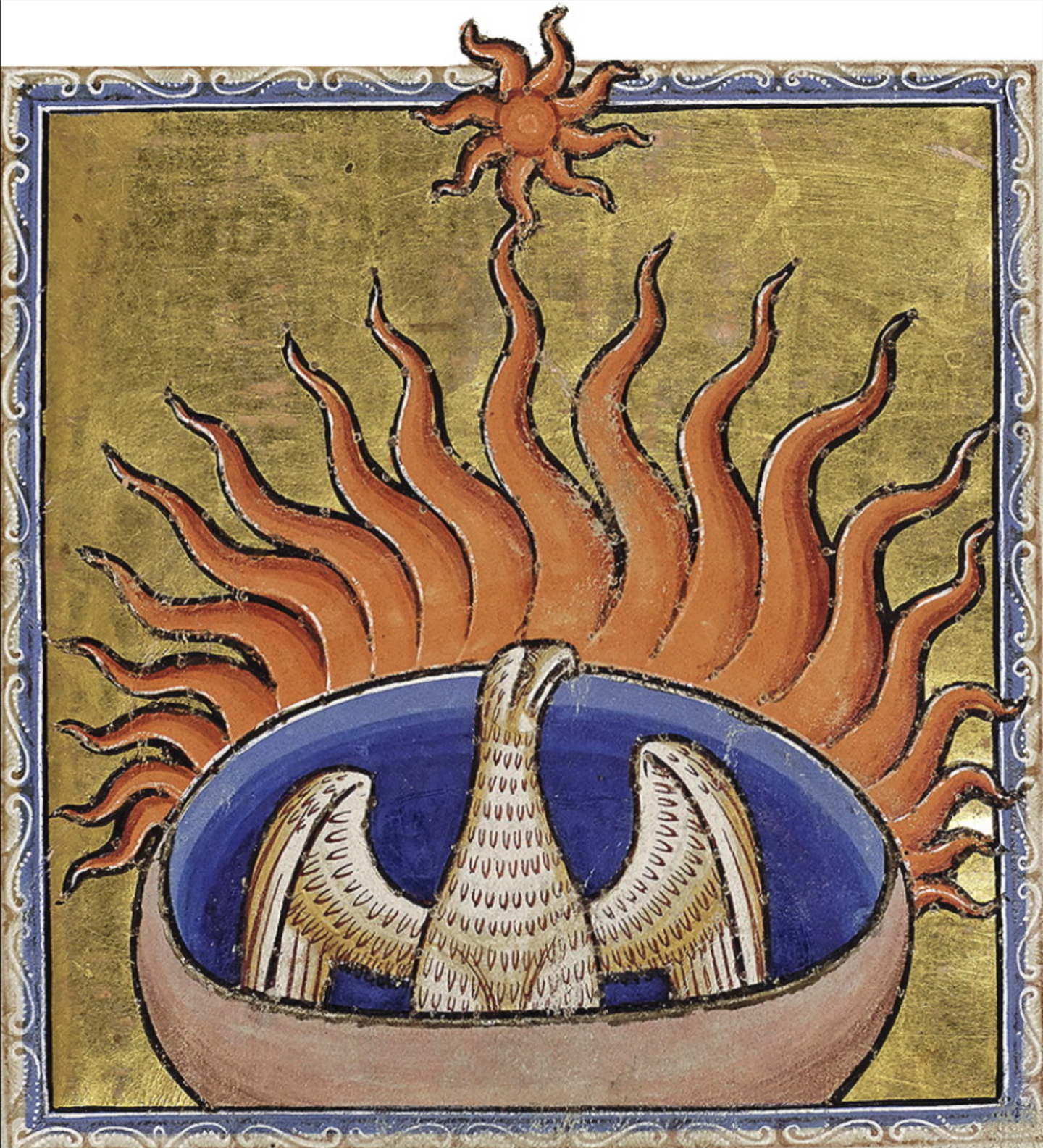
Concept
In the 12th–13th centuries in England, bestiaries became a prominent part of illuminated manuscript culture. They combined observations about nature, classical knowledge, legends, and Christian interpretations. Consequently, alongside animals familiar to Europeans, exotic beasts and creatures, known primarily from folklore, began appearing in the manuscript pages. For the medieval reader, these were not merely part of the surrounding world, but also figures through which one could contemplate human qualities and actions. The illustrations in these books transformed the description of an animal into a brief narrative. It was important for the artist to depict characteristic action rather than simply portraying the beast in a neutral pose. Thus, gestures, movement, the posture of figures, and expressive details held special significance in these miniatures. The inherent conventionality of such images is not always linked to a lack of knowledge about nature. It is also explained by the fact that the masters relied on established texts, recurring artistic motifs, and symbolic associations. Moreover, the same subject matter could differ considerably in the execution of various artists. Comparing these variations allows us to see how the image of an animal came into being—simultaneously recognizable and laden with meaning.
Bestiary—a medieval manuscript book featuring tales and illustrations of animals, in which real and fantastical creatures often receive moral or religious interpretation.
The aim of this visual study is to analyze how medieval artists of the 12th and 13th centuries shaped animal imagery in illuminated bestiaries. The central question is how artistic techniques—composition, proportion, color, posture, and characteristic details—were used to convey not only the external appearance of the animals but also their symbolic meaning. The research hypothesis posits that medieval miniaturists were primarily focused on revealing the moral and religious significance of the image; consequently, the accuracy of the depiction often yielded to expressiveness and narrative.The study includes miniatures from 12th–13th-century English bestiaries, specifically the Aberdeen, Werksop, and Northumberland bestiaries. The analysis covers depictions of animals familiar to Europeans, exotic species, and fantastic creatures. Special attention is given to recurring motifs and variations in the depiction of the same animals across different manuscripts.Thus, this research aims to identify the unique characteristics of the visual language of medieval bestiaries and the methods used to convey symbolic meaning through the portrayal of animals.
Introduction
In the 12th and 13th centuries, English masters created illuminated bestiaries, drawing upon ancient descriptions of nature, medieval folklore, and Christian tradition. Adjacent pages featured lions, birds, elephants, unicorns, and dragons. The reader perceived in these creatures not only inhabitants of the surrounding world but also examples of specific qualities and actions.
One of the most renowned examples is the Aberdeen Bestiary, created in England around 1200. The manuscript is distinguished by vibrant miniatures utilizing gold and detailed descriptions of animals. One of the initial illustrations depicts the creation of animals: God stands before various creatures arranged in separate tiers. This composition conveys the concept of divine origin and the ordered nature of the animal kingdom.
Another miniature shows Adam naming the animals. The beasts are positioned around him in groups, reflecting their place within the medieval classification of nature.
Together, these images establish a vision of a world where every creature occupies a specific place and possesses inherent meaning.
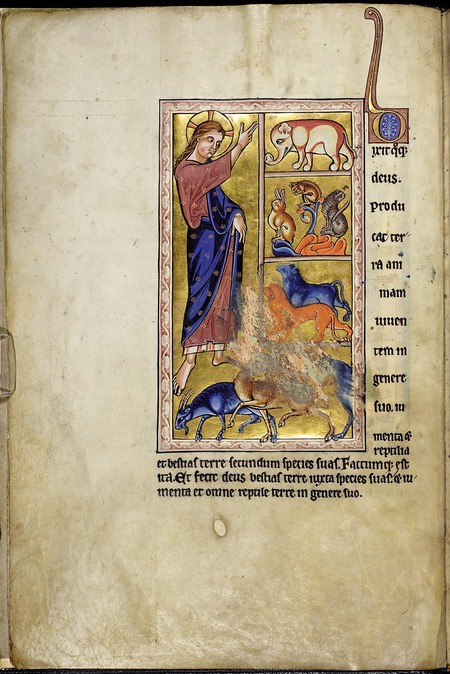
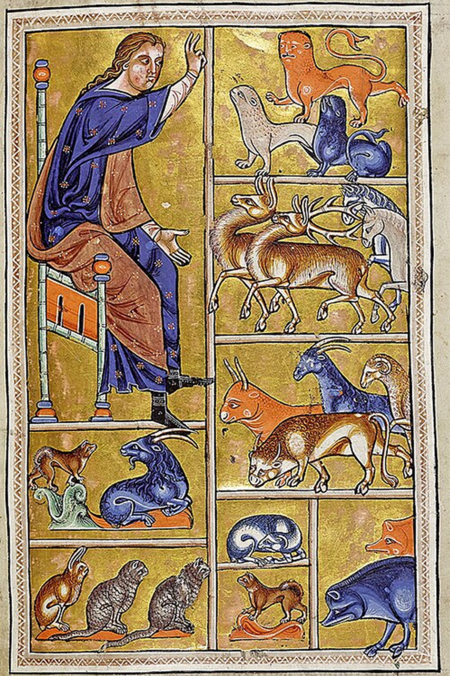
«Adam names the animals.» Aberdeen bestiary, England, c. 1200 // «Creation of animals.» Aberdeen bestiary, England, c. 1200
Animal Behavior
Familiar animals in bestiaries are rarely presented merely as examples of their species. Even where an artist preserves a recognizable silhouette, the image may be connected to a legend, a moral lesson, or a fixed association. The lion is distinguished from other beasts by its size, mane, and posture; the bull and wolf are recognized by their horns and heavy build. These characteristics help identify the animal, but they do not exhaust the meaning of the depiction.
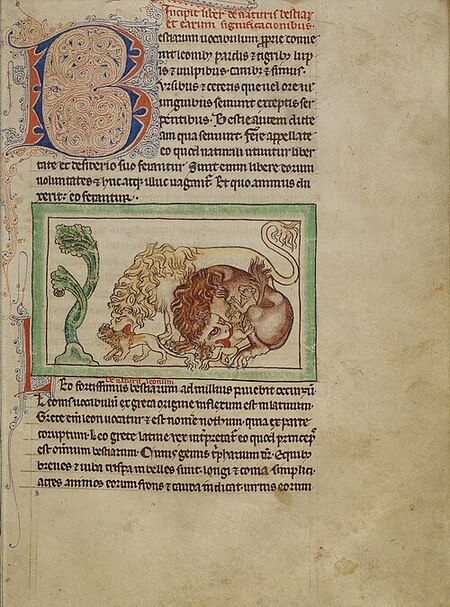
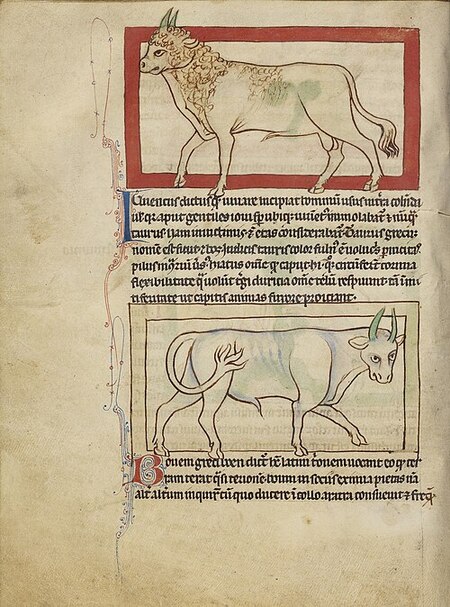
«Lions.» The Northumberland Bestiary, 1250–1260 // «Bull and Wolf.» The Northumberland Bestiary, 1250–1260
According to medieval legend, bear cubs were born formless, and the mother gave them their final shape by licking their bodies. This unusual process is depicted in the Aberdeen Bestiary miniature. The bear slopes down toward the cub, and their interaction becomes the central element of the composition. The artist focuses not on anatomical accuracy, but on the action that reveals the medieval person’s conception of nature. Through this scene, the idea of maternal care and the gradual formation of a living being is conveyed.
«Mother Bear with Cubs.» Aberdeen Bestiary, c. 1200
The figures of the fox and the beaver are explored through unusual stories about their behavior, which medieval authors imbued with moral significance. The fox pretends to be dead to attract unsuspecting birds and catch them. In the miniature, its motionless pose becomes the central element of the scene of deception, symbolizing cunning and temptation. The beaver, conversely, is depicted as an animal capable of sacrificing a part of its own body to escape hunters. According to medieval lore, it bites off its testes—the source of its persecution—which symbolizes renunciation of vices. Both miniatures demonstrate how, through animal behavior, artists conveyed opposing moral qualities: guile and the striving for salvation.
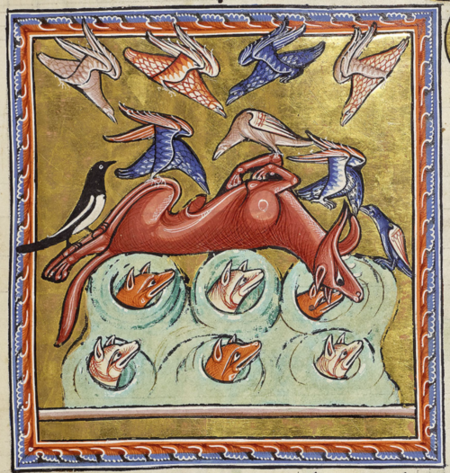
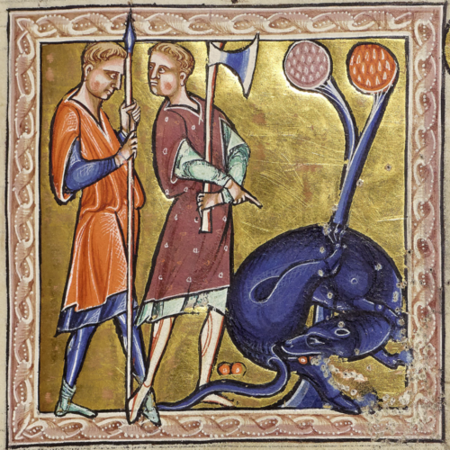
«The Fox Pretending to be Dead.» Aberdeen Bestiary, c. 1200 // «Beaver and Hunters.» Aberdeen Bestiary, c. 1200
In these miniatures, the animal remains recognizable, but the viewer must first read the story. The repetition of familiar forms makes the unusual behavior believable, and the narrative lends additional meaning to the drawing.
Exotic Animals
The appearance of animals that the English artist might never have seen was pieced together from descriptions, stories, and pre-existing illustrations. Therefore, specific characteristics became important: coloration, size, hump, trunk, or an unusual gait. Sometimes, instead of a detailed physical description, the miniature offered a narrative, by which the animal became easily memorable.
The tigress in the Aberdeen Bestiary pursues a rider who has stolen her cub, but she stops before a glass sphere, mistaking her own reflection for the child. According to medieval legend, hunters used this trick to escape a swift animal. In the miniature, the tigress leans toward the sphere, while the rider continues to recede with the stolen cub. The artist conveys not so much the tiger’s anatomical features as its speed, maternal attachment, and vulnerability. The composition transforms the image of the exotic beast into a vivid story about deception and the power of maternal instinct.
«The Tigress and the Hunter.» Aberdeen Bestiary, c. 1200
In the Workshop Bestiary, an elephant is depicted with a battle tower on its back, housing armed warriors. Its massive body, trunk, and unusual proportions combine with the details of military equipment, emphasizing the animal’s role in distant lands. The scene with the crocodile presents an attack by a hydrus—a legendary creature that penetrates its jaws and tears the body apart from the inside. The crocodile is rendered with conventional anatomy, and the composition focuses on the collision of the two creatures. In both instances, the artists aimed not so much to accurately portray the appearance of exotic animals as to vividly illustrate the stories and concepts associated with them.
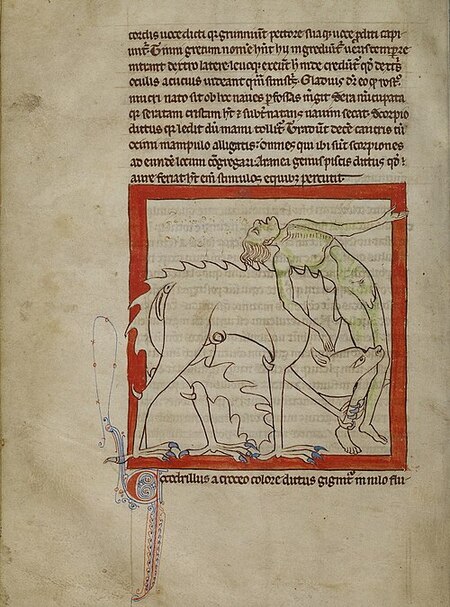
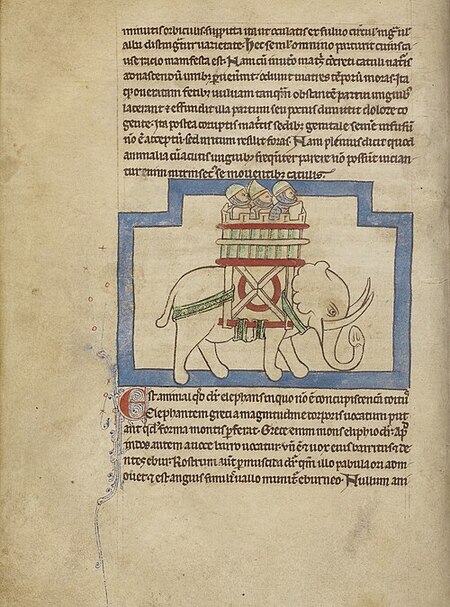
«Elephant with a battle tower.» Northumberland Bestiary, 1250–1260 // «Crocodile pursuing a man.» Northumberland Bestiary, 1250–1260
The image of the exotic animal is the result of selection: from numerous possible details, the miniature retains those that are crucial for recognition, storytelling, or conveying a sense of danger and power.
Fantastic Creatures
In bestiaries, there was no strict visual boundary between a real beast, a little-known animal, and a mythical creature. An artist could depict them using the same technique, place them in identical frames, and employ similar methods. The difference lay in which characteristics needed to be combined for the viewer to recognize the unusual creation.
The Bonaccone externally resembles a bull, but its exceptional trait is only revealed in the scene of the chase. According to the text, it defends itself against hunters using scorching excrement. The Aberdeen Bestiary focuses on the encounter between the beast and two armed pursuers, and the depiction itself recalls an almost comic episode. The figures stand out against a gold background; the saturated colors and decorative details lend expressiveness to the scene.
In the Northumberland Bestiary, created in the mid-13th century, the same narrative is presented in a more restrained artistic manner. Here, the artist uses delicate contour lines and light coloring, and instead of two warriors, depicts one pursuer with a spear. The space becomes looser, and the composition takes on a more graphic character. Despite the differences, both miniatures retain the main element of the plot—the Bonaccone’s unusual defense mechanism. The comparison shows how the same fantastic image could take on different artistic manifestations while retaining the recognizable traits and content of the medieval legend.
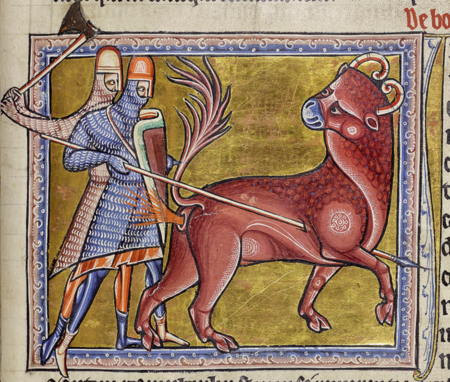
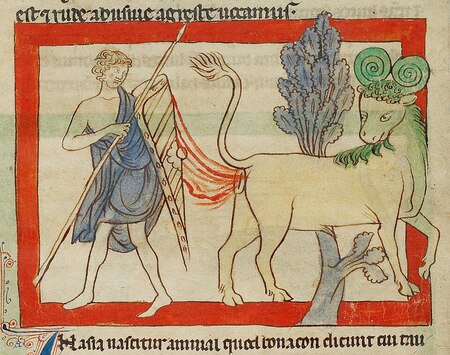
«Bonnecon and the Hunter.» Aberdeen Bestiary, c. 1200 // «Bonnecon.» Northumberland Bestiary, 1250–1260
In depictions of the centaur, medieval artists paid particular attention to the merging of human and animal characteristics. The contrast between body parts was emphasized through differences in proportions, posture, and figure plasticity. Nevertheless, both parts were unified into a single silhouette, which gave the fantastic creature a cohesive appearance. In Christian tradition, this duality could symbolize the conflict between reason and animal instincts. Thus, the unusual anatomy became a means of conveying not only the external appearance of the figure but also its symbolic meaning.
«Onocentaur.» Würzburg Bestiary, c. 1185
The imagery of the manticore and the amphibian demonstrates how medieval artists constructed fantastic creatures from recognizable natural forms. The manticore combined a human face with a lion’s body and a scorpion’s tail, and its fearsome appearance underscored its danger and ferocity. The amphibian was depicted as a snake with two heads at opposite ends of its body, which, according to legend, allowed it to move in both directions. Despite their unusual anatomy, both creatures retained characteristic features that made them identifiable. Miniaturists relied on literary descriptions, synthesizing familiar elements into novel forms.
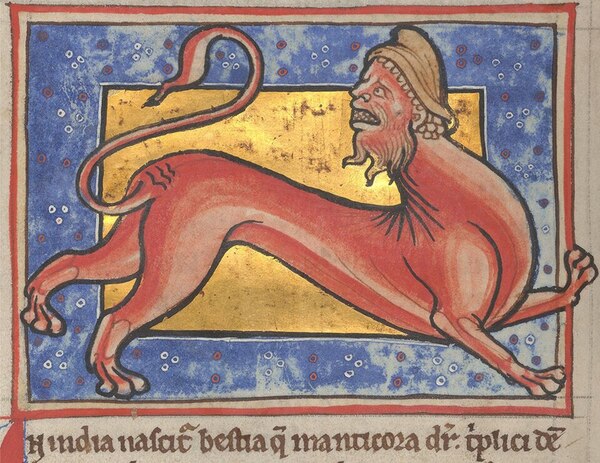
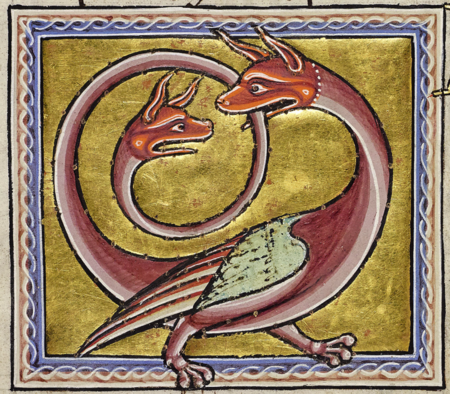
«Manticore.» Werkho beastiary, c. 1185 // «Amphisbaena.» Aberdeen beastiary, c. 1200
Thus, even the most fanciful imagery adhered to a specific artistic logic. The images show that the miniaturist’s goal was to create a cohesive, recognizable figure from disparate verbal characteristics. Imagination operated within tradition: the viewer was not meant only to be surprised by the being but also to understand who stood before them.