Navigator
- Concept
- Sense of Time
- Representation of Time: Absence of Editing
- Video Art and Various Editing Techniques
- Conclusion
Concept
In the context of contemporary visual culture, which is characterized by acceleration and a continuous flow of images, the issue of time acquires particular significance. Most screen-based forms strive to reduce duration and condense content, submitting time to the logic of short-form content. In this context, video art occupies a unique place: it does not follow the trend of acceleration to capture viewer attention, but rather experiments with duration.
Duration helps artists deepen the meaning of the video image. Moreover, duration engages the viewer in a process of experiencing, prompting them to interpret what they see. It is noteworthy that time in video art becomes a distinct form of experience for the public. In this medium, meaning is not conveyed directly. The viewer grasps the essence of the video material precisely through the prolonged interaction with it.
The Tate Gallery classifies video art as time-based art—art that is based on time and duration [3]
According to the definition, video art is a medium that transforms time into artistic material. Unlike film, video art does not always require plot elements or a sequential viewing experience. From this perspective, I was interested in examining: what function does time serve in video art? How does the duration of a video piece assist artists in realizing their concepts? These specific questions became central to defining the theme of my visual study.
The working hypothesis of this research is that the duration of a video art piece acquires a special meaning. In screen-based art, the concept of duration ceases to be governed by cinematic canons and instead becomes a vessel for meaning, metaphor, and experience.
The foundation of this study is an analysis of works that demonstrate various strategies for handling time in video art—including the rejection of montage or its utilization. As examples, I examined groups of works by video artists (and artists from other media for comparison) that allow for tracing the transformation of the concept of time across different artistic practices within video art.
The purpose of this research is to investigate the function of duration in video art. In this paper, I aim to demonstrate that time in video art is an independent artistic gesture that influences the perception of the video image.
Work with textual sources is based on selecting authoritative resources—including research papers and interviews with video artists—that focus on studying video art as a distinct contemporary medium. When selecting analytical material, I placed particular emphasis on the theoretical foundations and texts that examine the issue of duration. When working with sources, I reference the works of Art History Candidate A. D. Persheeva, which address the analysis of screen arts and the specifics of organizing video art as a medium [1]. The foundation of the research was the concept of video art classic Bill Viola regarding time as an artistic material, and about video art as a valuable experience that requires time, effort, and concentration [4]. Significant attention was given to analyzing editing techniques to understand what video artists were trying to achieve by using a particular approach.
Sense of Time
The concept of time is one of the key elements in the history of visual art, yet the perception of duration differs across various media.
For instance, in photography, time is fixed and stopped—leaving a frozen moment. In cinema, time is organized through montage and editing, thus submitting to the logic of narrative. In the 20th century, time ceases to be a subsidiary unit. In video art, it moves to the forefront, becoming a means of expressing the artist’s intent.
To better understand the specifics of video art, it is important to conduct a comparative analysis of two closely related media (photography and video art) and trace how time is organized within each of them.
Lewis Hine, photographs of the construction of the Empire State Building, 1931
In a series of photographs by Lewis Hine dedicated to the construction of the Empire State Building, documentation of a massive urban project is presented. Each photograph captures a specific moment in the long and complex process of erecting the skyscraper in New York City.
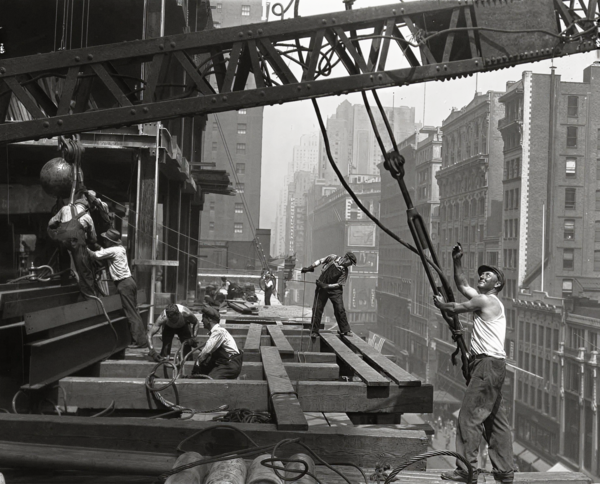
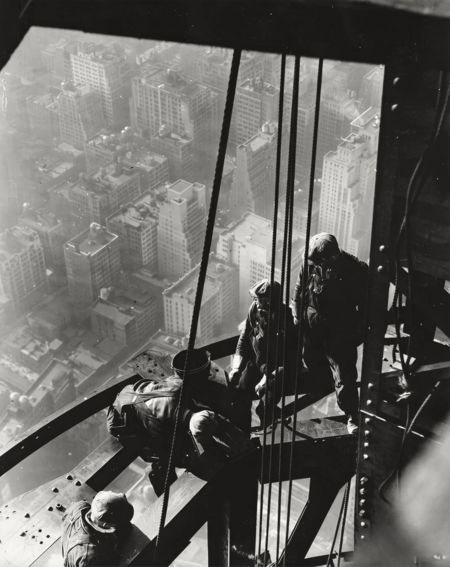
Lewis Hine, photographs of the construction of the Empire State Building, 1931
Photography allows us to capture and signify a specific span of time. By examining the photographs of Lynn Hyde, the viewer can discern the historical era, the atmosphere of the construction process, and the character of industrial New York. However, the genre of photography does not allow Louis Hyde to move beyond the «claim» of documentation. Photography remains true to the canons of static imagery—captured and motionless.
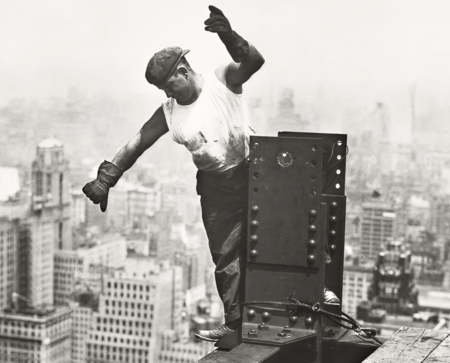
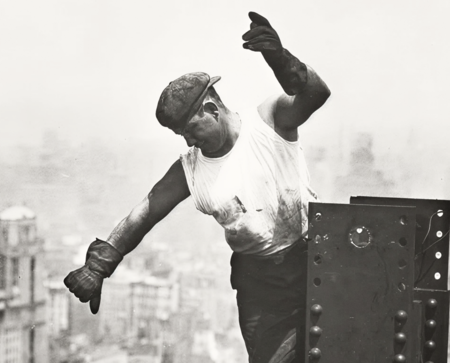
Lewis Hyde, photograph from the Empire State Building construction series, fragment, 1931
For example, in one of his photographs, Hein captures a dangerous moment during work—the subject is pictured engaged in an activity at a great height. The photographer achieves a dynamic shot, yet the viewer perceives neither the beginning nor the continuation of the movement. Time in the photograph is transformed into a cut excerpt from a continuous construction process.
Lewis Hine, photographs of the Empire State Building construction, 1931
A photograph halts the flow of time, controls the moment, and transforms it into a static image.
Lewis Hine, photographs of the construction of the Empire State Building, 1931
In photographs documenting the construction process, Hein chronicles various stages of the skyscraper’s erection. The workers, beams, structural elements, and machinery indicate the lengthy and massive scale of the construction. However, each shot remains merely a discrete fragment of that process.
Lewis Hine, photographs of the Empire State Building construction, 1931
It is impossible to capture the entire process—its duration and multifaceted nature—in a photograph.
Andy Warhol references the Empire State Building in his work, «Empire.» The artist creates a static video, centering it around the skyscraper [1]. Using an eight-hour video, Andy Warhol captures the transition from night to day, documenting the passage of time.
Andy Warhol, fragments from the work «Empire,» 1964
The distinctive aspect of this work is that time transcends mere documentation and takes center stage. These eight hours become the substance of the video piece. Through long, monotonous filming, Warhol prompts the viewer to exert effort to sense the duration of time—to slow down and perceive the subtlest changes in the urban landscape of a July night.
Andy Warhol, fragments from «Empire,» 1964
In video art, time takes center stage. In contrast to the frozen moment captured in photographs, time in video art is tangible and mutable.
For example, in Bill Viola’s work «The Passing,» long and nearly static shots evoke the genre of photography, yet the artist preserves the flow of time within the frame. Thanks to the dynamism of each video sequence, the viewer perceives duration.
Bill Viola, fragments from the work «The Passing, ” 1991
Bill Viola, fragments of the work «The Passing,» 1991