Types of Constructing Hybrid Creatures in 14th-Century Medieval Marginalia
Navigation Menu
Concept
Type 1. The merging of the human face/torso with the bodies of animals and birds.
Type 2. Formless beings: Head-footed creatures—14th-century characters whose legs or wings sprout directly from their head or ears.
Type 3. Biomorphic-object hybrids: The fusion of living flesh with inert matter.
Type 4. Plant-animal flora: Creature tails that transition into Gothic ornamentation (acanthus leaves, vines), where the monster literally «sprouts» into the page’s decor.
Conclusion: 14th-century marginalia as a precursor to Surrealism and contemporary art.
1. Concept
My topic is titled: «Types of Construction in Hybrid Creatures in 14th-Century Medieval Marginalia.» This is a period of unique artistic freedom in Europe. I am investigating the visual approach of artists to depicting medieval marginalia, specifically—the methods used to construct imagery by combining parts of animal and human bodies. The goal of my work is to identify the system and types of this construction.
I pose a key question: By what specific principles did the medieval master deconstruct the natural forms of nature and assemble them into new, each time original, forms? My research does not delve into the religious or allegorical subtext of the bestiaries. I am primarily interested in their visual component.
As my primary study material, I used digitized fragments of pages from the first half of the fourteenth century. Among these are the «Psalter of Lattrell» and the «Romance of Alexander.» I focus on the fourteenth century because, during this period, medieval graphic arts reach a peak of sophistication in their methods of form deformation. Through close visual analysis of the marginalia, I noticed a discernible logic in their creation. For example, there are numerous creatures the artist constructed by combining the animal world with plant ornamentation. This technique becomes a pattern.
Examining digitized manuscripts, I analyzed and compared the images to try and understand what assembly variants of hybrid creatures the medieval master employed. In my project, I will demonstrate how the creation of marginalia in manuscripts evolves from simple methods to more abstract approaches.
The first principle I identified is substitution. It is the simplest: an animal’s head is connected to a human torso (or vice versa) while maintaining conventional proportions. Next, I observed that sometimes the artist abandons the conventional torso, causing legs or wings to grow directly from the head or ears. In this way, the head itself becomes the body. The third type is the merging of inanimate objects—domestic items, architecture, weapons, or tableware—with a living body. The final type, which I mentioned earlier, is the combination of a living creature and botanical ornamentation. In this case, the ornamentation often continues, spreading across the page to encircle and decorate the text.
In my research hypothesis, I do not deny the religious or allegorical meaning of the images. However, by systematizing the techniques for assembling these creatures, I supplement this meaning with a crucial finding: 14th-century marginalia represents a well-integrated, coherent artistic system of construction (similar to modern concept art) that artists and designers still employ today. Medieval masters developed a universal language of the grotesque, one founded on modularity, the juxtaposition of disparate elements, and the violation of spatial boundaries.
2. Introduction
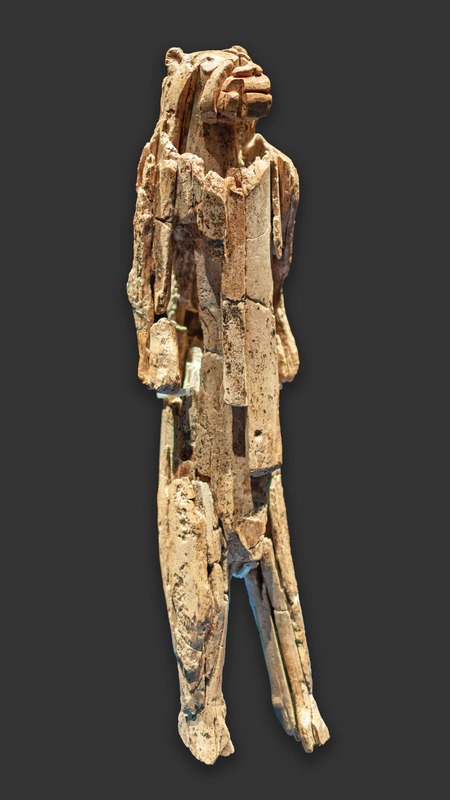
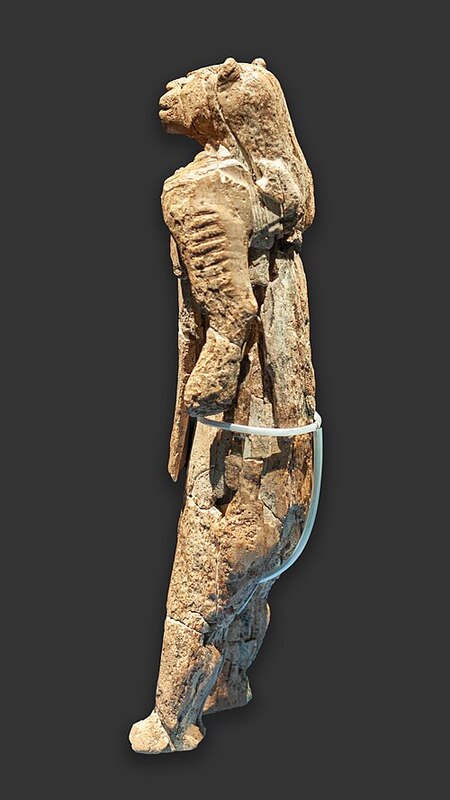
Archetypal point of reference. The «Löwenmensch» (Man-Lion) figurine, mammoth tusk, dating to approximately 35–40 thousand years ago (Aurignacian culture), Ulm Museum, Germany.
But the fantastic creature did not appear in the 14th century; it has deep archetypal roots. Even in the Paleolithic era, humans created totem monoliths, such as the «Werewolf» statue, striving to mystically unite the power of the beast with the human mind. However, for long millennia, the principle of combining forms was subject to strict canons. It was in the 14th century, though, that a visual revolution took place. Artists began to boldly experiment with form. Dynamism and freedom emerged in the imagery. Masters combined incompatible body parts, creating a unique language of the absurd—a visual technique that remains relevant today.
2. Type 1. Merging a human face/torso with the bodies of animals and birds.
This section demonstrates the simplest principle of the medieval «constructor”—the direct juxtaposition of human and animal anatomy.
Hybrid character with an owl. «Psalter of Lattrell, ” c. 1325–1340. British Library, London.
Here, the artist preserves the human body but replaces the head with an animal’s head.
Scene of confrontation between hybrid creatures. «Psalter of Lattrell,» circa 1325–1340. British Library, London.
The juncture between the human torso and the animal lower half is covered by an element of the costume.
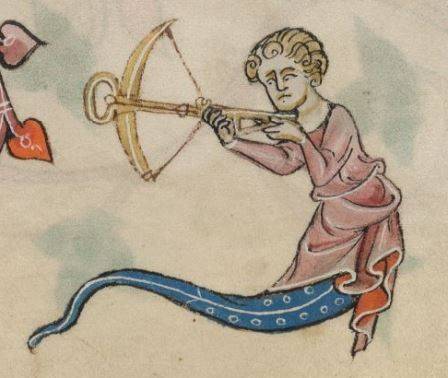
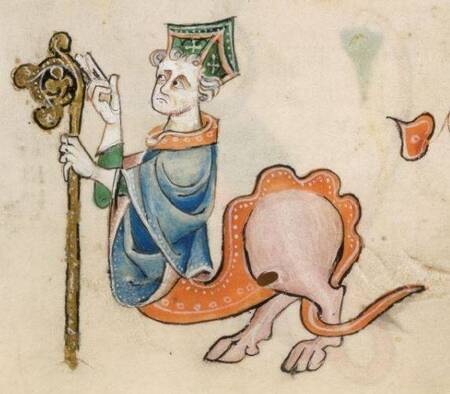
Centaur-Archer and Bishop-Dragon. «Romance of Alexander, ” 1338–1344. Bodleian Library, Oxford.
Left figure (archer): A smooth junction at the waistline. The human torso is connected to a scaled, serpentine tail. Right figure (bishop): A vertical human block—the human torso in a robe with attributes of power—is connected to ungulate limbs.
Hybrid Musicians in the Fields. «Romance of Alexander, ” 1338–1344. Bodleian Library, Oxford.
A human torso is fused with reptilian forms. The seam line is masked by the hem of the tunic.
Procession of characters with animal heads. «Romance of Alexander,» 1338–1344. Bodleian Library, Oxford.
Neckline module replacement. The human body and costume remain, while the head is replaced with a deer, rabbit, or horse module.
3. Type 2. Torso-less Creatures: Gohlonoغي—14th-century characters whose legs or wings sprout directly from their head or ears.
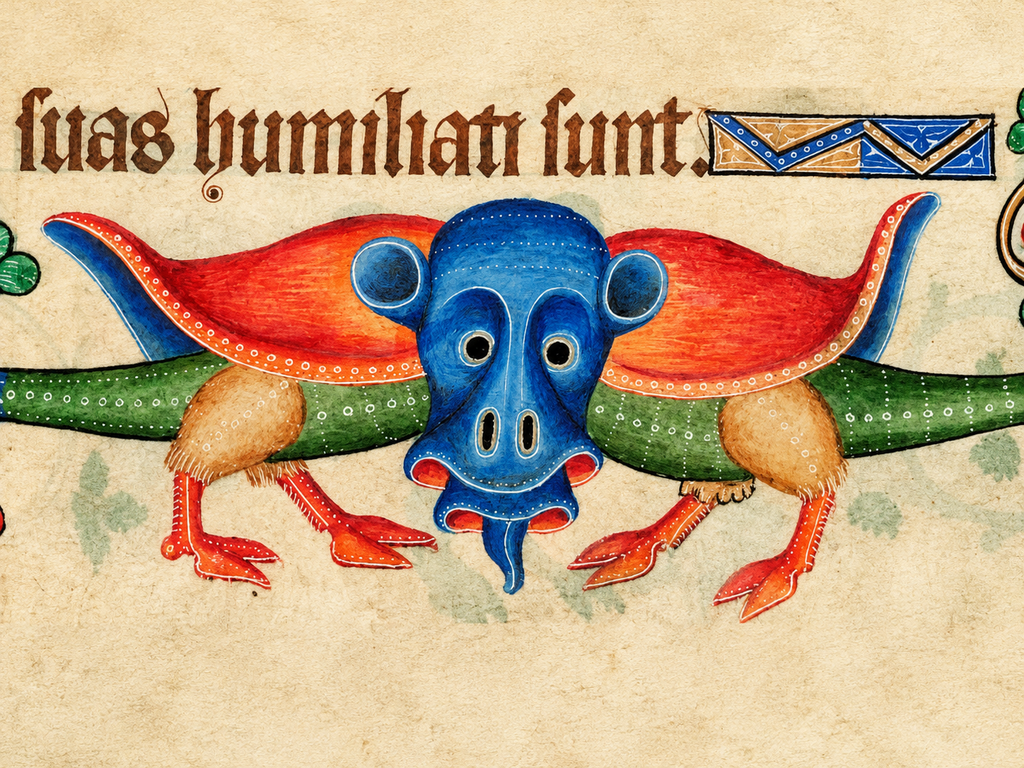
This style features a bolder approach—a deliberate rejection of the conventional torso. The head immediately becomes the central framework and nexus from which the limbs extend.
Zoomorphic slug. «Psalter of Lattrell,» c. 1325–1340. British Library, London.
The frontal visage serves as the central assembly node: limbs emerge from its sides. Lacking a neck or torso.