INDEX
- CONCEPT
- KRISTINA KUBISH: SOUND AND THE LISTENER
- HOW MOVEMENT ALTERs AUDIBLE SOUND
- «THE BREATH OF THE SEA»: LISTENING THROUGH HAND MOVEMENT
- «ELECTRIC STROLLS»: MOVEMENT THROUGH THE CITY
- «THE CLOUD»: MOVING AROUND SOUND SCULPTURE
- THREE WAYS FOR THE LISTENER TO ENGAGE AND WHAT THE DOCUMENTATION CONVEYS
- CONCLUSION
CONCEPT
In Kristina Kubish’s sound projects, listening is intertwined with movement. To explore the work, the participant moves the receiver, turns their head, approaches the signal source, or selects a path. These actions influence which sounds they hear and in what sequence.The study is built upon a comparison of three projects: «Sea’s Breath» (Il respiro del mare, 1981), «Electrical Walks”—exemplified by a walk through San Francisco in 2017—and „Cloud“ in the SFMOMA 2017 version. In the first, the participant moves the receiver near wires on the wall; in the second, they explore the city while wearing specialized headphones; in the third, they move around a suspended cable structure. These works allow for a comparison of different scales of movement: a gesture of the hand, the movement of the body within the exhibition space, and a walk through the city.
I chose this topic because I am interested in how human movement influences what a person hears. In Kubish’s projects, participants can walk in their own direction, stop, and move closer to sound sources. I want to understand what the artist sets within this experience and what the listener chooses for themselves. The analysis will be based on photographs, maps, diagrams, audio-visual documentation, and the artist’s statements. By comparing these elements, I will examine how the visible structure of the work guides the participant’s actions and how those actions relate to the changing sounds.
In this research, I pose the following questions: How does the listener’s movement influence what they hear in Christina Kubisch’s projects? How does the structure of her works guide their actions, and how does listening differ in a gallery setting versus in the city? What does the participant choose, and what does the artist determine? What can we learn from photographs, maps, and recordings about this experience?
The goal of this research is to compare three projects by Kristina Kubish and understand how the participant’s movements affect the perception of sound. I hypothesize that the artist sets the conditions for listening, and the participant influences what sounds they hear, in what combination, and for how long through their movements. I will test this hypothesis using each work as an example.
KRISTINA KUBISH: SOUND AND THE LISTENER
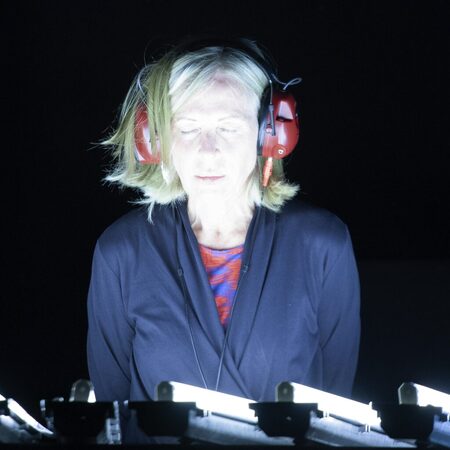
Krystina Kubiš is a German artist and composer, born in Bremen in 1948. She studied painting, music, and electronics. In her work, sound is connected to visual form and a space that the visitor can explore independently.In the late 1970s, Kubiš began to transition from concerts and performances to sound installations. She was interested in the opportunity to give every person the freedom to move between sources of sound and choose the duration of listening.
HOW SOUND CHANGES AS A MOVEMENT
In the selected works, Kubish’s sound is accessed via specialized receivers and headphones. These capture electromagnetic signals and convert them into audible sound. As the participant changes the device’s position, moves closer to the source, or turns their head, what they hear changes.
Kristina Kubish: «Every movement, even a slight turn of the head, leads to different sequences of tones» [1].
In «Sea Breath» and «Cloud,» the artist pre-selects recordings and transmits them through wires. In «Electrical Strolls,» the participant listens to signals from functioning urban devices. In the first two projects, the listener explores the soundscape curated by the artist, while in the third, they listen to the signals of the surrounding city.
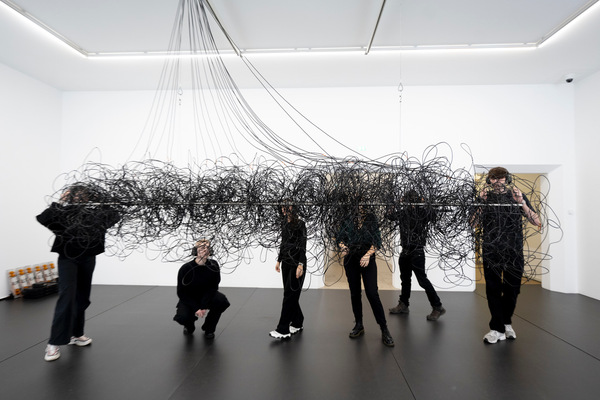
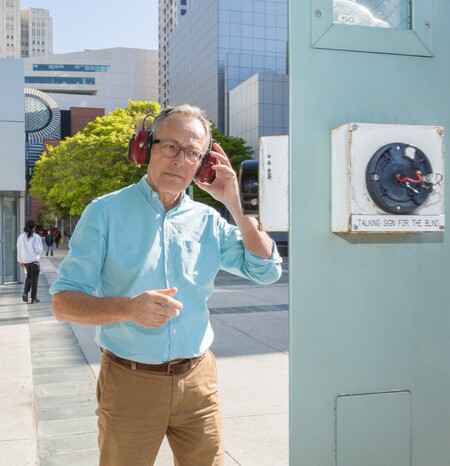
Kristina Kubish. «Cloud.» Museum of New Art, Freiburg, Germany, 2024. // Kristina Kubish. «Electrical Walks San Francisco,» San Francisco, USA, 2017.
In the first photograph, participants are gathered around the «Cloud.» The frame captures various body postures while interacting with the work.
In the second photograph, a participant stands next to an urban installation, holding a hand near a headset. The frame illustrates the listener’s position relative to the signal source.
«THE BREATH OF THE SEA»: LISTENING WITH THE MOVEMENT OF THE HAND
In «Sea Breath,» Kristina Kubish combines two simple actions: observing the lines and searching for sound. Red and blue wires, coiled into similar labyrinths, are displayed on the walls. To hear the piece, the visitor takes a small, handheld receiver.
Kristina Kubish. «Breath of the Sea» (Il respiro del mare). Capo d’Orlando, Italy, 1981.
In a general view, the outlines occupy adjacent walls. There remains open space between them, so a person can approach each one and change their position relative to both.
The outlines are similar in design but convey different narratives: blue is the sound of the sea, red is the breath of the artist. This difference is important for the study. Visually, the visitor notices the similarity of the two forms, but while listening, they discover the difference between them. To compare the sources, action is required: aiming the receiver, bringing it closer to the wires, and moving around.
Kristina Kubish. «The Breath of the Sea» (Il respiro del mare). Capo d’Orlando, Italy, 1981.
The cube receiver captures the electromagnetic signal near the wires and reproduces it through a built-in speaker. The device can be held up to the ear or moved in front of the cables.
The close-up helps reveal what is lost in the overall view: interacting with the work requires only a small hand movement. The wires are secured to the wall, and the user adjusts the receiver’s position independently. They can explore the line gradually, linger near one section, or move their hand further along. Distance has an auditory significance: as the receiver approaches a wire, its signal becomes louder. Thus, hand movement becomes a means of selection. By moving the receiver, the person influences both the volume and the combination of sounds. They decide where to pause and when to move their hand further—in essence, the user controls the conditions of their own listening experience.
Thus, Kubish pre-selects the sea and breath, the contours' shape, and their placement. This sets the boundaries of the work. The participant explores these conditions: selecting the source, the receiver’s position, the sequence of movements, and the duration of stops.
Kristina Kubish: «The audience actively participates in creating the sound mix» [2].
Kristina Kubish. «Breathing of the Sea» (Il respiro del mare). Ludwig Forum, Aachen, Germany, 2026.
Meaning, one person can listen to the sea near the blue contour for a longer period, while another can move between two sources, changing the combination of sounds. The artist provides the sonic material, and each participant chooses how to explore it. In «Breath of the Sea,» the research hypothesis is confirmed through specific action: the artist determines the material, and the listener influences how they hear it through hand movements. The receiver connects the stationary line on the wall with their personal listening tempo—approaching, pausing, and the next movement.
«ELECTRIC WALKS»: MOVING THROUGH THE CITY
In «Electric Walks, ” Christina Kubish invites viewers to explore the city using specialized headphones. The sources of sound are functioning devices: ATMs, screens, security systems, and transit. For this exploration, I examined a walk through San Francisco, created in 2017 around the San Francisco Museum of Modern Art.
Kristina Kubish. Fragment of the map «Electric Strolls Through San Francisco, ” 2017.