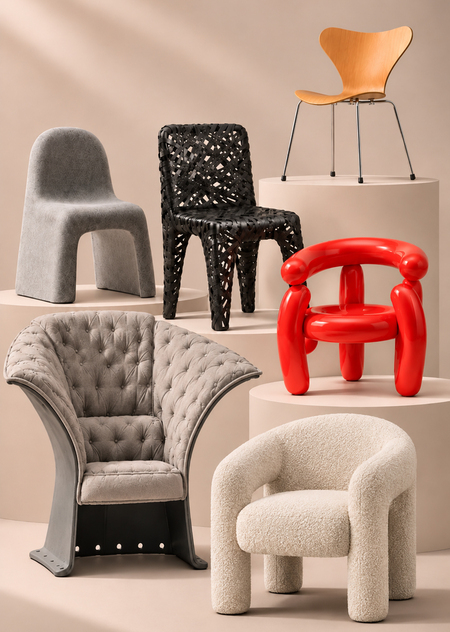
Object design extends far beyond mere practical functionality. An object’s value is determined not only by its convenience and purpose, but also by its capacity to evoke emotions, convey ideas, and create novel experiences. Unconventional materials, experimental technologies, expressive forms, and artistic concepts transform everyday items into objects imbued with a distinct meaning. In this context, the object becomes not just a tool for daily life, but a medium for emotional and artistic expression.
Hypothesis
The emotional impact of an object is more important than its practical utility.
The armchair—especially a successful example—is an excellent object for investigation. Its basic function is understood by everyone: to provide the ability to sit. Yet, designers often transform it into a sculpture, a material experiment, a provocation, or an object that evokes memories. In these instances, the armchair might be uncomfortable, expensive, difficult to manufacture, and yet remain a significant design object. Must the rational and emotional aspects always conflict? Can they complement each other? After all, an object can simultaneously be comfortable, functional, and emotionally expressive.
Sections
- We will study the relationship between material and perception: — texture, — color, — plasticity, — construction.
- We will explore three distinct conflicts: — artistic concept versus comfort, — emotional transformation versus rationality, — experimental technology versus mass production.
1. Material and perception: visual, physical, emotional.
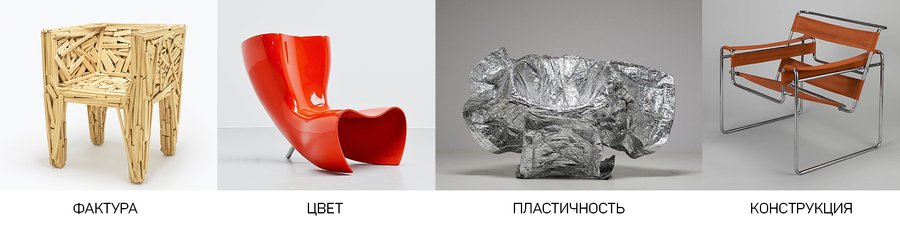
How do texture, color, plasticity, and construction dictate the scenario of human interaction with an object?
In product design, material is more than just the physical substance of an object. It dictates the object’s appearance, tactile qualities, usability features, and emotional character. The human first perceives an object visually, then assesses its presumed comfort, and finally interacts with it physically.
Texture—tactile and visual perception.
Fernando and Humberto Campana «Boa Sofa,» 2002 Emeco «1006 Navy Chair,» 1944
The texture of a material influences expectations of the object. A velvety surface is associated with softness and warmth, while polished metal suggests durability, coolness, and technological sophistication.
Color is the emotional character of an object.
Masanori Umeda «Getsuen Armchair,» 1990 Ludwig Mies van der Rohe «Barcelona Chair,» 1929
Color has the power to amplify the emotional expressiveness of a subject or to underscore its structural clarity. In «Getsuen, ” a rich red intensifies the natural imagery of the flower, while in the „Barcelona Chair, ” a restrained palette emphasizes form and proportion.
Plasticity—the interaction of form with the body.
Piero Gatti, Cesare Paolini, Franco Teodoro «Sacco,» 1968 Ron Arad «Voido Rocking Chair,» 2006
The malleability of an object is demonstrated not only by its ability to change shape, but also by its capacity for movement. «Sacco» adapts to the body through filler deformation, while «Voido» utilizes the geometry of a rigid shell to create a dynamic interaction with the human form.
Structure—the perception of stability and reliability.
Harry Berteya «Diamond Chair», 1952 Alfredo Heberli «Take a Line for a Walk», 2003
Both chairs feature a distinct spatial form; however, the first design allows space to pass through its structure, while the second envelops the human form. The «Diamond Chair» evokes a sense of lightness and openness, whereas the «Take a Line for a Walk» establishes a personal enclosure, providing a feeling of intimacy and security.
Section Conclusion:
The material properties of an object shape a person’s expectations even before direct contact, and during use, they can either confirm or alter those expectations.
2. Three Conflicts
Artistic vision versus comfort.
When does material become a means of artistic expression, and when do its properties submit to human convenience?
Tokujin Yoshioka «Honey-Pop Chair», 2000 Bill Stumpf and Don Chadwick «Aeron Chair», 1994
«Honey-Pop Chair» illustrates how material and artistic concept can define an object’s value, even if its practicality is limited. The «Aeron Chair, ” in contrast, demonstrates an approach where construction and materials are subservient to human comfort above all else. Yet, „Aeron“ also possesses aesthetic expressiveness, while „Honey-Pop“ is capable of conforming to the human form. Therefore, they are not absolute opposites but rather examples of different design priorities.
Teyo Remi «Rag Chair, ” 1991 Charles and Ray Eames „Eames Lounge Chair, ” 1956