Concept
The human inclination to return to a primordial state, despite the apparent irrationality of such an act, requires explanation, given that the urban environment offers significantly greater comfort and safety. One reason for the persistence of hiking is the reduction of simultaneously addressed tasks to a few clear and achievable ones—to arrive, shelter, warm up, and prepare food. In such circumstances, the experience achieves a quick comprehensibility that is absent in the urban environment. Furthermore, the natural setting does not impose a judgmental gaze, meaning solitude is appealing not because of the absence of people, but because of the absence of external critique.
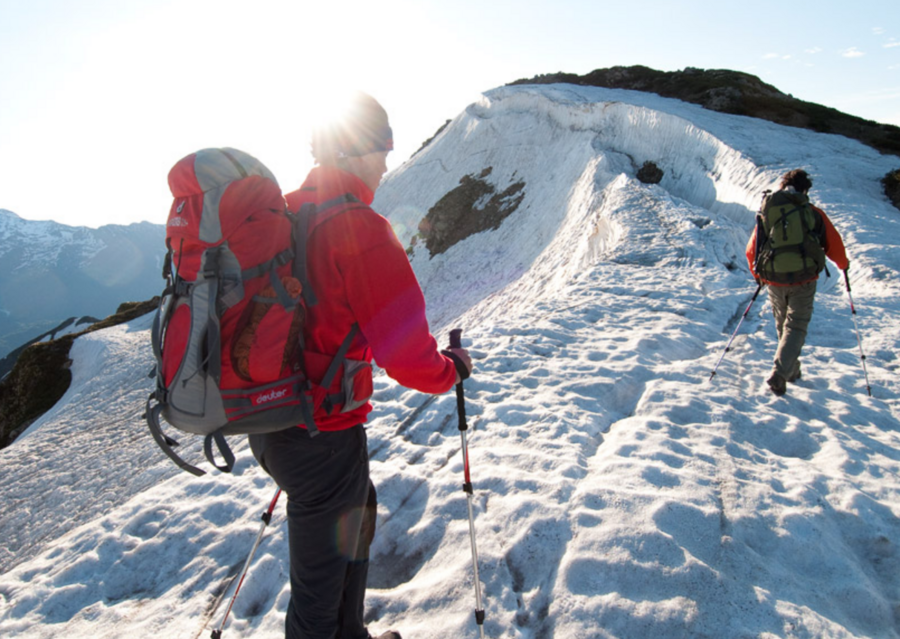
«Traverse of Achishkho Array. Krasnaya Polyana. June 2013» Image sourced from the website «Dmitry Kovinov Travel in Photographs»
Nevertheless, a complete rejection of civilization while hiking is fundamentally impossible: even the most ascetic trek into the mountains requires the use of items designed and manufactured industrially. Comfort is not eliminated; rather, it is translated into a streamlined form that necessitates a compromise regarding mass and volume.Hiking practice, therefore, does not represent a rejection of material culture, but rather its maximally condensed form. It is this fact that makes the study of hiking gear so interesting, because in this area, form is subordinated to the conditions of use with extreme rigor: mass must be carried directly, volume is limited, and functionality cannot rely on instructions or external energy sources.
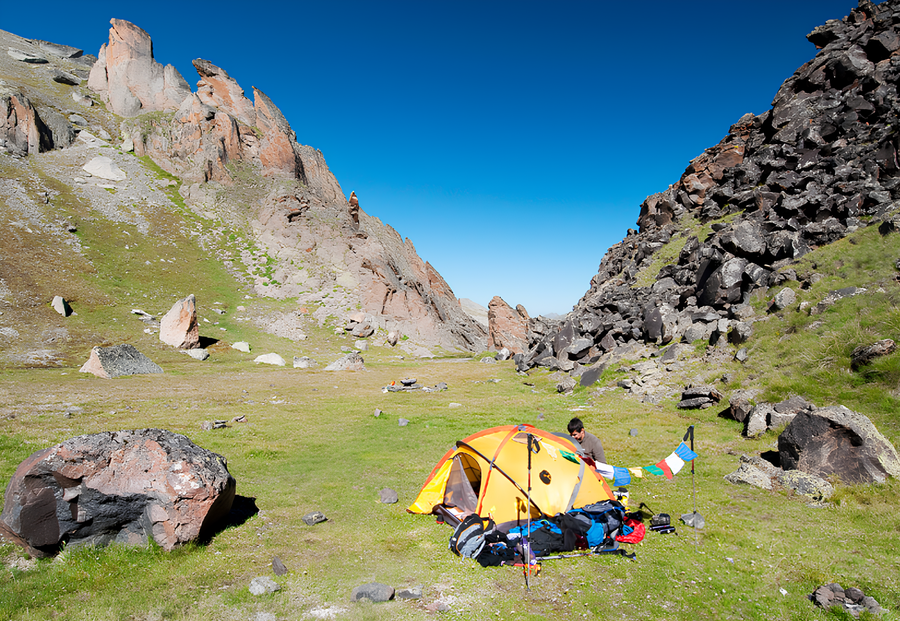
«Paradise Meadow. North Elbrus. July 2012» Image sourced from the website «Dmitry Kovinov Travels in Photographs»
This study examines the mechanisms by which utilitarian solutions from outdoor gear transition into mass consumer design, using carabiners, thermoses, and backpacks as case studies. So, what happens to an object when it loses its original context?
Karabiners
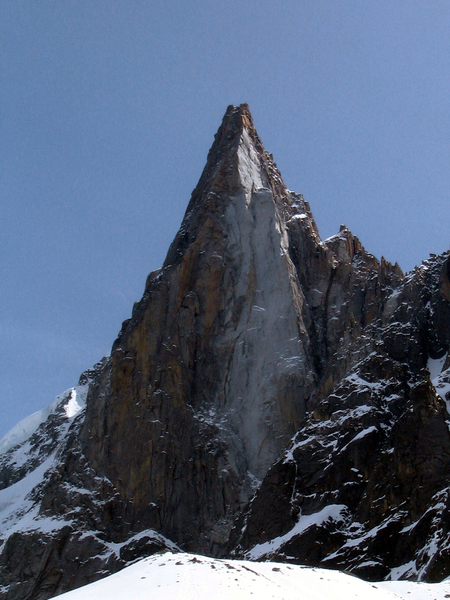
In 1935, Pierre Dunne scaled the north wall (image sourced from Wikipedia). While this is commonly referred to as a sporting achievement, another fact in Pierre Dunne’s biography is crucial: he approached the wall not with commercially available gear, but with equipment he built himself. This act became a rule of his entire life—and this is why he is interesting not as an athlete, but as an industrial designer.
We were supposed to inaugurate a new phase in the evolution of mountaineering.
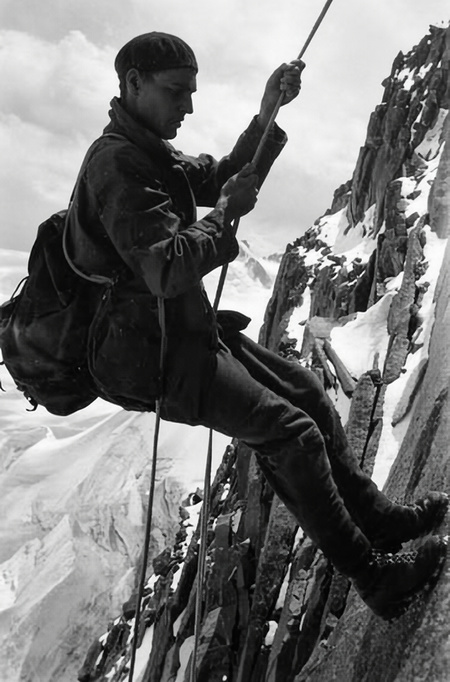
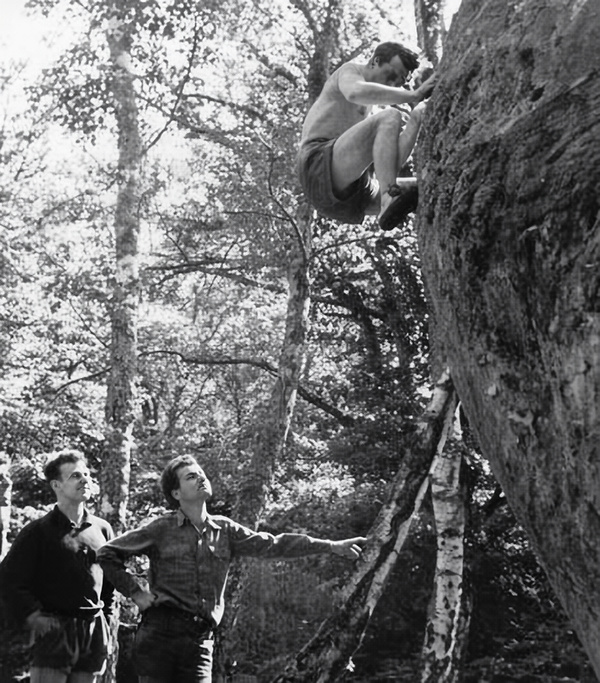
Photos are sourced from 4sport.ua
Allen Pier designed equipment to simplify rock climbing. One of these items was an improved carabiner model. While this object already existed at the time, it was not sufficiently functional. Here are the main drawbacks of contemporary equivalents:
- Steel carabiners weighed 135–140 grams. On a climber’s harness working on a wall, there weren’t just two or three carabiners—there were several dozen. Even eight to ten units added over a kilogram of weight that served no function other than connection. In artificial climbing, where the climber hangs from gear and sequentially attaches holds, this weight was noticeably burdensome.
In the photograph, «Valery before the belays, 1974–1975, ” you can clearly see the large number of carabiners required to overcome obstacles.
Valery Safiulin, a talented climber from Sverdlovsk «Valery before the belays, 1974–1975» photo by Ivan Gurin
- The second shortcoming was form-defining and likely more subtle. The existing carabiner is symmetrical, but the load applied to it is not. The most vulnerable part of the construction is the gate: the rope resting on the latch operates on its opening and bending, which causes the product’s load-bearing capacity to decrease. With a symmetrical contour, the rope has an approximately equal probability of resting on either side or on the gate—meaning the carabiner’s behavior under load is indeterminate.
3. The existing analog also has other drawbacks: the steel corrodes, and on damp limestone or in the snow, the carabiner rusts, which jams the hatch mechanism. The steel has high thermal conductivity: in the cold, the metal burns the hand, yet you must work with your bare fingers, relying on touch.