Hunting in Monochrome: A Visual Narrative of the «Metallist» Episode
Research Concept
How does one visually convey danger? This study examines the episode «The Metal Worker» from the series «Black Mirror» through the organization of viewer attention: what appears in the frame, what remains outside its boundaries, and when the pursuer becomes visible.
The topic was chosen due to an interest in how composition, lighting, movement, and editing participate in narrative construction. The black-and-white imagery allows for a focus on tonal relationships, silhouettes, and textures. The research aims to trace how these elements shape the relationship between human and machine, build an expectation of threat, and prepare the viewer for a final reinterpretation of the events.
Key research question: How does the visual organization of the episode «Metallist» direct the viewer’s attention, construct the relationship between the pursuer and the pursued, and prepare the audience to re-evaluate the narrative in the finale?
The working hypothesis is that the imagery operates on two levels. The composition of the shot, the shift in framing, and the alternation between visible and hidden elements create immediate tension during the chase. Simultaneously, individual objects and details accumulate information whose meaning is revealed later. It is posited that the finale alters the understanding of preceding events, prompting a re-assessment of the characters' motivations. We will test this hypothesis through a comparison of shots and sequences.
The primary material for this study consists of individual shots and sequences from the episode. The selection will be governed by their role in the narrative—the emergence of threat, shifts in the heroine’s status, attempts to conceal themselves, and the revelation of significant details. Each example must allow for the demonstration of a specific visual technique and an explanation of its effect.
We will use single shots to analyze composition, figure scale, lighting, and texture. Sequences of shots will help trace editing, movement, and the progression of information delivery. We will compare human and machine imagery, open spaces versus shelters, and wide versus close-up shots. For every example, we will record the timestamp from the episode version being used. This will allow us to verify our observations and maintain the link between the image and the scene’s context.
The research sections will be organized around visual narrative mechanisms: the space of threat, the depiction of human and machine, control of visibility, the editing of pursuit, and the role of detail. This structure will allow a progression from the construction of a single shot to a sequence of events, and finally—to a reinterpretation of the story in the finale. The theoretical framework of the research is based on interviews with the director and material from the visual effects studio. The sources were selected based on the direct involvement of their creators and interviewees in the creation of the episode—they allow for clarification of the monochrome choice, the robot’s design, and the resolution of the ending. The creators’ statements are compared with observations made from the shots. It is worth noting that the author’s intent and our interpretation differ; all information and borrowed ideas are accompanied by citations.
Threat Space
David Slade. «The Metallist,» Black Mirror series. 2017. Frame from the episode, at 00:45 in the version used.
The bright stripe of the road stands out against the dark earth, drawing the viewer’s eye from the bottom edge of the frame toward the horizon. The car becomes a point of focus because of its placement on this line, though it occupies only a small portion of the image. The sky and the open landscape take up the majority of the frame.
This scale ratio allows the space to be read as superior to the human figure. There are no other moving vehicles visible on the road segment, and there are no immediate coverages on either side. While the pursuer has not yet been shown, this shot establishes a sense of the characters' isolation. We will explore the connection between the open space and vulnerability further in the chase sequence shots.
David Slade. «Metalhead,» Black Mirror series. 2017. Frame from the episode, 05:05 in the utilized version.
On the road, the gaze could move freely across the open landscape. Here, the view is restricted: the left side of the frame is dominated by nearly solid shadow, and on the right, shelves create repeating verticals and horizontals. Their lines direct the eye into the depth of the narrow passageway.
Light highlights individual surfaces of the packaging and a patch of floor, but it does not reveal the entire space. The viewer sees the path of movement, but cannot observe the area beyond the obstacles. In this frame, the source of potential threat has not yet been indicated. The tension can be linked to the uneven distribution of visibility: lit areas allow for orientation, while dark areas maintain uncertainty.
David Slade. «The Metallist, ” Black Mirror series. 2017. Stills from the episode: 06:00 from the top view, 06:20 from the bottom view in the version used. The comparison was compiled by the study’s author.
In the upper frame, a lantern creates a bright focal point, yet it illuminates only a portion of the space. The light helps the heroine find her way, keeping most of the surroundings in darkness. Its directionality emphasizes the limited field of view—it is impossible to see everything at once.
In the lower frame, metal crossbars pass in front of the heroine’s face, segmenting the image into distinct areas. Because the camera is viewing the person through an obstacle, the viewer also receives an incomplete view.
In these examples, the restriction of visibility is constructed using different means: light and foreground occlusion. The warehouse space becomes a condition for the search: before she can act, the heroine must discern what is hidden.
David Slade. «Metalist, ” Black Mirror series. 2017. Frame from the episode, 18:00 in the version used.
The massive trunk and diverging branches occupy the right side of the frame. The heroine’s figure at the base of the fork is small, and her dark clothing is close in tone to the bark. Consequently, the person does not immediately stand out from the surrounding textures; they must be located among the trunks and branches.
The tree alters the direction of possible movement. The path previously dictated a horizontal route, but here a path upward emerges. The fork allows the viewer to read the space as a support for ascent.
Furthermore, the overall shot retains the visibility of the ground around the tree. The shelter is depicted with its environment, so the climb can be viewed as a temporary shift in the heroine’s position rather than a final escape from danger.
David Slade. «The Metallist, ” Black Mirror series. 2017. Frame from the episode, 26:15 in the version used.
The bright glazing occupies almost the entire background, sharply delineating the dark silhouette of the protagonist. The contours of the head, shoulders, and raised arm are clearly visible, while the face and details of the clothing remain in shadow. The light makes the figure prominent, but it limits access to her expression.
By the tree, the protagonist’s clothing was tonally similar to the bark. Here, the tonal contrast, conversely, separates the person from the environment. This distinction shows that being inside a building does not automatically imply visual concealment.
The frames divide the background into large rectangular sections and emphasize the interior’s geometry. However, this shot does not establish whether the protagonist is seen by the pursuer—her visibility to the viewer and her visibility within the narrative must be distinguished.
Human and Machine
In the previous section, we considered space as a condition for action. Now, we will compare the imagery of the heroine and the pursuer: the scale in the frame, the angle, the silhouette, and the nature of movement.
We will examine how the film prompts the viewer to read a person’s emotional state and a machine’s behavior. We will use individual shots to analyze the face and the robot’s construction, and sequences to compare movements. It is important to distinguish between the observed action and its interpretation: a posture, torso turn, or stop is visible on screen, whereas the pursuer’s intentions require separate justification.
David Slade. «The Metallist, ” Black Mirror series. 2017. Stills from the episode: top — 11:15, bottom — 06:40 in the used version. The comparison was compiled by the study’s author.
In the top frame, a close-up reveals the direction of the heroine’s gaze, the position of her eyebrows, and her open mouth. These features suggest an interpretation of her state as alertness or fear. To the right, along the line of sight, is a dark void—the viewer’s attention is directed toward something outside the frame.
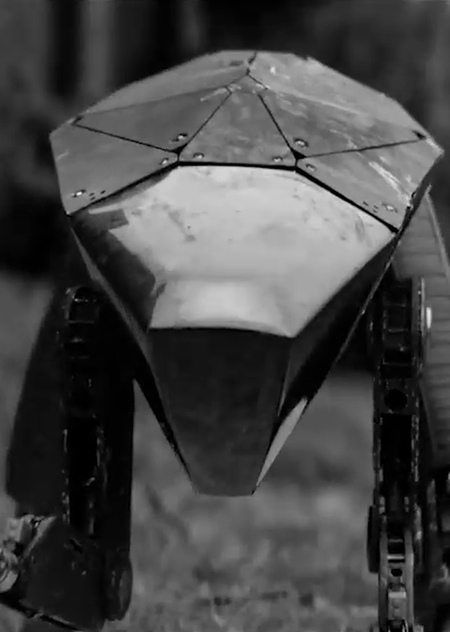
In the bottom frame, light highlights the edges of the metal casing. Its surface offers no typical facial cues from which to judge emotions. Therefore, the machine’s behavior must be read through its posture, movement, and action.
The comparison reveals a difference in how the characters are accessed: the heroine’s face provides emotional cues, whereas the depiction of the robot demands an observation of its conduct.
David Slade. «Metallist, ” Black Mirror series. 2017. Sequence of frames from a single shot: 13:44.60; 13:44.80; 13:45.00; 13:45.20 in the version used. Reading order is left to right, top to bottom. The layout was created by the author of the study.
In four frames, the position of the hinged joints changes: they bend, extend forward, and straighten. The rigid body maintains its recognizable elongated silhouette. The side view allows one to discern the mechanism of the limbs and compare their positions across successive phases of motion.
This plasticity allows for a comparison with the running gait of a quadruped animal. At the same time, the exposed joints and metallic surfaces constantly remind the viewer of the predator’s mechanical construction. The image bridges a familiar pattern of motion with an unfamiliar bodily structure.
This sequence demonstrates how the robot moves. The speed and rhythm of its run should be assessed while watching the clip itself; the static layout only captures selected phases.
David Slade. «Metalhead, ” Black Mirror series. 2017. Stills from the tree-climbing scene: 17:58 from above, 18:03 from below in the version used. The comparison was compiled by the study’s author.
In the top frame, the heroine’s face is close to the camera: squinted eyebrows, an slightly parted mouth, and exposed teeth are visible. Within the context of the ascent, these features allow the expression to be read as physical strain.
The lower frame shows the body interacting with the support. The heroine presses against the trunk and wraps her arm around it; the rough bark occupies a significant portion of the image. The contact with the surface becomes an important part of the action.
In the sequence featuring the robot’s run, the focus was on the movement of the joints. Here, the exertion is revealed through the combination of facial expression, posture, and touch. This distinction makes human vulnerability accessible to the viewer, whereas the machine’s condition must be assessed solely through its actions.
Visible and Hidden
For tension to be effective, not only the presence of danger matters, but also the order in which the viewer receives information about it. We will examine how the episode directs anticipation through the heroine’s gaze, the space outside the frame, and the appearance of the pursuer.
We can distinguish three scenarios: the viewer sees the threat alongside the heroine, notices it before she does, or observes her reaction without yet seeing the cause. To establish these relationships, it is necessary to consider the sequence of shots. Therefore, the basis of this section will be the shot sequences with timecodes—these will allow us to trace what is shown first and how the subsequent shot alters the understanding of the previous one.
David Slade. «Metallist,» Black Mirror series. 2017. Selected scene frames: 06:34; 06:36; 06:38; 06:40 in the version used. Reading order—left to right, top to bottom. The layout was created by the researcher.
In the selected sequence, attention is initially focused on the movement of the box. The man’s raised arms and the heroine’s gaze direct the viewer toward the top of the shelving unit. Next, a close-up of the man’s face highlights a wary side glance, and the following shot introduces the robot.
The object of concern shifts from an item to a source of danger. Boxes and crossbars restrict the view, so the revelation of the threat is tied to how the characters examine the space between obstacles.
The close-up of the reaction raises questions about the source of the alertness, while the image of the machine offers an answer. The sequence order connects the human gaze with the new point of focus. In doing so, the composition captures the key moments of the scene, and the precise duration of the tension must be judged based on the clip itself.
David Slade. «Metalhead,» Black Mirror series. 2017. Selected frames from the gate scene: 29:20; 29:22; 29:24; 29:26 in the version used. Reading order is left to right, top to bottom. The layout was created by the research author.
In the first and final shots, the robot is shown externally. The space between them is represented by numerous bright points against a black background. The surfaces retain their outlines and depth, but their usual photographic texture disappears.
This environment of point-based imagery frames the machine’s perception. The viewer is temporarily given access to the pursuer’s method of spatial examination.
The distribution of information also changes: we observe the robot’s actions while the protagonist is out of frame. This allows us to track the approach of the threat regardless of her awareness. However, the visualization does not explain the sensors' mechanics, nor does it independently prove that the machine can see through obstacles.