The Image of Motherhood: From Paleolithic Sculpture to Medieval Iconography
Relevance and Justification of Topic Selection The image of a woman with a child belongs to the group of the most enduring subjects in the history of fine art. However, its prevalence does not mean that throughout history it retained the same meaning. In different cultures, the female figure could represent fertility, the divine lineage of a ruler, protection, procreation, or religious intercession. Not only the functions of the image changed, but also the methods of artistic realization: the proportions of the human body, the nature of the figures’ interaction, the compositional structure, and the materials and scale of the works.
For this study, the period from the Upper Paleolithic to the Late Middle Ages was selected. Its boundaries allow for the examination of several fundamentally different systems for depicting the female figure and the relationship between mother and child. The main areas of focus include Paleolithic small sculpture, ancient Egyptian religious sculpture, Byzantine iconography, and Western European medieval sculpture and painting.
Of particular interest is the distinction between depicting the female body as an autonomous subject and depicting the woman through her relationship with her child. In Paleolithic sculpture, the female figure is often presented without a specific narrative context. In ancient Egyptian art, the interaction between mother and child acquires religious and political significance. In the Christian tradition, this becomes part of the depiction of the Theotokos and Christ, where human intimacy combines with theological content.
This research is not dedicated to the history of a single, unchanging symbol, but rather to the evolution of the ways motherhood is visually represented depending on cultural, religious, and social conditions.
Key Research Question
How did the artistic means of depicting motherhood evolve from the Upper Paleolithic to the Late Middle Ages, and how did composition, posture, scale, gestures, and the interaction between figures reflect the different epochs' perceptions of woman, child, and their relationship?
Hypothesis
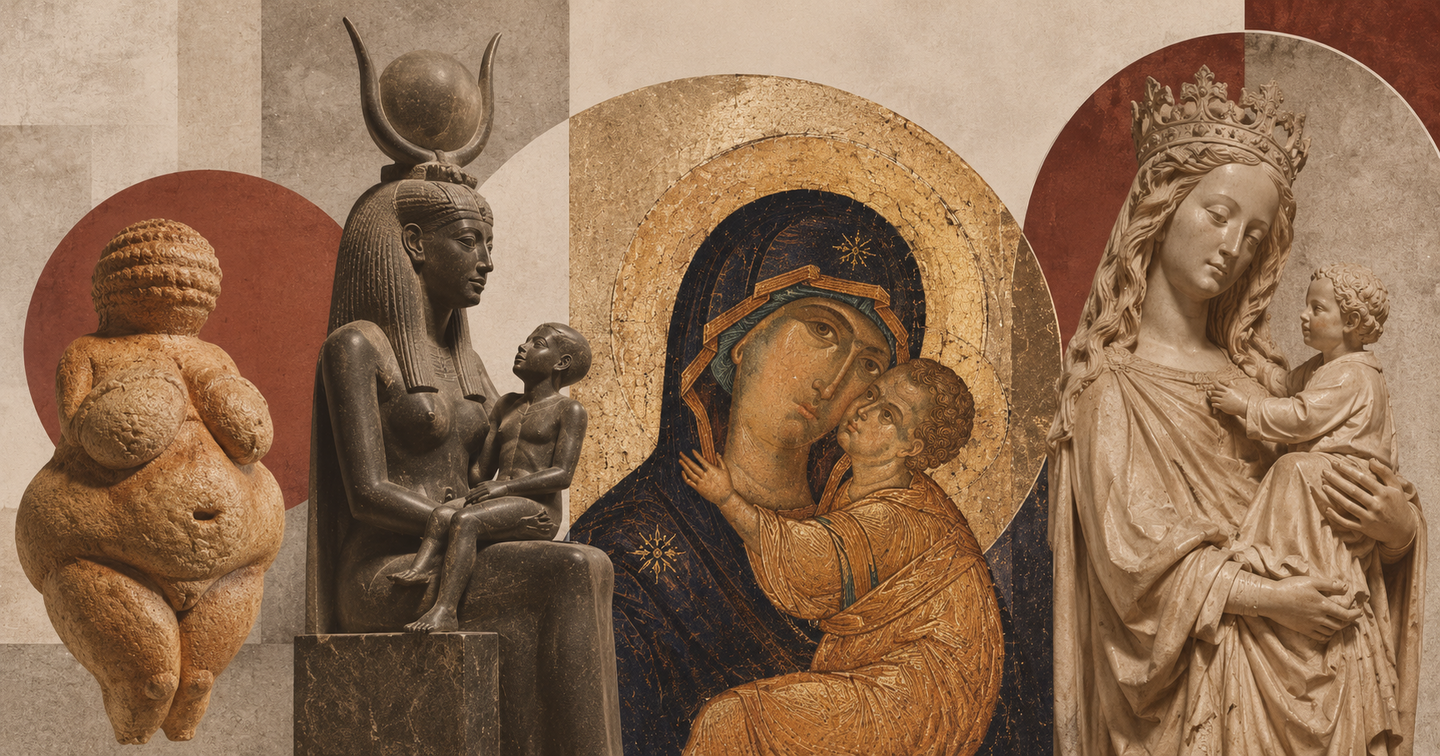
It is suggested that during the period under review, the ways of visually representing motherhood gradually expanded: moving from a generalized depiction of the female body—whose meaning remains subject to debate—to a specific image of mother and child integrated into the religious and social system of ideas. However, this change should not be understood as a linear progression from abstract form to realism. On the contrary, in different periods, conventionality, frontality, and emphasized schematization could have been deliberate tools for conveying specific content. For example, the Egyptian statuette of Isis with the infant Horus and the Byzantine icon of the Mother of God with the Christ Child both employ stable compositional schemes, yet they serve different artistic and semantic purposes.
Structuring Principle
The research is structured chronologically and divided into four main sections.
The first section is dedicated to the Upper Paleolithic era. It examines female figurines, their proportions, degree of abstraction, and material processing techniques. A separate analysis addresses the interpretive challenge of these objects—specifically, how strongly one can tie them exclusively to fertility or motherhood.
The second section focuses on Ancient Egypt. The primary example is the iconography of Isis nursing the infant Horus. It explores the poses of the figures, the goddess’s attributes, the characteristics of the Egyptian canon, and the significance of the maternal image within religious and royal ideology.
The third section covers Byzantine art. This section analyzes the main types of depictions of the Virgin Mary with the Child, notably the Hodegetria and Eleousa types. Special attention is paid to the positioning of hands, the direction of gazes, gestures, and the compositional differences between these types.
The fourth section is dedicated to Western European Medieval art. It reviews the evolution in the portrayal of the mother-child relationship, the development of sculptural representations of the Virgin Mary, the use of ivory, wood, and painting, and the increasing adoption of more intimate forms of figure interaction.
Analysis Method
Each artwork is analyzed based on several parameters: composition, proportion, figure placement, gesture, the nature of the interaction between characters, material, execution technique, and intended function. This approach prevents a purely descriptive listing of artworks. Comparisons are made not only based on similar subjects but also on differences in their visual execution. For instance, Isis breastfeeding and the Madonna and Child can be connected by the motif of maternal care, yet their artistic content is defined by different religious systems.
Working with Textual Sources
The factual portion is based on catalogs of museum collections, scholarly publications on archaeology and art history, as well as research into Byzantine iconography. Museum descriptions are used to verify dates, materials, dimensions, and attributions. Scholarly articles are incorporated to examine debatable issues, most notably the interpretation of Paleolithic female figurines. During the analysis, the museum’s interpretation is not assumed to be the only possible one. If the meaning of an object remains undetermined, this is explicitly noted. Visual observations are separated from historical assumptions.
Section I. Upper Paleolithic: The Female Figure in Upper Paleolithic Art. A female figure without a specific narrative.
The main objective of this section is to demonstrate that Paleolithic depictions of women cannot be automatically interpreted as images of mothers. It is important to examine which body parts are emphasized, which are omitted, how the material was utilized, and why the intended function of these artifacts remains a subject of debate.
Historical Context
The Upper Paleolithic covers a long period of human community development during which diverse forms of portable visual art emerged. Archaeological finds from this era include images of animals, anthropomorphic figurines, engravings, and reliefs.
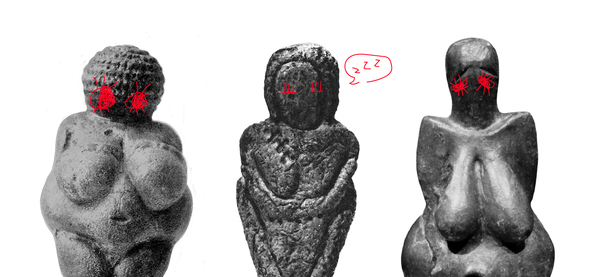
Female figurines constitute a particularly unique group of objects. They vary in material, size, and degree of detail. Some exhibit emphasized features of female anatomy, while others feature a more conventional body depiction.
A common characteristic of many of these items is their small size, allowing them to be considered portable objects. However, the precise function of most of the figurines remains unknown.
Unknown Master. Venus of Willendorf. Approximately 29,500 years ago. Oolitic limestone, originally covered with red ochre. Approximately 11 cm in height. Natural History Museum, Vienna.
The figure is a small sculpture featuring emphasized volumes in the chest, abdomen, and hips. The arms rest across the chest, and the head is tilted forward. The face lacks individualized features; instead, the head area is covered in a rhythmic ornamentation that can be interpreted as hair or a head covering.
The body proportions intentionally deviate from reality.
The main focus is on the torso’s volume, while the limbs and face are rendered with significantly less detail.
This distribution of detail suggests that anatomical characteristics held special significance for the creator. However, it is impossible to determine the object’s specific function based on its form alone.
Unknown Master. Venus of Willendorf. Circa 29,500 years ago. View from the back.
The reverse side of the figurine shows that the surface treatment extends across the entire body, rather than being limited to the frontal section. A repeating geometric pattern is clearly visible on the head. The regularity of this pattern distinguishes the treatment of this area from the more generalized modeling of the torso. The absence of individualized facial features is an important characteristic of the composition. The artist did not aim to convey a specific appearance or emotional state for the depicted woman. Instead, the focus is on the generalized form of the head and body. This decision sets the figurine apart from later works, where facial expression becomes an important means of characterization.
Female figure from Hole-Fells
Unknown master. Female figurine from the Hohle Fels Cave. Circa 40,000 years ago. Mammoth ivory. Approximately 6 cm in height. Museum of Prehistoric Art, Blaubeuren.
The Hohle Fels figurine is one of the earliest known three-dimensional representations of a human. It differs from the Willendorf Venus not only in dating but also in construction.
Instead of a head, it has a small perforation that may have been used to suspend an object.
The emphasized anatomical features, combined with its small size and portability, allow us to view the figurine not merely as a sculptural image but also as an object associated with individual use. Its precise function, however, remains undetermined.
A Lady from Brassempui
Unknown Master. Lady from Brassempuis. Circa 28,000 BCE. Mammoth tusk. National Archaeological Museum, France. Inventory number MAN 47019.
Unlike the pieces previously examined, only the head remains here. The facial form has been developed with greater detail: the forehead, nose, chin, and eye area have been indicated. The surface is covered with a regular grid of incisions, which forms a semblance of a headdress.
This object is significant for research because it shows a different direction of development in Paleolithic plasticity. The artist focused not on the anatomical volumes of the body, but on conveying the human face. Consequently, the female image in the art of this period was not limited to a single, fixed mode of representation.
Venus from Dolny-Vestonitsa