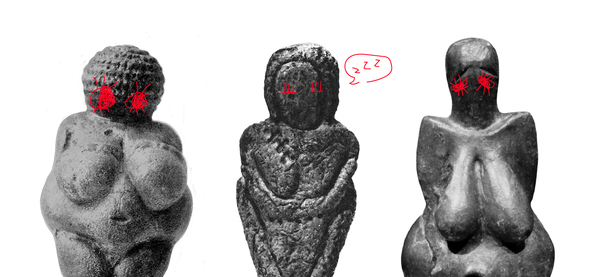
Concept
It is inherent to humans not only to interact with the world around them but also to shape it—to give objects a certain form, select colors, and create patterns and images. Even when primary efforts were directed toward survival, people engaged in actions that cannot always be explained by practical necessity. Why does the appearance of an object become as significant as its function? Where does the need to adorn oneself and one’s surroundings originate?
This study examines the nature and origins of the aesthetic need. The Paleolithic era was chosen to address this question—a period where early evidence of visual choice can be found. Archaeological findings indicate that alongside the creation of necessary objects, humans utilized color, crafted ornaments, and applied symbols and imagery to surfaces. These activities allow us to examine the aesthetic aspect of human endeavor long before the formation of the modern concept of art.
The work analyzes Paleolithic stone tools—their form and symmetry; the use of mineral pigments and shell adornments in the Middle Paleolithic; engravings, geometric motifs, and handprints; and late Paleolithic figurines and rock art. Examples illustrate various modes of visual transformation—from shaping utilitarian objects to creating imagery unrelated to their practical use. The material is organized chronologically to trace the diversity of these manifestations. However, this sequence is not viewed as a linear progression: individual practices may have arisen independently and coexisted across different regions.
Particular attention is paid to the reasons that may have influenced the visual choices.
The symmetry of the artifacts, the preference for certain colors, the use of ornamentation, and the repetition of graphic motifs are analyzed considering their practical, social, and symbolic functions. The external expressiveness of an object itself does not prove that it was created purely for beauty. Therefore, analyzing each find requires taking into account its archaeological context, material, method of manufacture, and presumed purpose.
By comparing the findings, we can determine when a person developed an interest in the appearance of objects: did it evolve gradually alongside cultural development, or did it exist during the early stages of human history?
Paleolithic findings do not provide a definitive answer or allow us to establish the motivations of their creators. However, they demonstrate that the selection of form, color, and ornamentation was a presence in human life even in prehistoric eras. This study examines beauty not as a later addition to practical activity, but as a possible need that could manifest concurrently with it—a desire to order, transform, and imbue surrounding objects and space with meaning. To trace the origins of aesthetic choice, one must return to the very beginning of human civilization.
Form and Symmetry
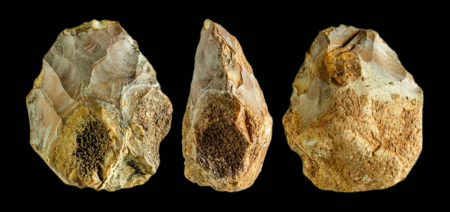
The earliest stone tools, dating to the Oldowan culture and approximately 2.5 million years ago, featured asymmetrical edges. Their creation involved striking flakes off large fragments from an initial core or blank. Often, this was a simple splitting in half without further refinement.
The oldest stone tools on Earth were found in Africa, in the Kada-Gona river basin. Their age is 2.6–2.5 million years. The key difference in these finds is their crude, random form and the lack of intentional standardization.
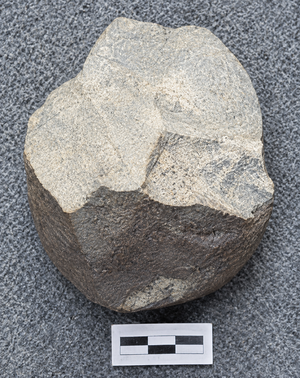

Stone tools dating back 2.6 million years, found in Kada Gona
Choppers (stone tools with one-sided edge retouch), dating to 1.7 million years ago, Ethiopia
Approximately 1.4 million years ago, a significant shift occurred: Acheulean bifacial tools, commonly referred to as hand axes, appeared.
Two contrasting views of Oldowan (top) and Acheulean (bottom) stone tools from DAN5 in Gona. Photo: Dr. Michael J. Rogers, University of Connecticut
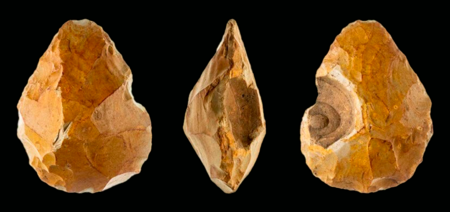
Unlike Olduai artifacts, early Acheulean hand-axes possess a deliberately defined overall shape and bilateral symmetry. In addition to their meticulously considered forms, many of these hand-axes were crafted from visually striking materials, such as stones with a smooth, polished surface.
Bifaces carved between 700,000 and 200,000 BCE, Enas, France
Thus, these Acheulean hand axes may represent some of the earliest material evidence of humans developing aesthetic preferences. This suggests that early hominids were paying attention not only to what the artifacts did, but also to how they looked.
Biface from West Tofts, Norfolk, England
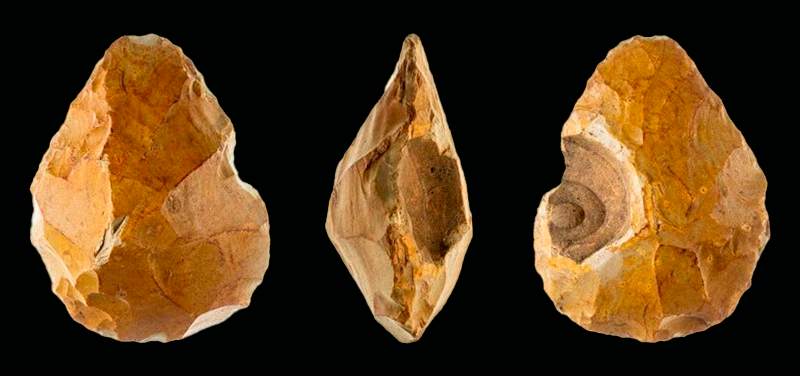
The find gained notoriety due to the theory that the manufacturer intentionally treated the stone around the sink, preserving and visually highlighting it on the surface. This interpretation was long considered possible evidence of an early aesthetic choice.
Biface from Swonskomb with sea urchin fossil
Kenneth Oakley believed the carving was intentionally treated to leave a scallop or a sea urchin fossil at the center.
Biface from Sima de los Wecos — «Excalibur»
This quartzite, featuring reddish veins, was named after King Arthur’s legendary sword—Excalibur. Researchers hypothesized that its unusual color, along with its possible intentional placement near the remains of 30 Neanderthal hominids, may have held symbolic significance.