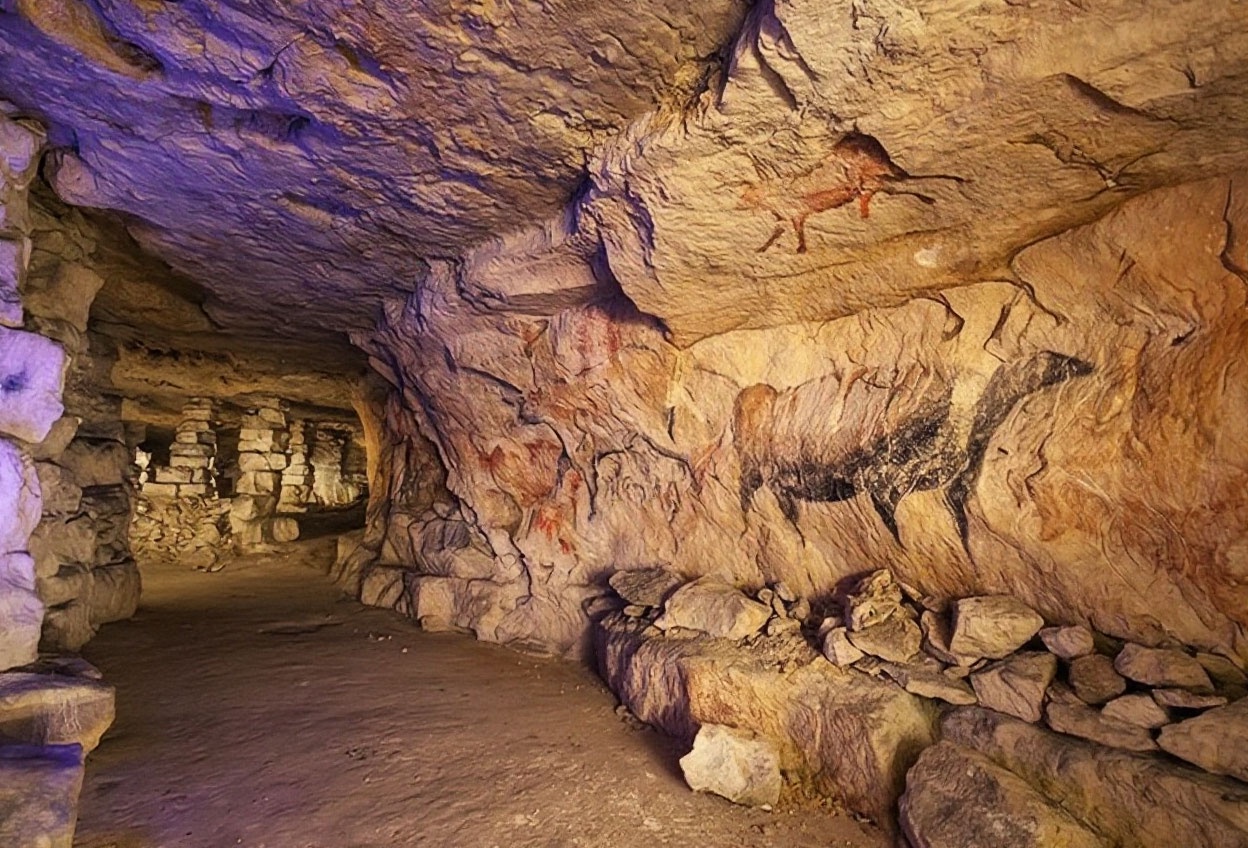
The unique rock paintings of the Chauvet and Lascaux caves, which are known as the «first art of humankind, ” represent not merely the most ancient monuments of primitive culture, but a monumental testament to the profound connection between early humans and the surrounding world.
The paintings in the Chauvet and Lascaux caves—"the first art of humanity"—demonstrate an extraordinary connection to nature and remarkable artistic boldness. In these rock art figures, humanity’s first attempts to depict its environment and world emerge: powerful bison silhouettes, swift outlines of horses, and enigmatic abstract symbols weave together into a unified visual chronicle of an age when art was just beginning to take shape. These ancient masters, working within the caves, succeeded in conveying not just the appearance of the animals, but their anatomy, their movement, their very essence—and this is what gives their creations their unique value: across millennia, they continue to speak to us in the universal language of imagery. By utilizing the natural contours of the walls—the protrusions and cracks in the rock—the prehistoric artists created astonishing optical illusions and three-dimensional effects, causing the images to seem to literally «come alive» with the movement of the flame. It is this capacity to capture life itself that holds the deep historical and spiritual value of their creations.
The creations of masters became humanity’s first universal chronicle, and even today, through millennia, they continue to impress with their spiritual and historical depth.
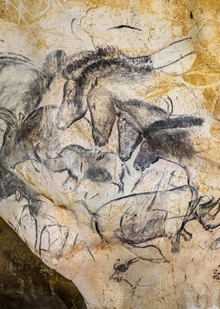
Chauvet Cave
The choice of the theme «The Cave Paintings of Chauvet and Lascaux—the first art of humanity» is due to its fundamental significance for art history. The cave paintings of Chauvet (approximately 36,000 years ago) and Lascaux (approximately 17,000–15,000 years ago) represent some of the oldest and most expressive monuments of human visual activity. Studying them allows us to trace the origins of artistic thought, the formation of the perception of the surrounding world, and the first visual images. The dynamic figures of animals, the use of the natural relief of the walls to create volume, and the various techniques demonstrate that the first ancient artists deeply analyzed early visual forms.
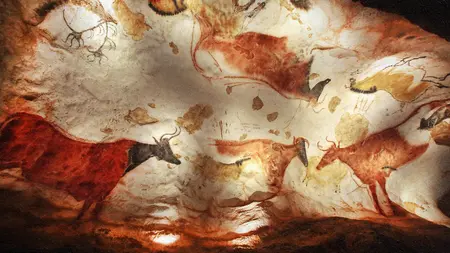
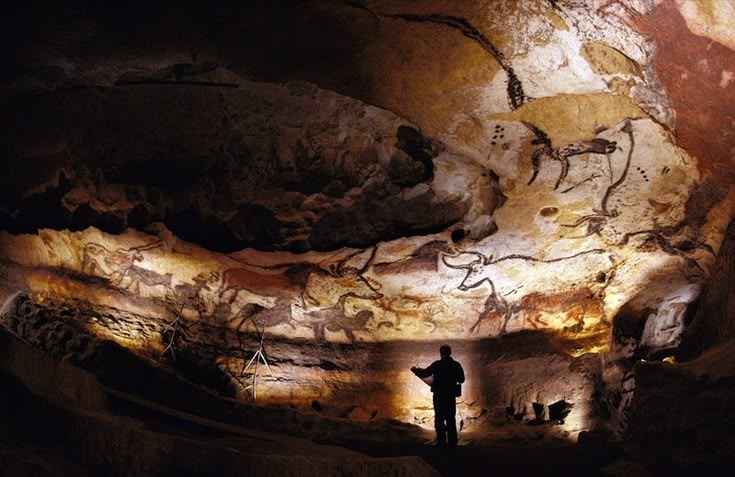
Lasko IV
The central research question is: how do the earliest artistic strategies of humans (composition, depiction of motion, selection of themes) manifest in the cave paintings of Chauvet and Lascaux, and what does this reveal about the emergence of a visual language?
Tours, horses, and reindeer depicted in the cave
The research hypothesis posits that intentional artistic techniques are already visible in the cave paintings of Chauvet and Lascaux: the artists employed various methods—figure construction, rhythm, and animal anatomy—and found expressive poses to convey animal movement. This allows us to regard Paleolithic paintings not as spontaneous sketches, but as the first attempts to establish a visual language through which ancient humans expressed their emotions and demonstrated the shaping of their worldview.
The animals were not depicted schematically, but with a clear understanding of proportion, volume, and scale relationships, indicating careful planning of the drawing on the uneven rock surface. The repetition of elements, alternation of contours, overlapping silhouettes, and grouping of figures created a complex visual composition that organized the viewer’s perception and guided their attention. Paleolithic artists demonstrated an astonishing knowledge of wild animal anatomy—from the characteristic curve of a bison’s neck to the joints and muscle contours of running horses—which suggests prolonged observation of nature.
Cow (or bull) and horse. «Axial Passage»
Categories
1. Concept
2. Main Part:
Chapter 1. Techniques: outline, silhouette, blending, engraving, use of stone relief
Chapter 2. Light and Composition: the interplay of torch lighting and vault unevenness
Chapter 3. The Style of Two Caves: the dynamic Chauvet and the monumental Lascaux
3. Conclusion
4. Bibliography
1. Techniques: outline, silhouette, shading, engraving, use of stone relief
The Big Lebowski
The Shawshank Redemption
The oldest technique is the line. In the show, masters often limited themselves to a clear outline: the silhouette of a horse, rhinoceros, or lion was traced with charcoal or ochre, and this was enough for the animal to «appear» on the stone. The contour here is primarily a confident line. Artists were skilled at drawing from memory—precise proportions, clear movements—even when live models were not in front of them.
Horse from the Lasco Cave. Replica in the Anthropoid Museum in Brno
«Panel of Horses, ” a fragment featuring a horse and a tour.
From the contour, the work transitions to the silhouette—a filled form. In the Lasco caves, enormous bulls and deer are rendered using dense patches of red, black, and yellow pigments: mineral dyes (ochre, charcoal, hematite) were ground up, mixed with fat or water, and applied using smeared clumps of wool and moss or blown through hollow bones—this technique created soft transitions. The silhouette allowed the artist to convey the animal’s mass, weight, and power.
Lascaux IV, Montignac, Dordogne, France. Photographs taken in the section called the «atelier» (or «workshop»).
Fragment of a bison cave painting
To prevent the figure from looking flat, masters used blending: they rubbed the paint onto the stone with their fingers, moss, or a piece of leather, creating smooth transitions from dark to light. This is how volume and depth were achieved: in Shove’s horses, the flanks and belly are lightened, while in Lasco’s bison, the shoulders are thickened with shadow. Blending—it is humanity’s first discovery of chiaroscuro.
Shouse Rhino
La Coche 4, Montignac, Dordogne, France
Not all images in the caves are paintings. Alongside them, there is engraving: lines pressed or scratched into the soft surface with a chert tool or simply a finger. In Lascaux, there are thousands of engraved signs—grids, dots, and also entire engraved figures: deer, horses, and even portrait heads. Engraving could exist on its own or serve as a foundation: the artist would scratch out an outline sketch, and then paint over it—this allowed the drawing to adhere well to the uneven stone.
«Copy of the prehistoric painting from the Lascaux Cave, Museum of Aquitaine, Bordeaux, France»
The decorated cave of Pont-d’Arc, known as the Chauvet-Pont-d’Arc Grotto, Ardèche
The most astonishing technique is the use of carved stone relief. The primitive artist was not afraid of the uneven cave surface; instead, they utilized it to their advantage: a protrusion in the wall became the chest or haunch of an animal, a crack became a horn, and a natural hollow became an eye. The figure seems to «grow out of» the stone, and the falling light intensifies its texture. In Shove, some bas-relief depictions of horse manes are emphasized precisely along the breed’s natural features.