Concept
In this study, I aim to explore how the human face was depicted in Old Russian icon painting from the 11th–13th centuries and how the methods artists used to convey its form and individual features evolved over time. My interest lies not in portrait likeness, but in the face as a component of the iconographic image. The shape of the visage, proportions, the placement of the eyes, nose, and lips, the direction of the gaze, and light—all these elements helped the master create the intended impression of the holy figure.
I chose this topic because while the face occupies a relatively small area on the icon, it is precisely where the artistic language of the era is most apparent. Comparing faces from different periods reveals which techniques persisted, which faded, and how the Byzantine tradition acquired new variations within Rus'. I do not intend to present this as a linear path from convention to realism. The icon was subordinate to religious meaning and specific rules, meaning various styles could exist simultaneously.
The primary selection consists of panel icons that were created or were present in Rus' during the chosen time period. When selecting these monuments, I considered the dating, attribution, origin, preservation, and the quality of the available images. It was important to me that the face could be examined in detail.
The Core Principle of Comparison
The research is structured chronologically, but it does not amount to a sequential cataloging of artifacts. First, I will examine Byzantine works as a comparative foundation, and then turn to Old Russian icons from the 11th through the first third of the 12th century, as well as artifacts from the second half of the 12th and 13th centuries. In a separate chapter, I will compare works with similar iconography to test my observations. I select textual sources based on their scholarly nature and relevance to a specific artifact—I utilize museum catalogs and studies by art historians and restorers. While I attempt to verify dates, origins, and the history of restorations across multiple publications, I prioritize academic research and museum catalogs.I aim to compare works with closely related iconography. This makes it easier to distinguish stylistic changes from variations that arise due to the character’s role or the narrative. I also include icons featuring different characters, but only as supplementary examples of how a face might be depicted.Visually, I will analyze several features: the overall shape and elongation of the face, the proportion of its parts, the size and placement of the eyes, the direction of the gaze, the shape of the nose and lips, the clarity of the contours, the combination of line and color, and the techniques used to convey light and shadow. Furthermore, I consider the head’s orientation and the facial expression in relation to the pose and the meaning of the image.
Key Question and Working Hypothesis
How did facial proportions and the methods of depicting individual features change in Old Russian icon painting of the 11th–13th centuries?I hypothesize that during the 11th–13th centuries, Old Russian icon painting maintained ties to the Byzantine tradition, yet the rendering of the face became more diverse. Alongside elongated, refined visages, larger, more monumental, and graphic forms began to appear. The expressiveness of the gaze, as well as the ratio between contour and chiaroscuro, shifted. Furthermore, this was not solely a matter of chronology; it was influenced by the artistic milieu, the iconographic type, and the specific objectives of each work.
Chapter 1. Byzantine Tradition: Foundations and Methods of Facial Representation
Ancient Russian painting developed under the strong influence of Byzantium. Along with Christianity, new subject matter and principles for depicting saints arrived in Rus'. These principles dictated how compositions were constructed and how the proportions of the body and facial features were rendered.Byzantine icon painters did not attempt to reproduce human appearance accurately. The face was part of a specific language through which a spiritual image was conveyed. Nevertheless, the masters employed diverse methods of modeling, proportioning, and stylization. Therefore, I do not consider the Byzantine tradition to be a single, immutable schema—solutions evolved over the centuries.
How Facial Proportions Are Constructed: The Example of Christ
Christ Pantocrator, St. Catherine’s Monastery (Sinai), 6th Century
Unknown Iconographer. Christ Pantocrator. 6th Century.
The face here is quite broad and round, and its features are not strictly symmetrical. The difference between the eyes is particularly striking: they vary in size, pupil placement, and expression. The nose is long, and there is also a slight asymmetry in the lips and eyebrows. However, the face does not appear flat or schematic. The artist has meticulously worked out the volume of the cheeks, forehead, nose, and the areas around the eyes. The study, «The Face of Christ in a Sixth-Century Icon from Sinai» [1], analyzes in detail how light and shadow create volume—features are composed of light and dark brushstrokes, not just contour lines.
Christ Pantocrator, Daphni Monastery, late 11th century
Unknown mosaicist. Christ Pantocrator. Late 11th century (c. 1080–1100).
In Dafne’s mosaic, the face of Christ is more elongated. Gabriel Millet notes in his research that the master chose an elongated facial type that became popular in the late 11th–12th centuries [2]. The expressiveness here is built upon a high forehead, strongly defined eyebrows, prominent cheekbones, a large nose, and a wide mouth. Because of this, the depiction appears more severe and mature.
Christ Pantocrator, St. Sophia in Kyiv, 11th Century
Unknown Master. Christ Pantocrator. 11th Century.
The Kyiv icon is also monumental. Christ is depicted in the temple’s dome, so his face and figure were meant to be seen from a distance and from below. V. D. Sarabyanov notes that the Pantocrator in the Sophia of Kyiv icon combines the traits of a stern Judge and a merciful God [3]. In my observation, the facial features are delineated quite distinctly. Compared to the Sinai icon, the sense of generalization and monumentality is stronger here. However, one must remember that the scale and placement of the mosaic influence the perception of proportions.
Where is the modeling volumetric, and where is it linear?
What should be considered the Byzantine norm for further comparison?
I wouldn’t strictly divide the icons into two groups. In Byzantine painting, both methods are usually combined: lines define the features, while color and chiaroscuro convey volume.
The Sinai Christ is predominantly volumetric and painterly. Volume is created through light and shadow, and features are sculpted with brushstrokes.
The Christ from Daphne combines both volumetric and linear approaches. Chiaroscuro highlights the cheekbones and other protruding parts, while contours emphasize the features.
The Christ from Hagia Sophia in Kyiv offers a more graphic and monumental interpretation. The features are clearly delineated, but the image cannot be considered entirely flat.
Based on these three examples, several general principles can be identified: a focus on the face, special attention to the eyes, elongated proportions, conventionalized depiction, the combination of line and volume, and the preservation of the character’s distinctive traits.
Chapter 2. XI—First Third of the XII Century: Early Old Russian Iconography and Byzantine Heritage
«Apostles Peter and Paul,» mid-11th century
Unknown Iconographer. Apostles Peter and Paul. Mid-11th Century.
This is one of the oldest surviving icons of Russian easel painting. It was created in the mid-11th century, and the upper part of the composition features a half-figure of Christ. For my work, this piece is significant because it allows me to examine the very beginning of easel iconography in Russia. The composition and artistic language are still closely connected to Byzantium here, which became the foundation for all subsequent local iconography.
Analysis
The original painting from the 11th century is not entirely preserved. Researchers note that the faces, hands, and feet of the apostles were altered later, although some believe that certain outlines of the heads may have survived [4]. Therefore, one cannot confidently determine the 11th-century techniques based on the current appearance of the faces.For me, this icon is primarily a historical starting point. It demonstrates that panel icon painting in Rus' emerged early and was connected to Byzantine models. Here, one can compare the overall composition, the positioning of the heads, the turn of the figures, and the surviving outlines and traces of later modifications. However, when comparing the faces, one must always remember that they look different now than they did in the original painting.
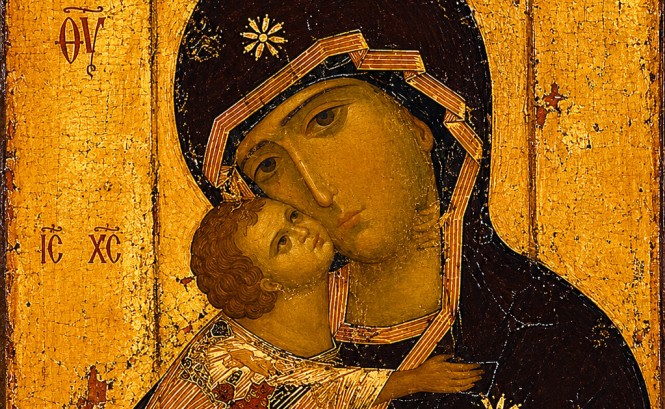
«Vladimirskaya Mother of God,» early 13th century
Unknown Byzantine master. The Vladimir Mother of God. Constantinople, early 13th century.
This is one of the most famous examples of Byzantine art that reached Rus'. The Vladimir Icon is considered the work of a Constantinople master and dates to the first third of the 12th century. According to chronicles, before being moved to Vladimir, it was located in Vyshgorod. In 1155, Prince Andrei Bogolyubsky transported it to Vladimir [5], where it became one of the main relics. Its modern name is directly related to this city.The icon depicts the Mother of God with the Infant Christ, and this type is known as the «Humiliation» (Umileniye): Christ presses his cheek against the Mother’s face and embraces her neck. Because of the closeness of the figures, the composition feels very intimate and emotional. Meanwhile, the Mother of God’s face is restrained and concentrated—it conveys not everyday tenderness, but a premonition of Christ’s future suffering.