Concept
In the Middle Ages, the cat occupied a special place in human life. It was a familiar domestic animal, helping to control rodents, and it lived alongside people in homes and monasteries.However, its portrayal in art was far more complex than a simple depiction of a pet. In medieval manuscripts, cats appeared in religious narratives, bestiaries, decorative elements, and marginal illustrations of books. In some cases, they were depicted as ordinary animals; in others, they became participants in comical scenes or acquired symbolic meanings related to cunning, sin, and demonic forces.Despite it being the same animal, its images could vary significantly. Artists approached the depiction of the cat in various ways. Sometimes they sought to convey the animal’s physical characteristics and behavior, paying attention to its anatomy and distinctive poses. In other instances, the cat took on human characteristics, participating in satirical scenes, playing musical instruments, or becoming part of a fantastical world. It is particularly fascinating to observe how this familiar animal transformed into a symbolic figure and became integrated into the religious and cultural landscape of the Middle Ages.
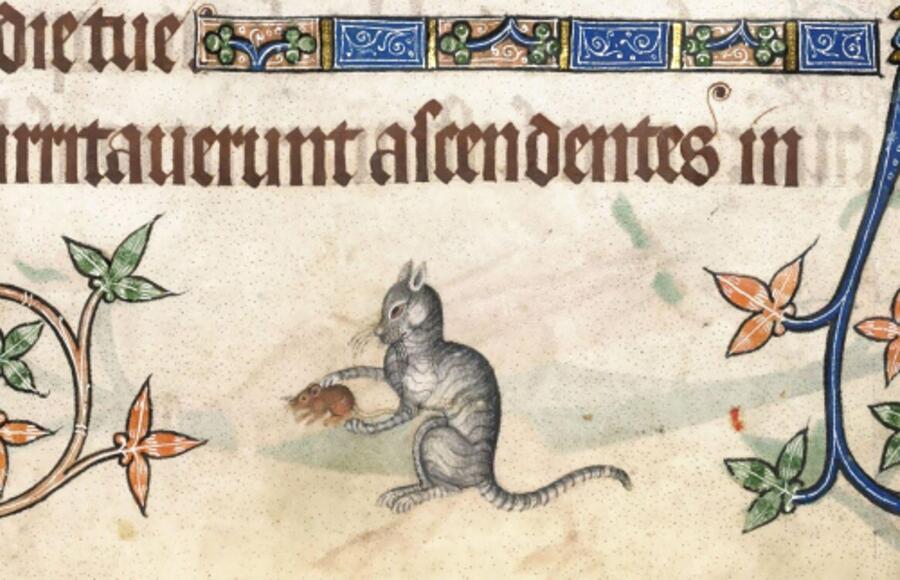
Unknown English illustrator. «Luttrell Psalter,» c. 1325–1340. England.
How did the visual portrayal of cats in European art change from the 8th to the 14th centuries depending on the artistic, domestic, and religious context?
I wanted to look at medieval depictions of cats to explore the features of how their visual image was formed and to trace what meanings were assigned to them in different periods. The chronological scope of this research covers the 8th–14th centuries, inclusive. The main focus is on European art, particularly medieval manuscripts, bestiaries, and religious books. These sources have preserved numerous interesting animal images, allowing for an examination not only of artistic characteristics but also of humanity’s relationship with the surrounding world.
The visual depiction of the cat in medieval art did not carry a single meaning; rather, it depended on the context of the image. Its formation was influenced by the artistic objectives and cultural perspectives of the era.
Miniature of the «Cat» from Thomas of Cantempere’s encyclopedia, On the Nature of Things (Ms. 320, fol. 72r), circa 1290, artist unknown.
The research is divided into several chapters that allow for the examination of the cat’s image from different perspectives. The first chapter studies its depiction in everyday life, including in domestic and monastic settings. The second chapter examines cats in manuscripts and marginalia, paying particular attention to humor, grotesquerie, and anthropomorphism. The third chapter is dedicated to religious symbolism and the representations of the cat as a carrier of negative connotations. The fourth chapter analyzes images of cats in medieval bestiaries, focusing on their anatomical features, poses, and artistic stylization.
When selecting visual materials, the primary criteria were historical accuracy, image preservation, relevance to the period under investigation, and the expressiveness of the artistic features.Sources include digitized medieval manuscripts from European library collections, scholarly articles, and research from historians and art critics. This approach allows us not only to gather a diverse collection of images but also to examine them within their historical and cultural context.
Chapter 1. The Cat in Medieval Everyday Life
In the Middle Ages, the cat was not only part of the domestic routine but could also become a companion, accompanying people during work, leisure, and daily activities. One of the cat’s main functions was protecting food stores from mice and rats. It lived in homes, barns, kitchens, and monastic quarters where provisions and other valuable materials were kept. Cats were particularly important in monasteries and scriptoriums because rodents could damage parchment, bindings, and manuscripts. Thus, the animal became part of not just the everyday, but also the intellectual sphere of the Middle Ages.
Unknown illustrator from the Liège–Maastricht region. Miniature depicting a nun spinning yarn and a cat playing with the spindle. «Maastricht Hours, ” first quarter of the 14th century, circa 1300–1325. Parchment, book miniature. British Library
However, the cat’s role was not limited to practical utility. Illustrations in manuscripts show that it could also be perceived as a domestic pet. For instance, in a miniature from the Maastricht Horarium, a cat plays with the nun’s spinning wheel, situated right beside her while she works. This scene allows us to see the animal not as a conventional symbol, but as a participant in daily life whose behavior was observed and translated into artistic representation.
Pietro Lorenzetti. «The Last Supper, ” c. 1315–1320. Fresco. Lower Church of the Basilica of San Francesco, Assisi, Italy.
Images of cats in domestic and everyday scenes, where they are not the central focus but freely situated near people, are also of interest. Their presence helps convey the atmosphere of a living space and emphasizes the animal’s natural integration into the human environment. In some manuscripts, cats are depicted with kittens, which allows the viewer to note the artists' observations of animal behavior.
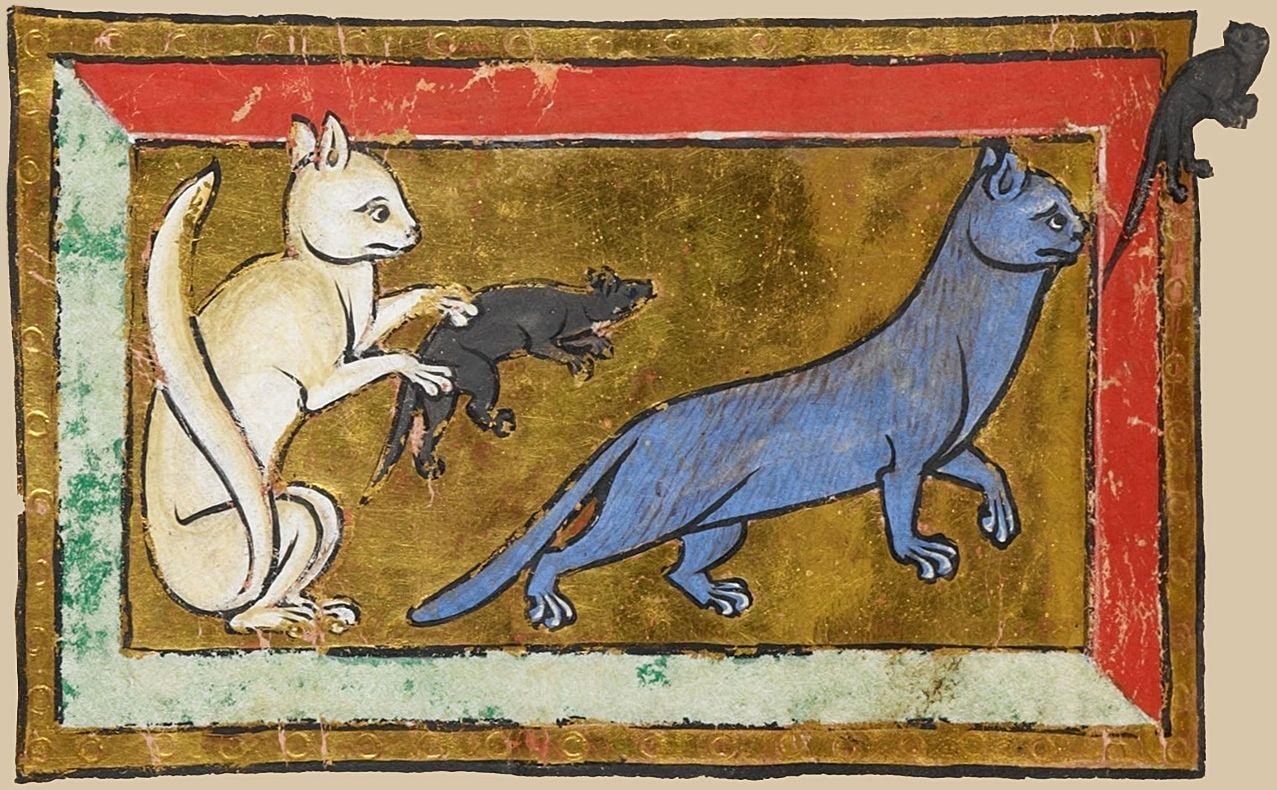
Unknown English illustrator. «Cats and a Mouse, ” circa 1250–1260. England. Pen and ink drawing with colored and translucent tonal washes. Getty Museum
However, attitudes toward cats in the Middle Ages were not uniform. On one hand, they were valued for their ability to catch rodents and could be attached to as pets. Mouse hunting was important for preserving food supplies and protecting farm buildings. On the other hand, in certain religious and cultural contexts, cats were associated with suspicious or negative concepts.
Unknown author. Manuscript with texts of Gregory the Great, 12th century, parchment, presumed cat paw prints on the leaf. British Library, London.
A particularly unique set of evidence regarding cats in medieval book culture consists not of drawn depictions of animals, but of the actual imprints of their paws, preserved directly on the pages of manuscripts. These traces are of special interest because they allow us to see the cat not as an artistic or symbolic figure created by an artist, but as a participant in the daily life of the monastery and the book environment.
Thus, image analysis allows us to trace how the animal became integrated into domestic space, monastic life, and the daily routines of people.
Chapter 2. Anthropomorphism and Comical Cat Figures in Medieval Art.
On the margins of prayer books, psalters, and other illuminated manuscripts, cats appeared in the most unusual situations—playing musical instruments, participating in battles, interacting with mice and other animals, and sometimes even adopting human activities and behavior. Such images often possessed a humorous or grotesque character and could be almost entirely unrelated to the main religious text of the manuscript.Marginalia occupy a special place in this context—that is, illustrations placed in the margins of pages, around the text, or at the bottom of the sheet. These elements expanded the visual space of the manuscript, allowing artists to explore fantastic, comic, and everyday themes.
Unknown illustrator. A cat playing the hurdy-gurdy. Chaucer, Southern England, circa 1320–1330, parchment, British Library
One of the most striking examples of anthropomorphic cat imagery is the miniature found in the margins of an English timepiece. This subject can be interpreted as an instance of the «inverted world» motif, characteristic of medieval marginalia. In such a system of images, animals adopt human occupations, disrupting the conventional hierarchy between humanity and nature. Music, craft, military affairs, and other forms of human activity become part of a fantastic animal world.
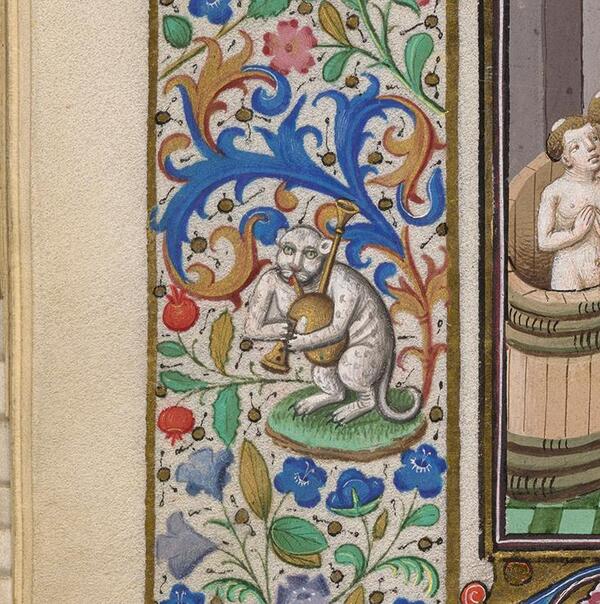
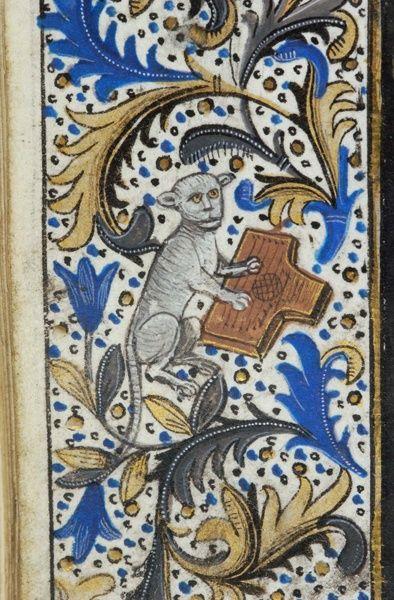
1. Unknown Illustrator. Hours Book, Southern England, circa 1320–1330, British Library. 2. Unknown Illustrator. Hours Book, Southern England, circa 1320–1330, British Library.
In addition to the image of a cat playing a harp, medieval manuscripts also feature other representations of the animal musician. For instance, in the English Animalier clock, the cat is depicted playing the bagpipes and psaltery. It is noteworthy that these musical scenes are unified in a complete series of illustrations in which animals perform on various instruments.
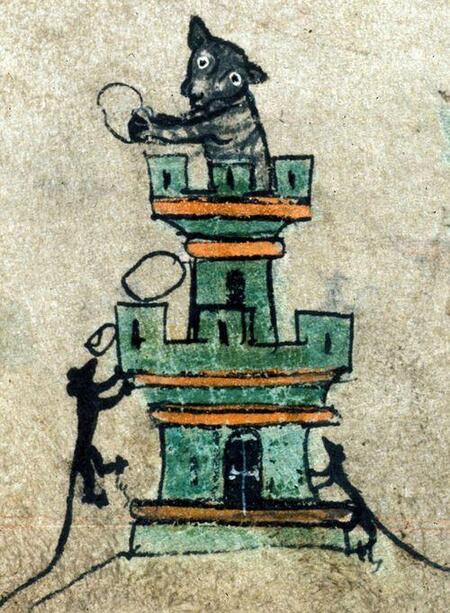
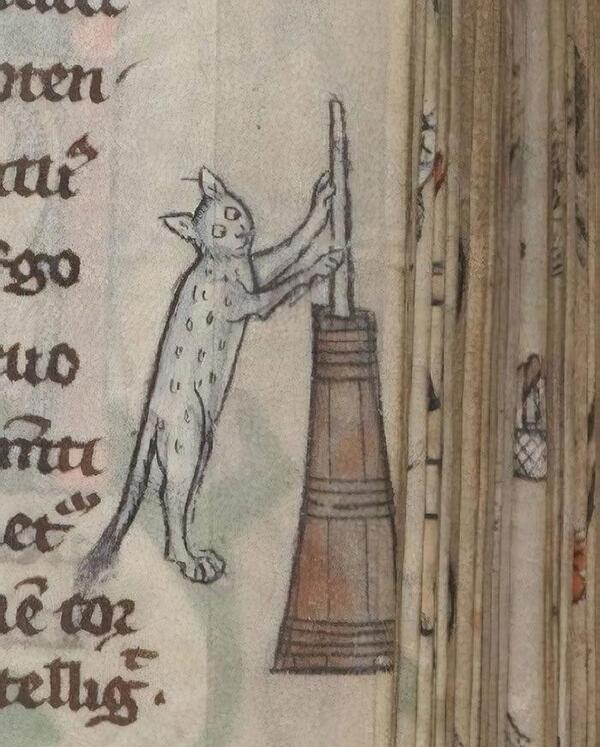
1. Unknown illustrator. Cat in a tower throwing stones at attacking mice. Hours of the Day, Southern England, c. 1320–1330, British Library. 2. Unknown illustrator. Cat batting at oil. «Rothschild Canticles, ” c. 1300, parchment, Beinecke Rare Book & Manuscript Library, Yale University.
The comedic quality of the image, «Cat in the Tower Throwing Stones at Attacking Mice,» is built on the inversion of expected relationships between animals. In real life, mice are typically prey to cats; however, in this marginal space, they transform into an organized adversary. The cat, in turn, behaves like a human defending a fortress against an enemy attack. Thus, the artist crafts a miniature parody of military events and human conflict.
An interesting example of anthropomorphism is presented in the manuscript «Rothschild Carolingians.» A cat is depicted in the margin of a leaf, churning butter. The animal performs an action typical of human domestic life, using objects and tools associated with cooking. The narrative is based on transplanting familiar household activities into the animal kingdom.
The comedic effect arises from the cat being placed in a role unusual for it. Instead of hunting mice or relaxing near a person, it is engaged in domestic labor. Such images demonstrate that medieval artists could endow animals not only with human-like physical traits or behavior but also with an entire set of social functions.