Categories
- Concept
- Costume by Country: France, England, Italy, Spain, German Lands, Russia
- Why the Costume Looks This Way
- What Came Before
- Conclusion
- Bibliography
- Image Sources
1. Concept
In the 18th century, men from Europe’s privileged classes wore the same set of garments: a kaftan, a камзол (short jacket), and short knee-length breeches (culottes). This pattern developed in France and spread from Madrid to St. Petersburg. At first glance, the nobleman in Goya’s portrait and the nobleman in Levitsky’s portrait appear to be dressed alike. The study is based on the inverse assumption: even with a shared general structure, the costume of each country retains its own characteristics. These are visible in the fabric, the trim, the silhouette, and the circumstances in which the garment was worn. The French costume was designed for the court, the English for the manor and equestrian pursuits, the Prussian was subservient to the military uniform, the Spanish existed in two versions—courtly and urban—the Venetian was enhanced with a mask, and the Russian was introduced by decree. The second objective is to explain the origin of the forms: why the kaftan has pleats on the sides, where the wig came from, and why silk gave way to wool by the end of the century. The third objective is to briefly show how this costume evolved in the 17th century. The material used includes portraits, genre paintings, caricatures, and preserved garments from museum collections. Painting was chosen because it illustrates not only the object itself but also the manner of wearing it: the posture, the gesture, the surroundings.
2. Costumes by Country
2.1. France
The French style served as the model for all of Europe. Its foundation was the «French costume»: a kaftan (robe), vest, and culottes. During the 1720s–1740s, the hems of the kaftan flared out due to deep side pleats, which were reinforced with stiff interfacing. The silhouette became broadened toward the bottom, echoing the women’s skirts worn with panniers.
Jean-François de Trueau. Reading Molière. 1728.
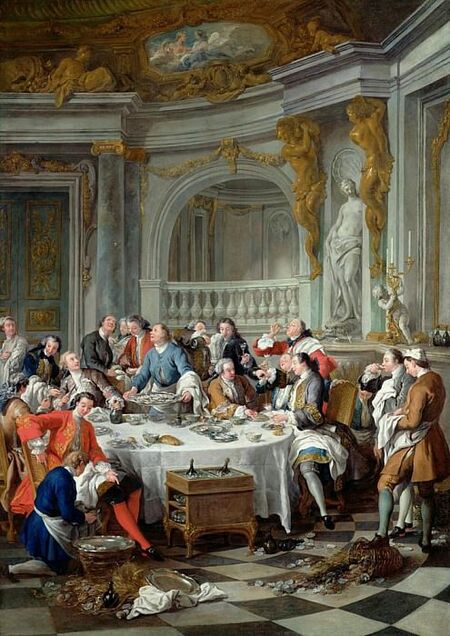
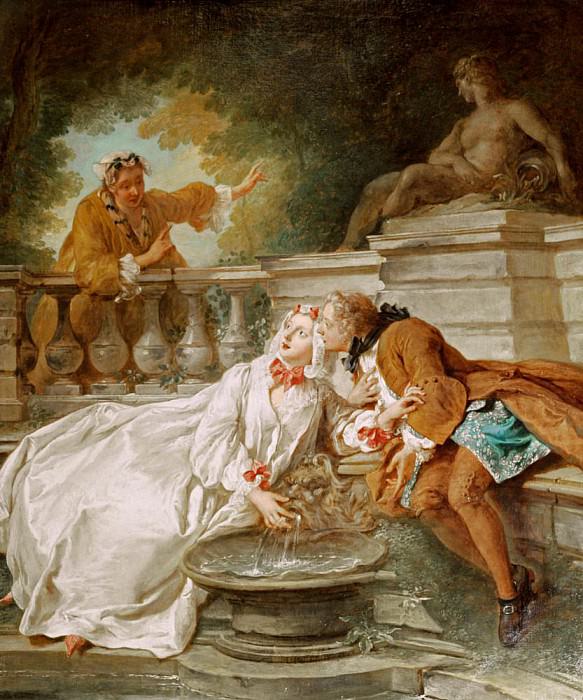
Jean-François de Troy. Oyster Lunch. 1735. Jean-François de Troy. Signal. 1723.
The defining characteristic of French costume was its material and embellishment. Caftans were sewn from silk and velvet, and the borders, pocket flaps, and facings were covered with embroidery. The pattern was stitched onto the fabric before cutting—the artisan would receive a bolt of cloth already marked with the contours of the pieces.
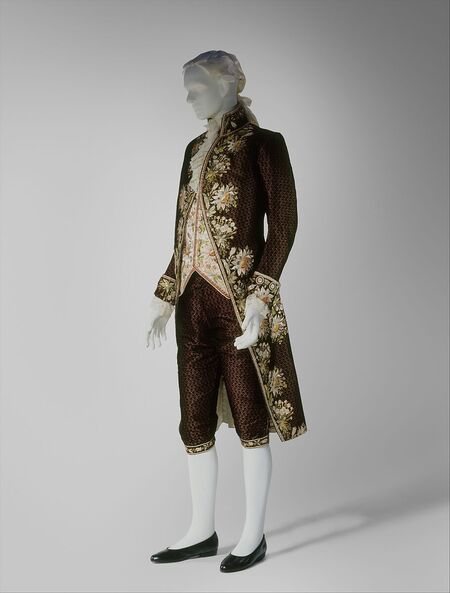
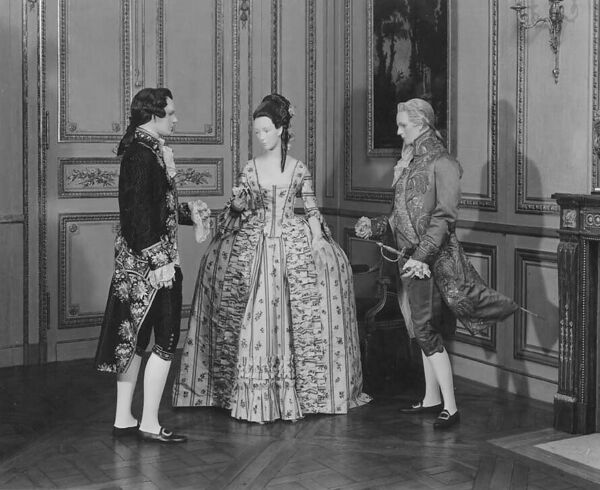
Men’s Suit: caftan, vest, culottes. France, 1770–1780s. Silk, embroidery.
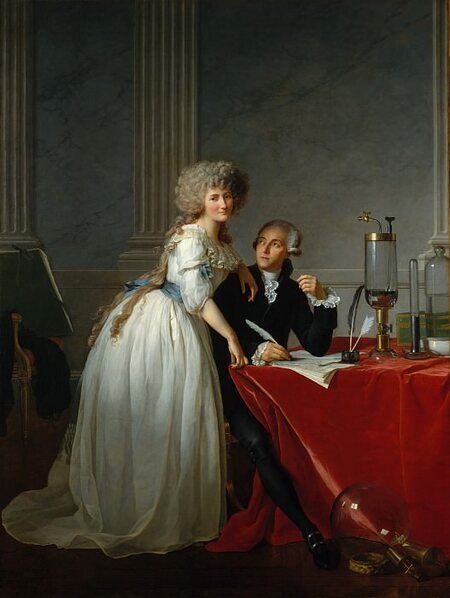
The costume included a lace jabot and cuffs, silk stockings, strapped shoes, a powdered wig with a queue tucked into a black silk bag, and a tricorn hat, which was often worn tucked under the arm to keep the hairstyle from creasing. Red heels were a mark of noble descent at the French court. By the 1770s–1780s, the silhouette narrowed: the skirt of the cassock was cut shorter in the back, the waistcoat was shortened to the waist, and the sleeve became slim. In domestic settings and in portraits of intellectuals, a loose robe and the absence of a wig appeared.
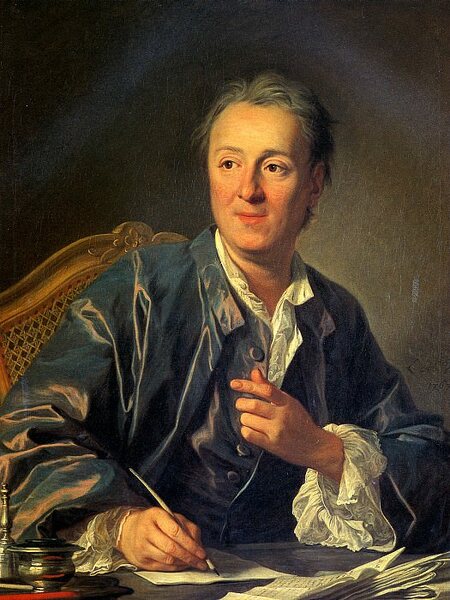
Louis-Michel Van Loo. Portrait of Denis Diderot. 1767. Louvre, Paris.
Jacques-Louis David. Portrait of Antoine Laurent Lavoisier and his Wife. 1788. Metropolitan Museum of Art, New York.
In the portrait, Lavoisier’s suit is already dark and nearly unadorned: several years before the revolution, courtly extravagance ceases to be a requirement even for the wealthy.
2.2. England
The English aristocracy spent a significant portion of the year at country estates, and their attire adapted for hunting and horseback riding. Its central piece is the woolen frock coat—originally practical, country wear with a fold-down collar, which gentlemen began wearing in informal settings starting in the 1730s.
Thomas Gainsborough. Mr. and Mrs. Andrews. 1750. National Gallery, London.
Robert Andrews is depicted against his own fields, holding a rifle and accompanied by a dog, wearing a loose, light-colored coat. The portrait presents him as a landowner, not a courtier—a fundamental divergence from the French tradition. Signs of the English variant include woolen cloth instead of silk, muted colors, minimal embroidery, boots instead of slippers, and a round hat instead of a tricorn. The quality of the costume was determined by its cut and fit, rather than its embellishment.
Joseph Wright of Derby. Sir Brook Bootby. 1781. Tate Gallery, London.
Buttby lies in the woods with a volume of Rousseau in his hand. A simple woolen suit was linked here to the idea of naturalness. The opposing pole to English fashion was «macaroni”—young men of the 1760s–1770s who, after traveling to the continent, exaggerated French and Italian fashions: very tall wigs, small hats, and tight, short coats. They were primarily depicted by caricaturists.
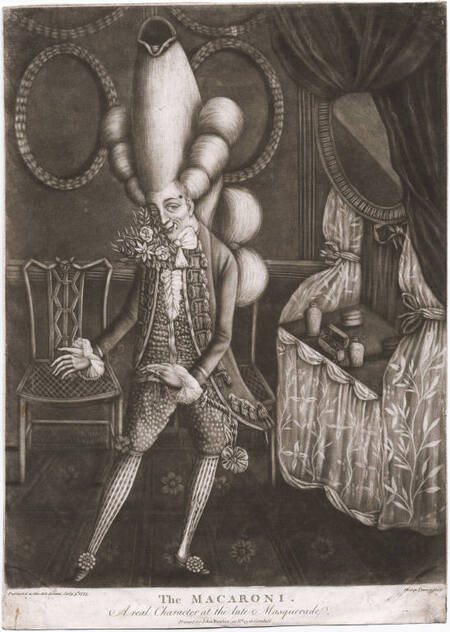
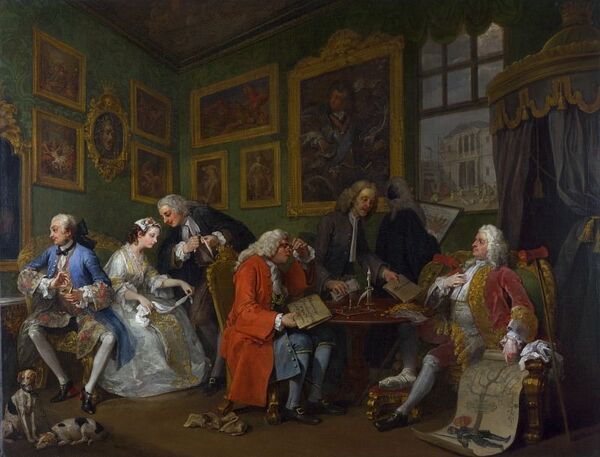
Philip Dou. Macaroni. A true character of the last masquerade. 1773. William Hoggart. Fashionable marriage: a prenuptial agreement. 1743.
Hogarth’s son, a count’s child, is dressed in French fashion and admires himself in the mirror: the foreign costume becomes a tool of satire against the aristocracy. In the 1780s, the English frock and redingote (from the English «riding coat») were adopted in France—a phenomenon that came to be called Anglomania.
2.3. Italy
In 18th-century Italy, there was no single state, and consequently, no unified fashion; courts looked to Paris as their guide. The most independent variant developed in Venice. Here, over the standard costume, people wore the bauta: a white mask, a black cloak covering the head and shoulders, the triangola, and a wide cloak—the tabarro. The bauta concealed the face and the wearer’s social standing.
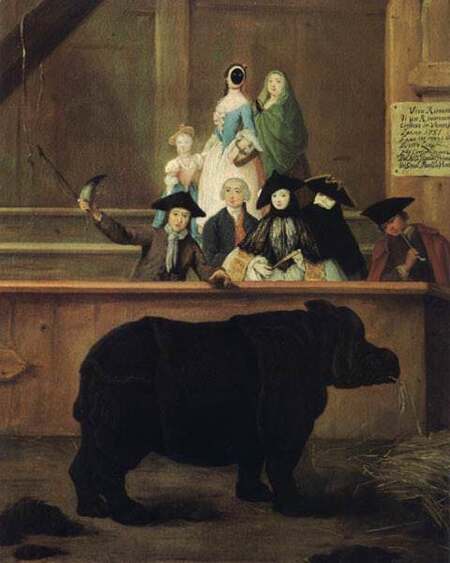
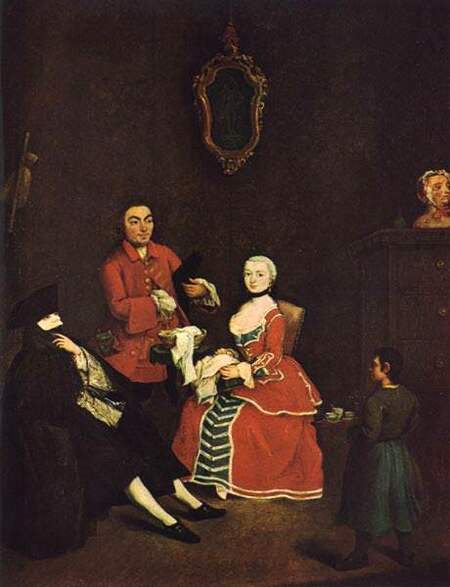
Pietro Longhi. Rhinoceros. 1751. Ca’ Rezzonico, Venice. Visit to the Bauat. 1760. Ca’ Rezzonico, Venice.
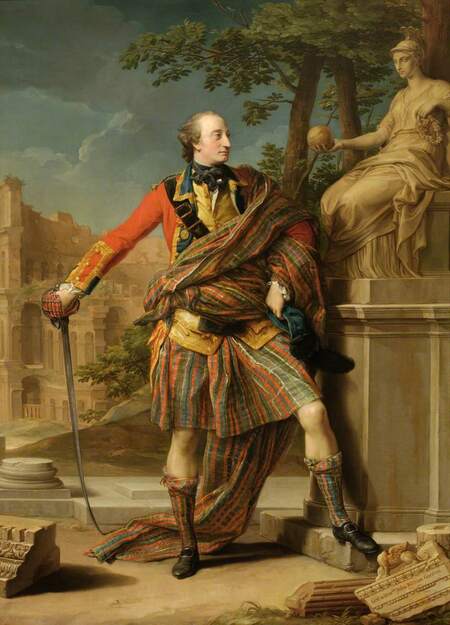
The second Italian theme is travelers. Rome was the destination of educational trips for young Europeans, particularly Britons, and the artist Pompeo Batoni specialized in their portraits. These canvases depict the attire of foreigners in expensive coats against the backdrop of ancient ruins. Gordon is draped in a Scottish tartan that resembles a Roman toga—a national textile combined with an ancient pose.
*Pompeo Batoni. Portrait of Colonel William Gordon. 1766. Fyvie Castle, Scotland.
2.4. Spain
Since 1700, the Bourbon dynasty ruled in Spain, and the court adopted French attire. The traditional black Spanish gown with a stiff collar was maintained at the beginning of the century primarily by civil servants and lawyers.

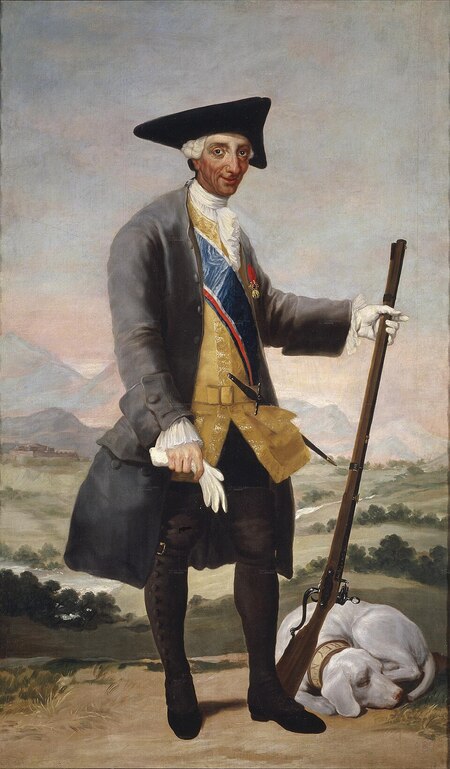
Francisco Goya. Charles III in hunting attire. Circa 1786–1788. Museo del Prado, Madrid.