Минойская настенная живопись. Зарождение движения
«Changeability and movement as the foundations of the artistic image, the wave-like quality of the pattern, the rapid succession of visions, and therefore the drive to capture the instantaneous moment—this is, in large part, what the art of Crete brought to the world, and it is closely related to the worldview of modern people.» [1]
INTRODUCTION
The Minoan culture, one of the most ancient, which emerged in the 3rd–2nd millennia BCE on the islands and coasts of the Mediterranean Sea, captures attention with its distinctiveness. Particularly fascinating for study are the works of art from the island of Crete, which Arthur Evans named «Minoan.» The picturesque palaces of Crete, the Kamares style vase painting, and the murals are unlike anything that existed before them. A special place in this heritage is held by the monumental painting of Minoan art. This is the subject of this study.
CONCEPT
«Among the first peoples whose artistic creations reached us, the Cretans joyfully admired the visible world. With awe, and a passionate desire to capture the earthly beauty playing out and blossoming in their souls, filling them with delight» [2]
The originality of Minoan art is evident in its attempt to capture the natural flow of life and convey the joy of the moment. Life-affirming motifs are central to this culture. Because this non-martial, peaceful culture existed alongside the constantly changing element of the sea, it helped the artists perceive and communicate the fundamental element of life—motion. Therefore, in their creations, they used movement to convey the fullness of life: in composition, posture, line, and ornamentation. This became the primary artistic and compositional technique in Cretan wall paintings. My interest in this topic relates to animation: as an animator, I am curious how artists depicted movement on a flat surface long before the advent of animation. The goal of my visual research is to trace the techniques Cretan masters used to achieve the effect of motion in a static image.
«NATURALISTIC» STYLE
One of the important characteristics of painting is the technique of execution. To depict the world in all its variability, Cretan artists used a special technique that differed significantly from what existed in the East. In Ancient Egypt, artists used tempera paints on dry plaster, while Cretans employed painting with water-based pigments on wet plaster—fresco. This lent the paintings «a special sense of dynamism to everything depicted» [4].
«Saffron Gatherer.» Knossos Palace, 1650–1500 BCE. Reconstruction with Monkeys. Archaeological Museum of Heraklion.
The movement begins to manifest in the earliest paintings discovered on Crete. This is particularly evident in the fresco «Saffron Gatherer, ” also known as the „Crocus Gatherer.“ Previously, existing fragments suggested that a boy was collecting crocuses. However, recently discovered new fragments have proven that it is a monkey, and not just one.In this fresco, asymmetry becomes a crucial technique. The artist divides the image plane into two equal parts, but they are not symmetrical: the lower flowers, unlike the upper ones, are gathered in vases. Furthermore, the lush flowers are tilted in different directions, as if they are growing in the wind. This asymmetry creates an illusion of movement and flow—of that lively natural environment that is perceived as natural. The postures of the animals also vary. One monkey reaches for a flower, while another is standing on its hind legs, looking intently at something.Moreover, the image is quite stylized: a reddish-brown background, schematic rock ledges, and simplified anatomy of the grayish-blue monkeys.
«Saffron Gatherer.» Knossos Palace, 1650–1500 BCE. Reconstruction with Monkeys. Archaeological Museum of Heraklion.
The overall composition is also noteworthy. The absence of straight vertical and horizontal lines, combined with the abundance of arcs, heightens the sense of chaos; the image seems to swirl toward the center.
Artists are interested in the surrounding world; they depict it as spiritualized and poetized. This period is called «Aegean Impressionism» [5] because the artists strove to capture the fleeting impression of what they saw. In these paintings, the author highlights individual features of what is seen, which allows the viewer to reconstruct the impression of an entire scene.
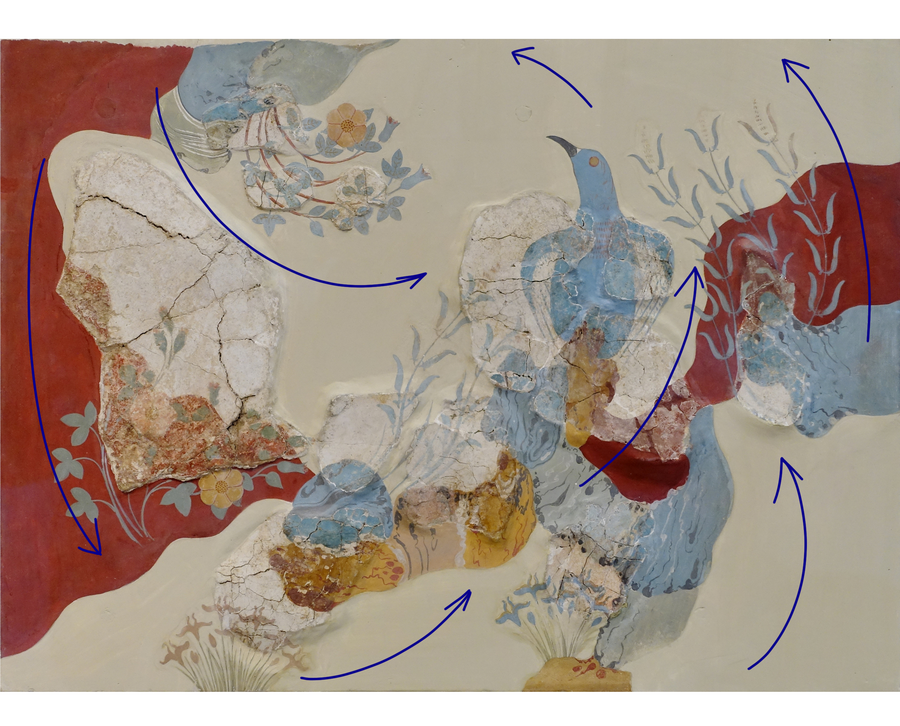
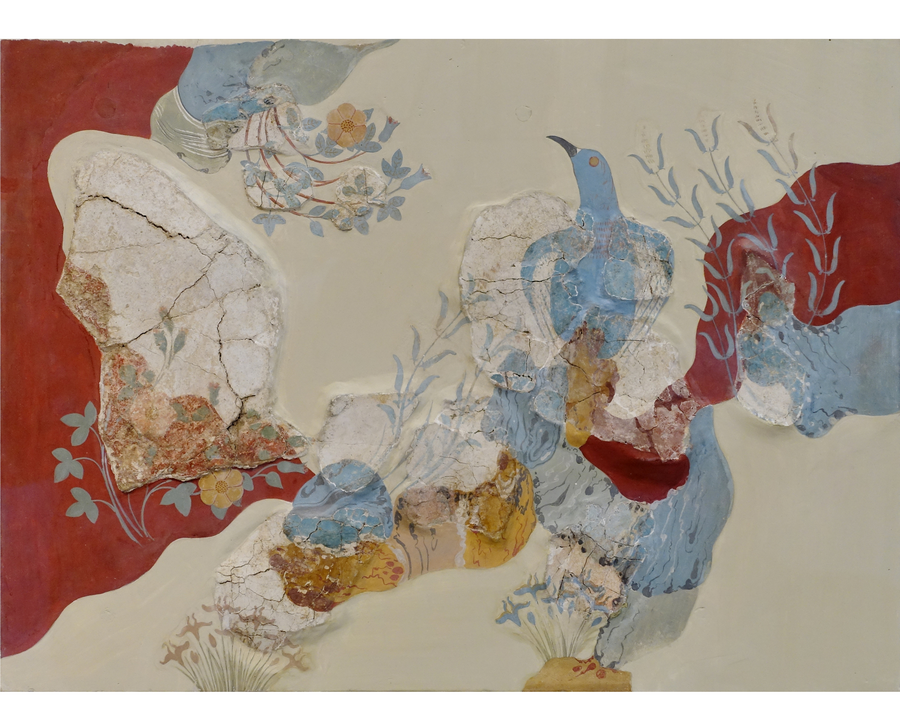
«Blue Bird.» 1600–1500 BCE. Fragment of the «Monkeys and Birds» fresco from the Knossos Fresco House. Archaeological Museum of Heraklion.
In the fresco «Blue Bird from the Knossos Palace, ” the bird sits with its back to us atop a rock, and as if hearing something, it has suddenly turned its head. The principle of framing is used here—the lower part of the bird is hidden behind the rock. This heightens the dynamic action. The whimsical outlines of the rocks and the branching, wind-bent foliage amplify the impression of fleetingness.
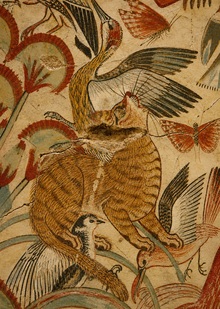
In the painting «Cat and Bird from the Villa in Agia Triada, ” a similar effect is achieved through the tension and expressiveness of the poses. On the left is the bird with a long tail, and on the right is the cat, poised to catch the bird: its left paw is extended forward, its ears are perked up, and its round eye is taut. This creates a sense of impending movement—we imagine the cat stealthily stalking the bird, about to strike.
Another example is the «Fresco with Lapwings from the Knossos Caravanserai.» Although this fresco is a narrow frieze within a room and has an ornamental quality, it lacks symmetry and staticity. Here, dynamism is evident in the attempt to construct depth: some birds stand before a hill, others behind it, their lower halves cropped by the artist and seemingly hidden by the elevation. The birds are grouped and depicted individually. Some birds stand calmly, while another bird appears ready to take flight—its wings are spread. An ostrich is concealed behind a bush, bringing the image to life.
Report