Concept
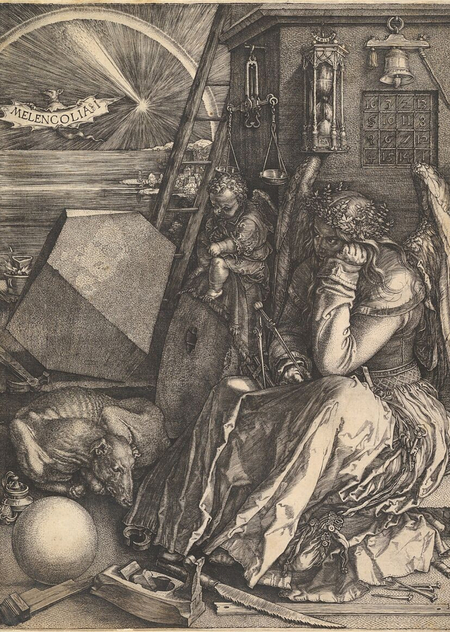
Melancholy was long considered not a mood, but a facet of the worldview. Ancient medicine ascribed it to an excess of black bile; astrology linked it to Saturn; and the Renaissance humanists saw it as a quality inherent to the scholar and the artist. Consequently, melancholy developed its own symbolic imagery, a complex assemblage of objects. Albrecht Dürer’s engraving, «Melencolia I» (1514), is the most renowned example of this imagery—it resembles a rebus: a compass, scales, hourglass, bell, magic square, polyhedron, sphere, and dog. Today, few people can decipher this rebus without commentary. However, the seated figure, whose head rests in a hand, is immediately recognizable without any explanation. This discrepancy intrigued me: the intricate system of symbols has been forgotten, while the simple posture of the body remains intuitively clear.
The key question: What remains of the personification of Melancholy once its attributes disappear?
The hypothesis is that melancholy’s attributes proved to be an unstable part of the image. After Dürer, they first become more prominent, then they change and blur, and by the 19th century, they almost entirely disappear from depictions. The rigid posture, however—a head resting on a hand, sometimes accompanied by a shaded face and a gaze into the distance—remains constant. In the 20th century, this gesture alone is enough for the viewer to understand the person’s state without a single symbol. But I also propose the reverse: without the attributes, the gesture loses its specificity, and only the setting helps distinguish melancholy from thoughtfulness, grief, or anxiety.
Selection Principle
The works included feature at least one of two elements: the personification of Melancholy with specific attributes or a recognizable gesture of melancholy. I selected pieces whose connection to the theme is substantiated either in the literature or in the title itself («Melancholy» by Cranach, Fetti, Charpentier, Degas, Munch). To ensure a fair assessment, I have also included examples that complicate the hypothesis: Cranach has the attributes but lacks the gesture; Degas has the title, but with a different gesture; and Rodin’s «The Thinker» demonstrates how the same gesture begins to signify deep contemplation. I excluded film and fashion photography. Dorothea Lange’s photograph is included as a concluding point in the series: it is a document, not an allegory, and the gesture functions independently within it.
The Principle of Rubrication
The research is structured chronologically because the hypothesis describes a process. Five sections correspond to five states of the image. The first demonstrates that the gesture predates the symbol—it appears in ancient sculpture and with Renaissance masters up to Dürer. The second analyzes «Melencolia I» as a point of maximum attribution. The third is dedicated to the 16th–17th centuries, when Dürer’s followers either added objects or replaced them with their own. The fourth covers the period from Goya to the end of the 19th century, when the attributes begin to disappear. The fifth shows the beginning of the 20th century, where only the gesture remains. Finally, all the heads found on the hand are compiled into a single comparative study.
Source Selection Principles
The foundation of the work was the book «Saturn and Melancholy» by R. Klebanzki, E. Panofsky, and F. Zaksl. This is the primary study on the history of the concept of melancholy and on Dürer’s engravings; I drew the attribute values from this work. For Dürer, I also referenced Panofsky’s monograph on the artist and materials from the Metropolitan Museum of Art. For the 17th–20th centuries, the main source was the catalog of the exhibition «Melancholy: Genius and Madness in the West» (Paris, 2005), edited by Jean Clair: it illustrates how the theme persisted after the Renaissance. I verified the dates, techniques, and storage locations using the museum pages where the works are held.
I. Gestures Older Than Symbols
Long before melancholy acquired its established iconography, art already knew the pose of a person resting their head on a hand. It signified expectation, sorrow, or deep contemplation. This section demonstrates that the gesture predates the symbol, showing that Dürer drew from an existing tradition.
«Penelope.» Rome, 1st century CE.
Penelope awaits Odysseus. She sits with her legs crossed, touching her cheek with her hand. There are no objects here that indicate melancholy—it is not a symbol yet, but a state of waiting and sadness. Yet, the posture is already the same as the defining characteristic of Melancholy, which will emerge in a thousand five hundred years.
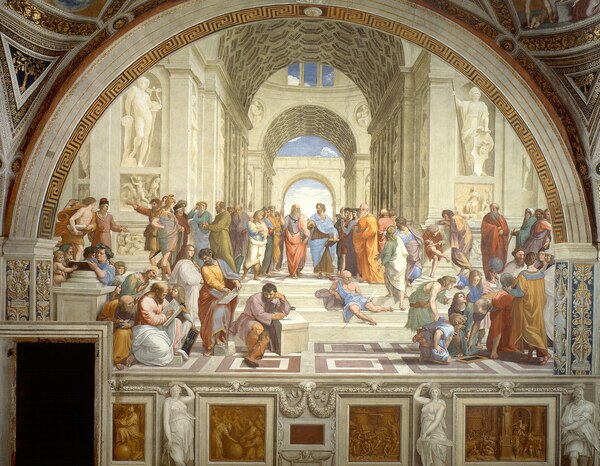
Raphael. The School of Athens. 1509–1511.
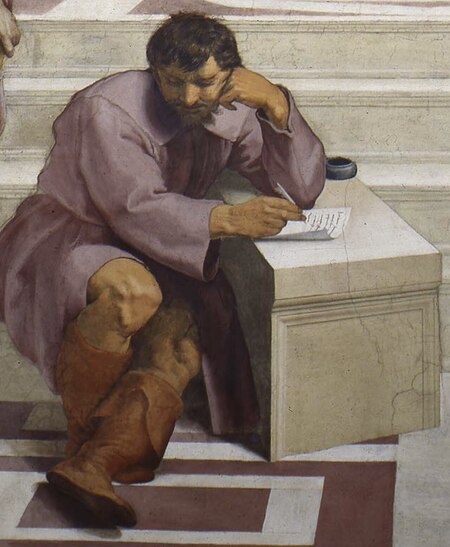
A general plan is needed to convey the solitude of the figure in the foreground. All the philosophers are debating and moving, while only one sits apart on the steps. Heraclitus, the «weeping philosopher, ” rests his head on his hand. Raphael added the figure later than the others, and according to the common version, endowed it with Michelangelo’s features. The gesture connects thought, loneliness, and the heaviness of character. This is already very close to the Renaissance understanding of melancholy as a trait of genius.
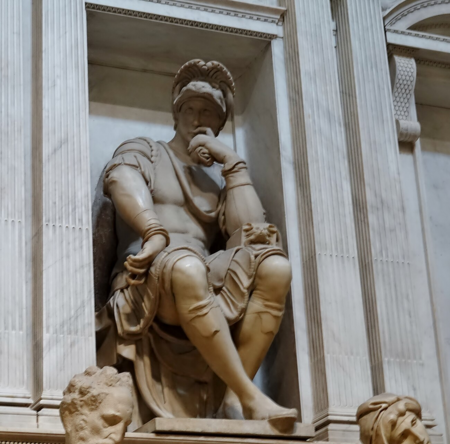
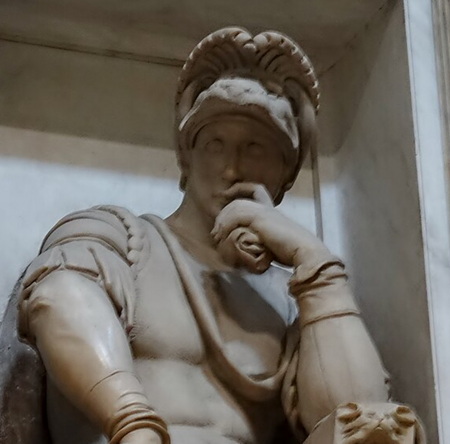
Michelangelo. Tomb of Lorenzo de' Medici, Duke of Urbino. 1524–1534.
A new sarcophagus, San Lorenzo, Florence. Commentary: the statue is called «Il Pensieroso, ” or „The Thinker.“ Lorenzo raises a hand to his face, his elbow resting on a casket. The helmet casts a shadow over his eyes.The shaded face deserves special note. The same technique is found in Dürer, where the face of Melancholy is dark. Coupled with the hand near the face, this is the second enduring characteristic that transcends mere attributes.
II. Dürer’s Formula
In 1514, Albrecht Dürer merged ancient gestures with a complete lexicon of melancholy symbols. The engraving «Melencolia I» became a nexus point for numerous attributes. To understand how these attributes later dissipate, one must first examine them individually.
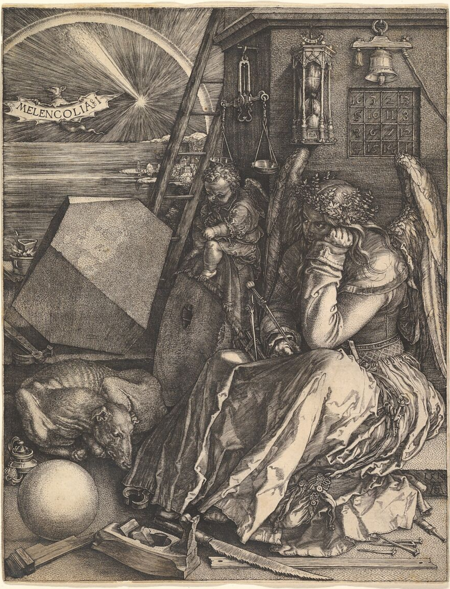
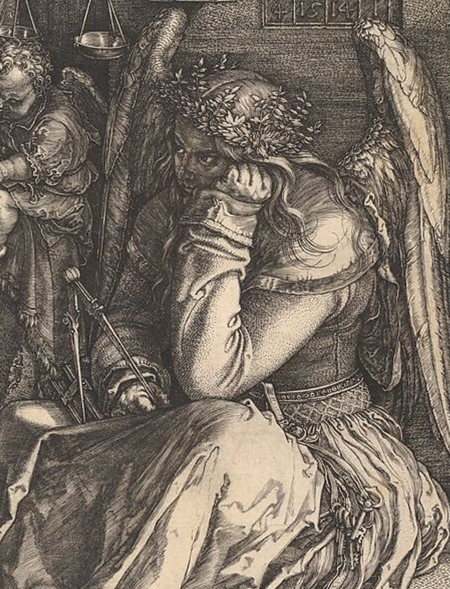
Albrecht Dürer. «Melencolia I.» 1514.
Engraving by burin. A winged woman sits on the steps of an unfinished building. Her head rests on her fist, her face is in shadow, and her gaze is directed to the side; in her right hand is a compass, which she is not using. Tools are scattered around. Dürer depicts not laziness, but a pause: Melancholy has everything to work with, but the work will not begin.
I specifically want to highlight the winged woman. Her hand is clenched into a fist, and shadow lies across her entire face. Medieval medicine linked a dark complexion to an excess of black bile.
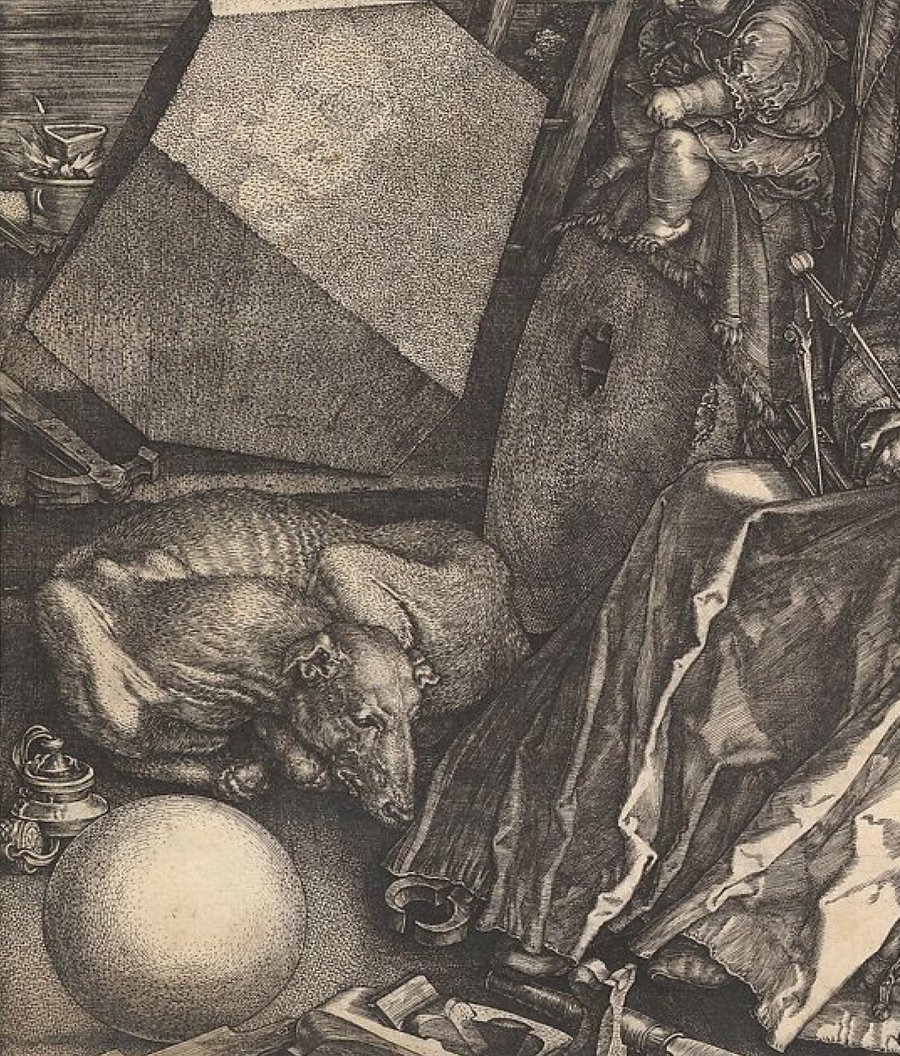
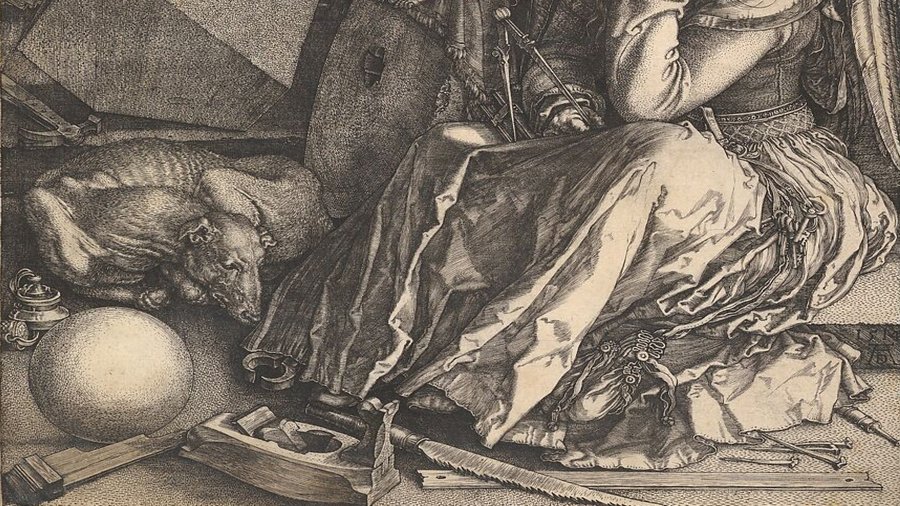
Albrecht Dürer. «Melencolia I, ” detail: instruments, polyhedron, sphere, and dog. 1514.