TABLE OF CONTENTS
1. Concept — Block 2–6 2. Medieval Madonnas — Block 7–31: Chimabue — Block 8–12 Duccio di Buoninsegna — Block 13–18 Simone Martini — Block 19–31 3. Renaissance Madonnas — Block 32–48: Leonardo da Vinci — Block 35–40 Raphael Santi — Block 41–48 4. Conclusion — Block 49–50 5. Bibliography — Block 51 6. Image Sources — Block 52
Concept
I am drawn to the process of exploring the same themes through different lenses depending on the period in which the artist lived; therefore, I would like to investigate the interpretation of the Virgin Mary in the Middle Ages and the Renaissance. This biblical figure inspires humility, acceptance of the world, and acceptance of fate as it is.
The selection of material for this visual investigation, as well as the textual sources, was based on visiting educational and museum websites to verify the accuracy of the information regarding the paintings. This was necessary because, in most cases, similar images are misinterpreted by the Yandex and Google search engines, yielding false results when analyzing the title, author, and year of creation. When searching for similar iconography fragments, the precise title was cross-referenced.
The structure is based on organizing the artists chronologically by their birth dates. Each subsequent cultural figure was inspired by the work of the previous one. In the collage blocks, I compared paintings, commenting on the similarities or differences between works by one or several artists, which may cause the dating in adjacent blocks to appear inconsistent.
The Middle Ages were a heterogeneous process, typically dated from the late 5th century to the end of the 15th century. Characteristic features of the Dark Ages included the flourishing of feudal land ownership and the corresponding hierarchical system of vassalage, as well as the infamous witch hunts that followed the Church’s desire, which held power, to bring the righteous light of God into the mortal world, and, of course, the plague epidemics.
The vast majority of the population consisted of uneducated peasants. The lives of citizens were regulated in many ways by religious law. It was the Church Fathers who were responsible for the cultural and moral enlightenment of the people.
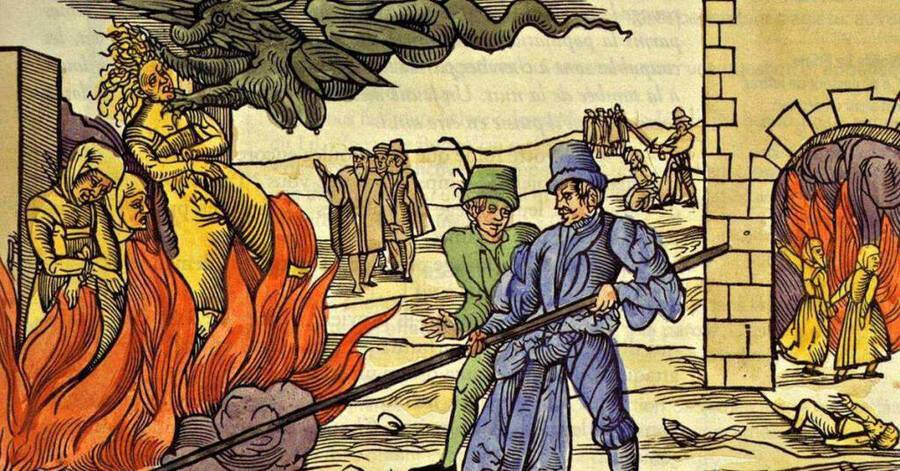
Unknown artist / Witch Burning at the Castle in Reinshtein (near Blankenburg) / 1555
Religious canons rejected the importance of outward appearance, elevating the purity of the soul, which is why the Dark Ages are renowned for their detachment from worldly life. The beauty of the naked body became a sinful manifestation of human nature. Art endured pressure from the Church, as the materials used to paint were expensive, and the main patrons were the nobility and the Church, who could afford significant expenditures. Images of saints, as well as of the aristocracy in similar portrayals, gained incredible popularity. Altarpiece art spread extensively. One of the most revered images became the Madonna or the Theotokos—a vibrant personality and magnificent woman. This is what we will discuss.
Madonnas of the Middle Ages
My narrative opens with the famous Florentine painter Cimabue and his fresco, located in the Basilica of Saint Francis of Assisi.
Chimamvu / Madonna on the Throne Surrounded by Angels and St. Francis / 1278–1280
Maria sits on a throne, slightly extending her right leg to maintain balance, while holding the infant Jesus.
She gently supports his body with a light gesture of her hand, taking on the role of a caring mother.
However, if you look closely, the gazes of all the angels—except for the one positioned to the left of the Mother of God—and the Saint are directed toward the viewer. The Madonna, meanwhile, gazes humbly into the void, as if she has long accepted the tragic and painful fate of her son.
Cimabue / Madonna on Throne with Angels / 1290–1295
Cimabue / Madonna and Child on Throne with Angels, St. Francis, and St. Dominic / c. 1280
Cimabue / Maestà / 1285–1286
It should be noted that in all three images, Maria is clearly larger than the angels. In doing so, the viewer subconsciously reads the author’s message: the Madonna is not a mere human. First and foremost, the Theotokos is a trinity of mind, body, and soul—that is, encompassing love—after which arguments about whether this woman deserves to be the one who gave birth to the Son of God immediately cease and are defeated, for love is the state of God.
Duccio di Buoninsegna / Madonna Rucellai / 1285
Next in line are the works of Duccio di Buoninsegna—a representative of the Sienese school of painting. For a time, the artist studied with Cimabue, working in his workshop.
Duccio di Buoninsegna / Madonna with Child and Six Angels / 1300–1305
Here, Madonna’s gaze is directed toward Jesus, but over his head. The woman has retreated deep into thought, and the child, whose gaze seems older than his years, reaches out a hand to his mother’s garments in a calming gesture.
The proportions of the Theotokos’s head are more correct when compared to Chimamanda Ngozi Adichie’s works. It is balanced by the elbows set to the sides and the voluminous cloak that covers her.
Duchio di Buoninsegna / Madonna and Child / 1280
Duchio di Buoninsegna / Madonna and Child with Six Angels / 1300–1305
In the aforementioned icons, the connection between the infant and its mother is intensified through their touching. The depiction of Mary becomes more graphic due to the application of decorative gold bands on her voluminous garment. This simulation of folds stylizes the painting.
Next, we will discuss the work of Simone Martini—a successor to the Sienese School and a student of Duccio di Buoninsegna.
Simone Martini / Madonna and Child / 1326
Simone Martini / Madonna and Child / 1308–1310
His depiction of the Madonna, perhaps the most memorable, significantly sets his icons apart from other medieval artists.
Mary’s unusual expression—with downturned lips—suggests internal tension, severity, or the heroine’s unattainability.
The artist actively employs graphic techniques for rendering the folds and ornamentation on the garments, methods adopted from his mentor.
Duccio di Buoninsegna / Maestro. Madonna and Child with Holy Angels / 1311
Simone Martini / Maestro / 1312–1315
Simone Martini / Maesta. Fragments / 1312–1315
A surprisingly subtle novelty: Madonna’s strands of hair escaped from beneath her headscarf, and most importantly—they were of an unusual golden hue.
Her garments were embroidered with gold and adorned with precious stones, and the throne resembled a royal seat. The entire figure of the Virgin Mary exudes majesty.
Simone Martini / The Annunciation with Two Saints / 1333
Maria is presented to the viewer as a living person capable of expressing complex emotions amidst shock.
Her spiral posture is closed off and unwelcoming. The artist is likely conveying an extreme degree of surprise and distrust, as the thought of whom she will bring into this world through her womb can be both frightening and inspiring.
Simone Martini / Madonna of Mercy / 1308–1310
Simone Martini / Christ Found in the Temple / 1342
Simone Martini / Annunciation / 1333
«Madonna of Mercy» embodies the concept of «taking under one’s wing.» She serves as a protector—bold and as steadfast as a stone wall—ready to warmly embrace anyone in need.
The second icon allows us to see Maria portrayed as a conversational partner. Previously, the language of the Madonna was a gaze filled with indescribable emotion, but now she has spoken.
This brilliant transformation brings a sense of unity with the viewer to the work, because people also communicate through speech.