«How to Draw a Bison: Representational Techniques in Franco-Cantabrian Paleolithic Cave Paintings»
Concept. Upper Paleolithic cave paintings are primarily perceived as the «first step» toward something else—an art, a naive, simple expression that merely anticipates true mastery. But standing beneath the image of the bison on the ceiling of Altamira dispels that impression. The contour is confident; the hatching lends volume and roundness to the body, and the pose of the reclining bison with its head tilted is rendered with such precision that the image is instantly legible: Janssen sees a wounded beast in its final agony, while contemporary researchers describe a resting animal. This is not even a beginning; it is already a developed language. For today’s viewer, and especially for a designer, it is interesting not as an archive—we solve the same problems—how to convey volume, movement, and character with a flat line and a patch of color—right now.
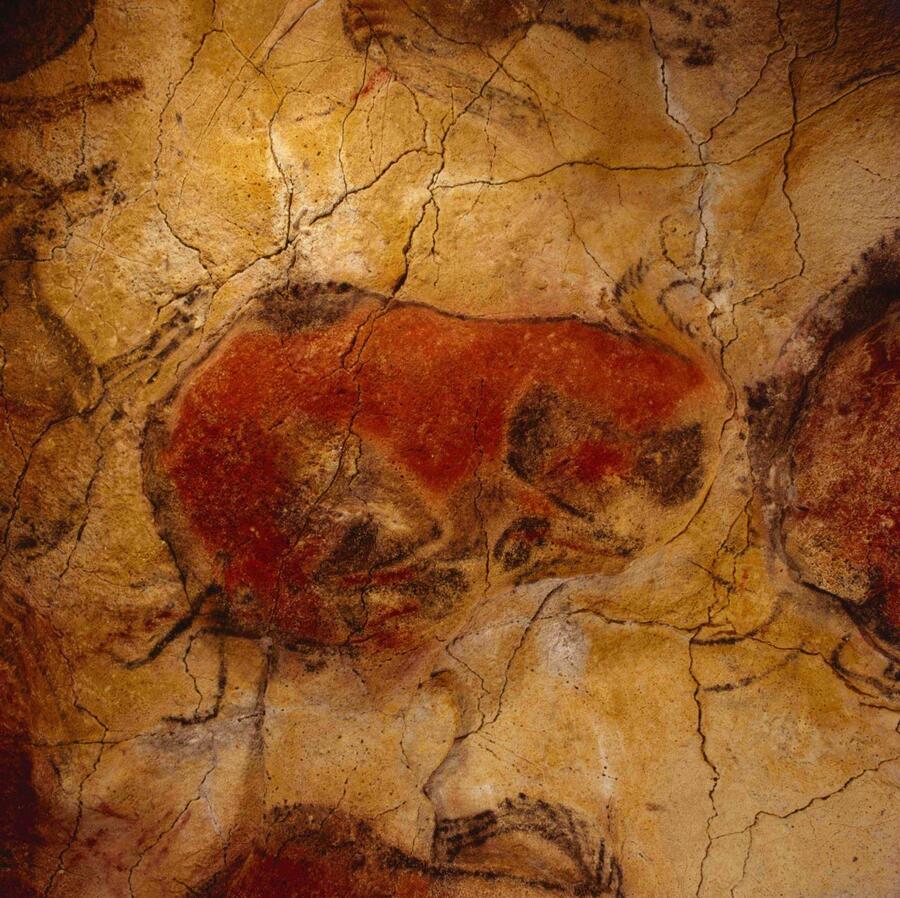
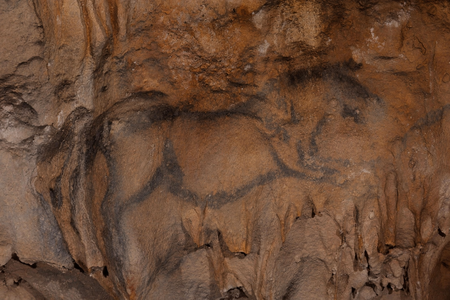
«The Bison.» Ceiling of the Altamira Cave, Spain. Upper Paleolithic period. Artist unknown. Photo: National Museum and Research Center of Altamira, Ministry of Culture of Spain, photographer not specified.
In our study, we ask the material a single question: what specific visual tools did Paleolithic artists use to achieve expression and painterly quality in their depictions? The question of why these images were created or what their creators believed remains beyond our scope—we are interested in how they were made, not what they meant. The central hypothesis of our work is that the apparent «simplicity» of Paleolithic drawings is underpinned by a set of conscious techniques that can be identified, named, and compared. Some artists conveyed a single form with a confident line, while others built volume through tone and color, a third group integrated the figure into the natural irregularities of the rock, and a fourth group achieved a sense of movement through perspective and composition. The material for our work consists of the paintings and engravings from the caves of Franco-Cantabria, the primary hub of Paleolithic art in Europe: Altamira, Lascaux, Rouffignac, and Pech Merle. This art dates to the Aurignacian and Magdalenian periods, roughly from the 35th to the 10th millennium BCE. We have enough monuments of first-rate art preserved here to compare them.
The structure of the work follows the principle of typology: each chapter relates to a specific artistic technique and illustrates it using various examples drawn from different caves. Over the six chapters, the work sequentially examines line and contour, volume, color, the use of rock relief, the depiction of movement, and composition through overlaid images. In each chapter, the same technique is compared across different monuments—thus revealing how the artists' approaches are similar and how they differ. The concluding section summarizes and compares these techniques with how the same problem—representing motion with a single pose—was later solved using the example of the Roman copy of Myron’s «Discobolus.»
The texts were selected based on their verifiability. Three sets of texts were chosen according to this criterion. The first is a general coursework section, where cave paintings are presented as an art element (Kh. V. Yanson, E. F. Yanson, «Fundamentals of Art History») plus a vocabulary section on primitive human art. The second is a specialized study that allows for the verification of general statements about a specific cave (C. de Las Eras, Kh. A. Lasheras, article on Altamira, 2014). The third consists of museum and ministry of culture pages from Spain and France, and the Bradshaw Foundation, used as sources for descriptions and dates. Consequently, every statement regarding technique or date must cite the author. The texts were analyzed through comparative study—if sources differ (for example, regarding the dating of Lascaux or the interpretation of the bison’s posture), both versions are presented in the work rather than selecting only one. Quotes are formatted with citations and do not exceed one-fifth of the text.
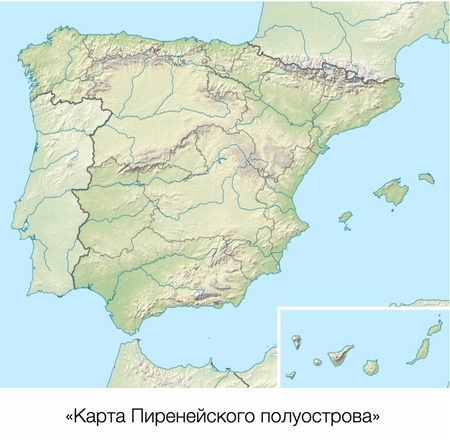
What they are. All the prehistoric caves listed here are located in the Pyrenean region: Altamira in the Spanish kingdom, Lascaux, Rouffignac, and Pe-Merl in the French territory. The Franco-Cantabrian region is named so for its two borders—the French one and its sibling, the Cantabrian one, which is located in the north of Spain. There is only one important point—the caves are close together, and the drawings within them were executed using the same technological base—limestone, charcoal, and ochre.
Four Caves.
Altamira: the ceiling with polychrome bison was created over a very long period. Lascaux: «the Chinese horse, ” bison, and overlapping figures. Rouffignac: hundreds of figures, including 158 mammoths. Pech-Merle: spotted horses and negative handprints. These four caves were chosen because each one allows a clear observation of a particular technique. What was most frequently depicted. According to the reference site „Reference Book, ” in the Franco-Cantabrian caves, horses account for about 30% of all imagery, bison—20%, mammoths—7.6%, ibex—7.5%, deer—7.1%, aurochs—6.8%, and deer (Cervids)—6.2%. Predators were depicted less often: bears—2.3%, lions—2.2%. Even if these figures are estimates, it is clear why there are so many bison and horses in the artwork—they are the most common subjects on the walls.
How to Date Drawings
On the Altamira ceiling, paintings dating back nearly 20,000 years were created by Erás and Laschaux (2014)—from 35,559 to 15,204 years ago (calibrated dates). Radiocarbon dating of the bison ranges from 13,130 to 16,480 years ago. According to the dictionary of drawings, Lascaux Braille attributed them to the 24th–19th millennia BCE; however, Leroi-Gourhan revised this in favor of the 15th millennium. In Refugio, there are no direct dates; an age of about 13,000 years was established based on style. Therefore, in the captions, we consistently use the term «period» and cite the author of the dating.
The Principle of Rubrication.
Each chapter is dedicated to a specific technique. We do not delve into the history of cave discovery or the reasons why rock paintings emerged. Our focus is on how the artist approached solving their creative problems. There are six such techniques: contour, volume, color, relief, movement, composition, and overlay.
How we compare.
Each chapter begins with an introduction, followed by several slides showcasing examples from different caves. Next, there is a comparison slide where we address two questions: what is similar and how do they differ. Finally, we draw a conclusion. For instance, the primary artistic technique in both the Rouffignac and Pech-Merle caves is contouring. However, in Rouffignac, the contour outlines the animal, highlighting its key features, whereas in Pech-Merle, the contour gathers disparate spots into a unified image.
Chapter 1. Contour: The line decides what to show