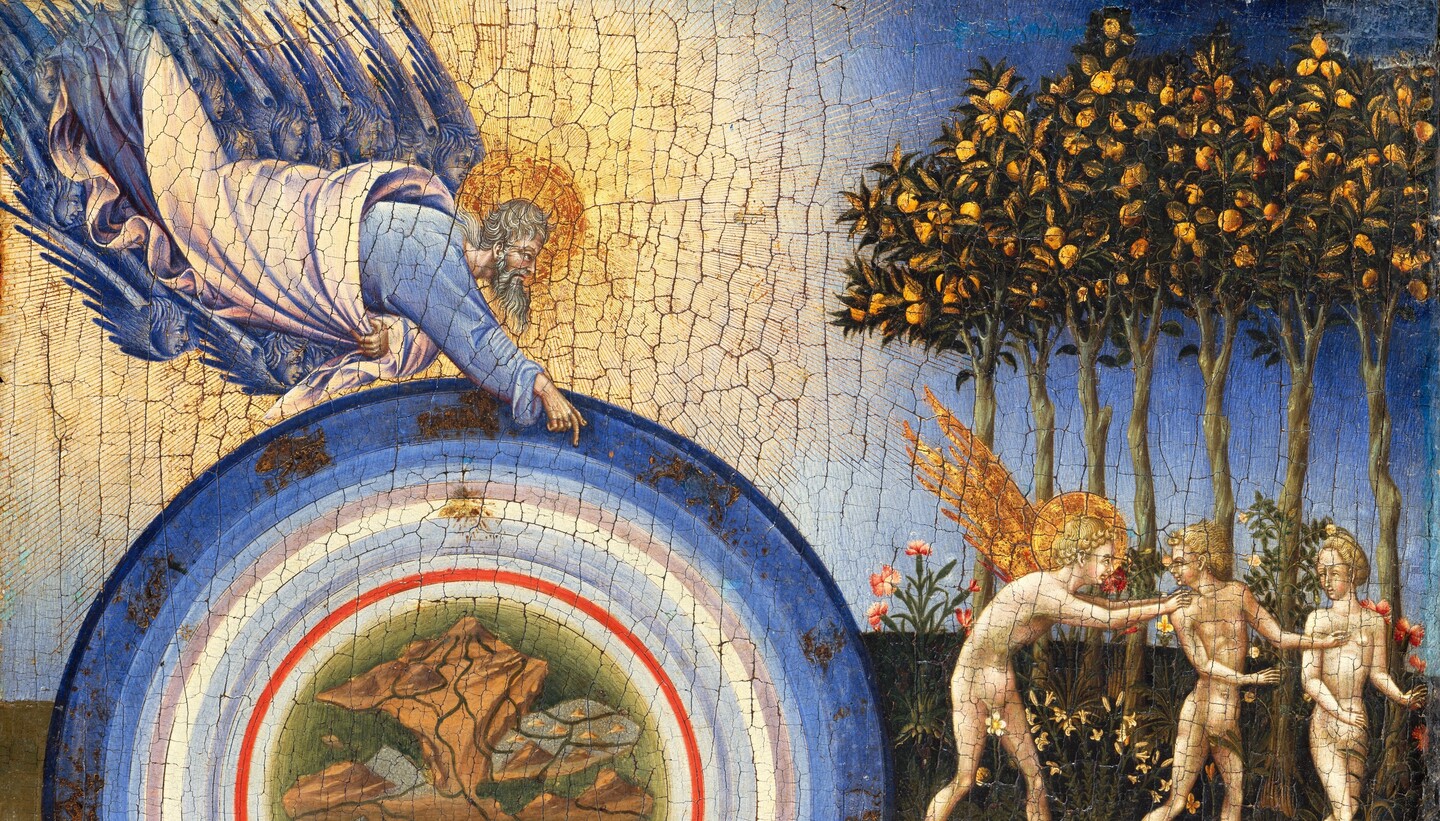
Изображение неба и космических пространств как объяснение устройства мира и понимания своего места во Вселенной в искусстве Италии XIII–XV веков
«Everything created possesses an internal order, and this order lends the universe a semblance of God.» — Dante Alighieri, early 14th century [4].
Navigation Menu
Principle of the Rubricator:The rubricator is organized chronologically, which helps track the recurrence of similar phrasing and verify whether these concepts coexisted during a specific period.Introduction Concept I. Two Ways to Depict Space II. III. IV.
Introduction
First and foremost, it is essential to understand the structure of the world as conceived in the Middle Ages. In the first half of the 13th century, John de Sacrobosco presented a geocentric model in his treatise, «On the Sphere, ” incorporating the work of Arab scholars, including Al-Farghani. The spherical Earth was placed at the center, around which the celestial spheres were situated. This model was studied in the universities. It was based on the ancient works of Aristotle (4th century BCE) and Ptolemy (2nd century), which were read and developed within various scientific traditions during the Middle Ages. The connection between this model and the Christian Creation and salvation is demonstrated in works across different genres, ranging from biblical miniatures to Dante’s epic poems. [1] [2]
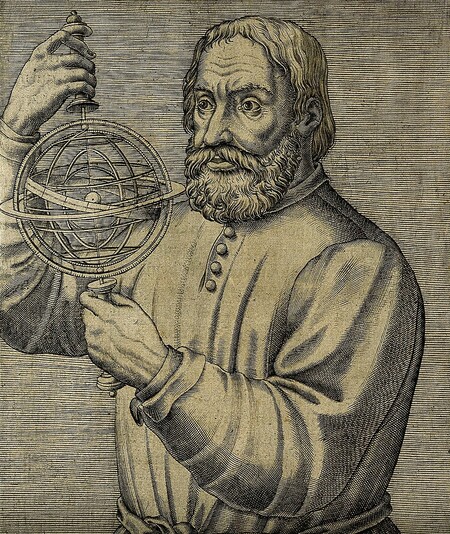
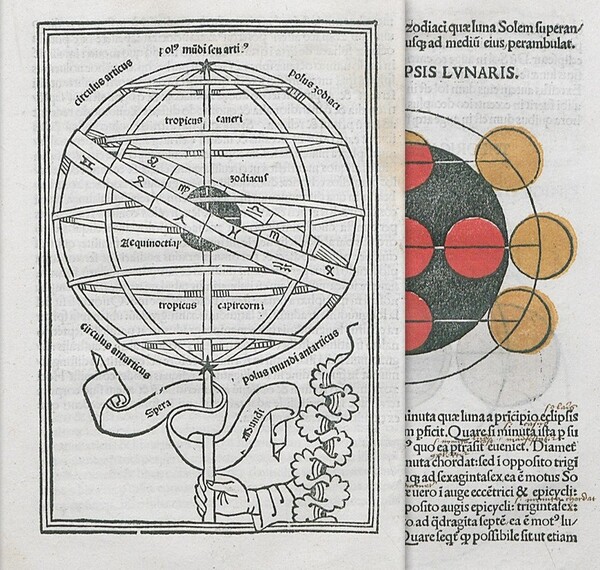
1 — John of Holywood. «Joannes de Sacrobosco, ” 1584; 2 — Johannes Sacrobosco. „On the Sphere, ” 1488
Concept
Throughout human history, people have gazed at the night sky, questioning the vastness of the world and their place within it. Peoples of the Late Middle Ages and Proto-Renaissance conceived of the Universe and depicted the connection between the heavens, time, and daily human life. This study examines Italy from the 12th to the 15th centuries, considering various perspectives and interpretations of humanity’s role in the medieval world: what they thought about the stars, planets, the change of seasons, and the divine structure of the Universe—and how all of this was reflected in art.In this research, I am interested in tracing how the pervasive mystery overhead prompted people to seek answers about who they were and how their perception of the world and their place within it evolved. The work focuses on three aspects: what exactly is depicted, what concept of time the image conveys, and for whom and what space it was created. Studying this topic reveals that the interest in nature, the surrounding world, and humanity itself began to intensify even within medieval culture, which is crucial for understanding Proto-Renaissance art.The depiction of the sky largely depended on the function of the work. In biblical cycles, the sky helped convey the sequence of sacred events; in calendars, it was connected to the recurring rhythm of earthly life and labor; and in astronomical illustrations, it reflected the position of celestial bodies at a specific moment in time. Yet, all three approaches could coexist simultaneously, even within the same artistic culture. The heavens establish the order of time, explain the change of seasons, and link daily labor to the religious worldview.
Furthermore, the depiction of space is also considered within the context of organizing the viewer’s experience. In these works, the location where the stars, zodiac signs, and celestial bodies are depicted is crucial: on the wall of a chapel, on the ceiling of a sacristy, or within a city palace. The format dictates how the viewer encounters the image and what connection it conveys between the sky and the earth.The primary focus is on fourteenth-century Italian painting within the context of the Proto-Renaissance. Comparing works from different periods allows one to trace how the same visual solutions reappeared in art and which ones existed concurrently. French and Castilian art is used for comparison, while fifteenth-century Italian works help track how these traditions developed and changed during the Early Renaissance [3].
I. Two Ways to Depict Space
1225–1249 and 1276–1279, 13th century. The Parisian region and Castile.
God the Geometer in the Viennese Moralized Bible
An anonymous master depicted God leaning over a circle with a compass. The miniature opens the manuscript. An inscription on the page speaks of the creation of the sky, the earth, the Sun, the Moon, and the elements. It is the location of the miniature within the book that makes it the beginning of the biblical story. The National Library of Austria and the French Institute of Art History date the leaf to 1225–1249 (see Figure 3) [5].
Alphonse X’s Book of Knowledge on Astrology
In the second half of the 13th century, Alfonso X the Wise oversaw the creation of a Castilian compendium on celestial spheres, measuring instruments, and timekeeping methods. Among the contributors were Jehuda ben Moshe and Isaac ben Sid from Toledo. In the first treatise, concerning the eighth sphere, Ptolemy’s star catalog was revised in the tradition of al-Sufi. The Complutense Library dates the creation of the compendium to 1276–1279. [6] [7] [8]Figure 3 shows the same circular form performing two functions. In the Bible, the gaze moves from the hand holding a compass to the created world. The Castilian leaf depicts the «spider» of the universal astrolabe—a rotating piece featuring star indicators. The juxtaposition of the leaves allows one to distinguish two tasks: to illustrate the act of Creation and to explain the instrument’s mechanism. [5] [11, p. 305, fig. 11]
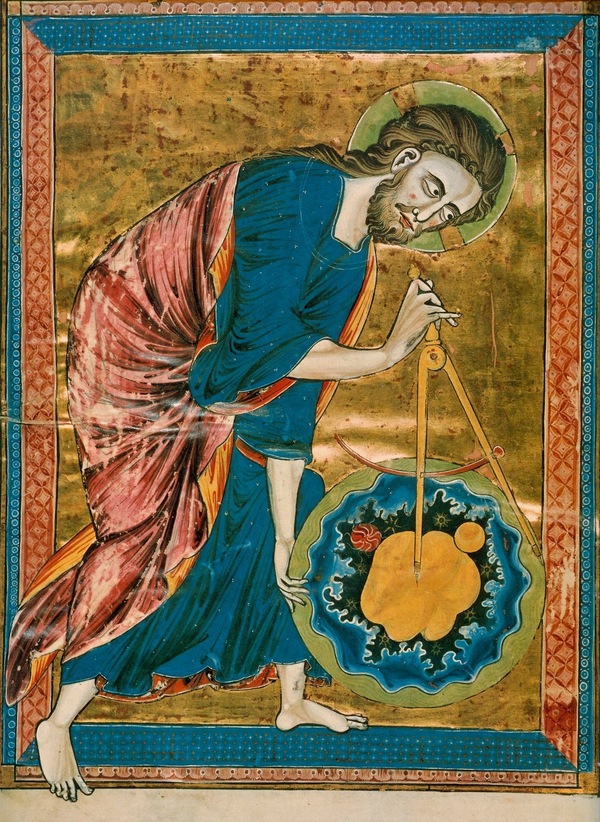
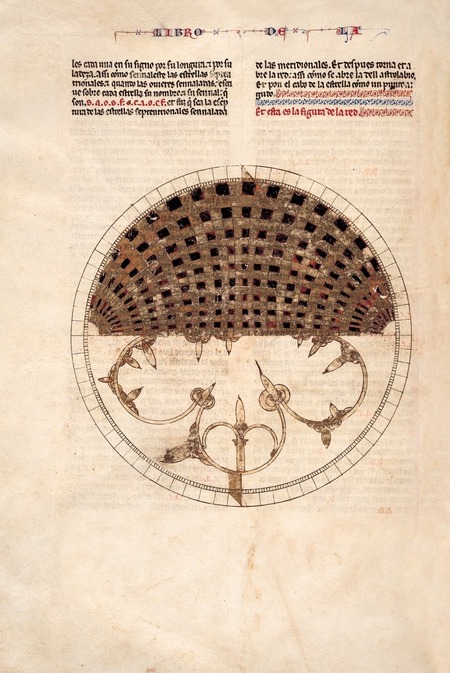
3 — Unknown Author. «Bible moralisée, ” 1225–1249. [5]; 4 — Alfonso X the Wise. „Libro del saber de astrología, ” 1276–1279. [6] [7]
II. Giotto and the Time of the Gospel Event
1303–1305, early 14th century. Padua, Cappella Scrovegni.
Giotto di Bondone. Adoration of the Magi
The next work is «Adoration of the Magi.» Enrico Scrovegni commissioned Giotto di Bondone to paint the chapel’s frescoes. This piece is part of a cycle depicting the life of Christ. In Figure 2, a vibrant head with a long, fiery tail is visible above the roofline. It directs the viewer’s gaze toward the group featuring Mary, the Infant, and the Magi.
Sacrobosco’s De sphaera // The Sphere. Max Planck Institute for the History of Science. — URL: https://sphaera.mpiwg-berlin.mpg.de/collections/sacrobosco_sphaera.html (Accessed: 10.11.2026).
Dante’s Idea of Paradise and the Cosmos // Discover Dante. University of Leeds. — URL: https://ahc.leeds.ac.uk/discover-dante/doc/paradiso (Accessed: 10.11.2026).
Meagher, J. Italian Painting of the Later Middle Ages / J. Meagher // Heilbrunn Timeline of Art History. The Metropolitan Museum of Art. — 2010. — URL: https://www.metmuseum.org/essays/italian-painting-of-the-later-middle-ages (Accessed: 10.11.2026).
Alighieri, D. Paradiso. Canto I, vv. 103–105 / D. Alighieri // Princeton Dante Project. Princeton University. — URL: https://dante.princeton.edu/cgi-bin/dante/DispPoemByTitle.pl?LINE=103-105&SECT=i.&TITLE=Par (Accessed: 11.11.2026).
Cod. 2554, fol. Iv: Bible moralisée (French): God as Creator of the World // ÖNB Digital. Austrian National Library. — URL: https://viewer.onb.ac.at/10017A6C/6 (Accessed: 12.11.2026).
Alfonso X. Libro del saber de astrología: BH MSS 156 // Biblioteca Histórica Marqués de Valdecilla. Complutense University of Madrid. — URL: https://www.ucm.es/historica/libros-del-saber-de-astronomia (Accessed: 10.11.2026).
Alfonso X. Libro del saber de astrología: BH MSS 156: Digital copy of the manuscript // Digital Heritage. Complutense University of Madrid. — CC BY 4.0. — URL: https://patrimoniodigital.ucm.es/s/patrimonio/item/139 (Accessed: 10.11.2026).
García Avilés, A. Magic Images. The Astromagic Work of Alfonso X and Its Fortune in Late Medieval Europe / A. García Avilés // Virtual Miguel de Cervantes Library. — URL: https://www.cervantesvirtual.com/obra-visor/imagenes-magicas-la-obra-astromagica-de-alfonso-x-y-su-fortuna-en-la-europa-bajomedieval/html/e12ecb23-b8d4-46c0-a2a0-ca9a692b991a_18.html (Accessed: 10.11.2026).
l
l
https://commons.wikimedia.org/wiki/File:God_the_Geometer.jpg (Accessed: November 12, 2026)
https://biblioteca.ucm.es/historica/file/bh-mss-156-h.-86v-?ver=n (Accessed: November 10, 2026)