Navigation
— Introduction — Social Context and the Role of Women in the Avant-Garde — Olga Rozanova — Lyubov Popova — Varvara Stepanova — The Influence of Female Artists on Modern Design — Conclusion
Introduction
Russian avant-garde emerged as one of the most radical artistic phenomena of the 20th century, decisively breaking with academic tradition and offering new ways to perceive, think about, and organize artistic space. However, within the established historical narrative, this innovation is often associated primarily with key male figures. Women who played an equally significant role in the formation of the avant-garde have remained on the periphery of scholarly attention. Their contributions rarely appear in textbooks, and their names are often known only to specialists. Yet, it was they who authored a large number of works that defined the language of the new era—from Suprematist painting to scenography, from experimental book graphics to Constructivist textiles.
This research is dedicated to reinstating the women of the Russian avant-garde at the center of art history. Through a visual analysis of their work, we aim to demonstrate that the avant-garde was not just a space for experimentation, but also a space of rare creative freedom for its time. Women within it were not an «exception”—on the contrary, many of the most innovative plastic solutions belonged to them. Their approach to artistic form was remarkably broad: they moved freely from painting to design, from the theatrical stage to typography, and from academic workshops to industrial experimentation. This interdisciplinarity became a crucial characteristic of the female avant-garde line.
The decision to explore this topic stems from a desire to reveal and highlight this specific multidimensionality. Engaging with the works of these artists reveals that the history of the avant-garde is incomplete without their voices. The paradox, however, is that despite the vast volume of work they created, their contribution remained undervalued for a long time. This was due to cultural, institutional, and ideological reasons—ranging from the dominance of male art schools to the postwar policies of canonizing select authors. Therefore, reconstructing their place today is not just a scholarly endeavor, but a cultural imperative: to restore visibility to those who shaped the visual style of an entire era.
The central question posed by this research is: what role did women play in the development of the Russian Avant-garde, and why has their contribution been partially sidelined in the canonical narrative? The study operates from the hypothesis that women’s artistic practice within the Avant-garde possessed its own distinct characteristics—a synthesis of thought, an acute attention to materiality, active transitions between mediums, and a willingness to experiment with applied forms. Moreover, it was women who made significant strides in integrating art with daily life: many Constructivist projects spanning fashion, textiles, scenography, and visual communication were created by them.
The research aims to demonstrate that women of the Russian Avant-garde were not mere companions but full-fledged creators of a new artistic language. Their work is not an aside in art history; it constitutes one of the most vital chapters in the evolution of art during the first third of the 20th century.
Social Context and the Role of Women in the Avant-Garde
The Russian avant-garde developed amid rapid social change: the modernization of cities, the emergence of new educational institutions, the growth of print culture, and artistic associations. In this dynamic environment, women gained sustainable access to professional art education for the first time. The founding of art studios, private schools, and «Free Workshops» created a situation where talent mattered more than social standing. This institutional restructuring was the primary condition for the emergence of a vibrant female presence in the avant-garde.
For female artists, avant-garde environments—futurist associations, Constructivist laboratories, theater studios, and the Vitebsk School—became spaces where experimentation was valued above adherence to tradition. Women participated in collective projects on equal footing: they worked in publishing houses, created scenography, designed textiles and costumes, and participated in composition and form theory courses. Their contributions were primarily tied to applied and interdisciplinary fields—those where the avant-garde sought to connect art with real life. This direction, unlike the «canon» of painting, became less visible later, but many technological and visual innovations occurred within it.
Despite their actual involvement, women’s names long remained on the periphery of art history. The reason was a combination of institutional stereotypes and the fact that a significant portion of their work related to ephemeral media: stage constructions, theatrical costumes, experimental textiles, and book graphics. These materials deteriorated more easily and were less frequently acquired by museums, which complicated subsequent research. Yet, it was these very areas that set new visual standards for the era and shaped the aesthetic environment of the 1920s.
Therefore, engaging with the female avant-garde is not an attempt to «complete» history, but a necessity to understand its structure. Women played a key role in transforming the avant-garde into an interdisciplinary art form that extended beyond the painting canvas. They worked where new forms were born—in movement, in material, in fabric, and in the stage space. Comprehending their contributions helps us see the avant-garde not as a collection of isolated manifestos, but as a broad system of artistic practices shaped by collective effort.
Olga Rosanova
Olga Rozanova is one of the most original figures of the Russian avant-garde. Her work is characterized by a distinct plastic freedom that does not adhere to the rigid geometry of Cubo-Futurism or Constructivism. In her pieces, color becomes an independent driving force of the composition, making her exploration unique among artists of her circle.
This section is dedicated to how Rozanova arrived at this visual language and which works define her contribution to the development of avant-garde abstraction.
Olga Rozanova was born in 1886 in Vladimir to a clerk’s family. Like many female artists of her time, she began her creative journey in private art schools in Moscow—the Stroganov School and Konstantin Yuon’s studios. Unlike academic courses, these studios allowed students to experiment freely and familiarize themselves with the newest European trends.
A pivotal moment came when she connected with Moscow Futurists in the early 1910s. Rozanova participated in the renowned «Bobnovy Valet» exhibitions, collaborated with Cubo-Futurists, worked on Futurist books, and experimented with hand-typography. It was during this period that her intense engagement with color and rhythm began to take shape.
After encountering Suprematism between 1916 and 1917, Rozanova developed her own concept of abstraction, one distinct from Malevich’s work. Her later compositions were not built upon geometric rigidity but on an internal impulse of color that seemed to «vibrate» within the plane. Her short but intensely rich creative life concluded in 1918 when the artist died at the age of 32. Despite her early passing, her influence on the development of color abstraction is immense and remains underexplored.
«Green Strip,» Olga Rozanova, 1917.
One of Rozanova’s most concise yet expressive works. Unlike Malevich’s Suprematism, where color is subservient to form, here color becomes an independent actor in the composition. The green vertical seems to slice through the space, establishing tension between brilliance and emptiness. The work demonstrates the artist’s shift toward «pure» color solutions, which would later influence European Neoplasticism and American color abstraction.
«Non-Objective Composition, ” Olga Rozanova, 1916–1917.
This work dates from a period of Rosa’s active engagement with Suprematism, yet it almost entirely lacks geometric rigor. Instead of constructing compositions through the juxtaposition of forms, Rosa creates a dynamic structure built upon the interaction of color fields—they seem to collide, repel, and engage in a rhythmic dialogue. This is one of the early examples of «emotional» Suprematism.
Color Painting, Olga Rosanova. 1918
Three primary color blocks interact as elements of visual mechanics. The yellow field creates vibration, the red acts as an impulse, and the black functions as a visual stop sign—a point of fixation. The composition’s structure is built upon the intersection of diagonals and verticals, yet it is not reduced to a geometric code; the artist maintains a dynamic, «painterly» trace. The painting demonstrates how Rozanova evolves Suprematism toward a painterly temperament, distinguishing her from her peers in the movement.
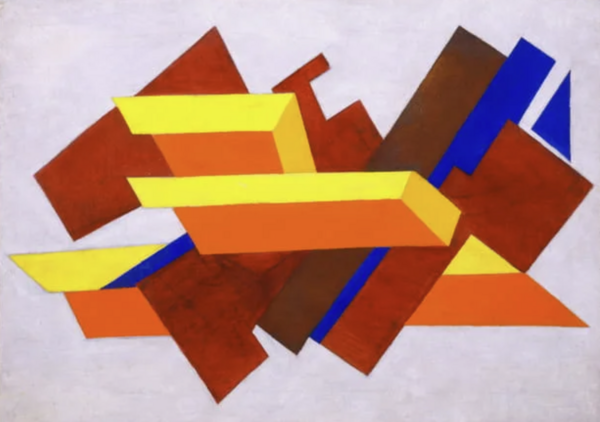
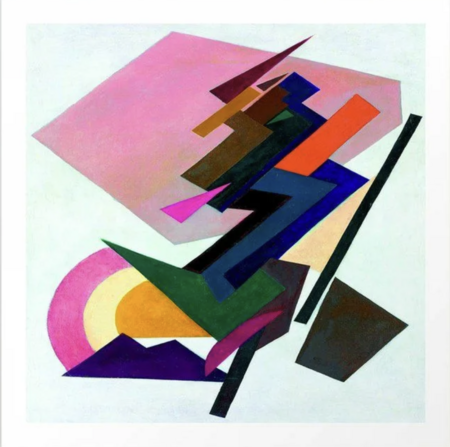
The artist’s pursuit of pure color is evident. The lines are not contours of objects—they are autonomous, free-form elements. The internal dynamics of the composition are created not through shape, but through the saturation of the colors. Rosanova here advances the understanding of color as a primary artistic material, establishing her as a precursor to the color field in 20th-century painting.
Rozanova is one of those artists whose work demonstrates that the female line of the avant-garde was not secondary, but independent and groundbreaking. Her color studies anticipated many trends of modernism, and her futuristic book projects became significant examples of the synthesis of art and print. Most importantly, her works showcase a freedom that was often lacking in more systematic avant-garde movements. In this sense, Rozanova is a vital reference point for understanding how women shaped the visual language of the era.
Lyubov Popova
Lyubov Popova is one of the key figures of the Russian avant-garde, whose work merges the energy of Cubo-Futurism, the analytical rigor of Constructivism, and the search for a «universal» artistic form. For her, what matters is not the severity of pure expression, but the principle of construction: a painting, object, textile, or set design is perceived as a system that the artist assembles, organizes, and infuses with internal movement. This section is dedicated to how Popova arrived at her Constructivist method and which works define her contribution to the avant-garde.
Lyubov Popova was born in 1889 in Ivanovo-Sergievskoye, a town near Moscow. Having received a strong private education, she began her studies at private Moscow studios—with Yone and Rerikh—before continuing at the Parisian ateliers of La Fressonnière and Colarossi. Thanks to this European environment, Popova was quickly exposed to the newest movements: Cubism, Orphism, and Futurism.
By the early 1910s, she was actively participating in the exhibitions «The Knave of Bourbon» and the «Youth Union.» During this period, her interest grew in the structure of the image and the decomposition of form into dynamic elements. Following trips to Italy and France, Popova worked within the stream of Cubo-Futurism, creating complex compositions where objects seemed to «disintegrate» into energetic planes.
Between 1917 and 1921, the artist arrived at a constructivist mindset: she was not interested in depicting an object—only in the construction as a universal principle of design. Popova worked in theater, created propaganda panels and textile prints, and participated in Vkhutemas studios. She became one of the primary theorists and practitioners of early Constructivism. Her early death in 1924 from scarlet fever interrupted the rapid development of her artistic language.
Pictorial Architectonics, Popova L. S. 1916.
Popova explores the interaction between color and spatial planes, generating a sense of internal tension within the structure. The form becomes dynamic, as if assembled from «forceful» lines.
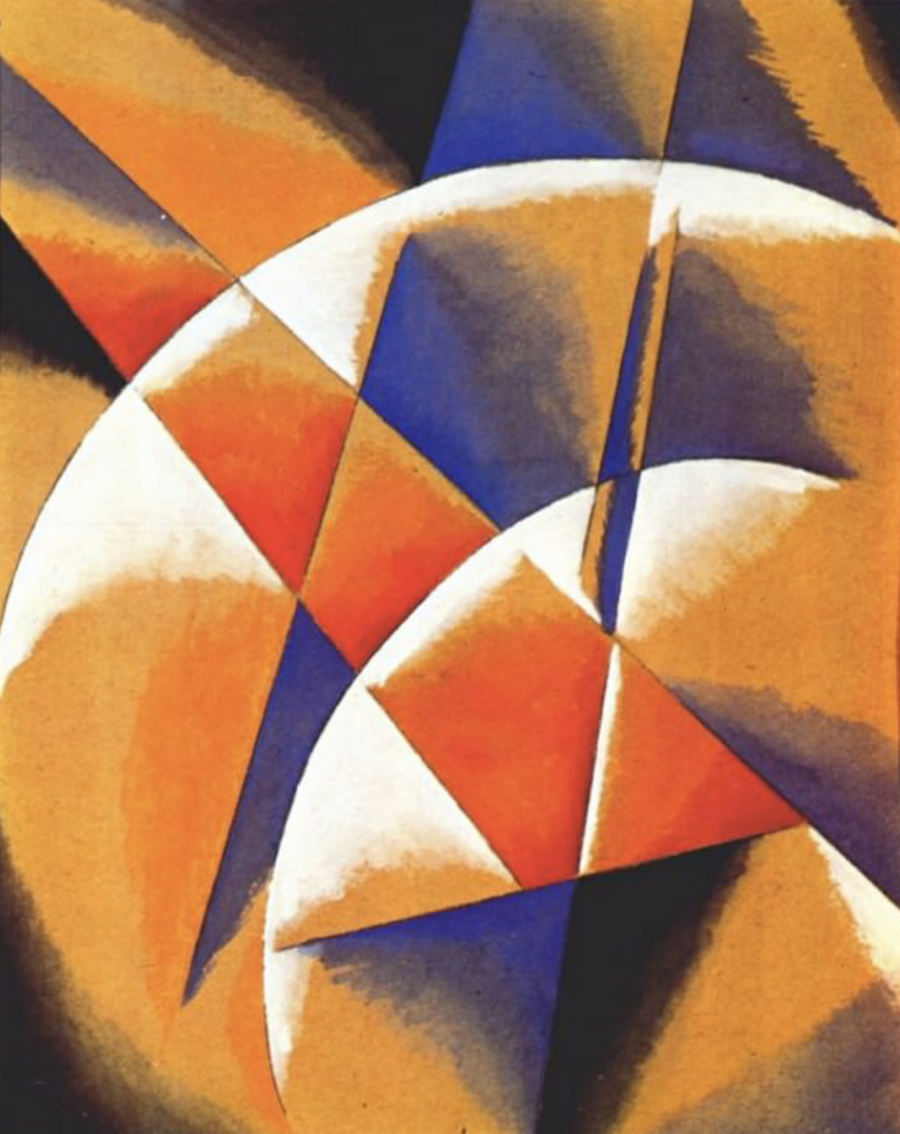
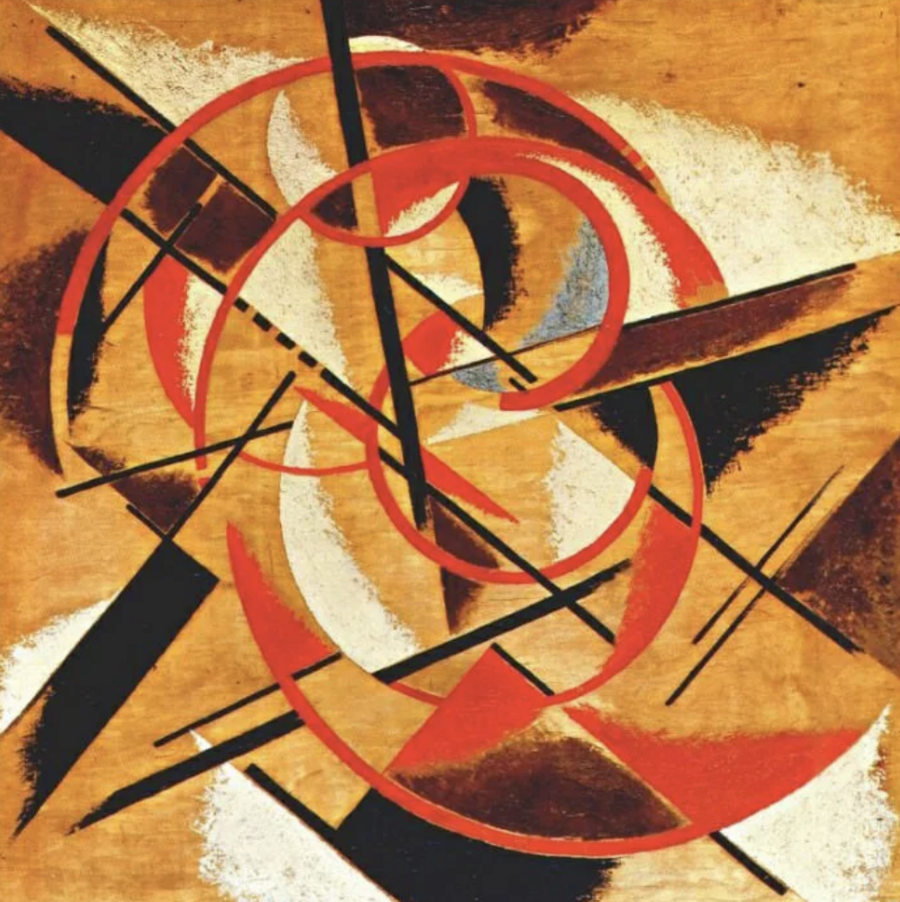
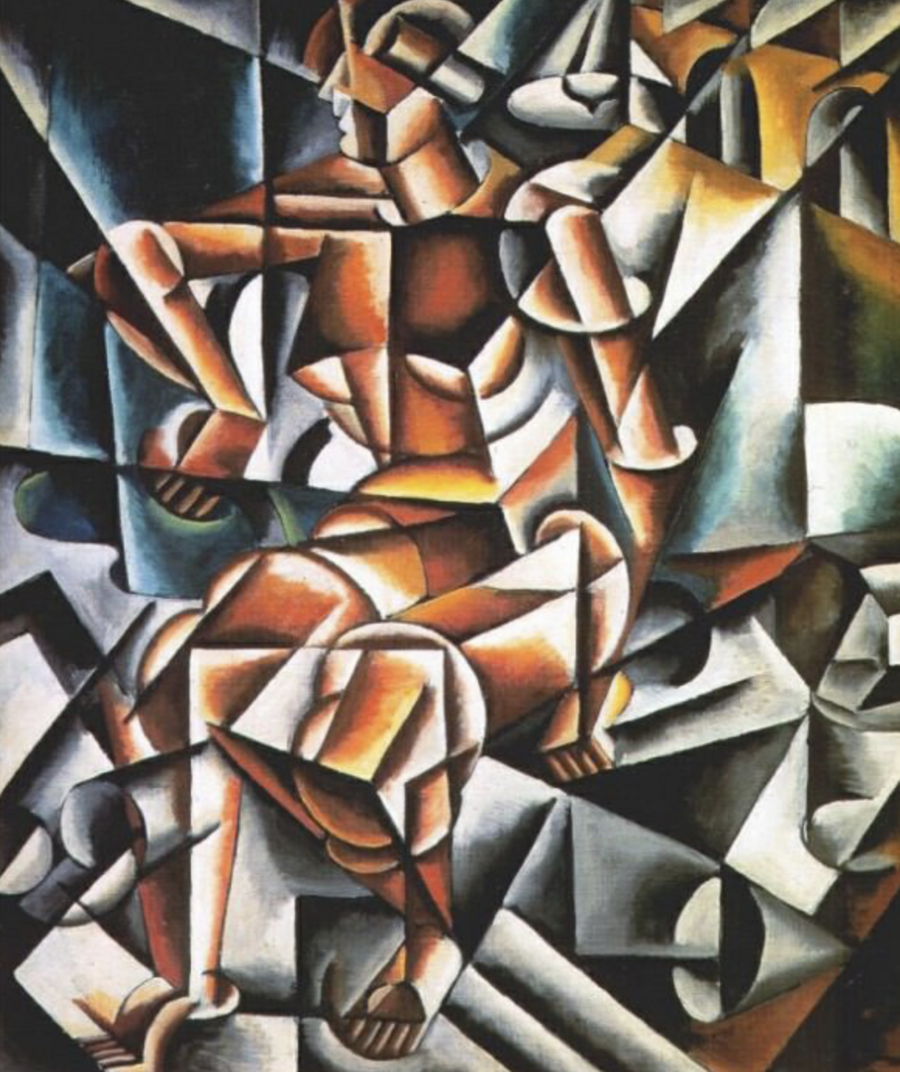
Spatial-force structure, 1921 / Human + air + space. 1915/ Composition, 1921
The composition is built on the interplay of diagonals that «pull» the space of the painting in different directions. This is an experiment with the perception of depth—it is not depicted in the traditional way, but is constructed through the tension of the lines. The work demonstrates how the artist seeks to move away from representationality, leaving behind only the principles of movement and structure.
Design for the installation for the studio of V. Meyerhold’s «The Greathearted Hornblower.» Paper, collage, ink. 1922. GTG