Concept
This study analyzes the work of British composer Trevor Wishart through the lens of the modern technological age. The key question here is how the interplay between the human and the technological in his compositional practice is influenced by historical context, and whether this relationship will be reflected in the contemporary phenomenon of virtual spaces.
Topic Selection is driven by the fact that contemporary sound art is almost entirely based on computer technologies. Trevor Wishart is a composer-programmer, an innovator in the field of digital sound transformation and its application in compositional practice. In his concept of sound art, the primary focus is liberation from conventional European sound thinking—a mindset imposed by the limited palette of timbres and the structure of classical musical notation—and this liberation is primarily made possible by computer technologies.
However, music—an art of shared experience—has its roots in live interaction, in the collective gathering of people. A strong interest in the human voice, and in communities where the voice serves both as a mediator and a portrait, features prominently in Wishart’s practice. Yet, in the contemporary context, communities almost invariably incorporate a virtual and technological component, ranging from group chats to fully virtual metaverses. The concert, as a collective form of musical experience, continues not only in physical space but also in virtual space. Spaces within VRChat serve as an example, used as venues for performances, raves, and installations.
The interest, therefore, lies in the friction between the in-person and the technologically mediated, the collective and the individual. Is it possible to translate the essence of Weishart’s sound art into a fully virtual environment? The central hypothesis of this research is that virtual space serves as a technical extension of Weishart’s ideas, yet it only achieves the same artistic function under the condition of a deliberately designed act of collective listening.
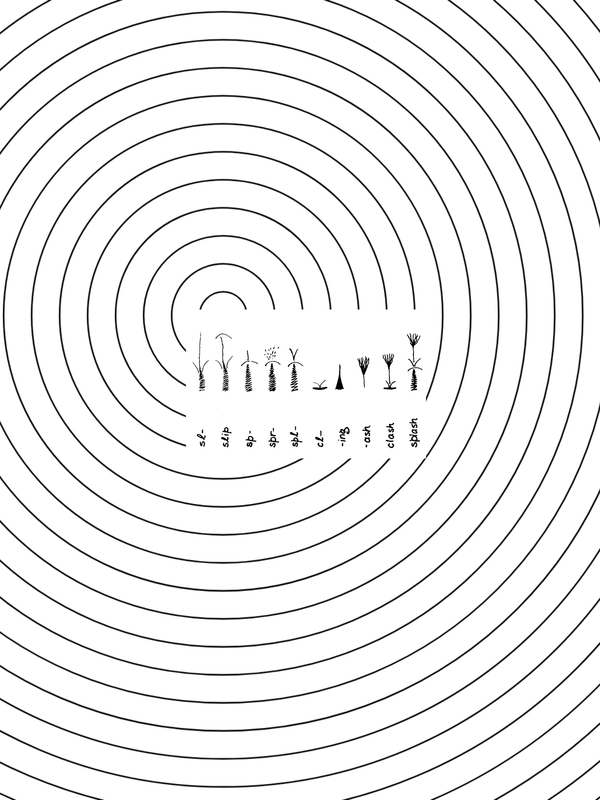
The visual materials for the research include: Whishart’s graphic and «anti-scores,» which demonstrate the author’s system of signs and visual thinking; the covers of his works, reflecting his overall aesthetic; and screenshots of various VRChat environments.
Textual sources consist of Whishart’s own books, interviews, and artwork descriptions, VRChat documentation, as well as related academic literature.
Research Structure:I. The Aesthetics and Practice of Trevor Wishart1. Technologies: transformations and space 2. Voice: instrument and language 3. Community: collective portrait and societyII. VRChat: the metaverse as a location1. Technologies: play and virtual space 2. Voice: avatar and spatial audio 3. Community: concert and collective experienceIII. The Garden of Earthly Delights in virtual space1. Architecture 2. Sound 3. Scenario for collective listening
Aesthetics and Practice of Trevor Wishart
Trevor Wishart in a home studio, circa 2008
Trevor Wishart is a British composer, performer, and sound researcher, born on October 11, 1946, in Leeds, United Kingdom. After beginning his studies as a chemist at Oxford, he soon transitioned to music, completing his degree at the University of York while simultaneously mastering programming. His practice exists at the intersection of electroacoustic music, digital sound processing, vocal performance, and musical theater.
Technologies: Transformation and Space
The cover for the first Wishart release — Machine, a re-release by Paradigm Discs, 2008, by Clive Graham
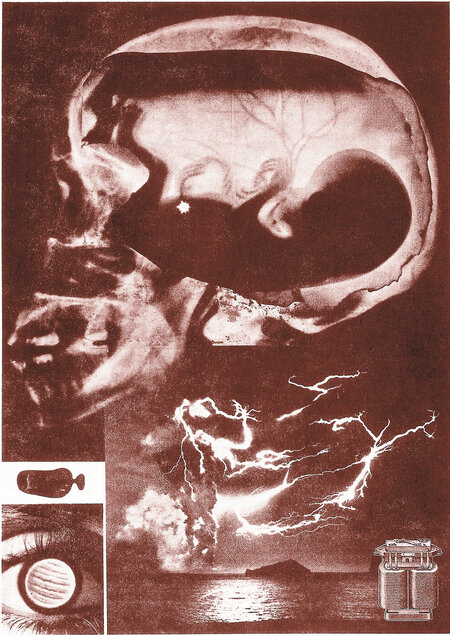
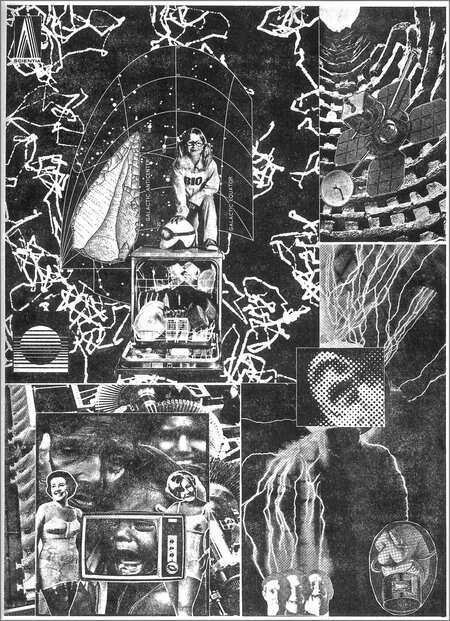
Images from the Machine 2008 booklet by Peter Coleman
In the early 1970s, Wishart began treating the surrounding acoustic environment as independent musical material. After his father, who worked at a factory in Leeds, passed away, the composer started recording the sounds of industrial production in Leeds and Nottingham. In Machine (1970–1971, released in 1973), recordings of machinery, human speech, and improvised choral parts are combined through montage and layering.
This approach develops within the context of post-war electroacoustic music and the tradition of musique concrète, which originated in France in the late 1940s. By the early 1970s, tape recording, montage, manipulation of playback speed, and mixing had already become significant tools in experimental composition. However, in Wishart’s approach, industrial noise retains a connection to the real world and becomes part of a musical narrative that, in scope and variety, approaches a theatrical production.
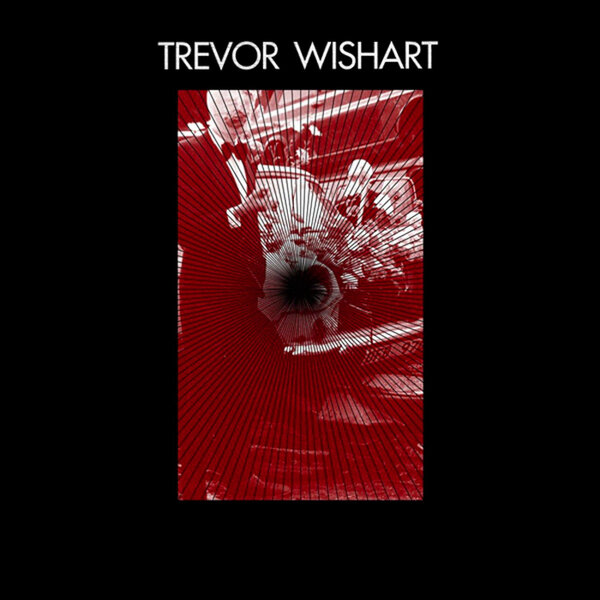
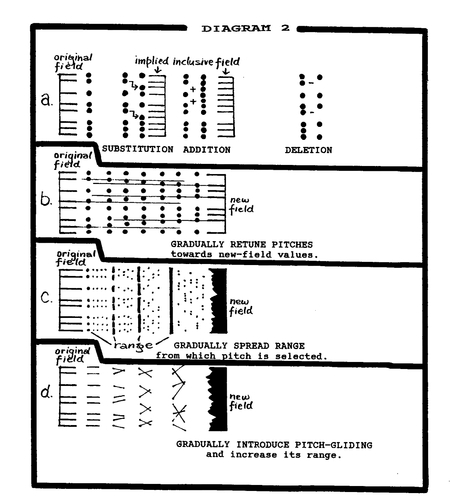
Left: Cover of the publication Fanfare & Contrapunctus / Imago, on the PAN label, 2010, Kathryn Politis & Bill Kouligas Right: Diagram from the book Audible Design — Algorithms of Sound Field Manipulation, 1994, Trevor Wishart
In the 1980s, Wishart began developing his own software tools to manage the internal structure of sound. In 1985–1986, he co-founded the Composers' Desktop Project (CDP) with a group of composers and developers. His goal was to make complex digital audio processing accessible on personal computers.
Unlike many musical programs of that time, CDP was conceived not as a means of imitating existing instruments, but as a set of specialized sound tools that a composer could select and combine according to the artistic objective.
In Imago, this practice achieves particularly striking expression: a single source sound passes sequentially through numerous processing operations, generating diverse timbres and textures. The technology becomes not merely a method of recording manipulation, but the foundation of compositional form.
Voice: Tool and Language
Cover art for the double album Red Bird / Anticredos & Voiceprints, ICR Distribution, 2019
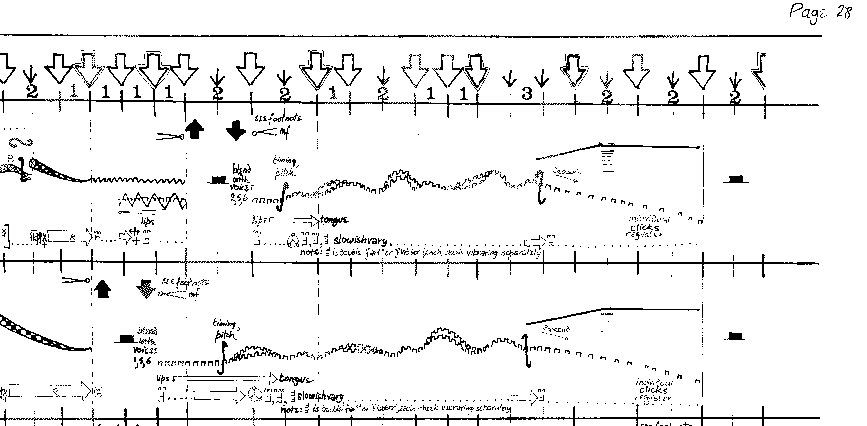
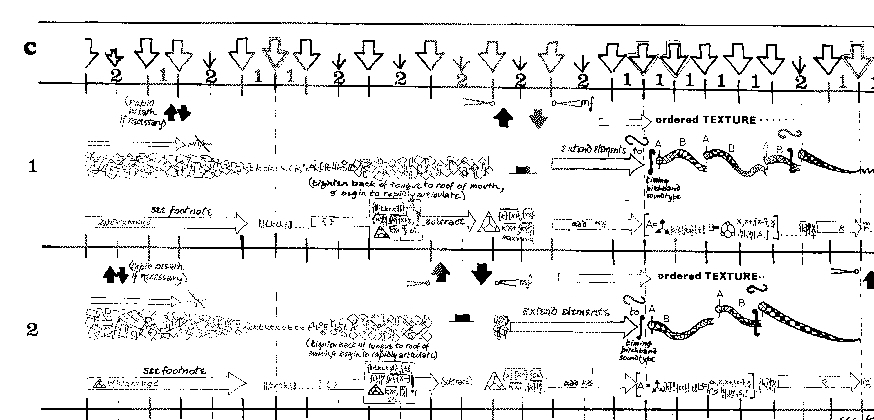
Excerpt from the score to Anticredos, 1980, Trevor Wishart







