Concept
Compressed network video is typically perceived as a transparent carrier of an image: the viewer notices the narrative, and the codec’s work remains invisible. Datamoshing alters this hierarchy. Blocks, motion trails, and segments of the original image that persist within the subsequent frame move to the forefront. This topic was chosen because such a failure allows us to view digital video as a material possessing its own memory and transformation rules. I am not interested in any arbitrarily «damaged» image, but rather in the aesthetics of intervening in inter-frame compression—a situation where the movement and appearance of objects cease to align. Unlike the broad concept of glitching, which encompasses numerous errors and their imitations, datamoshing here defines a narrower area of analysis. It allows one to connect the technical structure of a file to how an image organizes time, conceals a cut, and retains the trace of a vanished object.
The key research question is how video codec glitches transform into an independent artistic language within net video art. The hypothesis is that the expressiveness of datamoshing emerges from a disruption of temporal continuity: fragments from the preceding scene persist and adhere to the motion of the new one, thereby creating a tension between the recognizable image and the codec’s behavior.
The main body covers works from 2003–2011; the epilogue references the tools from 2021 and 2023 as evidence of the method’s continued proliferation. Material is selected based on three criteria: proven work with compression, the ability to observe image change over time, and the availability of either authorial or institutional documentation. The visual material is constructed from sequential shots, video fragments, and comparisons of similar techniques across different artists. Alongside the experimental video, music videos and the tools through which the technique becomes reproducible are presented. Their inclusion does not imply that any work published online is net.art. The network environment is examined as a condition for the exchange of files, knowledge, and examples—it influences the accessibility of the method and the ways it is recognized, rather than solely ensuring the delivery of the final video to the viewer.
The structure connects chronology with formal analysis. First, the mechanism of interframe compression is introduced, and the difference between datamoshing and neighboring effects is defined. Then, early experiments are examined—the transformation of error into a sustained technique, its transition into mass visual culture, and its subsequent instrumentalization. In each section, the recognizability of the object, the nature of the movement, the boundary of the edit splice, and the duration of the residual trace are compared. Textual sources are selected based on their purpose: authors' pages and archives clarify the titles, dates, and context of the works; technical documentation explains the mechanism; and theoretical papers help discuss the materiality of digital imagery. None of these types of sources replaces the observation of the video itself. The conclusion links the comparison results to the hypothesis: it allows us to determine which properties of compression became elements of artistic language and how their networked dissemination altered the meaning of the glitch.
The expressiveness of datamoshing emerges from the rift between an image and its own motion. In the new plane, the material of the previous work continues to live on. The glitch reveals the file’s temporal memory.
Code as Memory
In inter-frame compression, part of the image is reconstructed using already decoded frames. In a simplified scheme, an I-frame is encoded independently, a P-frame relies on previous images, and a B-frame can use references on both sides of itself in the display order. To reconstruct the predicted frame, the decoder shifts the blocks of the reference image and adds the residual difference—a correction that refines the result. This allows some data from the previous image to be utilized in the construction of the next one.
One classic method of datamashing involves removing the frame that is meant to update the reference image at the boundary between two scenes. The decoder can apply movement data from the new scene to the retained image of the previous scene. As a result, the montage splice is stretched over time: contours from the past shot remain discernible, even though their movement has already dictated the next. How long this trace persists and how the new scene emerges depends on the video format and the decoder.
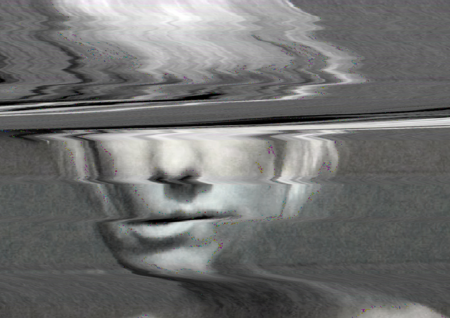
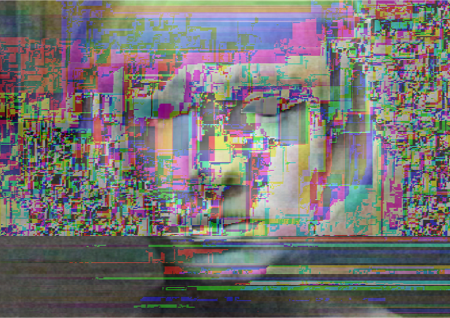
Roza Menkman. A Vernacular of File Formats — BMP. 2010.
In the project «A Vernacular of File Formats, ” Rosa Menkman demonstrates how distortions in BMP and PNG files manifest as banding and color shifts. In a single stop-frame, these artifacts can resemble datamoshing. The difference becomes apparent when analyzing the sequence of frames: in datamoshing, it is crucial to track how the image from the preceding scene is retained after splicing and altered by the motion of the next scene.
Outline in a state of decay
In early compression experiments, the way the viewer recognizes an image changes. In Jacques Perconte’s «Uaoen, ” trees and the distant background remain discernible, even as their details fade into soft color patches. The bright strip of the road and dark silhouettes help reconstruct the depth of the space. A few such landmarks are enough for the image to continue being read as a landscape.
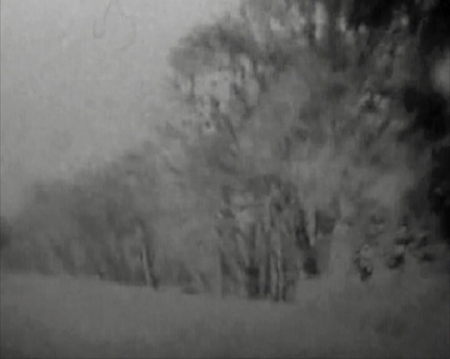
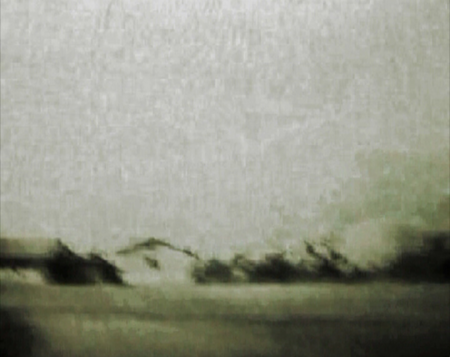
Jacques Perconte. Uaoen. 2003.
Jacques Perconte. Uaoen. 2003.
For «Monster Movie, ” Takeshi Murata took a clip from the film Caveman (1981) and processed it frame by frame. In his work, the character alternately emerges from blocks of color or merges with them. Even when the silhouette dissolves, individual fragments allow the figure to be recognized again. The viewer’s gaze shifts between the character and the abstract surface from which it arises.
Takeshi Murata. Monster Movie. 2005.
In one frame from «Monster Movie, ” a dark profile with an open mouth is surrounded by green, white, and violet blocks. The contour is still discernible, but in places, it merges with the background. In another frame, two light stripes with stepped edges stand out against a gray-blue field. It is difficult to assemble them into a single silhouette, so attention shifts to the variations in brightness and the rectangular texture of the image.Comparing museum stills from „Monster Movie“ shows how differently the figure is perceived within a single work. In some frames, a surviving fragment of the contour helps the viewer mentally complete the character. In others, the distortion is more pronounced, and the image is perceived as a combination of color masses. This reveals which details allow the form to remain recognizable even during severe disintegration.
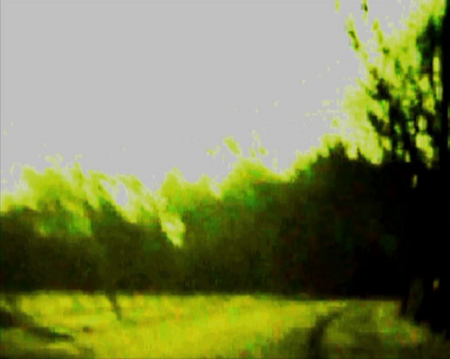
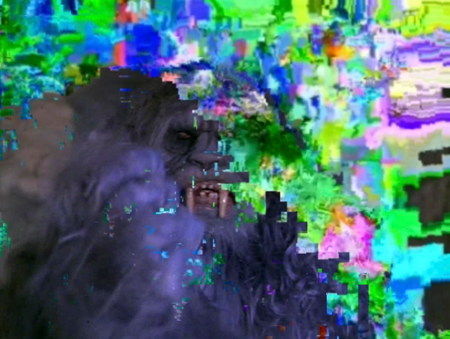
Jacques Perconte. Uaoen. 2003. / Takeshi Murata. Monster Movie. 2005.
In «Uaoen,» the light road and tree silhouettes preserve the memory of the space. In «Monster Movie,» the remnants of the character’s contour fulfill the same role. In both works, the viewer completes the whole from several details as the colored spots and blocks increasingly define the image.
The Network as a Workshop
In the project «Download Finished» (2006), the group! Mediengruppe Bitnik and Sven König invite the user to transform a downloaded video. The network becomes part of the work, as it is through it that the user receives both the source material and access to the processing tool. Familiar footage changes its appearance depending on what happens to the file. In the creation of the new image version, the authors of the tool and the user who initiates the transformation collaborate.
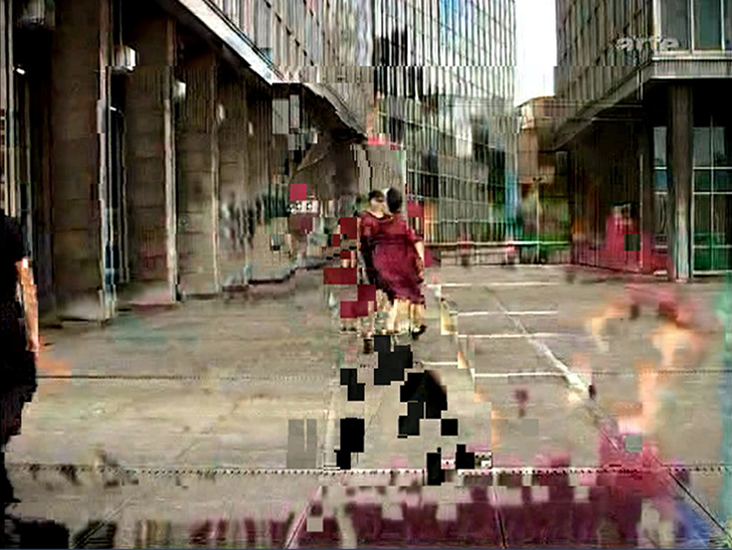
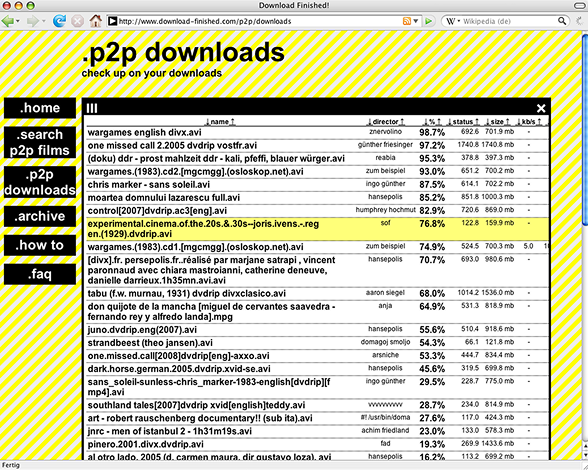
! Mediengruppe Bitnik, in collaboration with Sven König. Download Finished. 2006.
In the work «Video Compression Study II / Untitled Data Mash-Up» (2007), Paul B. Davis and Jacob Chiocchi utilize compression artifacts as part of the editing. In an interview, Davis connects Chiocchi’s title for the published clip, «umbrella zombie datamosh mistake.» This is one episode in the history of the term: the word datamosh appears in the title of a specific video and links the technique to an image that the viewer can see.
Paul B. Davies and Jacob Ciocchi / Paper Rad. Video Compression Study II / Untitled Data Mash-Up. 2007.
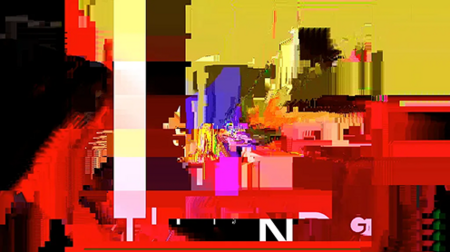
The title «Compression Reel» (2008) references the reel format in which the artist showcases his work. David O’Reilly constructs a collection around how compression alters an image. One frame against a blue field shows dark and green stripes, a red fragment, and traces of another plane. The shift between scenes is read by how their fragments coexist on screen for a period of time.
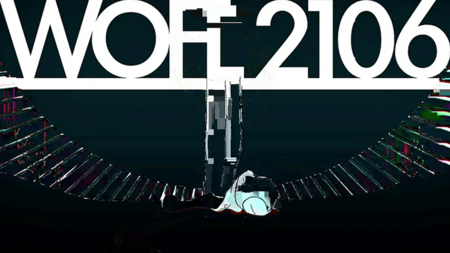
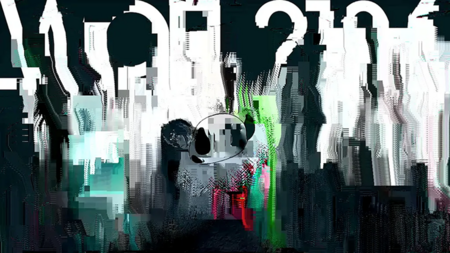
David O’Reilly. Compression Reel. 2008.
In the frame titled «octocat adventure 2,» the red background and text still hold the composition together, even though its center is already breaking down into colorful fragments. In another frame, large white letters stretch into strips along with a light vertical figure. The comparison shows that the text helps the viewer recognize the original image while it remains legible, only to then become part of the distortion.
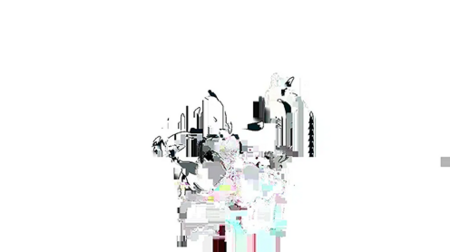
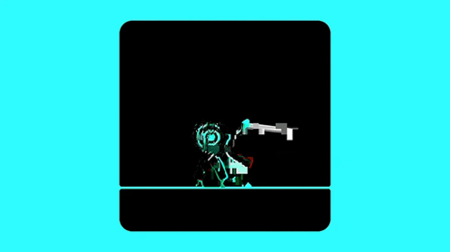
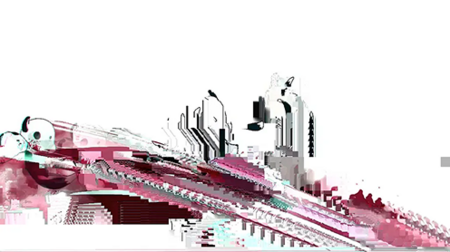
David O’Reilly. Compression Reel. 2008.