Concept
Queen’s music is often perceived through the grand scale of Freddie Mercury’s personality, his stage presence, and recognizable choruses, but behind this lies a far more complex system of musical decisions. The band experimented with harmony, melody structure, polyphony, instrumental timbres, and dynamics, turning every composition into an independent drama.
In this study, five songs are examined as five distinct ways to convey an emotional experience through music.
It is not only important what the songs are about, but also how the sound itself is constructed: why a melody is perceived as an affirmation, how the choir conveys solitude, and what lends a rock composition the scale of a symphonic piece.
Music is capable of telling stories without conventional narrative tools, and it doesn’t necessarily require a linear plot or concrete characters. Sometimes, a few chords and a change in melodic intonation can convey an experience far more expressively than a direct verbal explanation.Queen excelled at this—which is precisely why I decided to examine this capacity of music to construct its own emotional reality.
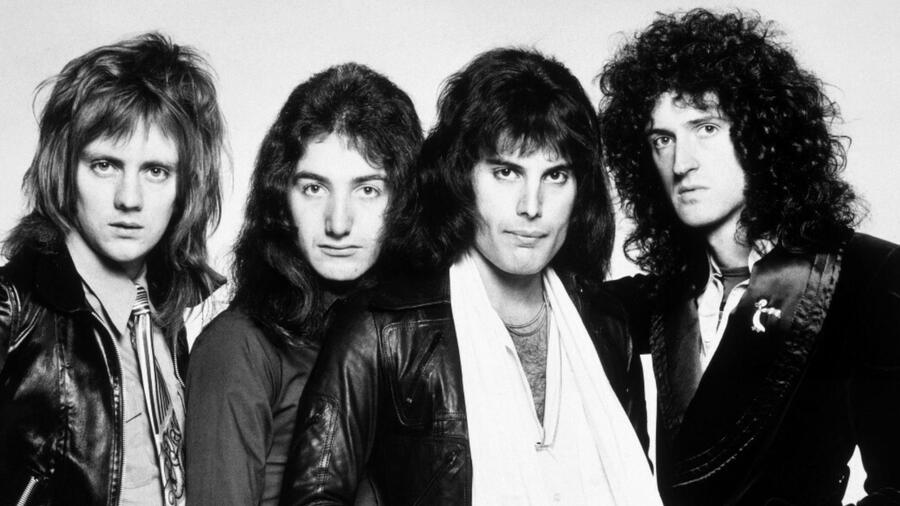
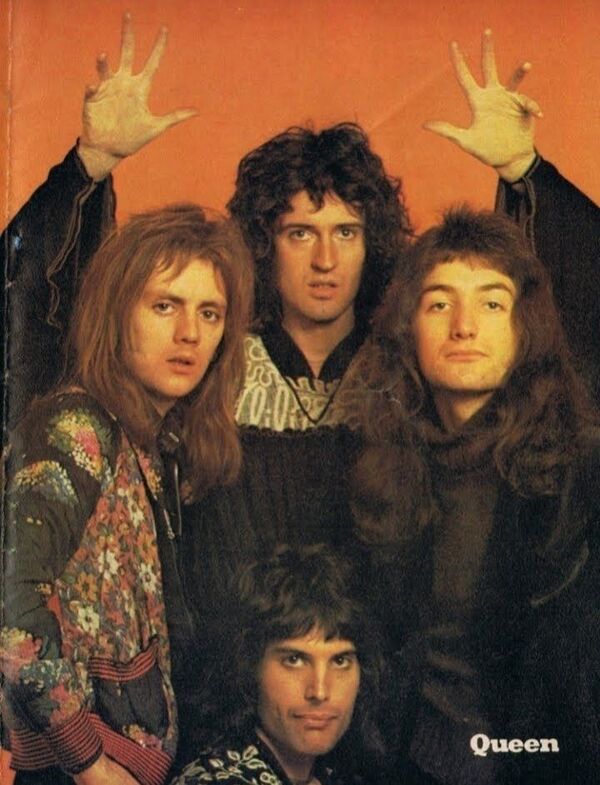
Queen. Archival group portrait, 1970s
Introduction. How does music create emotion?
The emotional impact of music is not confined to the lyrics alone; even when a listener does not understand the words, they can feel the emotion embedded in the song. This occurs through the interaction of musical elements, each serving a distinct expressive function. The work of the British band Queen is particularly fascinating from the perspective of this element interaction, as their creativity freely merges rock, operatic inflections, gospel, ballad structure, and orchestral techniques. In their music, these elements rarely exist in isolation, constantly interacting to create musical contrasts. Consequently, chamber piano accompaniment in their compositions can gradually transform into a grand polyphony, and a singular vocal line can become the foundation of a collective performance.
Queen during the 1970s studio period
The study examines five songs that distinctly demonstrate varied approaches to building emotional dramaturgy: «Love of My Life» (1975), «Somebody to Love» (1976), «Who Wants to Live Forever» (1986), «We Are the Champions» (1977), and «The Show Must Go On» (1991).
01. LOVE OF MY LIFE
Love of My Life—one of Queen’s most intimate compositions. Against the backdrop of the album A Night at the Opera's grand musical experiments, the song stands out with its restrained texture and focus on the vocal melody.
Freddie Mercury and Brian May during a performance of «Love of My Life.» Live performance with acoustic guitar.
The composition begins with a piano introduction, where the instrument immediately establishes the harmonic foundation. It dictates the character of the subsequent sound, creating the appropriate atmosphere from the outset, thus immediately immersing the listener in the story. Mercury’s part, in turn, is not limited to simple accompaniment. It generates independent melodic movements, smooth transitions, and ornaments characteristic of classical piano music.The piano creates a sense of space where the voice can develop freely. Furthermore, the accompaniment does not overcrowd the composition: a proper balance is maintained between instrumental phrases and vocals. Harmony is also of particular importance. Despite the ballad’s outward simplicity, it utilizes not only stable chords but also additional harmonic nuances that make the sound more expressive and less predictable.
A key detail in the original studio recording is the harp Brian May played. It is a very unusual instrument for rock composition, but despite this, it is perfectly suited for Queen.
The harp does not replace the piano; rather, it creates an additional timbral layer, and its sound is particularly noticeable during specific transitions and at the conclusion of the composition. This is one of the rare instances of a real orchestral harp being used in Queen’s discography.
Brian May learned to play it specifically for recording the song, and it paid off: the characteristic sweeping transitions between notes added softness and airiness to the sound, making the song’s mood even truer.
Queen during the recording of the album A Night at the Opera, 1975.
Mercury’s vocal part is characterized by the smoothness and length of its phrases. He avoids the forceful performance style typical of rock music here.
His voice is soft, with subtle inflections and careful attention to the end of each phrase, allowing individual notes to resonate long enough for the listener to focus on the intonation itself.The interplay between the lead vocal and the background vocals is particularly interesting. In certain sections of the composition, additional voices join the main line, broadening its sound, yet they never transform the song into a full choir—the chamber quality remains intact.
It is also interesting to note the song’s transformation in the live performance setting, as Bryan May re-worked the composition for a twelve-string acoustic guitar despite the studio version being based on Freddie Mercury’s piano.
This instrumental shift influenced the overall sound, and the guitar part made the song more open and suitable for a large stage performance. Consequently, the intimate piece evolved into a unique dialogue between the musicians and the audience, where the crowd began to perform a significant portion of the melody independently.
«Love of My Life» demonstrates that musical expressiveness can arise from minimalism, and the small ensemble and restrained delivery allow for a powerful emotional impact.
02. SOMEBODY TO LOVE
If Love of My Life is built on intimacy, then Somebody to Love presents the opposite principle of musical organization.
Queen during the recording of the studio version of the composition «Somebody to Love,» 1976.
The composition features not only a solo vocal but also a complex structure that conveys the impression of a full choir. It is this element that gives the song its unique scope. Simultaneously, its core emotional theme revolves around solitude and the search for connection, creating an interesting contrast: the experience of an individual is expressed through a collective soundscape.
A primary source of inspiration for the composition was the gospel tradition—a genre of spiritual music that relies heavily on collective singing, emotional delivery, and vocal interplay. Freddie Mercury was inspired by Aretha Franklin’s vocal style and the character of gospel performance, but Queen did not simply want to reproduce the sound of a church choir. Their goal was to create something new and compelling, so they decided to merge the characteristics of a choir with rock music, utilizing signature harmonies, polyphony, and a gradual increase in musical intensity.
One of the most compelling aspects of the song is that the grand choral sound is created by the voices of the group members themselves.
Freddie Mercury, Brian May, and Roger Taylor would record numerous vocal layers, which were later merged into a cohesive arrangement. The multiple superposition of individual parts created the feeling of a large vocal ensemble.At the same time, their voices form independent harmonic lines that interact with each other, giving the melody a distinct character. This allows for the creation of a complex sound structure where individual parts retain their own expressive quality while simultaneously forming a unified sonic whole.
Queen at a concert in Hyde Park, September 18, 1976
At the beginning of the song, the focus is on the lead vocal line and the piano; additional voices join in afterward. This polyphony transforms the perception of the composition’s protagonist: initially, the listener perceives him as an individual addressing the world, but then an entire soundscape emerges around his voice, seemingly responding to him. In other words, the chorus conveys the composition’s internal conflict.The song’s development is built upon the constant expansion of the sonic space, and Mercury utilizes a wide range of expressive devices—from a more restrained intonation to emotionally charged phrases with sustained notes.In the climactic sections, his voice becomes more intense. The supplementary vocal lines amplify the main melody, creating a sense of collective address. It is here that the close relationship between the vocal arrangement and the orchestration becomes apparent—without the polyphony, the composition would lose a significant portion of its dramatic power.
Freddie Mercury during a performance of Somebody to Love
03. WHO WANTS TO LIVE FOREVER
Who Wants to Live Forever is one of Queen’s most ambitious musical experiments. In this composition, rock instrumentation merges with a full symphony orchestra, and the song’s development evokes the construction of a cinematic musical scene.
The composition was written by Brian May for the film Highlander (1986). Its musical imagery is tied to themes of time, loss, and human mortality.
Unlike a traditional rock ballad, where the orchestra might serve as supplementary accompaniment, the symphonic sound defines the entire composition. The orchestration was prepared by Michael Kamen, who worked with the National Philharmonic Orchestra.