Navigation
1) Concept2) Form and Morphology: Visual Analysis3) Material Science: Texture and Color4) Semantics and Function: Context of Everyday Life5) Visual Sample Documentation Checklist6) Conclusion
Concept
This study stems from a contradiction recorded in museum data: the scarab is one of the most prolific items of ancient Egyptian material culture. According to the Royal Ontario Museum, «hundreds of thousands» of scarabs were produced over three millennia of pharaonic history, spanning from the First Intermediate Period to the Greco-Roman era. However, the visual form of the scarab remains strikingly consistent. While the base, size, material, and attachment method vary, the basic anatomical code of the carapace—the division of elytra, the clypeus, and leg segmentation—is reproduced with almost unwavering consistency. It is precisely this discrepancy between mass production and morphological conservatism that makes the scarab a productive object of visual inquiry: the stability of its form cannot be accidental; it suggests that visual recognizability was a prerequisite for the object’s function within daily practices.
The relevance of this work stems from the fact that museum descriptions and existing literature focus heavily on epigraphy and symbolic interpretation, while the question of how the object’s visual parameters—such as the backrest’s detail, the base’s configuration, material selection, and glaze color—encode its function remains on the periphery of research. Meanwhile, even a cursory typology suggests: a flattened base with engraving corresponds to a printing function, large size and the absence of a hole indicate a funerary purpose, and a tripartite structure with multiple perforations suggests the need for fastening on mummy wrappings.
Methodologically, the work is based on visual-typological analysis with elements of contextual interpretation. Sources include open data and images from the collections of the Art Institute of Chicago, the Metropolitan Museum of Art, and the Royal Ontario Museum. Four variables are tracked: the degree of backrest detail, the functional type of base engraving, material and color, and attachment method. Representative samples include the Senebtifi scarab (glazed steatite, 2,2 × 1,6 × 1.3 cm, Late Middle Kingdom) titled «Great Ten of Upper Egypt»; the heart scarab with a human head (basalt, 6,5 × 3,9 × 2.5 cm, New Kingdom) featuring ten lines of the 30B spell from the «Book of the Dead»; and the winged scarab of the 26th Dynasty (faience, blue glaze, 5,9 × 13 × 0.8 cm) with sewing holes.
The investigation centers on the question: do the form, material, and fastening method of the scarab constitute a system where every visual parameter corresponds to a specific use-case scenario? The preliminary hypothesis to be tested is as follows. In the ancient Egyptian context, material and color were not decorative but semantic: the blue glaze of the winged scarab refers to the «color and regenerative power of the sky, ” the green stone of the heart amulets is associated with rebirth and is recommended in the „Book of the Dead, ” and gold in the setting marks exceptional status. The fastening method is also functional: a longitudinal hole for stringing, a rotating wire for sealing, multiple piercings for sewing—each variant is visually „readable“ and sets a use-case scenario.
The visual materiality of the scarab forms a system of alignment: «function—material—semantics.» The endurance of this system over three millennia is not attributable to the inertia of tradition, but rather to the fact that the scarab’s utility in daily Egyptian life relied on the immediate recognizability of its form. The object had to be «readable» at first glance—whether in administrative practice, mortuary ritual, or personal magic. It was this visual transparency, rather than hidden symbolism, that secured the scarab’s unique position at the intersection of daily life and cult.
Form and Morphology: Visual Analysis
1.1. Zoomorphic Basis: Realism and Schematism
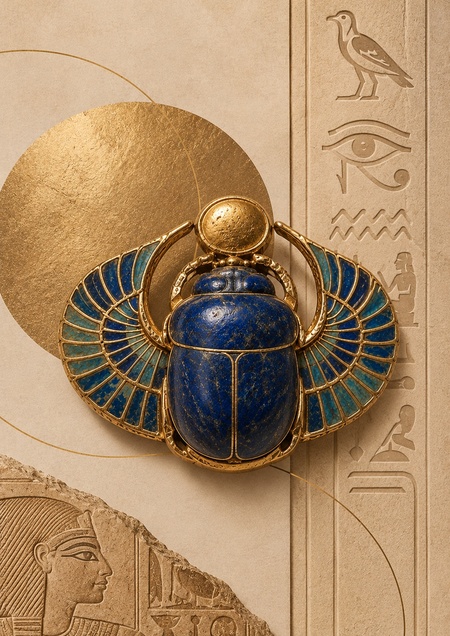
Winged Scarab Amulet, Late Period, Dynasty 26 (664–525 BCE). Faience, 5,9 × 13 × 0.8 cm. Art Institute of Chicago, No. 1892.231a–c.
The Scarab depicts the anatomy of the dung beetle (Scarabaeus sacer), but the degree of detail varies. In the winged scarab from the 26th Dynasty (Chicago Institute of Art), the dorsal surface is detailed: the division of the elytra and the fan-shaped clypeus on the anterior part of the head. This is not ornamentation, but a visual representation of key anatomical features. In mass-produced faience items, the detailing is minimal.
1.2. Functional Form Modifications
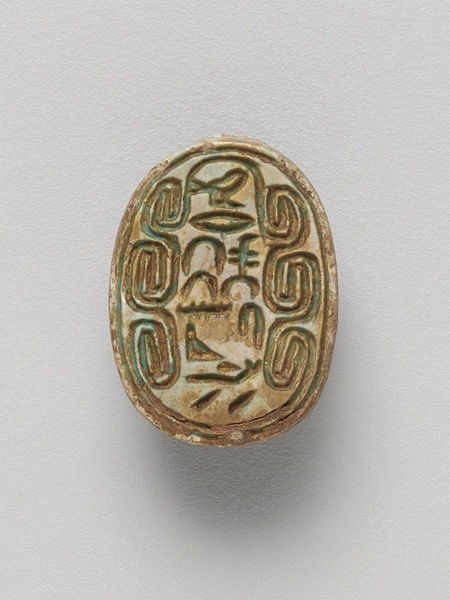
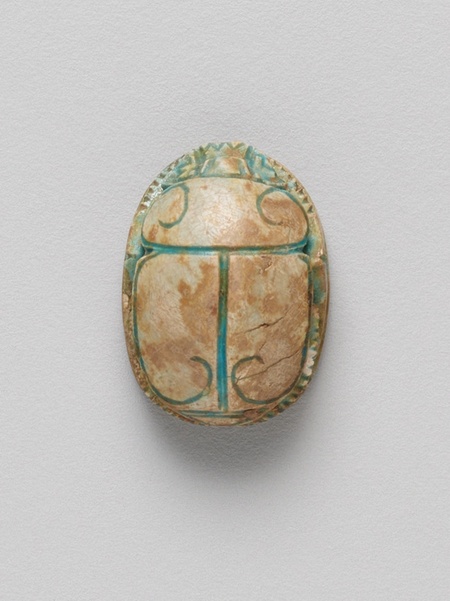
Scarab of Senebtifi, Late Middle Kingdom (c. 1850–1650 BCE). Glazed steatite. Art Institute of Chicago, No. 1892.231a–c (associated object).
Printed type. A flattened base with engraving. The Scarab of Senebtifi (Chicago Institute of Art, glazed steatite, 2,2 × 1,6 × 1.3 cm) features a column of hieroglyphs at its center, encircled by a spiral border. The inscription includes the title «Great Tens of Upper Egypt» and the owner’s name.
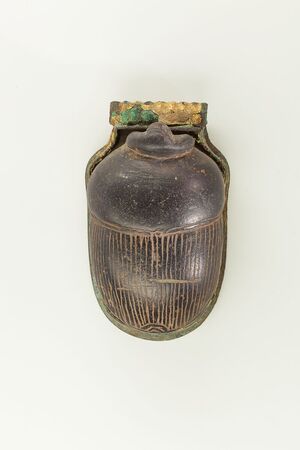
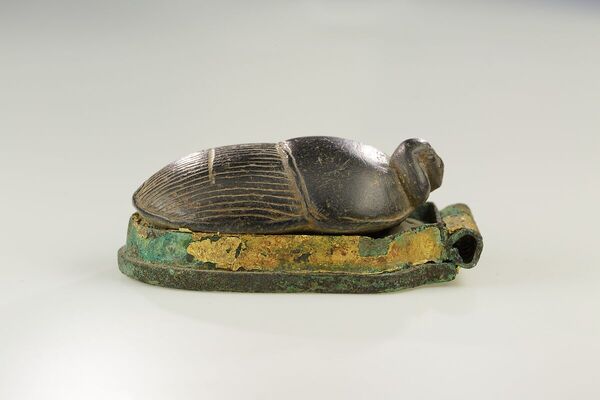
Heart Scarab with a Human Head, New Kingdom (c. 1550–1080 BCE). Basalt, bronze, traces of gold foil, 6,5 × 3,9 × 2.5 cm. Metropolitan Museum of Art, Accession No. 30.8.1080.
Heart Scarab. Large size, no printing function. The Heart Scarab with a human head (Metropolitan Museum of Art, basalt, bronze, remnants of gold foil, 6,5 × 3,9 × 2.5 cm) features a flat underside inscribed with ten horizontal lines of spells from the «Book of the Dead.»
Methods of Attachment and Carrying
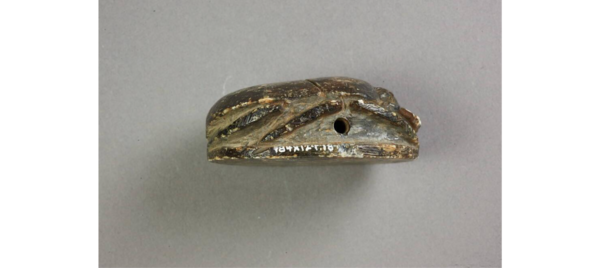
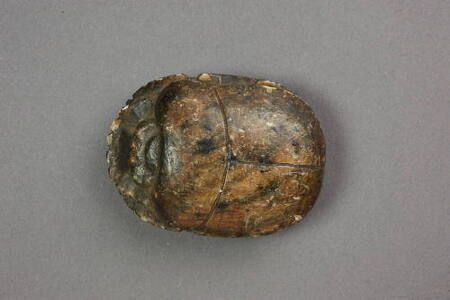
Amulet, scarab, New Kingdom, 18th–20th Dynasty (c. 1550–1069 BCE). Serpentinite, 5,3 × 4 × 2.2 cm. Royal Ontario Museum, No. 984X124.18.
Visual markers: a longitudinal hole for a cord; rotating wire for a signet ring; multiple attachment holes (winged forms); a later-added gilded rim with a loop (heart scarabs). The heart scarab with a human head features two holes on the underside, which were used for securing the item to a cord; a later-added heart-shaped rim with a large loop allowed it to be hung. The large serpentine scarab (Royal Ontario Museum, 5,3 × 4 × 2.2 cm, New Kingdom) was drilled for suspension and could be worn in life or sewn into the shrouds of the deceased.
Material Science: Texture and Color
2.1. Stones
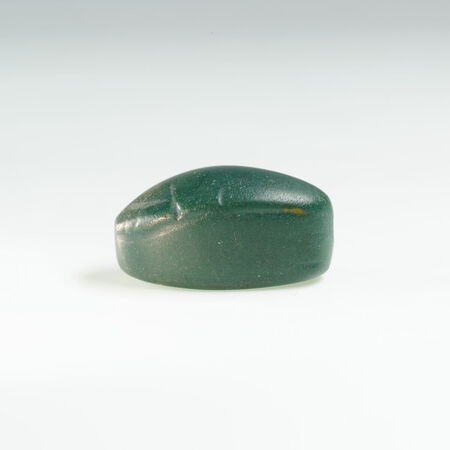
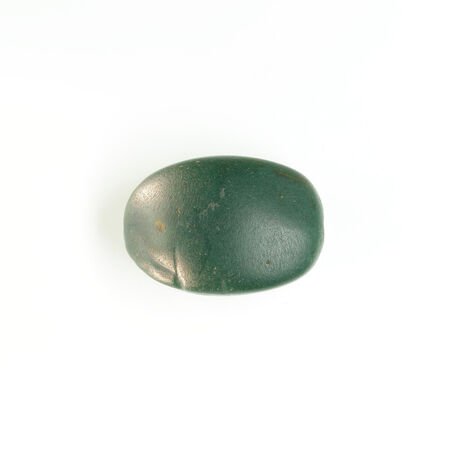
Scarab, Middle Kingdom–Second Intermediate Period. Agate, 2 × 1,4 × 1.1 cm. Metropolitan Museum of Art, No. 19.3.156.
Jasper. A hard stone used for amulets of rebirth. Metropolitan Museum of Art: a jasper scarab found tied to a mummy’s finger.
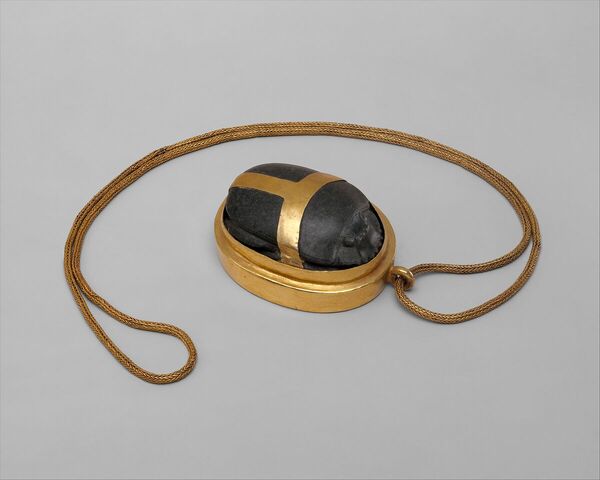
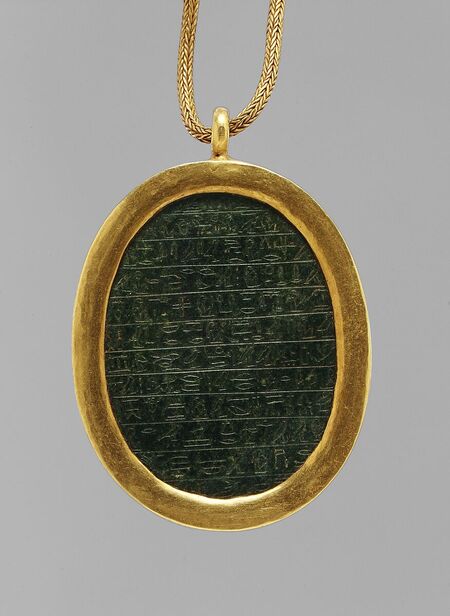
Heart Scarab of Hatnefer, New Kingdom, Dynasty 18 (c. 1491–1473 BCE). Serpentinite, gold. Scarab: 6,6 × 5,3 × 2.8 cm; chain: 77.5 cm. Metropolitan Museum of Art, No. 36.3.2.
Serpentinite. Material of the Heart Scarab from Hatnefer (Metropolitan Museum, serpentinite, gold, scarab 6.6 cm, chain 77.5 cm). The base features a rendition of a chapter from the «Book of the Dead, ” in which the deceased addresses her own heart, pleading with it not to testify against her in the afterlife judgment.
The inscription on the artifact reads: «The heart of my mother, the heart of my mother, the heart of my (true) nature—do not rise against me as a witness; do not judge me in court; do not resist me before the guardian of balance. You are my bodily Ka, Khnum, who revived my limbs. When you rise to the perfection from which we originate, do not let our names stink before the environment that humanity creates in its proper place; let everything be well with us and with the listener so that the judge may rejoice. Do not invent lies against me in the presence of a god, for your calculation approaches.»
2.2. Color Semantics
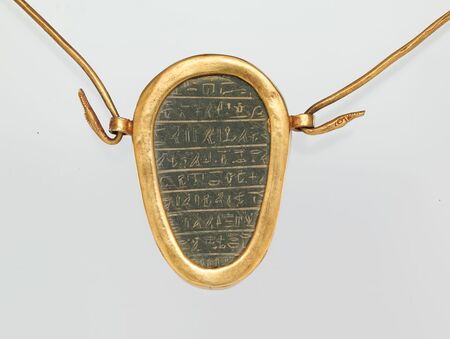
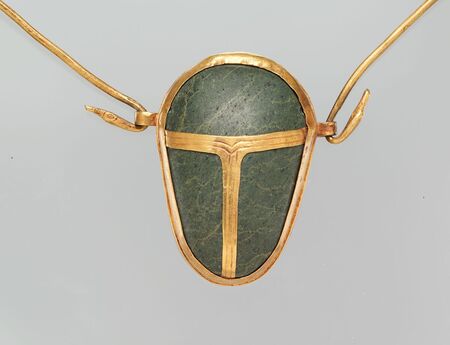
Heart Scarab of Manhata, New Kingdom, Dynasty 18, reign of Thutmose III (c. 1479–1425 BCE). Gold, green slate, 5,6 × 3,8 × 1.9 cm. Metropolitan Museum of Art, No. 26.8.144.
Green. The color of rebirth. Queen Manehata’s heart amulet (Metropolitan Museum of Art, gold, green slate, 5,6 × 3,8 × 1.9 cm) is crafted from green stone. The museum’s description notes: «This spell was usually inscribed on a large scarab made of green stone that was placed on the mummy’s chest.»