Adapting Images of Ancient Greek Mythology into the Marvel Cinematic Universe
Area of Study: The mythological heritage of Ancient Greece.
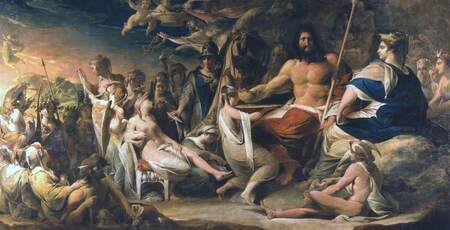
«The Birth of Pandora» 1804 James Barrie
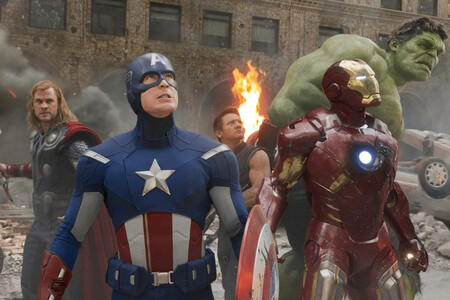
Subject of Study: The application of ancient archetypes and narrative models in the Marvel cinematic universe.
Frame from the film «The Avengers» 2012
Research Objective: To analyze the specifics of reinterpreting ancient Greek imagery and mythological narratives within Marvel superhero culture, identifying the preservation of continuity with classical concepts of heroism, fate, and supernatural power.
Concept: This visual exploration aims to identify the reasons why archaic mythological archetypes, originating many centuries ago, remain relevant and are actively reinterpreted in contemporary mass culture. The Marvel cinematic universe represents one of the most influential media phenomena, whose characters have effectively become new mythological heroes understood by audiences globally. A detailed examination of Marvel’s narratives and characters reveals clear echoes of ancient Greek myths—from direct borrowings, such as that of Hercules, to more complex allusions, like Thanos’s connection to the Greek deity Thanatos. This intersection of classical tradition and current cultural product is of particular interest because it allows for the study of mechanisms for transmitting cultural codes and demonstrates how ancient symbols acquire new resonance through modern visual narrative.
The relevance of this topic stems from the fact that ancient Greek mythology forms the foundation of the European cultural code, while Marvel represents a phenomenon of global popular culture. The collision of these two layers creates a rich field for visual analysis, where classical archetypes, by transforming, continue to fulfill their original functions: they interpret the world order, shape perceptions of heroism, and define ethical boundaries. The goal of this work is to examine how Marvel does not merely cite Greek motifs but builds a cohesive mythological system upon them that meets the demands of the contemporary viewer.
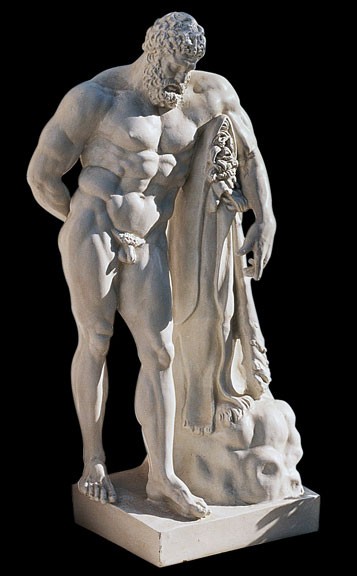
The material selection methodology is based on a comparative analysis of three types of visual sources: ancient art works (statues, vase painting, reliefs) and fragments of Marvel film reels. This approach allows for a clear demonstration of the evolution of heroic archetypes, highlighting stable visual elements and those that have changed under the influence of a new era. The criterion for material selection is thematic correspondence: ancient images are chosen whose characters are most closely aligned with Marvel heroes in terms of symbolism, narrative role, or functional set.
The central research question is formulated as follows: How exactly are the images of ancient Greek mythology transformed into the Marvel superhero universe, and what key elements of the classical heritage are retained in its visual language?
The research hypothesis posits that Marvel does not engage in fragmentary borrowing, but rather in a comprehensive revision of ancient Greek mythology, creating its own mythological system based upon it. Within this system, the gods and heroes of antiquity, taking on new forms, continue to fulfill their archetypal roles.
A Comparison of Ancient Greek Mythology Heroes and Marvel Cinematic Universe Characters
Comparative Analysis of Thanatos and Thanos Archetypes
First and foremost, both characters are personifications of death, serving as its supreme embodiments within their respective narrative universes. If Thanatos in ancient Greek mythology is the literal personification of the concept of nothingness—devoid of personal motives—then Thanos is its active, volitional incarnation. He doesn’t simply represent death; he becomes its instrument and embodied will, elevating it to an absolute cosmic principle. Both serve as a living reminder of the inevitability of the end.
Both characters fulfill the key function of a guide to another state, acting as the force that enacts a fundamental transition. Within the framework of the ancient cosmic order, Thanatos functions as a psychopomp—one whose task is to transport the soul from the world of the living into the realm of Hades, thereby ensuring the functioning of the cosmic cycle. Thanos, within his utopian and twisted ideology, sees himself as the guide of the entire universe into a «new» state, effecting a mass transition from life to death through Snap—a transition that, in his design, should lead to rebirth and balance.
Furthermore, their images visually and narratively underscore the idea of inevitability and total dominance. The visual canon depicting Thanatos as a winged youth with an extinguished torch or a sword conveys his impersonal and relentless nature—he cannot be escaped, he cannot be persuaded. In contrast, the mighty, throne-sitting Thanos in the visual aesthetic of comic-book cinema demonstrates a personal, tyrannical inevitability. His will, akin to a natural law, allows for no choice, and his physical power renders resistance meaningless. Both of them are the end—a conclusion with which no compromise can be made.
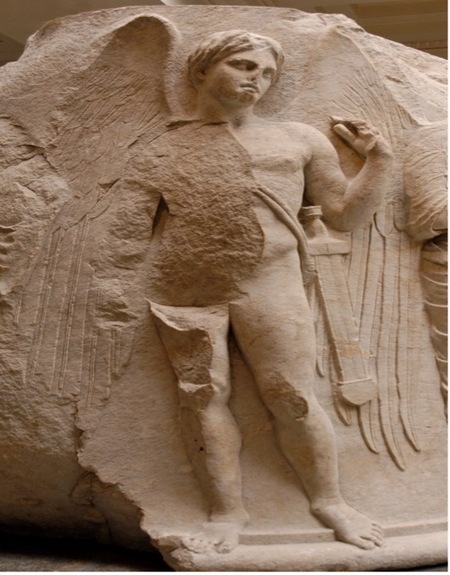
Thanatos as a winged youth with swords. Sculptural marble drum of the Artemis Temple column in Ephesus, 325–300 BCE.
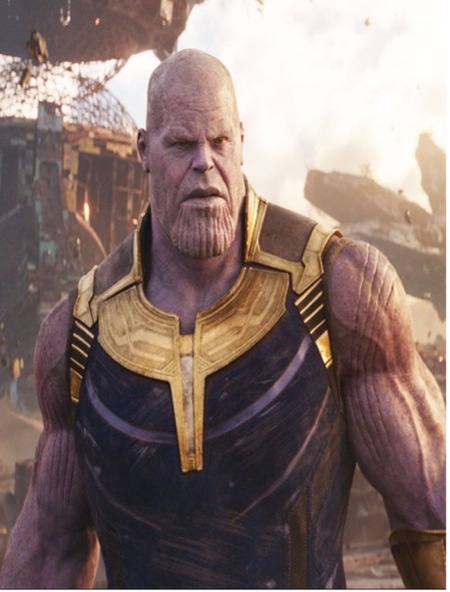
Josh Brolin as Thanos In the film «Avengers: Infinity War» (2018)
Comparative Analysis of Thor and Zeus
First and foremost, both gods possess supreme authority over the element of thunder and lightning. Zeus hurls golden peruns, forged by the Cyclopes, while Thor strikes his enemies with Mjölnir, a hammer that returns to its wielder like a boomerang and also serves as an instrument of blessing. Both Zeus’s lightning and Thor’s hammer are not merely weapons, but sacred symbols of their divine power and control over natural phenomena.
Both serve the key function of defending the world order against the forces of chaos. Although their status in the pantheon differs (Zeus is the king, Thor is the prince), their primary struggle is directed against chthonic beings that embody destruction. Zeus fights the Titans and Giants in the Titanomachy and Gigantomachy, establishing a new cosmogony. Thor wages a constant war against the frost giants (Jötnar), who threaten both Asgard and Midgard (the world of men), acting as the chief shield for the gods and humanity.
Furthermore, the myths emphasize their untamed martial rage and unparalleled physical strength. While Zeus often appears as a wise ruler, his fury in battle is described as an overwhelming storm. Thor, however, is the very embodiment of martial valor—his wild nature and mighty physique are a constant source of material in the Eddic poems.
Finally, both gods are closely connected to the human world and act as its protectors. Zeus is the guardian of oaths and hospitality (Xenia), while Thor, being a popular deity among common people and warriors, defends their homes and communities from evil forces. This role makes them not only celestial rulers but also popular protectors.
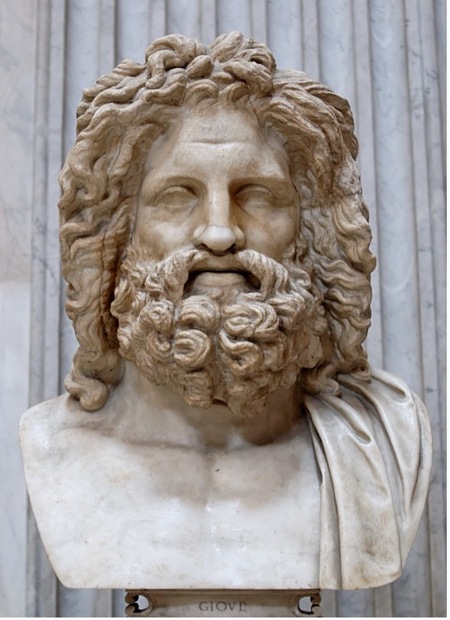
Otricoli Bust (Zeus of Otricoli) — an ancient Roman marble bust, discovered in 1775 in the town of Otricoli (Umbria, Italy) during excavations organized by Pope Pius VI.
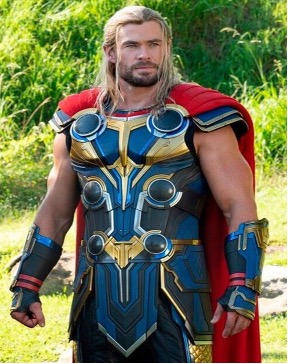
Chris Hemsworth as Thor in the film «Thor: Love and Thunder» (2022)
A Comparative Analysis of Captain Marvel and Athena
Primarily, both figures are powerful warriors whose strength derives not only from might but also from intellect and strategy. Athena, born from Zeus’s head in full battle armor, personified wise and measured warfare, in contrast to the volatile Ares. Her strength lies in tactics, cunning, and unwavering will. Captain Marvel, whose abilities awakened under the influence of the Tesseract (a cosmic artifact linked to space and mind), similarly embodies a heroic archetype whose greatest weapons are her will, determination, and capacity for strategic thought on a galactic scale. Olympus and S.H.I.E.L.D. are different institutions, but both Athena and Carol Danvers are among their elite operatives.
Both fulfill the crucial function of protectors and patrons of civilization and the polis. Athena was the divine guardian of Athens, sponsoring crafts, the arts, and just governance, embodying civilization’s creative impulse. Within the Marvel universe, Captain Marvel assumed the role of protector of the entire planet, and subsequently of other worlds, becoming a cosmic guarantor of safety. Her mission is to shield entire civilizations from intergalactic threats, which is a direct projection of Athena as Promachos (Front-line Warrior) onto a cosmic level.
Furthermore, their personas underscore the idea of sovereign autonomy and independence. Athena was one of the few virgin goddesses of Olympus; her power and status were not dependent on marriage, making her a figure entirely unto herself. Captain Marvel, having gone through memory loss and manipulation by the Kree, went on a journey to discover her own identity. Her central narrative arc is a story of who she is by her own volition, rather than by the will of others, which makes her a modern embodiment of female self-sufficiency.
Finally, both serve as archetypal mentors and inspirations. Athena often acted as a mentor to heroes like Odysseus, guiding them and offering counsel. Captain Marvel, in turn, becomes a figure who passes the torch to the next generation, much like Monica Rambeau, and inspires other heroes and ordinary people with her example of fearlessness and duty.
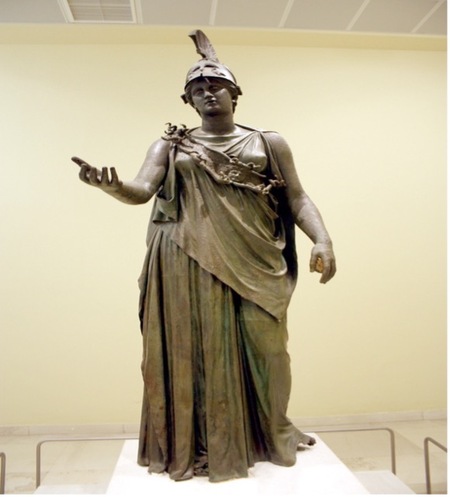
Athena of Pireus. Around 360 BCE Piraeus Archaeological Museum
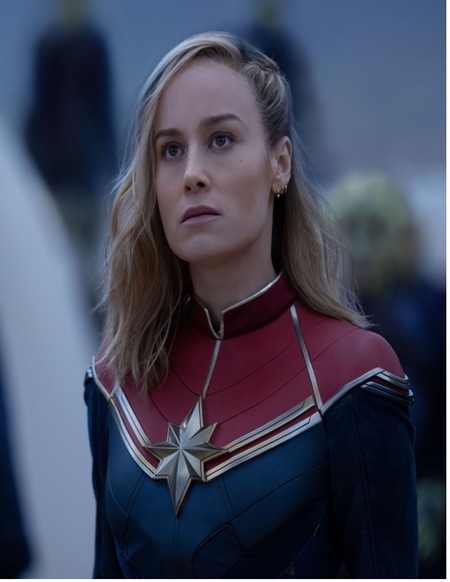
Brie Larson as Carol Danvers / Captain Marvel In the film «Captain Marvel 2» (2018)
Comparative Analysis of Prometheus and Iron Man
First and foremost, both are colossal demiurges and givers of technologies that fundamentally altered the course of human history. According to myth, Prometheus stole fire from the gods—a foundational technology that gifted humanity warmth, light, crafts, and the capacity for progress. Tony Stark, in turn, committed a similar act in a modern context: he didn’t just create advanced weaponry; he gave the world a new source of pure energy (the Arc Reactor) and a technology that transformed man into a superhuman being (the Iron Man armor). Both fire and armor symbolize the technological leap granted to humanity by a singular genius.
Both defied the mighty powers of their respective worlds, breaking taboos for a higher purpose. Prometheus dared to trick Zeus and go against his will, concealing knowledge and technology intended for humankind. Tony Stark, in his classic narrative, challenged the entrenched military-industrial complex, renouncing the role of an arms baron and openly confronting his former partners and the government. His famous declaration, «I am Iron Man, ” is just as much a defiance of the existing hierarchy as Prometheus’s actions.
Furthermore, a central theme in their mythologies is the concept of redemptive sacrifice and eternal suffering for the sake of humanity. For his transgression, Prometheus was chained to a rock where an eagle daily tore out his liver, which would regenerate for renewed torment. Tony Stark’s fate is his own „Promethean liver“: his technological heart, the Arc Reactor, initially slowly poisoned his body with palladium, literally binding him to the necessity of finding a cure. His sacrifice in the finale of Avengers: Endgame is the culmination of this arc—he gave his life to save the universe, absorbing the energy of all the Infinity Stones, which is a direct allusion to the titan’s eternal torment.
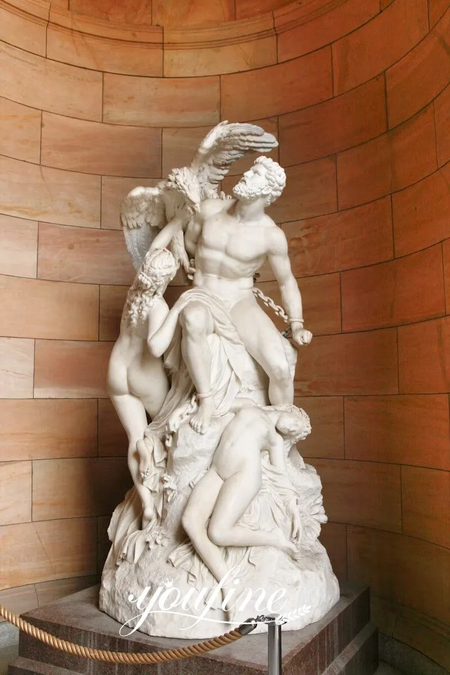
Marble copy of the statue «Prometheus Bound and the Oceanids» Athens, Greece
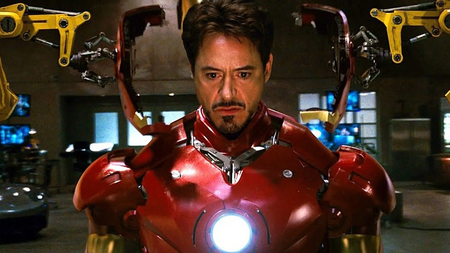
Robert Downey Jr. as Tony Stark/Iron Man In the film «Iron Man 2» (2010)
Comparative Analysis of Odysseus and StarLord
Above all, both are archetypal tricksters and masters of improvisation whose salvation hinges on wit, not muscle. Odysseus, the «cunning» husband, earned renown not through the strength of his sword, but through the power of language and deceit: he creates the Trojan Horse, tricks the Cyclops Polyphemus by claiming to be «Nobody, ” and spends years at the court of King Alcinous. Peter Quill, on the other hand, is the epitome of the cosmic adventurer whose plans are born on the fly. His exploits—from stealing the Orb to daring negotiations with cosmic entities—are built on bluff, charm, and unconventional thinking, making him a direct heir to Odysseus’s metis (cunning).
Both command diverse crews of loyal companions, becoming not just leaders, but spiritual anchors and families to them. Odysseus’s companions are his faithful warriors, whom he loses along the way, followed by the crew aboard his ship. However, his key alliances are formed along the journey (with Circe, with Telemachus). Star-Lord becomes the heart of the Guardians of the Galaxy—a group of outcasts and marginal figures (Groot, Rocket, Gamora, Drax)—whom he unites into a genuine family. While Odysseus seeks a familial home on Ithaca, Quill finds his family within this hastily assembled crew.
Furthermore, the central thematic motif for both is homesickness and the search for their true identity. The entire Odyssey is an epic about nostalgia—a hero’s journey back to the shores of Ithaca, to his wife Penelope and son Telemachus. For Peter Quill, snatched from Earth in childhood, Earth and the memory of his mother become his „Ithaca.“ His journey is not only a physical relocation but also a search for an answer to the question, „Who am I?”—a question torn between earthly past and cosmic present, between human heritage and titan.
Finally, their characters highlight the combination of heroic spirit with deeply human, and sometimes comical, flaws. Odysseus is a great hero, yet he is vain; his curiosity endangers his men with Aeolus’s bags of winds, and his ego compels him to state his name to the enraged Polyphemus. Peter Quill is a leader capable of the greatest sacrifices, but also impulsive and foolish actions (such as his fight with Thanos on Titan over Gamora’s revenge), which make his character complex and recognizable.
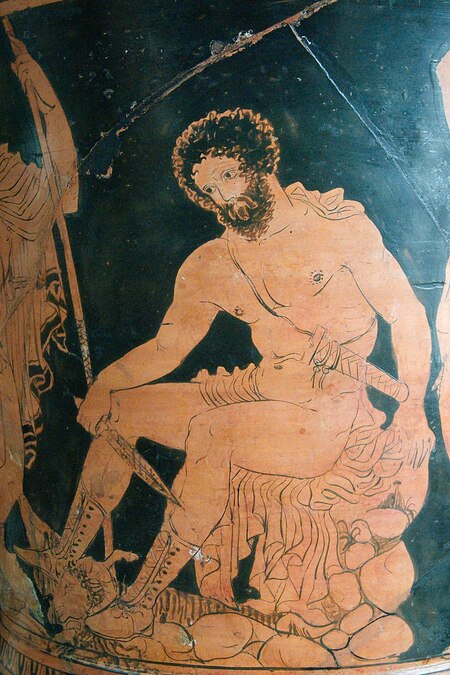
Odyssey, receiving guidance from Tiresias. Red-figure painting on a crater. 4th century BCE
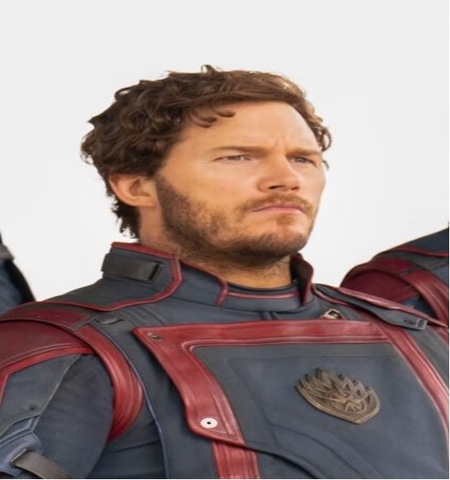
Chris Pratt as Peter Quill/Star-Lord In the film «Guardians of the Galaxy Vol. 3» (2023)