The serpent is one of the most multifaceted and contradictory images in art history. In Ancient Egypt, it protected pharaohs; in antiquity, it symbolized healing and wisdom; and within Christian tradition, it became one embodiment of temptation and sin.
Why was the same image imbued with opposing meanings? This study examines how the depiction and symbolism of the serpent evolved across the art of different cultures from the Paleolithic era through the 14th century, and what role religious beliefs, artistic traditions, and historical context played in this transformation.
Table of Contents
1. Concept 1.1 Research Objective 1.2 Research Hypothesis 1.3 Introduction: The Serpent as a Contradictory Symbol in Art History 2. Origins of the Image: Early Depictions of the Snake 3. The Sacred Serpent: Power and Protection in Ancient Egypt 4. Between Life and Death: The Snake in Ancient Civilizations' Art 5. Healing and Wisdom: The Serpent Image in Antiquity 6. The Birth of the Monster: The Snake as the Embodiment of Danger 7. From the Sacred to the Sinful: The Snake in Christian Art 8. Comparative Analysis: One Image—Opposing Meanings 9. Conclusion 10. Bibliography (Textual Sources) 11. Image Sources
Concept
Research Objective
To trace the evolution of the serpent image in visual arts from ancient epochs through the 14th century, to identify shifts in its symbolic meaning and artistic representation, and to determine how cultural and religious conceptions influenced the ways the serpent was depicted across different historical periods.
Research Hypothesis
The image of the snake in art does not carry a single, immutable meaning: its symbolism is shaped by cultural, religious, and historical perceptions. It is assumed that changes in the perception of the snake are reflected in the ways it is depicted—in its composition, plasticity, scale, and interaction with other characters. Moreover, contradictory meanings of the image can coexist simultaneously, rather than succeeding one another sequentially.
Introduction
The snake holds a significant place in the art of various eras and cultures. Its imagery appears on ritual objects, adornments, architectural structures, sculpture, and painting. Despite the recognizability of its outward form, the symbolic meaning of the snake varies significantly depending on the historical and cultural context. In Ancient Egypt, the image of the cobra served as a sign of royal power and divine protection. In Minoan art, snakes appeared in religious depictions related to concepts of the underworld. In ancient culture, the snake could accompany a healing deity, but simultaneously became part of the form of dangerous mythical creatures. In Christian art, it acquired a particular significance in depictions of the Fall of Man, embodying temptation and the violation of a divine prohibition. Such contradictions allow us to view the snake not as a symbol with a single meaning, but as an artistic motif whose content was shaped and reinterpreted across different cultures. Of particular interest is not only the evolution of its symbolism but also the development of how the snake was depicted. Its placement relative to the human figure, the character of its movement, scale, and role in the composition help to understand how artists conveyed concepts of protection, sacred power, danger, or sin. The selected works for this study are those in which the snake motif plays a prominent role: engravings on ancient artifacts, reliefs, cult images, sculptures, and book miniatures. The material is arranged predominantly in chronological order to trace how artistic practices changed.
Origins of the Image: The Serpent in Primitive Art
The engraving on the Chernoozersky dagger is a winding line that researchers interpret as a snake. Previously, it was considered a geometric ornament. Perhaps the snake held special symbolic meaning for ancient people, but it is impossible to confirm this definitively. This example demonstrates how ambiguous the interpretation of ancient imagery can be.
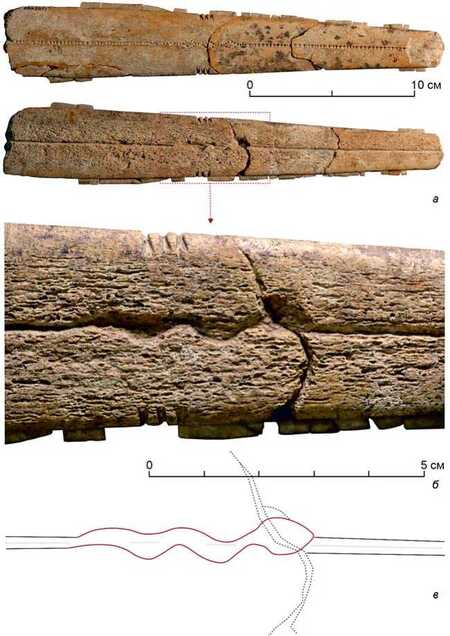
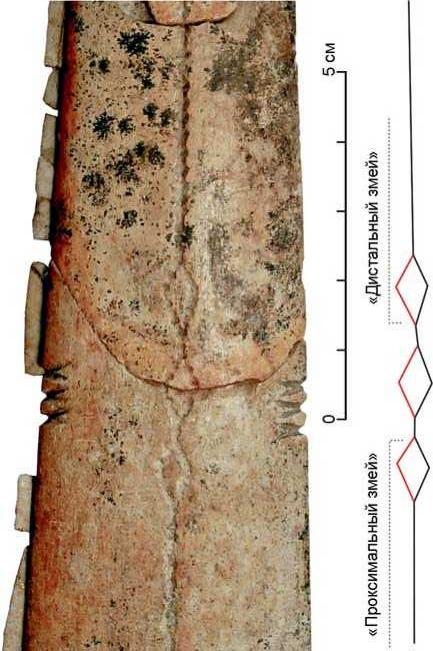
Black Lake Dagger with Serpent Motif. Late Paleolithic — Mesolithic. Middle Irtysh Region. Omsk State Historical and Local Lore Museum.
On the stone pillar of Göbekli Tepe, snakes are depicted alongside other animals and symbolic signs, forming a complex composition. Researchers hypothesize that such images may have held protective or mythological significance, though their exact symbolism remains unknown. Unlike the engraving on the Chernoozersky dagger, here the image of the snake becomes part of a monumental relief.
Reliefs with snakes on Pillar No. 33. Göbekli Tepe, modern Turkey. Preceramic Neolithic, 10,000–9,000 BC. Limestone, relief sculpture.
On the stone from Netiv-ha-Guduad, the image of a snake is rendered as a winding geometric pattern. The absence of a head and other anatomical details makes the image almost abstract. Researchers link such motifs to the symbol of the snake, yet its original meaning remains a subject of interpretation. This demonstrates how a natural image could transform into a conventional artistic sign.
Stone with a serpentine meander pattern. Negev-HaGedud, Levant. Preceramic Neolithic A, circa 10,000 years ago. Stone, engraving. Israel Museum, Jerusalem.
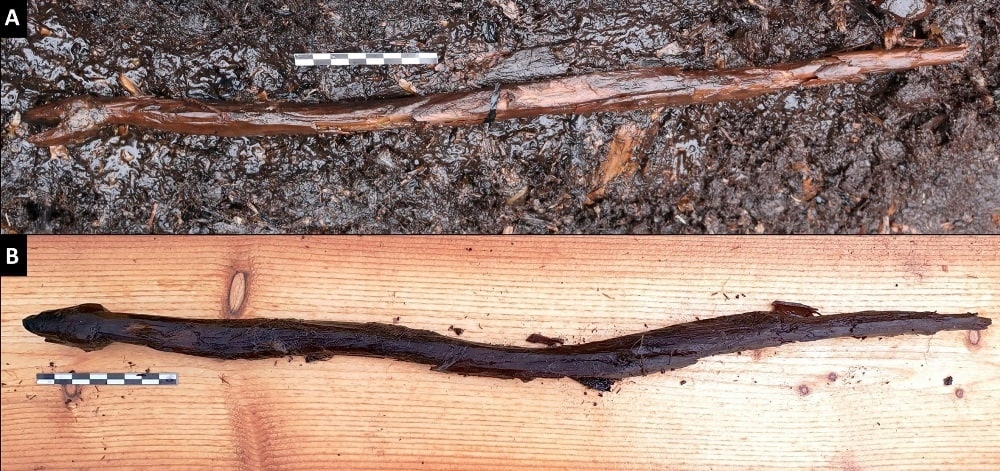
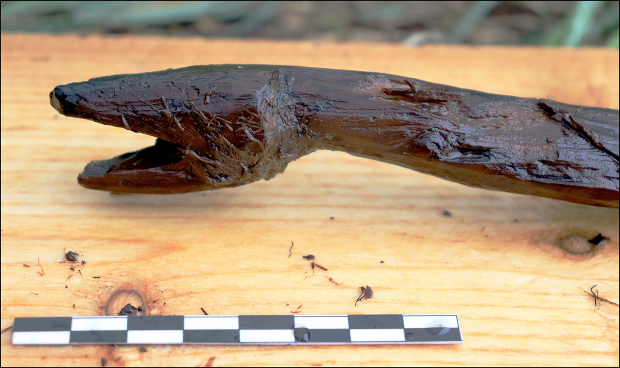
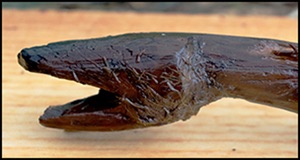
Unlike conventional engravings, the serpent from Yarvensuo is a three-dimensional sculpture featuring meticulously rendered body curves, an raised head, and an open mouth. Researchers suggest the figurine may have held ritualistic significance, possibly serving as part of a ceremonial staff. However, its original purpose remains unknown.