Navigation
1. Concept 2. Main Body: Chapter 1. The Historical Context of Astrology in the 13th Century Chapter 2. Zodiac Signs and Their Symbolism Chapter 3. Astrological Imagery in Painting and Book Miniatures Chapter 4. Zodiac Symbolism in Architecture and Decorative Arts Chapter 5. Comparison and Analysis of Astrological Imagery 3. Conclusion
Concept
Выбор темы
I chose this topic because zodiac signs are currently perceived as part of horoscopes, even though their visual history is connected to science, courtly culture, and religious art. The 13th century is particularly interesting—it was during this period that knowledge of the heavens, imported from antiquity and the Arab world, began to take on a sophisticated visual form in illuminated manuscripts and sculpture. For me, it was important to understand how astronomical knowledge transforms into imagery.
Historical Context
In the 13th century, Arab astronomical treatises arrived in Europe, and their translations into Latin and Romance languages made the ancient heritage accessible to a wide readership. At the court of Alfonso X the Wise, large manuscripts on the heavens were created under the king’s commission, including the «Book of Knowledge of Astrology» (c. 1276–1279). In the Islamic world, al-Sufi’s «Book of Fixed Stars» continued to be copied, while zodiac signs were incorporated into the sculptural décor of Christian churches. Astrology was a part of the science of its time, and it is in this capacity that it is examined in this work.
Object and Subject of Study
Area of Study: Depictions of zodiac signs, planets, and constellations in 13th-century art. Subject: Methods of depicting the heavens in illuminated manuscripts, architecture, and decorative arts. Chronological Scope: The 13th century, with a brief historical background extending from Mesopotamia to the Early Middle Ages. Geography: Spain, Western Europe, and the Islamic world.
The central research question
How did astronomical knowledge of the heavens transform into artistic imagery in the 13th century, and how do the zodiac images differ between the book and the temple?
Research Objective
Explore how zodiac signs and astrological motifs were represented in 13th-century art, and analyze how their functions differed across manuscripts, architecture, and decorative arts.
Hypothesis
The same zodiacal images served different functions: in manuscripts, they functioned as tools of knowledge, while in temples and decor, they transformed into symbols of cosmic order.
Method
Primary Method: Comparative and Visual Analysis. The same symbol is juxtaposed in miniature and in sculpture. The dating, medium, and function of the image are examined separately. I distinguish between the date of the text’s origin, the date of the surviving copy, and the place of storage. Religious representations are examined strictly within their historical context.
The materials used included manuscripts and monuments from the 13th century, primarily Alfonso’s Books of Heaven (Spain, 1270s), a copy of al-Sufi’s «Book of Fixed Stars» from the British Library, and zodiacal imagery in temple sculpture. The foundation of the work is built upon studies in the history of astronomy and medieval miniature painting, as well as museum and library catalogs.
Research Material
Chapter 1. The Historical Context of Astrology in the 13th Century
In the 13th century, celestial images were primarily created for reading and calculation. This chapter examines who commissioned such depictions and for what purpose. This context is necessary to later compare the book zodiac with the temple iconography.
Background: The image of the sky predates the 13th century
The Origins of the Imagery
The zodiac had a thousand-year history by the 13th century. In the Egyptian Dendera zodiac (around 50 BCE), the signs already formed a circular map. Planets were depicted in positions dating back to around 50 BCE. Europe in the 13th century received these images through a chain of copies, not directly.
Dendera Zodiac. Circa 50 BCE. Ptolemaic Egypt, Temple of Hathor in Dendera. Paris, Louvre, E 13482.
Image Keepers
The Leiden Arethusa was created around 816 and likely replicates a late antique original. It is an example of how the zodiac survived the Middle Ages—it was copied with almost no alterations. This is why the images from the 13th century look older than the era itself.
Leiden Arethusa, [leaf ___]. Circa 816. Lotharingia. Leiden, University Library, VLQ 79
Alphonse X: The Client of Knowledge
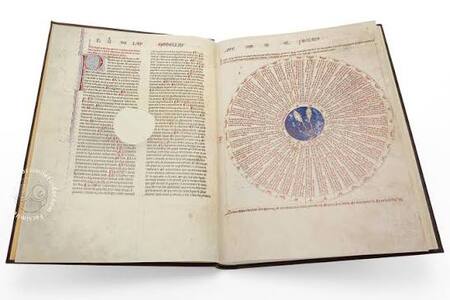
In the 1270s, King Alfonso X of Castile commissioned the «Book of Astrological Knowledge"—a collection of 16 treatises featuring diagrams and descriptions of instruments. The manuscript was created for functional study, not ornamentation; the illustrations explain how the tools operate. Thus, in this book, the image serves knowledge.
Book of Astrological Knowledge. c. 1276–1279. Castile. Madrid, Complutense University Library, MS 156.
Zodiac and Stones
In Alphonse X’s «Lapidary,» stones are linked to zodiac signs. The sign functions as a section header—below each, the mineral properties are gathered. The zodiac transforms into a system of classification.
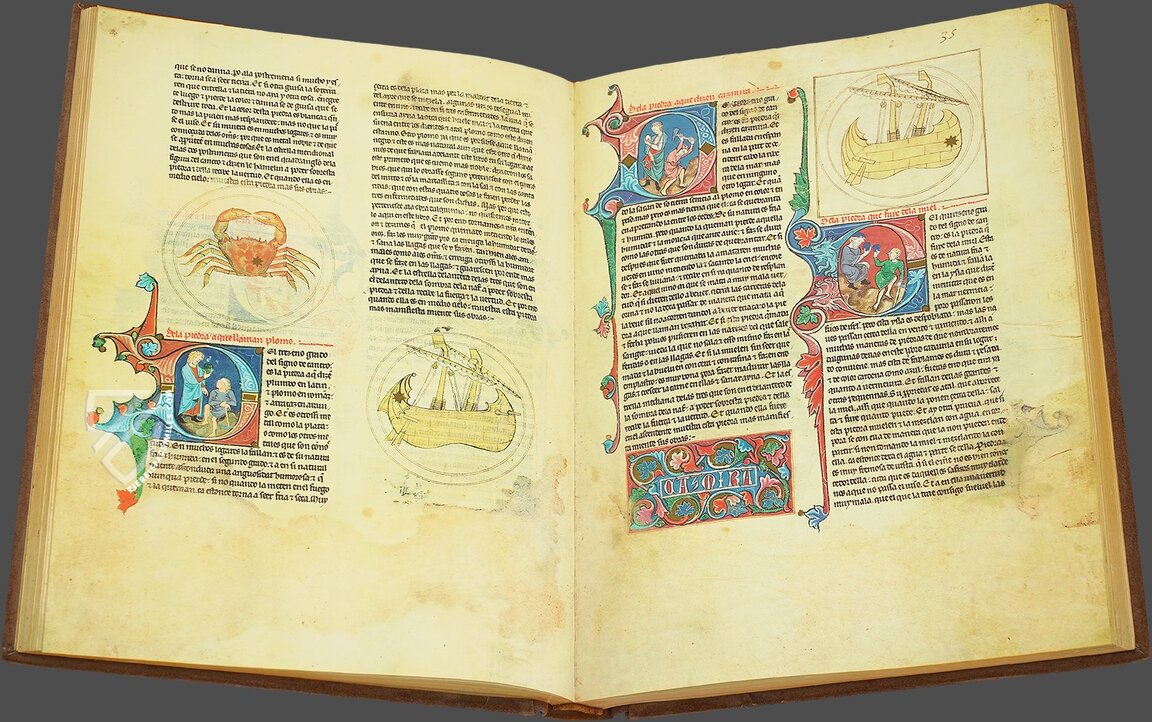
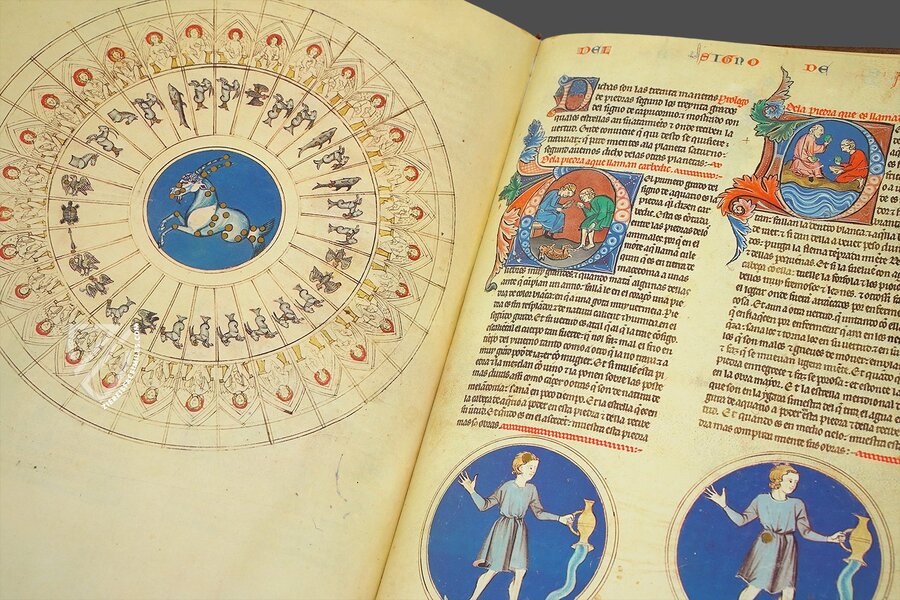
Lapidary of Alfonso X. c. 1270–1275. Spain. Escorial, Royal Library, MS h-I-15