How often do you notice your nose?
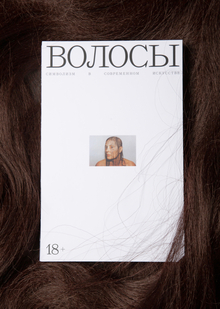
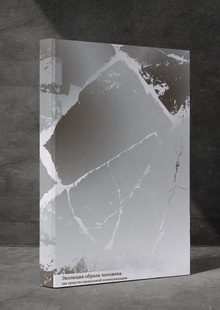
This part of the body is permanently in our field of vision, yet we do not see it. However, just by recalling the existence of the nose, it immediately becomes noticeable. What changed? Our perception—what our attention is focused on—nothing in the surrounding world has changed.Why does this happen, and what does it mean?This is how one of the mechanisms of human perception works: the visual system reduces sensitivity to unchanging information, ceasing to process it, and directs attention toward more significant events and objects in the environment. Look again at the book cover, focus your gaze on the central cross for 15–20 seconds, without diverting your attention to the surrounding elements. Did you see it? This is a similar mechanism—the Troxler effect, described back in 1804, vividly demonstrates the «nose problem» and one of our attention’s «blind spots”¹.</em\br>The peculiarities of attention, visual perception, and memory are not always obvious or easily understood, yet people are often convinced of the opposite. The idea behind my thesis project lies in this paradox.¹ „Blind spot“ is a metaphor for the research, denoting everything we do not notice, see, or realize. The phrase is placed in quotation marks because it is not used in the study as a scientific term.</em>
Do we ever truly notice, see, and remember what is actually happening?
The format of my Final Qualifying Project (FQP) is an experimental cultural and educational project aimed at exploring the peculiarities of human perception through direct experience. Therefore, in the initial investigation, it was crucial to study the entire visuality and mechanics of such phenomena in order to use the research findings as the foundation for the FQP’s narrative and select the most relevant and suitable format.
The basis of the bibliographic sources comprised scientific studies and experiments in cognitive psychology, psychophysics, and spatial perception, specifically the works of Daniel Simon, Christopher Chabris, Alfred Yarbus, Kevin Lynch, and others.
When developing the logic and structure of the initial investigation, it was important to adapt complex theoretical material, making it accessible and understandable. Therefore, the main research method employed was comparative visual analysis: each perception mechanism is revealed and explained through common life situations and observations that happen to each of us:
surprise $\rightarrow$ explain the mechanism $\rightarrow$ real-life example $\rightarrow$ practical application of knowledge about these features (in certain cases).
The visuals are not unified based on the principle of complete correspondence between illusion mechanisms and everyday situations, but rather on the similarity of visual experience and sensation. Universal cards and brief theoretical blocks at the end of each example explain what has been observed. It is in this way that we previously learned about the «nose problem» and the Troxler effect (from simple to complex).
The progression through three chapters reflects the general logic of visual information processing: selection (attention) → interpretation (context) → storage and retrieval (memory).
i Attention (How does attention determine what we notice?)The first chapter is about the selectivity of attention: why we fail to notice individual objects or changes in the environment, which affects how we allocate our focus.ii Context (How can the environment alter what we perceive?)The central and most comprehensive chapter addresses the influence of surroundings on the perception of size, space, color, and motion.iii Memory (How does memory alter what we remember and create false memories?)The final chapter discusses how memory preserves and changes information: from forgetting details of familiar objects to distortion and the formation of false memories.
Contents:
Concepti Attention ii Context iii MemoryConclusion Sources
Attention
ii Context
iii Memory
Fifteen images of the same coin are shown here—which one is correct?
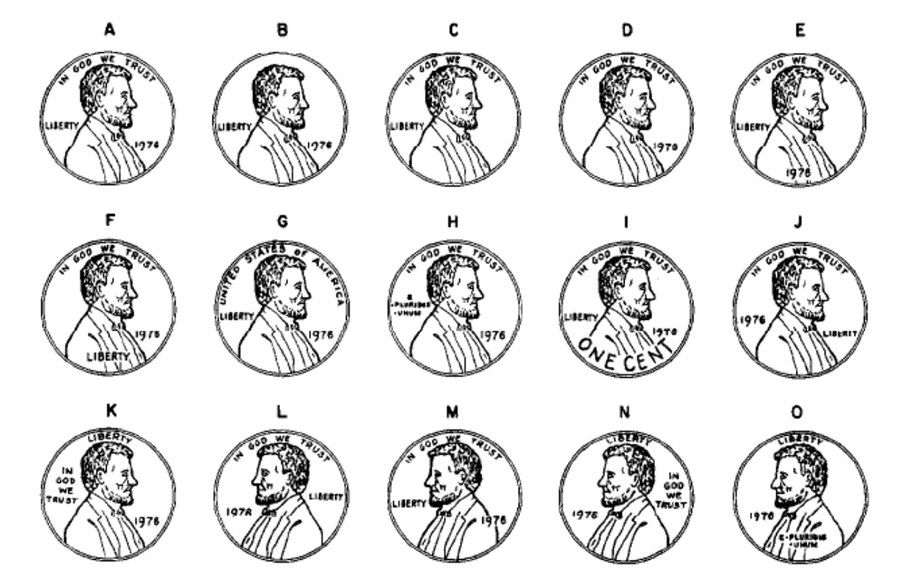
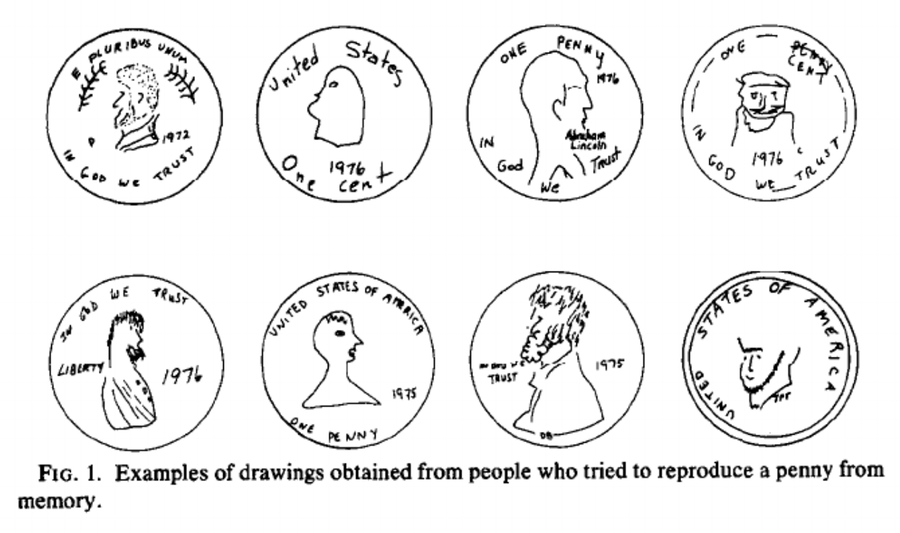
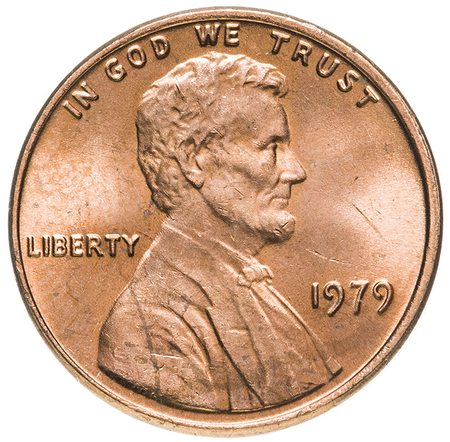
Core of the Study:In 1979, psychologists Raymond Nickerson and Marilyn Adams sought to test the accuracy of people’s memory regarding the appearance of familiar objects. In the first experiment, 20 participants were asked to sketch both sides of the American one-cent coin from memory, an object they see frequently in daily life. Subsequently, another 36 people were shown 15 versions of the coin’s image, only one of which was accurate.Title: «Long-Term Memory of a Familiar Object»Author, Year: Raymond Nickerson and Marilyn Adams, 1979Observation: Despite the appearance of the one-cent coin remaining unchanged for over 20 years, participants were presented with 15 different versions of its image.Result: 5% correctly reproduced all the coin’s details (1/20). 41,7% selected the correct coin image from the 15 options (15/36).Mechanism: Incomplete coding of visual information: Even frequent interaction with an object does not guarantee an exact memory of its appearance. We retain enough features to recognize the coin, but we do not necessarily retain every detail of its image.
What do you think the most accurate way people managed to reproduce the familiar logo in the drawing is?
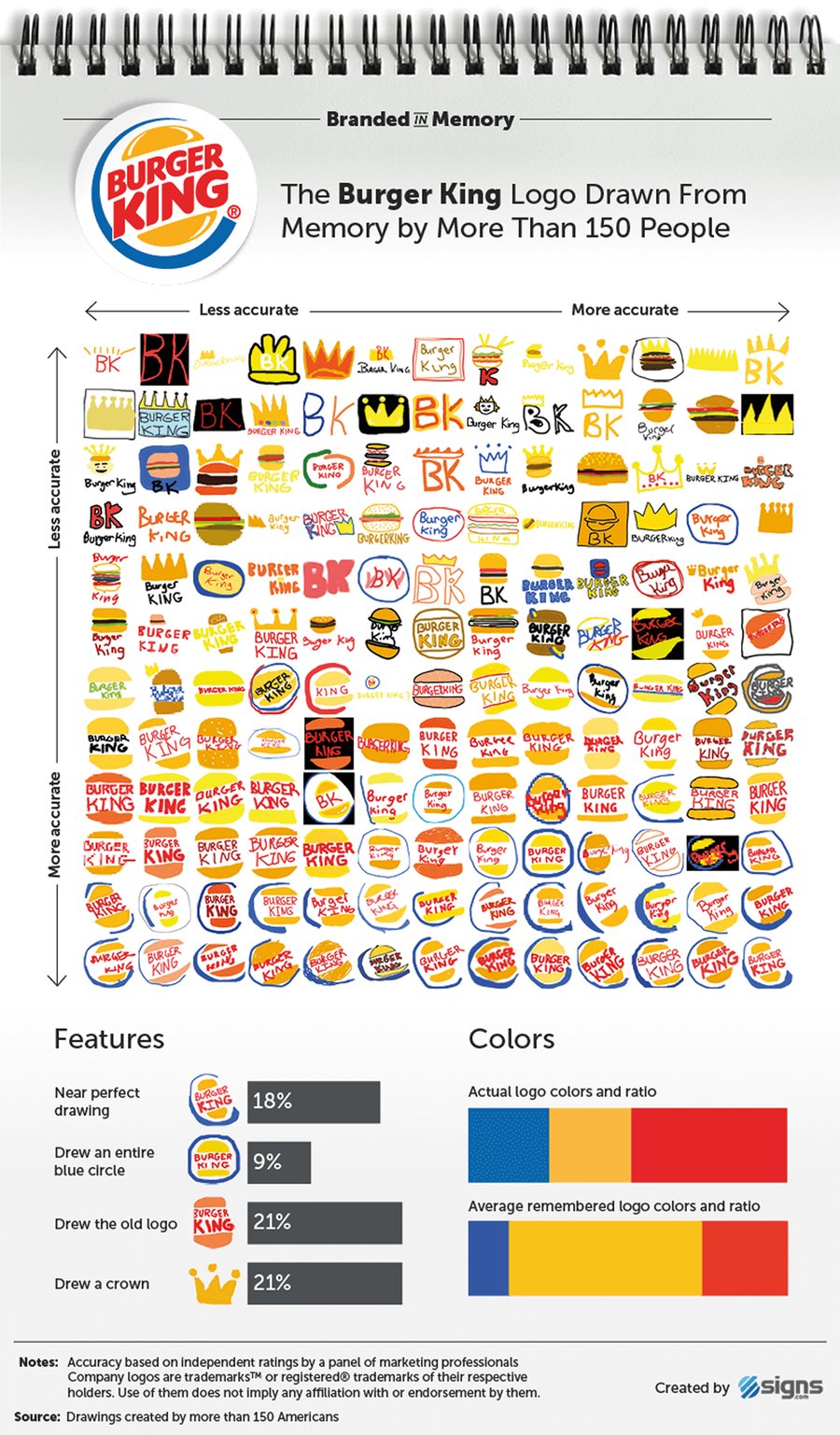
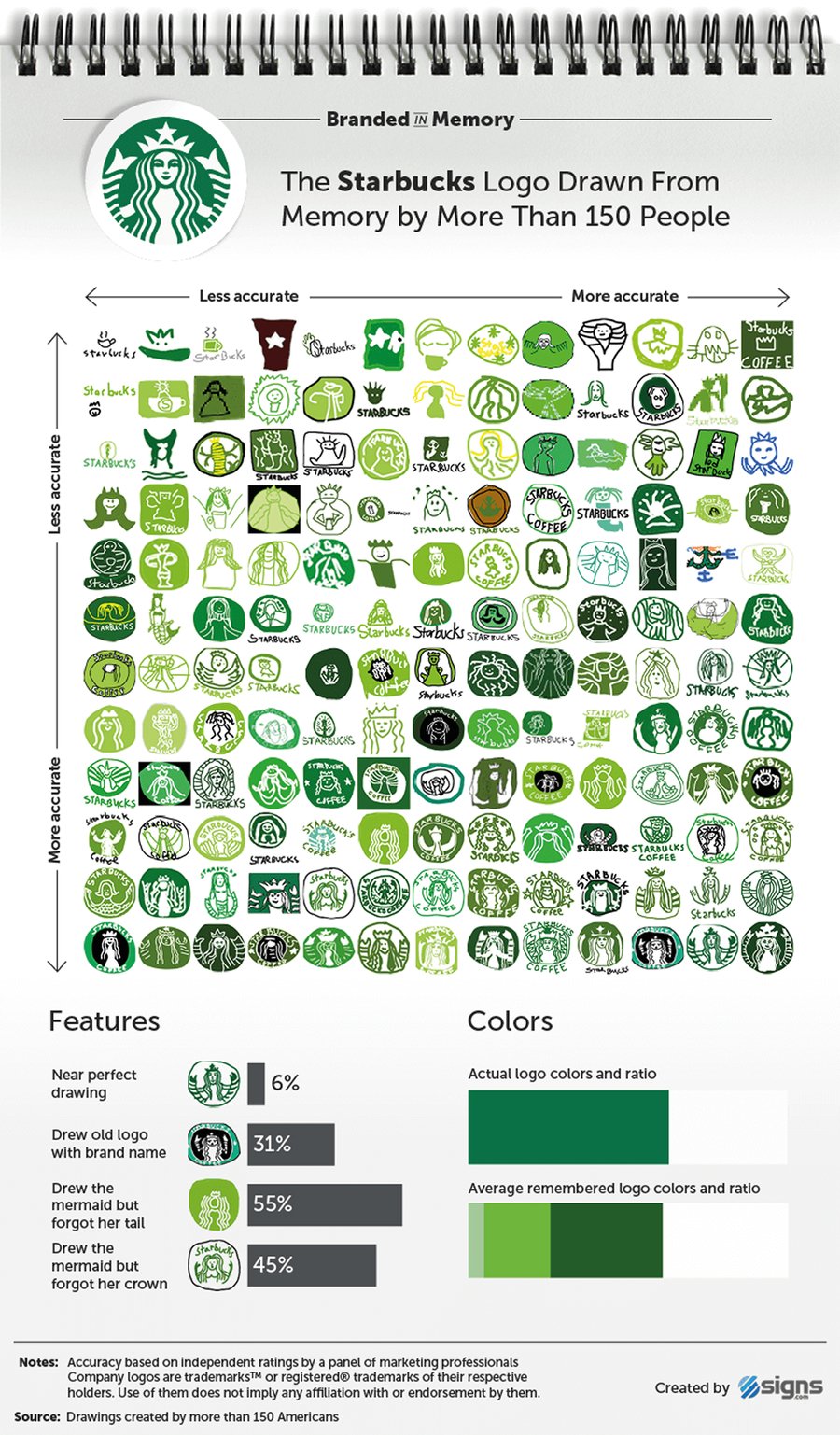
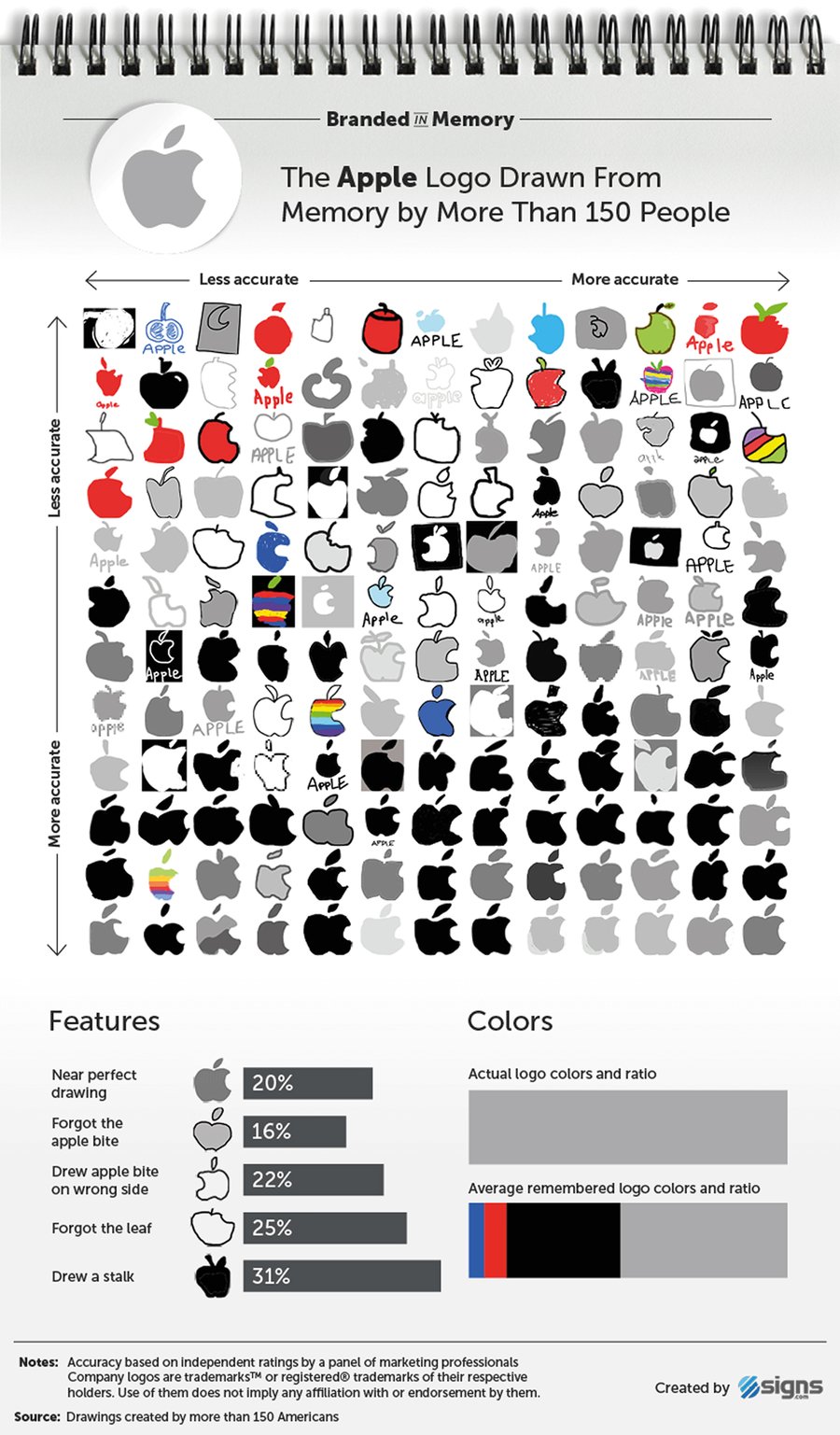
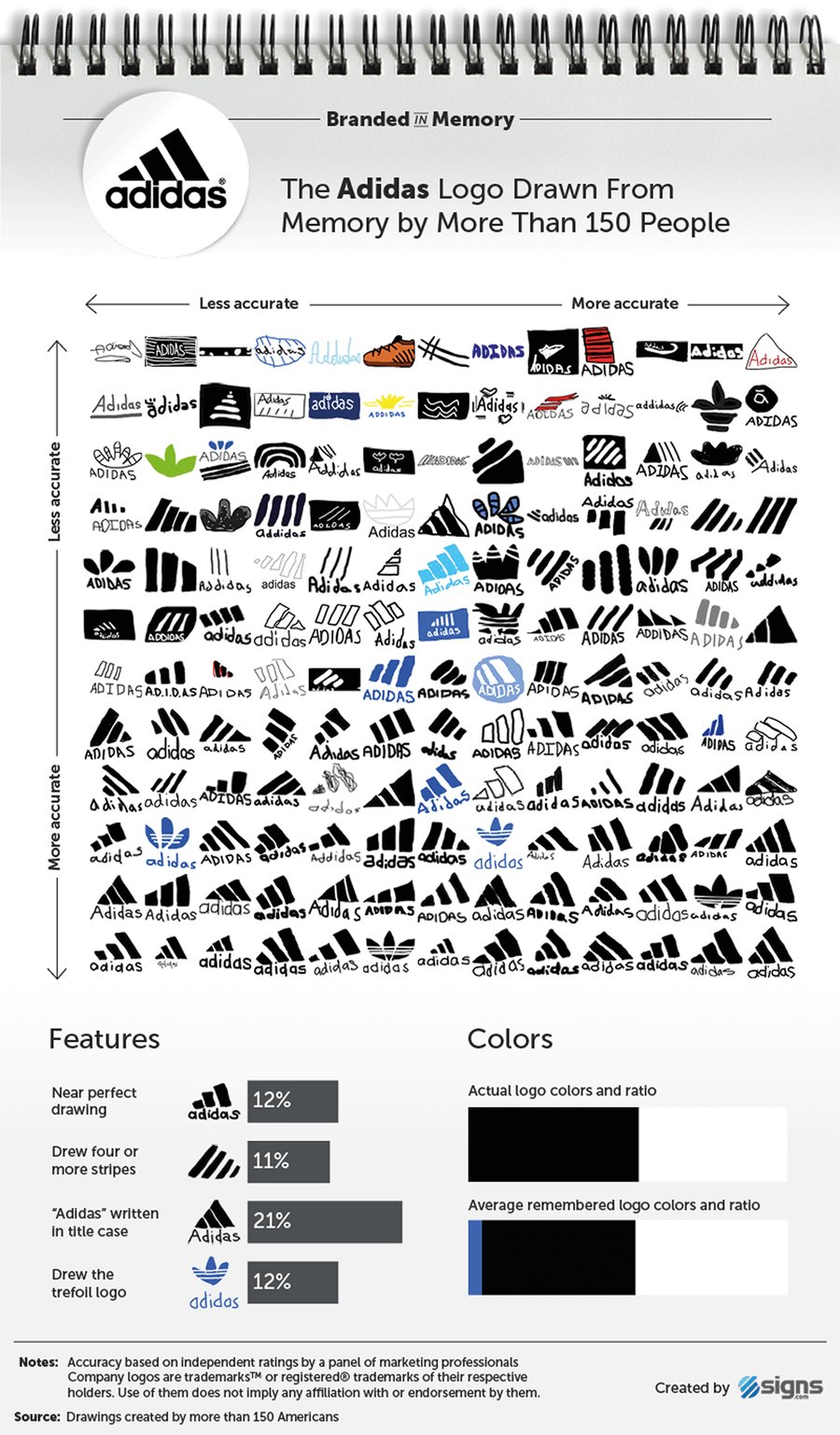
Research Summary:In 2017, the advertising product company Signs.com sought to determine how well people remember logos they see almost every day. For this study, 156 participants from the United States were asked to sketch the logos of ten well-known brands from memory to test which elements of brand identity are truly retained in memory. This resulted in 1,560 drawings.Title: Branded in Memory («Brands from Memory»)Author, Year: American advertising company Signs.com, 2017.Observation: Despite the recognizability of the logos, the versions reproduced from memory varied noticeably in shape, proportions, and detail. However, color remained the most consistent element—the majority of participants reproduced it correctly.Results: 16% of the drawings almost accurately reproduced the original logos. 47% of the drawings differed significantly from the original logos. 80% of the drawings correctly conveyed the brand colors.Mechanism: Selective encoding of information: Brand recognition does not require precise memorization of every element of a logo. The most distinctive features—color, silhouette, or composition—may be retained in memory, while the other details are reproduced approximately.
Remember the game «Telephone»?
Research Summary:
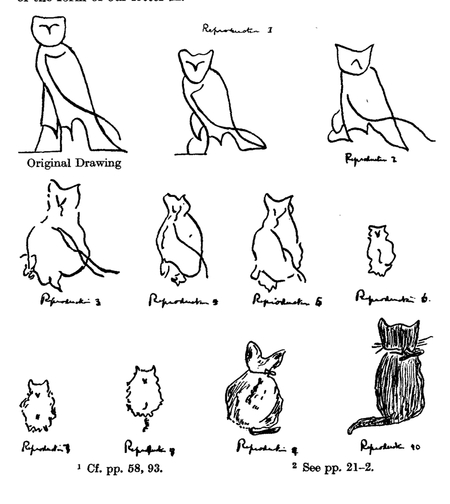
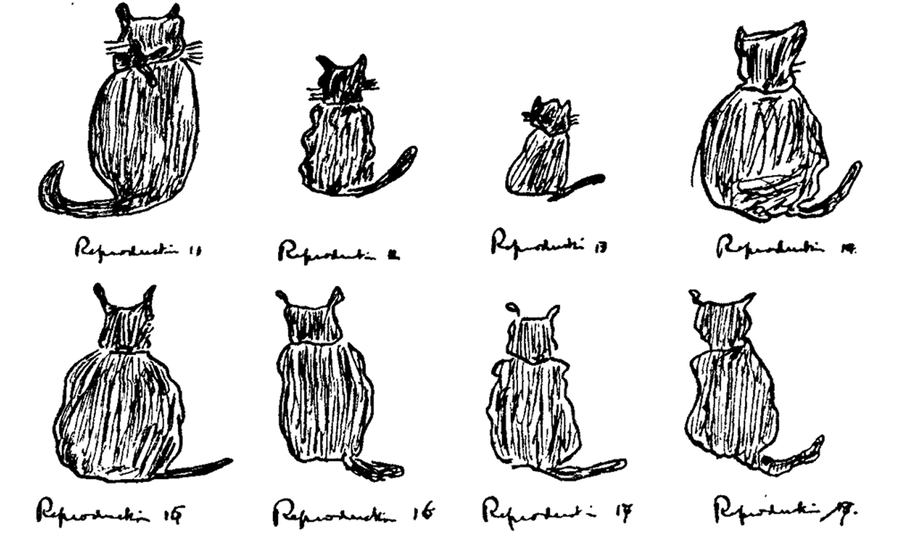
Frederick Bartlett investigated how images change as people transmit them to one another through memory. The first participant viewed a drawing and then reproduced it without prompts. The next person saw this copy and drew it from memory. Thus, the image passed from person to person, gradually transforming.
Title:
«Remembering»
Author, Year:
Frederick Bartlett, 1932.
Observation:
With each new drawing, the image changes more significantly. The owl gradually acquires cat ears, whiskers, and a tail. Ultimately, the first and last drawings appear…
Mechanism:
Reconstructive Memory:
When we recall an unfamiliar image, we can unconsciously alter it to make it more coherent. When a drawing is passed from person to person, these changes accumulate and intensify.
Can one recall something that never existed?
Conclusion
Shabri, K. The Invisible Gorilla. An Experiment Revealing Why Attention Impairs Focus, Memory Fails, and Intuition Deceives / K. Shabri, D. Simmons; translated from English by N. Ivkina. — Moscow: Eksmo, 2023. — 384 p.
Simmons, D. J. Inability to Detect Changes in People During Real-Life Interaction / D. J. Simmons, D. T. Levin // Psychonomic Bulletin & Review. — 1998. — Vol. 5, No. 4. — pp. 644–649.
Yarbus, A. L. The Role of Eye Movements in Vision / A. L. Yarbus. — Moscow: Nauka, 1965. — 166 p.
White, M. A New Effect of Image Structure on Perceived Brightness / M. White // Perception. — 1979. — Vol. 8, No. 4. — pp. 413–416.
Adelson, E. H. Perception of Brightness and Brightness Illusion / E. H. Adelson // The New Cognitive Neurosciences / edited by M. Cazzaniga. — Cambridge: MIT Press, 2000. — pp. 339–351.
Gegenfurtner, K. R. The Many Colors of a «Dress» / K. R. Gegenfurtner, M. Bloy, M. Toscani // Current Biology. — 2015. — Vol. 25, No. 13. — pp. R543–R544.
Lafer-Souza, R. Distinct Individual Differences in Color Perception Revealed by the «Dress» Photograph / R. Lafer-Souza, K. L. Hermann, B. R. Conway // Current Biology. — 2015. — Vol. 25, No. 13. — pp. R545–R546.
Lafer-Souza, R. Distinct Individual Differences in Color Perception Revealed by the «Dress» Photograph / R. Lafer-Souza, K. L. Hermann, B. R. Conway // Current Biology. — 2015. — Vol. 25, No. 13. — pp. R545–R546.
Thompson, P. Perceived Motion Speed Depends on Contrast / P. Thompson // Vision Research. — 1982. — Vol. 22, No. 3. — pp. 377–380.
Kitaoka, A. Characteristics of the Peripheral Motion Illusion / A. Kitaoka, H. Asida // VISION. — 2003. — Vol. 15, No. 4. — pp. 261–262.
Nickerson, R. S. Long-Term Memory of a Familiar Object / R. S. Nickerson, M. J. Adams // Cognitive Psychology. — 1979. — Vol. 11, No. 3. — pp. 287–307.
Bartlett, F. C. Memory: A Study in Experimental and Social Psychology / F. C. Bartlett. — Cambridge: Cambridge University Press, 1932. — 317 p.
Neisser, U. Phantom Vivid Memories: False Memories of Receiving News of the Challenger Disaster / U. Neisser, N. Harsh // Affect and Accuracy in Recall: Studies of «Flashbulb» Memories. — Cambridge: Cambridge University Press, 1992. — pp. 9–31.
Loftus, E. F. The Formation of False Memories / E. F. Loftus, J. E. PiKrell // Psychiatric Annals. — 1995. — Vol. 25, No. 12. — pp. 720–725.
Wade, K. A. A Photograph Costs Thousands of Lies: The Use of Fake Photographs to Create False Childhood Memories / K. A. Wade, M. Harry, J. D. Reed, D. S. Lindsay // Psychonomic Bulletin & Review. — 2002. — Vol. 9, No. 3. — pp. 597–603.
Lynch, K. The Image of the City / K. Lynch; translated from English by V. L. Glazycheva. — Moscow: Stroiizdat, 1982. — 328 p.
Benway, J. P. Banner Blindness: The Irony of Attentional Capture on the World Wide Web / J. P. Benway // Proceedings of the Human Factors and Ergonomics Society Annual Meeting. — 1998. — Vol. 42, No. 5. — pp. 463–467. — DOI: 10.1177/154193129804200504.
Talariqo, J. M. Confidence, Not Consistency, Characterizes Vivid Autobiographical Memories / J. M. Talariqo, D. K. Rubin // Psychological Science. — 2003. — Vol. 14, No. 5. — pp. 455–461. — DOI: 10.1111/1467-9280.02453.
Gegenfurtner, K. R. Perceptual Maturation of Oranges / K. R. Gegenfurtner // i-Perception. — 2024. — Vol. 15, No. 4. — pp. 1–5. — DOI: 10.1177/20416695241258748.
Santore, P. Consistent Values of Shadow Brightness for Artists / P. Santore // Journal of the International Colour Association. — 2015. — Vol. 14. — URL: https://www.aic-publishing.org/ojs/index.php/JAIC/article/view/153 (Accessed: 11/12/2026).
Keshavarc, B. Vertigo and Vision-Induced Sickness: How Are They Related? / B. Keshavarc, B. E. Rike, L. J. Hettinger, J. L. Campos // Frontiers in Psychology. — 2015. — Vol. 6. — Article 472. — DOI: 10.3389/fpsyg.2015.00472.
Rike, B. E. Beyond Vision: Multisensory Contribution to the Sense of Illusory Self-Motion (Vertigo) / B. E. Rike, B. Murovec, J. L. Campos, B. Keshavarc // Multisensory Research. — 2023. — Vol. 36, No. 8. — pp. 827–864. — DOI: 10.1163/22134808-bja10112.
Branded in Memory: A Study of Logo Recall [Electronic Resource] / Signs.com. — 2017. — URL: https://www.signs.com/branded-in-memory/ (Accessed: 11/12/2026).
The Delboeuf Illusion: How Plate Size Deceives the Brain and Why We Overeat [Electronic Resource] // DDHV. — URL: https://ddhv.ru/illyuziya-delbyofa-kak-razmer-posudy-obmanyvaet-mozg-i-pochemu-my-pereedaem (Accessed: 11/12/2026).
Which Plate Will You Eat Less From: Choosing Color, Shape, and Size [Electronic Resource] // VkusVill. — URL: https://vkusvill.ru/media/journal/iz-kakoy-tarelki-vy-sedite-menshe-podbiraem-tsvet-formu-i-razmer.html (Accessed: 11/12/2026).
How Plate Color and Size Affect Appetite: Choosing Dinnerware Correctly [Electronic Resource] // Posudamart. — URL: https://posudamart.ru/journal/articles/kak-cvet-i-razmer-tarelok-vliyaet-na-appetit-vybiraem-stolovuyu-posudu-pravilno/ (Accessed: 11/12/2026).
The Moon Illusion: Why the Moon Appears So Large on the Horizon [Electronic Resource] // Star Walk. — URL: https://starwalk.space/ru/news/big-moon-what-is-moon-illusion (Accessed: 11/12/2026).
Palazzo Spada Gallery: Architecture and History [Electronic Resource] // Eclectica. — URL: https://eclectica.ru/info/articles/the_palazzo_spada/ (Accessed: 11/12/2026).
Munker–White: The Optical Illusion of Color [Electronic Resource] // ColorScript. — URL: https://colorscript.ru/color/a/munker-white-optical-illusion (Accessed: 11/12/2026).
Adelson, E. H. The Chessboard Shadow Illusion [Electronic Resource] / E. H. Adelson // MIT Perceptual Science Group. — URL: https://persci.mit.edu/gallery/checkershadow (Accessed: 11/12/2026).
Sish, K. What Color Is That Dress? [Electronic Resource] / K. Sish // BuzzFeed. — 2015. — URL: https://www.buzzfeed.com/catesish/help-am-i-going-insane-its-definitely-blue (Accessed: 11/12/2026).
Riley, B. Movement in Squares (1961): Catalogue of Works [Electronic Resource] / B. Riley // Bridget Riley: The Complete Paintings. — URL: https://bridget-riley.publications.britishart.yale.edu/catalogue/1/ (Accessed: 11/12/2026).
Apple announces new accessibility features, including Eye Tracking [Electronic Resource] // Apple Newsroom. — 2024. — May 15. — URL: https://www.apple.com/uk/newsroom/2024/05/apple-announces-new-accessibility-features-including-eye-tracking/ (Accessed: 11/12/2026).
Using the Vehicle Motion Cues feature on iPhone [Electronic Resource] // Apple Support. — URL: https://support.apple.com/ru-ru/guide/iphone/iph55564cb22/27/ios/27 (Accessed: 11/12/2026).