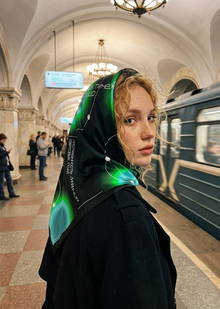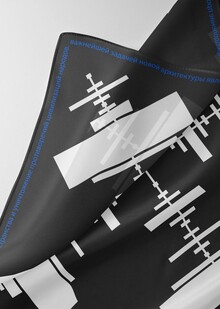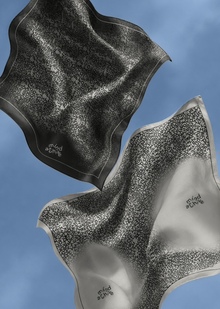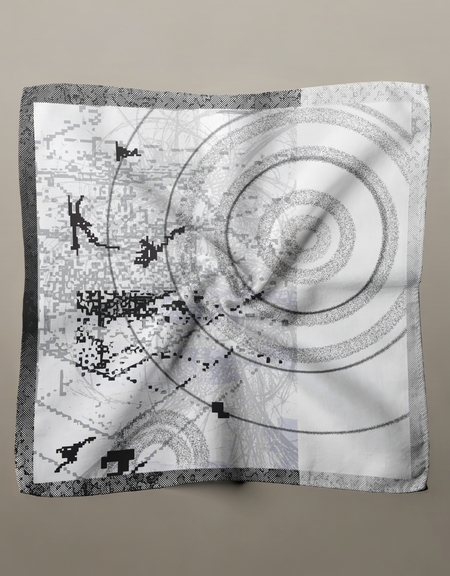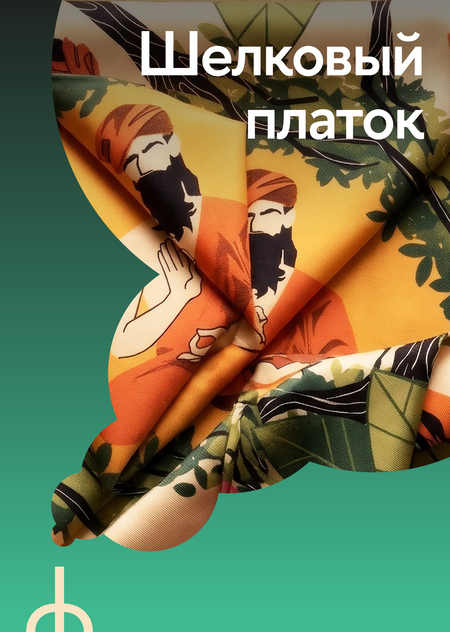
A silk scarf is an авторский textile object where the image shifts depending on how it is folded, tied, and worn. This imagery can be a drawing, pattern, typography, ornament, characters, or a composition built around a center, border, and corners.
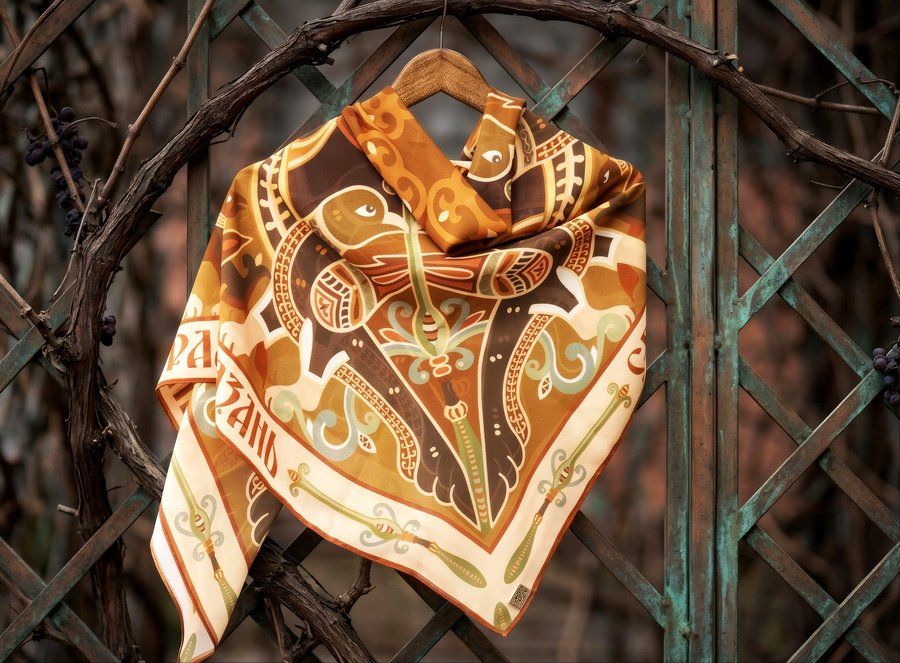
It is important to design not just as a unified image, but as a collection of individual fragments that will reveal themselves differently when the scarf is folded and draped.
Student Task
The student will develop an original design for a silk scarf, select one of two available formats, conceptualize the composition considering various folding and wearing methods, and prepare the layout for full-color textile printing.
Technical Specifications
Material
100% natural silk, 14 momme twill.Twill is a silk fabric with a twill weave. It is dense and durable—which makes it suitable for a scarf that will be worn regularly.
Size
Two formats are available:For a 90 × 90 cm scarf, the mockup must be 91 × 91 cm;
for a 120 × 120 cm scarf, the mockup must be 121 × 121 cm.
An additional 5 mm on each side is required for machine hemming.
Printing
Full-color digital printing on silk is used for production. The image is printed on one side, but the ink penetrates the fabric, so the design is also visible from the reverse side. When the scarf is folded, both sides can simultaneously become part of the composition.Edge Finishing
The edge is machine-stitched with an imitation of hand-finishing. It is necessary to allow a margin of **5 mm** on each side for the stitching. Significant elements of the composition, text, and fine details should not be placed in this area.Scarf Design
The design must be reviewed not only as a laid-out square,
but also in several states: fully open, diagonal, folded
into a strip, tied, and draped.
Special attention should be paid to the center, edges, and corners—after folding, it is often these small fragments that become the primary visible part of the scarf.
The composition can incorporate:
· a full illustration;
· a repeating pattern;
· an ornament;
· typography;
· a large central element;
· a distinctive border;
· different images in the four corners;
· an asymmetrical composition;
· a combination of several techniques.
A border is not a required element, and the image does not necessarily need to cover the entire surface of the scarf.
Mockup Preparation
The mock-up is prepared at 1:1 scale
For raster graphics:
· format — TIFF;
· resolution — 150–200 dpi;
· color profile — RGB or sRGB;
· all layers must be merged.
For vector graphics:
· format — EPS;
· scale — 1:1.
Important
The image and background must extend to the very edge of the layout. CMYK color profiles are acceptable, but the image may appear less vibrant when printed compared to RGB.
You do not need to separately mark cutting lines, folding lines, or sewing zones. Accounting for fabric shrinkage is also not required—the technologist handles necessary production adjustments.
The composition must be designed keeping in mind that the image edge will fall within the machine sewing area—5 mm on each side.
Before submission, please verify the physical dimensions of the layout, resolution, color profile, and the positioning of elements relative to the edge.
Production and Cost
Production Process:
layout proofing → silk screen printing → cutting → edge finishing → quality control → packaging
Minimum order — 1 piece.
Production time — from 5 business days.
Each scarf is packed in an individual, clear self-sealing bag.
What to Submit
For the final submission, you must prepare the following:
· Project title and a description of its concept (up to 500 characters);
· Final scarf design;
· Mockup in the chosen format;
· Final production file;
· Editable source file;
· Full visualization of the scarf;
· Visualization of one or more folding and wearing variations.
Production Files
The student uploads the complete set of production materials to their folder in the Temp section of the School’s network drive.
Before the final submission, the curator verifies the presence of the files and moves the project folder from Temp to the private Personal section. Access to this section is restricted to staff members working on projects.
Production mockups and source files are not made publicly available and are not attached to public longreads.
Questions and Answers
Why twill instead of satin?
Both fabrics can be made of 100% natural silk, but they differ in weave and properties. Twill, at 14 momme, is denser and more durable for everyday use, and it allows for both selected formats. Satin is most often supplied in rolls that are 90 cm wide.
Is it possible to create a series of scarves?
Yes. You can first produce one sample, assess the result, and only then decide on a series.
Should I add a border?
No. A border is one possible compositional technique, not a technical requirement.
Can I use a photograph or a complex full-color image?
Yes. Digital printing allows for the use of many colors, shades, and complex raster graphics. However, the actual color reproduction may differ noticeably from the image on the screen.
Should I consider the reverse side?
Yes. The design passes through a thin silk fabric and is visible from the back, so when worn, the reverse side also becomes a visible part of the item. You do not need to design anything separate for it.