Navigator
- Automatic Drawing: Line as Message
- Symmetry of the Unseen: Ornament as Higher Order
- Geometry of the Invisible: An Attempt to Depict Energy
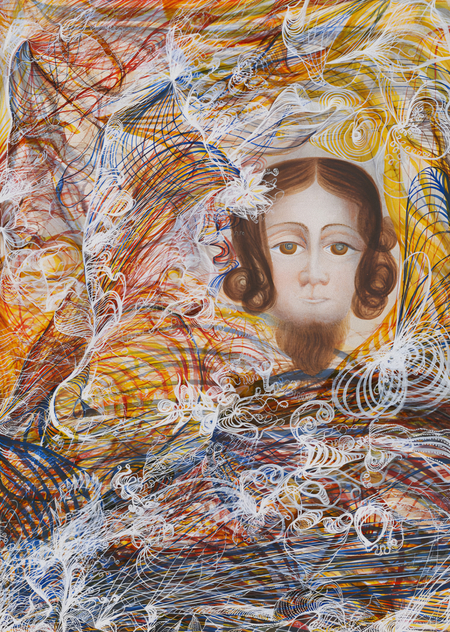
- Figures of the Spirit: Between Portrait and Fantastic Being
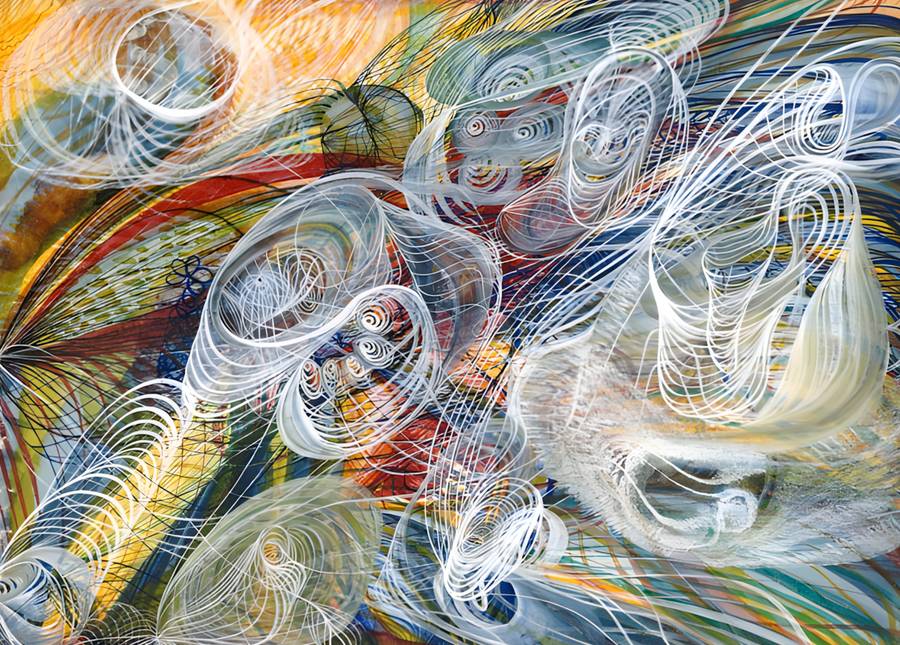
Georgiana Houghton. «Glory to God» (1864).
Concept
In the latter half of the 19th century, Spiritualism spread across Europe and America—a religious-philosophical movement based on the belief that communication with the world of the dead was possible. It was believed that the medium could act as an intermediary between the material and spiritual realms, receiving messages from otherworldly entities. Sessions, automatic writing, the use of spirit boards, and other methods of communicating with spirits gradually formed a distinct artistic practice—mediumistic art.
In this practice, the artist ceased to be perceived as the sole author of the work. Instead, they could see themselves as a conduit through which another will manifested—the spirit of a deceased relative, a great master from the past, an angelic essence, or some universal force. This conception changed not only the relationship to authorship but also the very principle of image creation. The artist was no longer obligated to reproduce the visible world, observe anatomical proportions, perspective, or conventional compositional rules. Their task became conveying what, in their belief, was impossible to see with the naked eye.
The result was the emergence of visual languages built upon continuous lines, complex ornamental systems, geometric structures, repetitive symbols, and fantastical anthropomorphic figures. Some of these works appeared long before abstraction became a recognized movement in European art. Georgiana Houghton’s watercolor paintings from the 1860s are particularly illustrative—they demonstrate that an engagement with the unseen world could lead to a departure from representational imagery as early as the mid-19th century.
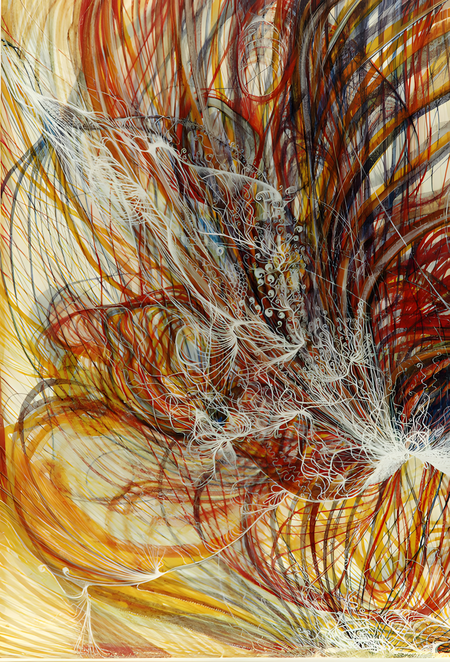
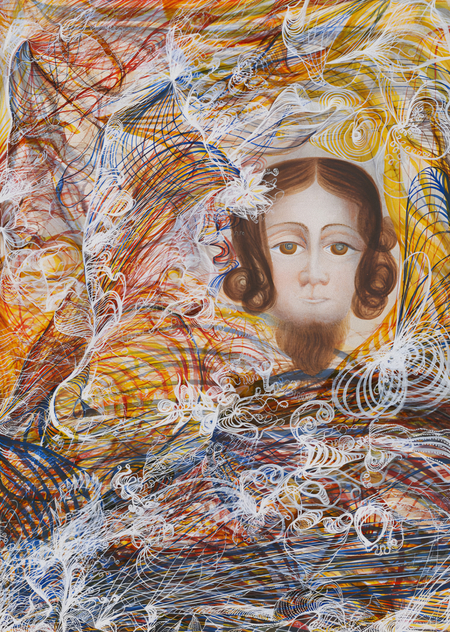
Georgiana Houghton. «The Almighty’s Shelter Wing» (c. 1861) // «Portrait of the Lord Jesus Christ» (c. 1862).
However, the mediumistic art was not a unified style. Some artists sought to convey the movement of the hand, which they attributed to spiritual influence; others created meticulously balanced symmetrical compositions; and a third group developed their own systems of geometric signs or depicted creatures inhabiting imaginary worlds. Therefore, its history can be examined through several visual strategies, where belief in the supernatural served as the foundation for artistic experimentation.
When examining mediumistic art, it is important to consider not only its visual characteristics but also the cultural mechanisms that define the boundaries of recognized artistic creation. In this context, referencing Michel Foucault’s concept, as elaborated in Madness and Civilization: A History of Insanity in the Age of Reason, proves highly productive.
Foucault views madness as a historically constructed concept, whose content depends on the relationship between individuals and societal institutions, particularly institutions of knowledge. The mediumistic artist finds themselves in an ambiguous position: on the one hand, they function as the author of a material image; on the other, they deny their own role as the sole source of artistic intent. Within the scope of this study, this perspective allows us to question the status of mediumistic images: how do works created in a state of purported spiritual contact or automatic hand movement relate to notions of conscious artistic creation? Is it relevant to question who the author is of the new visual languages that have emerged in the work of mediumistic artists?
Research Question:
How has the belief in the existence of otherworldly realms served as a means for some artists to liberate themselves from traditional artistic rules and forge new visual languages?
Automatic Drawing: Line as Message
Automatic drawing is one of the most radical practices in mediumistic art. Its core concept is the idea that the artist’s hand can move under the influence of an external force, bypassing conscious control and habitual methods of image construction. In this context, the line functions not merely as a formal element, but as a unique channel of communication. It records a movement that the artist perceives as originating from an external source.
One of the earliest examples of this practice was Georgiana Houghton (1814–1884)—a British painter and medium. In the 1860s, she created a series of watercolors which she termed «spirit drawings.» Initially, Houghton used a specialized instrument for séances—a slate—before transitioning to drawing by hand. The artworks themselves were accompanied by detailed explanations on the reverse: the artist indicated precisely which spiritual entities guided her hand and what meaning was embedded in the composition. Among her guides, she mentioned deceased relatives, Renaissance artists, particularly Titian and Correggio, as well as angelic beings.
Georgiana Houghton. «The Eye of God,» 1862.
Vortices, spirals, and interwoven colored lines form a complex composition where no single central subject or conventional vanishing point can be discerned. Layers of color and delicate white hatching create a sense of movement within the image. The piece invites the viewer to perceive the image as a visualization of a spiritual structure, moving beyond a conventional rendering of form.
It is particularly interesting that Houghton was not striving for abstraction in the sense that developed in 20th-century art. For her, these images were not an experiment with color and form, but rather a truthful testament to the existence of a spiritual reality. This is the fundamental difference between her approach and later artistic abstraction: non-objectivity became not an independent aesthetic goal, but a consequence of the attempt to represent that which lacks a material form.
Another example is Lore Pigeon (1882–1965), a French artist who began drawing in 1935 after encountering spiritualist practices. Unlike Hawthorne, who primarily worked in watercolor, Pigeon used ink and paper. Her early works resemble an intricate weaving of threads: thin lines intertwine, cross over one another, and form loops, knots, and shapes reminiscent of written characters. Sometimes, the profiles of faces, birds, or individual words—often names—emerge from this tangle.
In this type of work, the line transforms into a continuous flow that simultaneously resembles writing, ornament, and image. The viewer attempts to read the emerging forms, but they do not coalesce into a stable system of signs. Since 1953, Pizhon has almost entirely worked with blue ink, creating dense, saturated compositions.
In the work of Hawthorne and Pizhon, the line becomes an independent carrier of information. It does not so much delineate the boundaries of objects as it registers the presumed presence of the invisible. As a result, the conventional hierarchy of the image collapses: the line ceases to be a subordinate tool and becomes the main subject of the work itself.
Symmetry of the Afterlife: Ornament as the Highest Order
When the free line becomes the primary element in automatic drawing, in the works of Augustin Lesage (1876–1954), the otherworldly realm takes the form of a complex architectural system. His pieces resemble fantastic temples, palaces, facades, and ornamental structures governed by strict symmetry.
Lefevre worked as a miner in northern France. In 1911, while in a mine, he heard a voice, according to his own account, that predicted he would one day become an artist. After becoming acquainted with spiritualism, he began creating drawings he believed were dictated by the deceased, including the spirit of his younger sister. Between 1912 and 1913, Lefevre worked on his first large canvas, which measured about nine square meters.
Lesage worked as a miner in northern France. In 1911, while in a mine, he heard a voice, according to his own account, that predicted he would one day become an artist. After becoming familiar with spiritualism, he began creating drawings that he believed were dictated by the deceased, including the spirit of his younger sister. Between 1912 and 1913, Lesage worked on his first large canvas, which was about nine square meters in size.
In his subsequent works, symmetry becomes the primary principle governing the composition of the image. Numerous small elements—arches, columns, towers, domes, windows, botanical motifs, and symbolic figures—coalesce into a unified space. What is crucial is not any individual element, but its placement in relation to others: repetition, mirror symmetry, and rhythmic alternation create a sense of singular order.
The work «Symbolic Composition of the Spiritual World» (1923) is particularly noteworthy. The title alone suggests an aspiration to represent the otherworldly reality as an organized system. Instead of the chaotic space one might expect from an image of a dream or a trance, Lesage creates a meticulously structured universe. Its arrangement is reminiscent of the architectural blueprint of an unknown world, where each element has been assigned a specific place.
Symmetry, in this context, can be viewed as a visual metaphor of the highest order. If the visible world is subject to chance and decay, the spiritual reality in the artist’s representation possesses a perfect structure. Ornamentation becomes a means of conveying a harmony that is inaccessible to immediate human perception.
The technique itself is significant: Lesage worked with small brushes, meticulously detailing every minute element. His painting demonstrates that a belief in the supernatural did not necessarily lead to spontaneity or a rejection of control. On the contrary, the conception of a spiritual order might demand extreme precision, repeatability, and discipline. Thus, in Lesage’s work, ornament ceases to be a mere decorative addition. It transforms into an autonomous method for constructing space and depicting the invisible. Fantastic architecture becomes a kind of map of the spiritual universe.
The Geometry of the Unseen: An Attempt to Depict Energy
In the work of Emma Kunz (1892–1963), geometry assumes an entirely different meaning. Where Lesage sought to depict the architecture of the supernatural realm, Kunz attempted to visualize unseen connections, energetic flows, and patterns that, in her view, exist within nature and the human body.
The Swiss artist did not consider herself an artist in the conventional sense. She described herself as a researcher and a healer. From a young age, Kunz engaged in divination practices, utilized a pendulum, and believed she could perceive hidden relationships between phenomena. In 1938, she began creating large-format drawings on millimeter paper, employing pencils, colored pastels, and oil-based chalks.
The process of creating the drawings involved using a pendulum. Kunz posed questions, and she transferred the directions and indications obtained through the pendulum onto paper, connecting the points with numerous lines. This resulted in compositions built upon the intersections of straight lines, circles, triangles, rhombuses, and radial structures. The artist viewed these not only as works of art but also as the results of an investigation.







