This visual study explores how the perception of the individual and daily life in Russian photography has evolved from the 1940s to the present day. Where early Soviet photography emphasized heroism, collectivity, and ideology, the focus of photographers gradually shifted over time toward ordinary life, chance moments, urban space, and the individual’s personal experience.
Through photographs from different eras, the study demonstrates how the visual language of photography has transformed alongside historical changes—from staged and official shots to a more vibrant, observational, and intimate view of reality.
Photography is a way to understand how time looks.
To explore this theme, we use visual comparisons of photographs from different decades, analyzing composition, light, space, and the placement of the human figure within the frame. Particular attention is paid to how photography, through everyday scenes, street atmosphere, and quotidian details, begins to convey a sense of time and preserve the memory of an era.
CATEGORIZATION
What is the Visual Study About?
Introduction «The Poetics of the Everyday»
Chapter 1 1940s–1950s «Man as a Symbol of the Era»
Chapter 2 1960s «The Thaw and the Emergence of the Living Person»
Chapter 3 1970s–1980s «Daily Life as Atmosphere»
Chapter 4 1990s «Decline and New Reality»
Chapter 5 2000s–Present «Personal Everyday Life»
Conclusion «What Remains in Memory»
POETICS OF THE EVERYDAY
How Russian Photography Learned to See Everyday Life
In the latter half of the 20th century, photography in the USSR gradually shifted its focus from ideology and heroism to everyday life. The frame came to feature streets, courtyards, public transportation, solitude, casual gestures, and ordinary people. Through these domestic scenes, photography began to tell the story of a particular time.
The history of photography is not merely the history of events. It is the history of how our perception of everyday life has evolved.
In the latter half of the 20th century, Soviet photography gradually shifted its focus from heroic imagery toward the mundane, the fleeting moment, and the individual human experience.
The more closely photography observes everyday life, the more accurately it begins to convey the sensation of time.
1940s–1950s HUMAN AS A SYMBOL OF THE ERA
The photograph doesn’t show life; it shows an ideal.
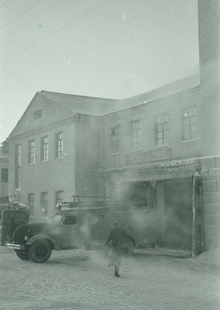
After the war, Soviet photography became a tool for constructing the image of a strong state. The individual in the frame was portrayed as part of a large collective: a worker, a soldier, a builder of the new country. Photography rarely depicted private life—the idea of a shared future, discipline, and heroism was more important.
In early Soviet photography, the individual almost never exists separate from the state.
The worker, the soldier, the builder, the scientist—they are first and foremost a symbol of the era, not a private personality.
The camera captures not everyday life, but the image of an ideal world.
Hero of the Soviet Union, navigator Sergey Dupliy, 1944, Evgeny Ananievich Khaldey
The protagonist’s identity dissolves into the image of victory and the state.
Victory Banner over the Reichstag, 1945, Khaled Evgeny Ananievich


Construction of the gas holder, 1934. Evgeniy Chaldey / Globus, 1950. Dmitry Baltermantz.
The human is depicted as a part of an industrial mechanism. Even domestic scenes retain a sense of discipline and collectivity.
Beetle Mound 1940, Albert Max
Pioneer Parade in Stalingrad 1945, Fridland Semyon
Presentation by Academician Timofey Lysenko at the VASKHNIL Session. Moscow, 1948
The photograph captures not doubt or chance, but authority and order.
Spools 1951, Albert Max
To Berlin! 1945


Red Square, Moscow / Kirghiz Women, 1950s, Dmitry Baltermanz
After Stalin’s death, photography gradually ceased to be solely an instrument of ideology. Chance, movement, emotion, and ordinary city life began to appear in the frame.
1960s THE THAW AND THE EMERGENCE OF THE LIVING HUMAN
Photography becomes more human.
During the Thaw, photography begins to move away from strict officialdom. Chance moments, movement, emotion, and daily urban life start appearing in the frames. Photographers increasingly observe people rather than creating ideological portraits. Everyday life becomes an independent subject for the first time.
The camera begins to observe rather than assert for the first time.
The photographer increasingly captures not the «correct» moment, but the living presence of a person within the city and time.