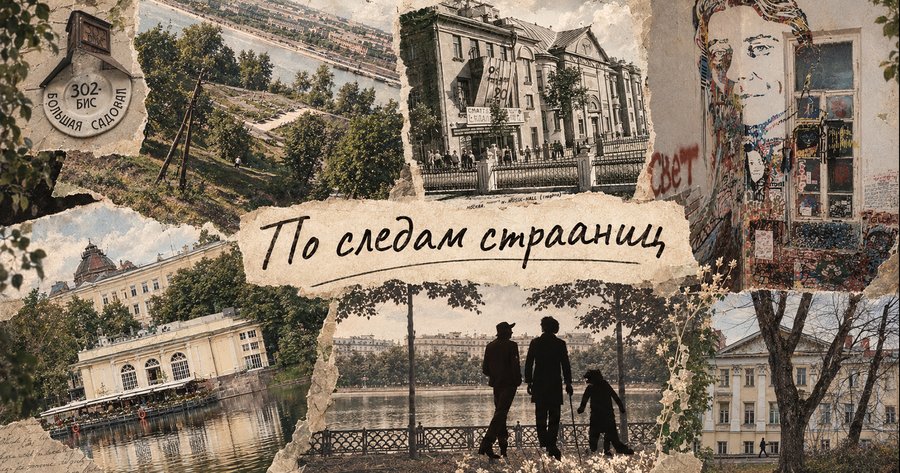
Concept
«Following the Pages» is a cultural and educational media platform that introduces Russian classic literature through real-life locations—authors' homes, museums, streets, and cities connected to the works. The project’s idea is to move Russian classics from the pages of books onto the streets of the city, transforming exposure to literature into an independent exploration. The goal is to engage the reader with literature, explain its historical and cultural context, and help them take their own literary journey.
Target Audience
✧ Students and young people who need clear explanations of artworks. ✧ Young individuals eager to read more and broaden their horizons. ✧ Literature enthusiasts interested in unusual facts and cultural events. ✧ Independent travelers seeking meaningful city walks.
Main Venue:
Public Telegram channel. Three main publications are planned per week: educational content, an interactive element, and a practical itinerary or local spot guide.
Main Categories
✧ «Following the Hero» — literary routes featuring map points and activities.
✧ «Literary Address» — stories of the houses, streets, and locations from writers' lives.
✧ «Beyond the Pages» — unusual facts and cultural context.
✧ «Classic in a Minute» — brief analyses of works, characters, and themes.
✧ «Guess the Place» — quizzes and literary riddles.
✧ «Where to Go?» — museums, exhibitions, and literary spaces.
✧ «Reading the City» — observations and mini-quests during a walk.
Data Sources for Media
- Literary Sources. Texts from works, letters, diaries, and memoirs allow researchers to find quotes, place descriptions, and biographical evidence. This data is used for analyses, assignments, and explaining the connection between a work and the city.
- Digital Libraries. Digitized editions, scholarly literature, and historical periodicals help verify citations and study context. For example, materials can be searched in the National Electronic Library.
- Official Websites of Literary Museums. These are used to obtain information about exhibits, addresses, and visitation requirements. An example of such a source is the official website of the Dostoevsky Museum.
- Academic Research and Literary Criticism. These help verify complex claims, analyze works, and study theories regarding character prototypes and literary locations.
- Mapping Services. These are necessary for determining coordinates, distances, and pedestrian connections between points. Preliminary routes and maps are compiled based on this data.
- Editorial Materials. Walks, photographs, and interviews allow for an assessment of the current state of a location, route verification, and supplementing publications with original observations.
- Audience Feedback. Suggestions for topics, error reports, and impressions from walks help update materials. Reader information is vetted before use.
- Channel Analytics. Views, reactions, comments, and poll participation are used to assess interest in topics and formats.
The core principle is to match the source to the specific claim. Quotes are verified by the work’s publication, operational details are sourced from the museum’s official information, and point locations are determined by map data and on-site observation. Controversial literary locations are cross-referenced with research while maintaining notation of uncertainty.
Data schema divided into human and machine processing
✧ The database stores sources, verified facts, literary locations, routes, and publications. Each record type has its own data set. 1 Sources Material title, author or organization, link or publication description, and date accessed. 2. Facts Fact statement, associated writer or work, supporting sources, verification status, and responsible editor. 3. Literary Locations Name, city, current address, coordinates, connection to the writer or work, and verification date. It is separately noted whether this connection is a verified fact, a research theory, or an urban legend. 4. Routes Name, sequence of points, distance, estimated walking time, reader tasks, and route verification date. 5. Publications Section, text, associated facts and routes, illustrations, readiness status, and release date. After publication, views, reactions, comments, and survey results are added, indicating the measurement time. ✧ Data Relationships Every fact is supported by sources. Literary locations are linked to facts about writers and works. Routes are composed of these locations, and verified data is used to prepare publications.
Data processing occurs as follows:
The machine performs repetitive operations. The human is responsible for authenticity, literary interpretation, route quality, and the decision to publish. In a small project, one participant may hold multiple editorial roles.
- The person selects a topic and sources. The editor determines whether the material will focus on a specific author, work, or city.
- The machine gathers and systematizes the data. The service accesses available materials, extracts names, dates, and addresses, flags possible duplicates, and suggests thematic tags.
- The person verifies the information. The editor cross-references quotes, historical facts, and the relationship between the location and the literature. Verified entries are moved to a separate section of the database.
- The machine prepares the draft materials. Based on the verified information, variants of text, quizzes, routes, and cards are created.
- The person edits and approves the result. The author checks the meaning, style, assignments, practical information, and itinerary.
- The machine publishes the approved material. The service posts the content according to schedule and collects available statistics.
- The person analyzes the results. The editor studies the audience reaction, selects new topics, and decides on material updates.
Guidelines for Automated Services in the Schema
- Material Collection Service Retrieves a list of approved sources and adds the found materials to the database. For each entry, it saves the title, link, and date of acquisition. If a source is unavailable, it logs the error and notifies the editor.2. Data Extraction and Classification Service Extracts names, dates, titles of works, and addresses from the materials. Each extracted piece of information must be linked to the original segment. Historical, modern, and fictional addresses are stored separately. Homonymous locations cannot be automatically merged without verification.3. Author AI Assistant Generates drafts of posts, questions, and assignments based on verified entries. It must not fabricate facts, quotes, links, or addresses. If information is insufficient, it flags the entry as «requires verification.» Research versions and assumptions must carry appropriate disclaimers.4. Route Preparation Service Suggests a sequence of verified points, calculates the approximate walking distance and time. Calculations must be designated as estimates. A human verifies the accessibility of paths, entrances, and individual sections.5. Visual Material Preparation Service Creates cards according to approved templates. It must retain image captions and source information, ensure text legibility, and maintain visual consistency. Generated images must never be presented as archival photographs.6. Scheduled Publishing Service Publishes only materials with an «approved» status. If the text changes after approval, the material is returned for review. In case of a failure, the service notifies the editor and checks if the post has already appeared in the channel before resubmitting.7. Analytics Service Collects available metrics and generates a regular report. Publications are compared over the same time period after release. Results from different formats are reviewed separately. Unavailable metrics are marked as missing.
The following general rules apply to all services:
✧ Every fact must have a verifiable source. ✧ Discrepancies between sources are reported to the editor. ✧ Practical information is verified before publication; the verification date is retained. ✧ Texts must adhere to a friendly and educational media style. ✧ Change history and material approval details are preserved. ✧ Reader feedback is used as a prompt for verification. ✧ Readers' personal data is not included in public materials without consent.