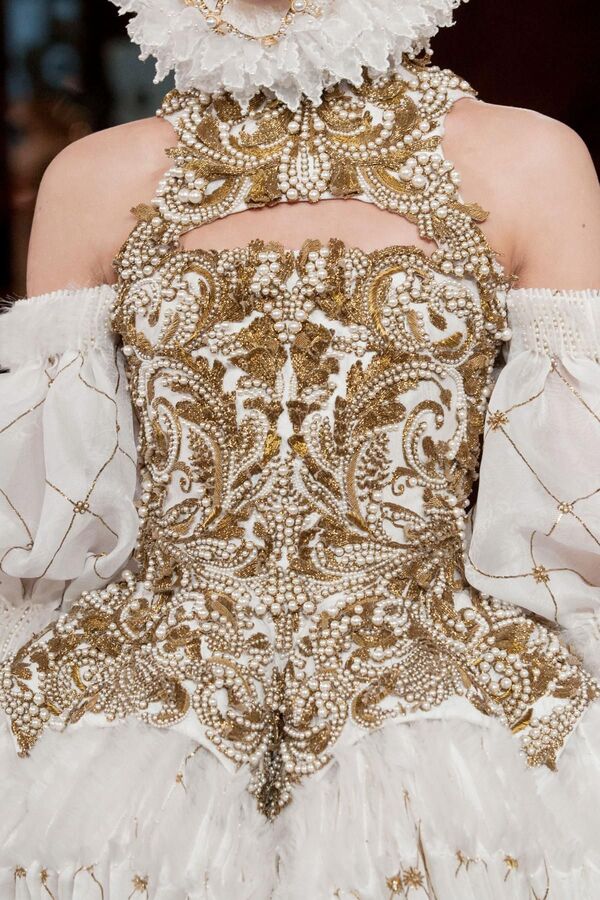
Government of the Russian Federation Federal State Autonomous Educational Institution of Higher Professional Education National Research University Higher School of EconomicsFinal Qualifying Work in the Field of Study 54.03.01. «Design»Title: From Counter-Reformation to the Modern Market: How the Baroque Code Changes in Fashion Final Qualifying Work:Profile: Communication Design Group: BD3232 Student: Eremeeva Sofya Supervisor: Syrovatskaya Sofia Reviewer: Malich KseniaHSE ART AND DESIGN SCHOOL St. Petersburg, 2026
Navigator
ConceptChapter 1. Baroque: Origins and Essence 1.1. The Historical Context of Baroque 1.2. Baroque as a System of Techniques 1.3. The Baroque Costume as a Language of PowerChapter 2. The Transformation of Baroque 2.1. Shifting Context: From Church and Court to Market and Digital Environment 2.2. Which Baroque Techniques Are Adapted in Contemporary Fashion? 2.3. How Does the Meaning of Baroque Techniques Change?Chapter 3. Baroque and the Modern Market 3.1. Baroque Techniques in the Collections of Contemporary Designers 3.2. The Baroque Code in the Mass Market: The Statement Piece in the Modern WardrobeConclusion
Concept
I need the Russian text you want me to translate. Please provide the text.
[No text provided to translate.]
Please provide the Russian text you would like me to translate.
Chapter 1. Baroque: Origins and Essence
1.1. Historical Context of Baroque
Versailles Palace, Hall of Mirrors, France, 17th Century
The word Baroque has Portuguese origins. Initially, the term «perola barroco» referred to a pearl of irregular shape. In Italian, the word «barocco» became established to mean ornate or inclined toward excess.
It was only in the 19th century that this term began to be used to denote an entire era in art. Today, Baroque is associated with luxury, emotional richness, and drama.
How the Baroque style developed independently in Europe at the turn of the 16th and 17th centuries. Italy is considered the birthplace of the style. It was in Rome, Venice, and Florence that the first architectural and pictorial masterpieces emerged. Later, the Baroque spread to France, Spain, Germany, and Austria. In each country, the style acquired its own uniqueness while retaining common characteristics.
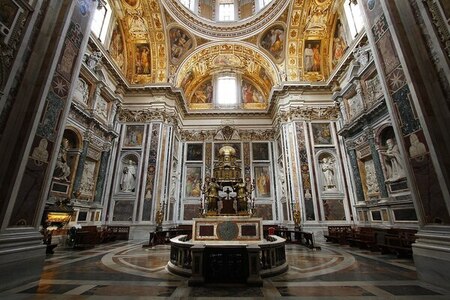
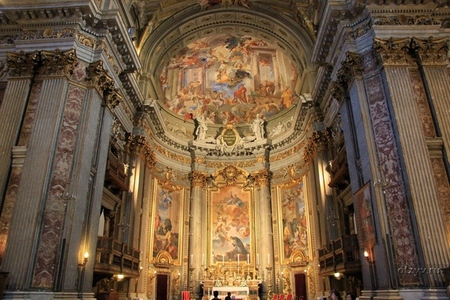
Sistine Chapel, Santa Maria Maggiore Church, Rome, Italy / High Altar, Sant’Ignazio Church, Rome, Italy
The emergence of Baroque art is closely linked to the historical events of the 16th century, specifically the Counter-Reformation. The Catholic Church needed a new instrument to influence believers. Art became a powerful tool for propaganda. Through emotional impact, scale, and spectacle, the Church sought to strengthen faith and demonstrate its might. Baroque art became a direct expression of these spiritual and political shifts.
Bernini, Ecstasy of Saint Teresa, 1645–1652
Swiss art historian Heinrich Wölfflin, in his work «Renaissance and Baroque, ” explains the transition to a new style through a shift in artistic principles. He notes that the rigorous and complete art of the Renaissance gave way to something freer and more painterly.
According to Wölfflin, Baroque lacked the strict theory found in the Renaissance. The style developed intuitively. A taste for novelty became dominant, and a love for breaking rules and departing from classical models became widespread.
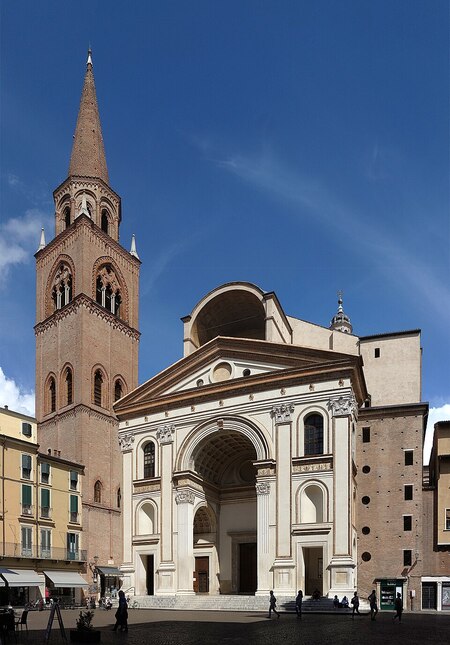
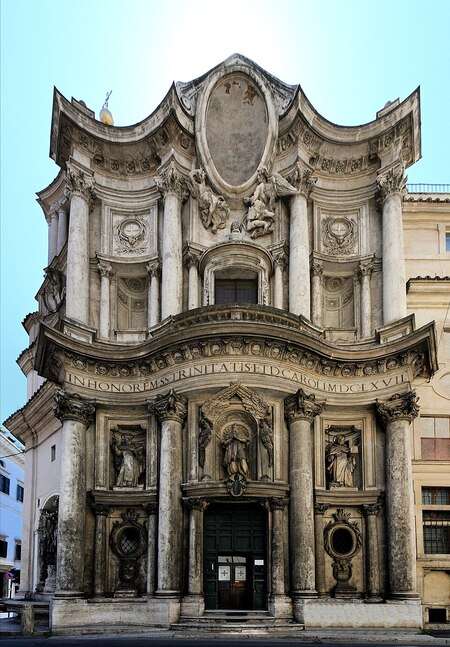
Leon Battista Alberti, Sant’Andrea Church, Mantua, Italy, Renaissance Architecture / Francesco Borromini, San Carlo alle Quattro Fontane Church, Rome, Italy, Baroque Architecture
Baroque should not be perceived merely as a collection of decorative techniques. It is a massive cultural phenomenon that permeated every aspect of life. Architecture, painting, music, and fashion all developed under the influence of unified ideas.Contemporary philosopher Vladislav Degtyarev notes in his book, «Baroque as Connection and Rupture, ” that the Baroque experience of novelty and the realization of the world’s complexity remains valuable for us today. This is precisely why 17th-century aesthetics still resonates in contemporary design.
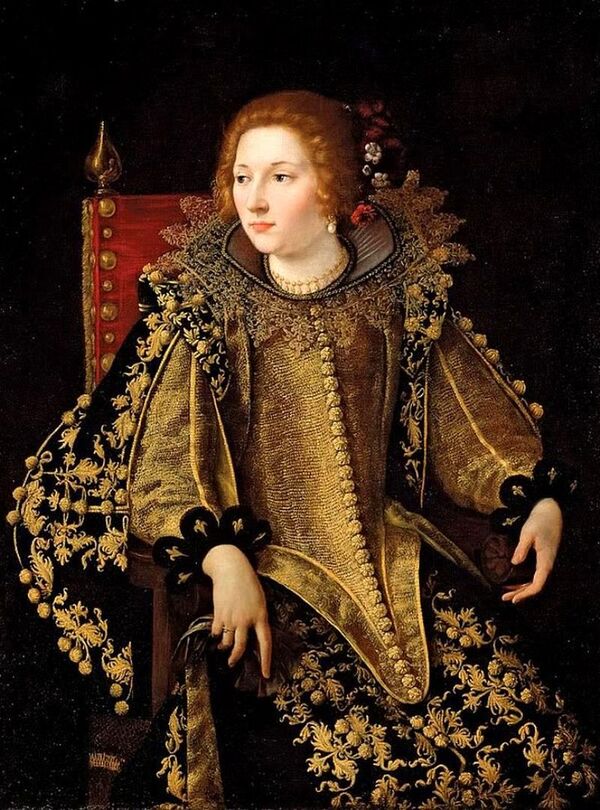
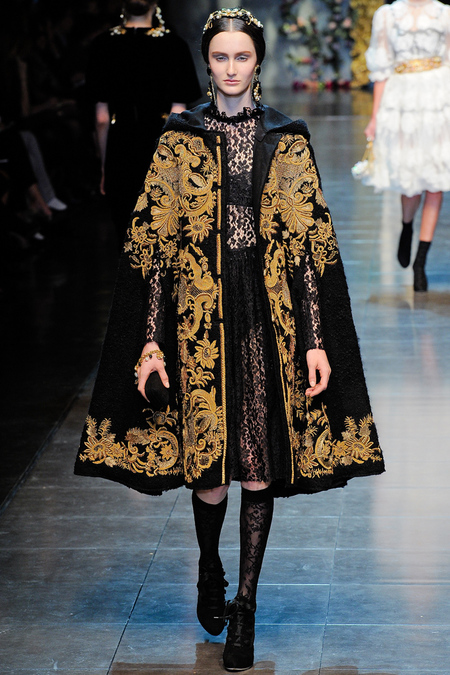
Artemisia Gentileschi, Portrait of a Seated Lady, 1625 / Dolce & Gabbana, Autumn/Winter 2012–2013
The second half of the 17th century was marked by the consolidation of absolute monarchy. The court of Louis XIV in France became the primary fashion arbiter in Europe. The king utilized fashion as a political instrument. The opulence of the gowns, the complexity of the tailoring and silhouettes, and the profusion of jewels underscored aristocratic status. It was during this period that the French court began dictating Baroque fashion across Europe, setting standards of grandeur and solemnity.
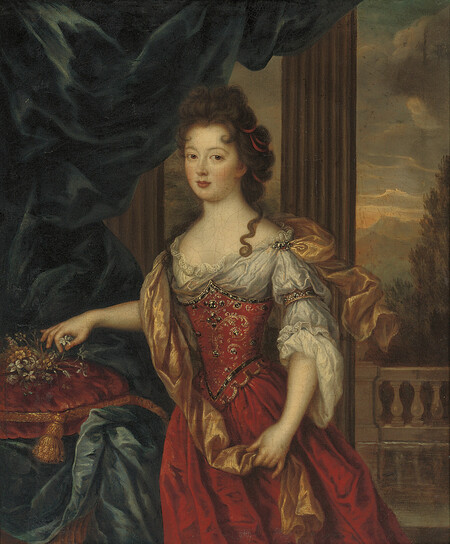
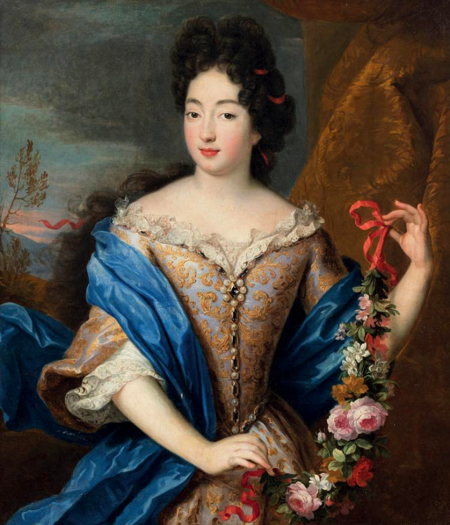
Pierre Minier, Portrait of Maria Theresa of Bourbon, c. 1680 / Pierre Gobert, Portrait of Anna of Bavaria, c. 1680
1.2. Baroque as a System of Devices
To understand Baroque costume, one must first grasp the system of techniques defining this style. Unlike the Renaissance, which strove for strict harmony and symmetry, Baroque rejects staticity. The art of this period leans toward drama and expressiveness. It intentionally disrupts conventional proportions, creating a sense of tension and latent energy.
Heinrich Wölfflin provided a detailed account of the transition from the Renaissance to the Baroque. He observed that the new style abandoned clear lines and enclosed forms in favor of open space and pictorial dynamism. According to Wölfflin, Baroque art seeks to create the illusion of continuous movement. Masses of light and shadow replace strict linear outlines. Instead of arranging figures in perfect order, artists and architects deliberately disrupt balance. It is this sensation of dynamism and incompleteness that becomes the defining artistic characteristic of the era.
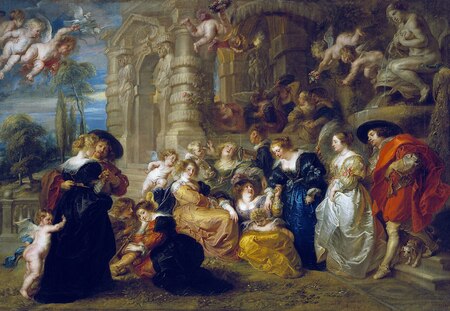
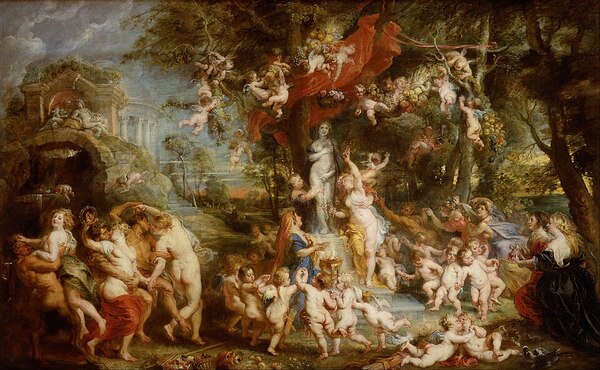
Rubens, Garden of Love, 1632 / Rubens, Triumph of Venus, 1635–1636
Redundancy in the Baroque style is not a flaw—it is an intentional principle. The style is built on contrasts. Light is set against shadow, heavy materials are paired with light ones, and massive forms are juxtaposed with small details.
The color palette is also constructed through contrast. Deep, dark hues emphasize the brilliance of gold, gemstones, or light fabrics. This combination is designed to evoke powerful emotion and admiration.
François Lemoyne, Apotheosis of Hercules, fresco, 1731–1735, Palace of Versailles
One of the primary tools of the Baroque period becomes the manipulation of space. Walls and ceilings cease to be flat planes. They curve, break, and recede into depth. Architects use light as a building material. Streams of light falling from domes or hidden windows create dramatic effects. Shadows become as important as the illuminated areas.
All these principles are directly reflected in the costume. Baroque-era clothing could not be simple or restrained; it had to amaze the imagination.The theatricality, the contrast of textures, and the deliberate excess of decoration transitioned from painting and architecture into fashion. This very system of techniques will form the basis for the further analysis of Baroque costume.
1.3. Baroque Costume as a Language of Power