
Navigator
1. Concept
2. Mansi
3. Khanty
4. Komi
5. Nenets
6. Dolgan
7. Selkups
8. Ornament Creation Techniques
9. Conclusion
Concept
Ornament is an important element of the material and spiritual culture of peoples. Over the centuries, it has been used not only as a decorative motif but also as a means of conveying conceptions of the surrounding world, natural phenomena, beliefs, and cultural identity. Particular interest is drawn to the ornamental art of the indigenous peoples of Siberia, distinguished by its variety of forms, compositions, color schemes, and execution techniques. The geographical, climatic, and historical characteristics of the region influenced the formation of unique artistic traditions, which are reflected in clothing, footwear, jewelry, and everyday objects.
I chose to study the peoples of Siberia because I am originally from Novosibirsk, and I would like to learn more about the history of my hometown.
The study examines the ornamental heritage of various peoples of Siberia. Special attention is given to the individual characteristics of each people’s ornaments—their visual language, materials, application methods, and placement on objects. The work aims to identify both common artistic patterns and ethnic distinctions, allowing the ornament to be viewed as an independent component of Siberia’s cultural heritage.
Mansi
In folk art, ornament holds a central place, with motifs similar to those of the related Khanty and Selkup peoples. These are geometric shapes such as reindeer antlers, rhomboids, wavy lines, Greek-style meander, and zigzag lines, which are most often arranged in a band.
1 seated sable, 2 birch branch, 3 wild deer antlers, 4 male deer antlers, 5 fox elbow, 6 squirrel track, 7 birch branch, 8 young sable’s ears, 9 birch branch, 10 pike jaw, 11 bass scale pattern, 12 seated next to each other, 13 large waves, 14 tips, 15 double row of tips, 16 sparse tip, 17 triple tip, 18 double-sided tip, 19 single-sided tips.
The ornament generally features relatively large geometric patterns dominated by straight lines, sharp bends, and various extensions. In some instances, there is a tendency toward equalizing the background and the pattern. The ornament is silhouetted and predominantly border-like (zonal), though enclosed patterns (rosettes) are also present. Most figures exhibit symmetry, while some are asymmetrical. A characteristic feature of the ornament is the contrast between light and dark materials. In fur, this ornament is achromatic, whereas in suedes and beads, it displays vibrant coloration.
pattern for a handbag, person on a horse, deer, pattern for a handbag, pattern for a handbag, frog
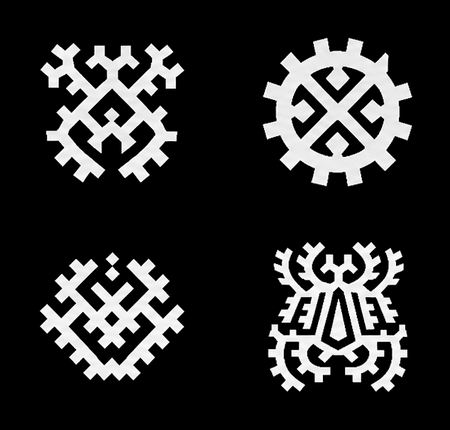
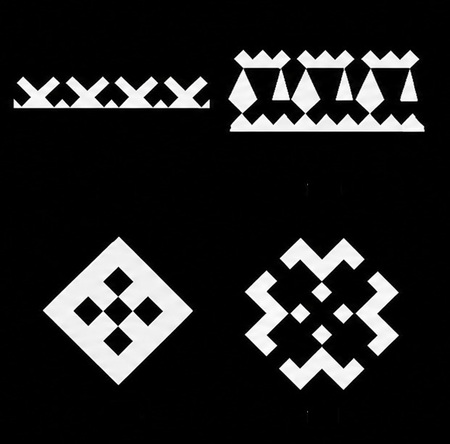
ornament for a handbag, large nest, pike teeth, foal’s hooves, ornament for a handbag, image of a bear, sewing pattern ornament, crows over a swamp
Khanty
Key Motifs: individual or paired birds flanking the tree, a cruciform rosette, an eight-pointed rosette, a stepped rhombus.
The ornamentation is zoomorphic, vegetal, and geometric, leaning toward heraldic arrangements of zoomorphic motifs and strict symmetry. Dark outlines are typically used for the figures. It is often composed into rosettes. The patterns are two-toned, predominantly red and blue. Figures within the outlines undergo decorative refinement. Small scrolls and whiskers can often be found on the contour lines (Lower Irtysh ornament type). The ornamentation mostly densely fills the object’s surface, integrating into a system of geometric patterns.
Comi
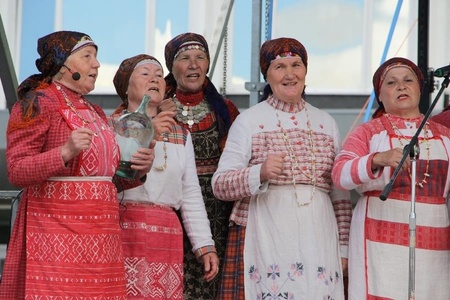
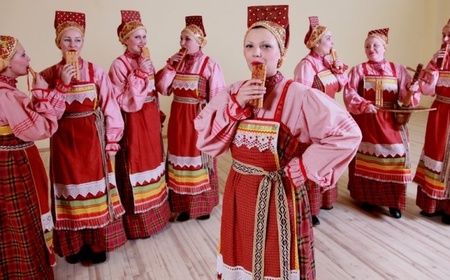
The ornamentation is predominantly characterized by geometric motifs: the diagonal cross, the simple rhombus, and a layered design with intersecting and extended sides. In addition to typical geometric elements, there are stylized figures of humans and animals, as well as vegetal motifs such as rosette flowers, stalks with buds, and flowering branches.
Nenets
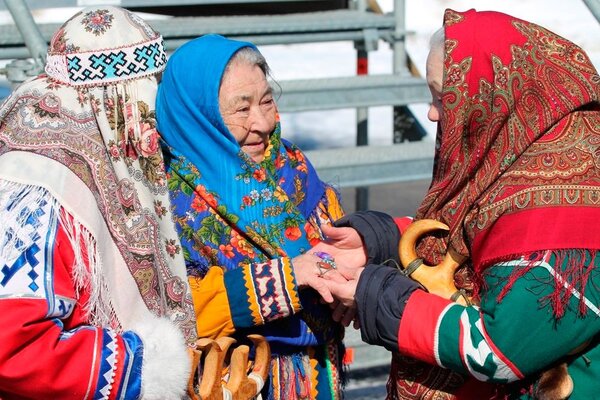
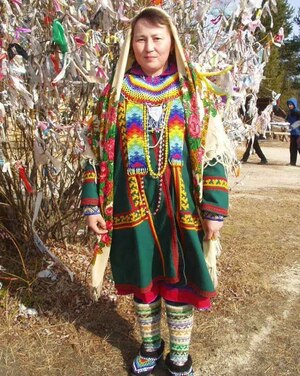
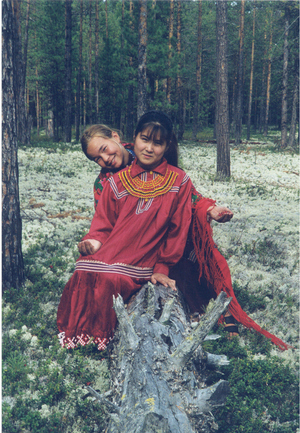
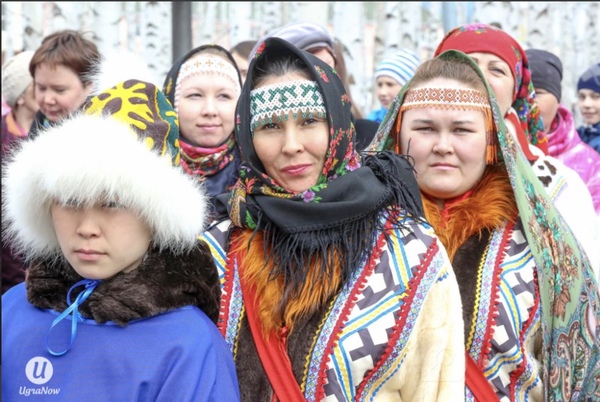
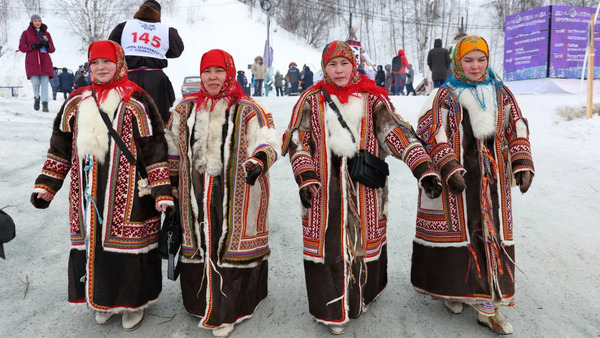
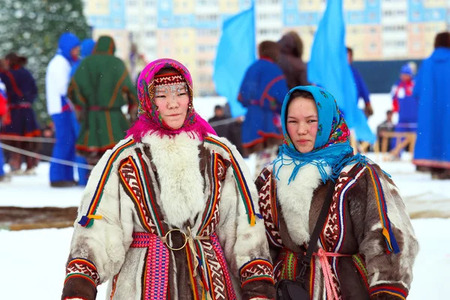
The patterns of Nenets ornamentation are strictly geometric, composed of rectangles, zigzags, angles, and diamonds. The Nenets interpret these designs as a living representation of the northern nature close to them. Nenets ornamentation is based on a direct perception of nature. This is clearly indicated by its names: «deer antlers, ” „rabbit ears, ” „fish tails, ” „pinecone, ” and „swans.“
Nenets ornamentation also includes motifs that distinctly resemble figures of people, animals, and plants.
Key motifs include meanders, G-shaped figures, branch-like or antler-like figures (both symmetrical and asymmetrical), „heads, ” vertical lines with protrusions, and crosses.
Dolgany
The simplest form of geometric ornamentation, dolgan—the striped pattern—developed significantly among them. It is executed in various ways—painting on the flatcloth, most often with white hair tassels along the edges of the design, appliquéing colored fabric onto the skin, sewing in pieces of colored or dark fur, or attaching colored beads. The number of stripes varies—from one or two to several dozen.
The Dolgan, like other peoples of the North, enjoy diversifying the colors and materials of their bands, as well as their widths. In addition to bands, the Dolgan ornamentation features a group of motifs in the form of rectangles, squares, and rhombuses—large, small, layered upon one another, or placed at an angle.Women’s clothing is adorned with special ornaments; for instance, on the side panels of the Dolgan headdress, a large pattern resembling a yurt—a symbol of a woman—is embroidered.The ornamentation is simple, strictly geometric, and predominantly linear, often featuring intricate detailing within the motifs. Both large and small figures appear, most often in an achromatic palette. Among the curved figures, the almond-shaped pattern is characteristic, sometimes intersected by a straight line. A prevalence of smooth, rounded lines and loop elements is typical. Compositions are structured around the interlacing of arcs, scrolls, and circular shapes, which form symmetrical patterns. Central circular elements, repeating loops, and intersecting lines are often encountered. These ornaments are distinguished by their soft outlines and the combination of fluid forms with geometric symmetry.