Образ кошки в погребальном искусстве Древнего Египта
Categorization
1. Concept 2. Cat Imagery on Tombs 3. The Sacred Icon of the Goddess Bastet 4. Cat Mummification 5. Burial Containers and Sarcophagi 6. Feline Necropolises 7. Conclusion 8. Final Summary 9. Bibliography 10. Image Sources
Concept
The cat is one of the most recognizable symbols of Ancient Egypt. Before becoming household pets, they were considered protective animals. It was believed that cats defended against serious illnesses, made the surroundings safer, and hunted rodents and snakes. They were depicted in sculptures, reliefs, and paintings. There were numerous Egyptian deities with the heads of various feline species.
However, in my opinion, the role of cats in burial culture is particularly interesting, as the Egyptians mummified not only humans but also animals.
The goddess Bastet holds great significance. She was the daughter of Ra, the sun god. A cult dedicated to her was created, which was closely associated with cats. The goddess herself was linked to protection, domestic well-being, and fertility. One form of honoring Bastet was presenting her with mummified cats. These mummies were votive offerings—meaning believers brought them to sanctuaries as religious gifts to the gods. However, not all feline mummies served the same purpose. Researchers distinguish different categories of mummified animals, such as domestic pets, sacred animals, and so on.
What role did the cat play in Ancient Egyptian funerary art? How did the Egyptians express their views on death through its image?
The cat became an important part of the funerary-religious practices in the cult of Bast. It was not simply an image of an animal, but a mediator between humans and the divine. Objects associated with it also became part of the ritual.
The research topic explores the connection between cats and conceptions of death in Ancient Egypt.
In studying this topic, I referenced museum exhibits, materials on archaeological findings, and sources dedicated to Egyptian culture. Key details included the descriptions of feline mummies and statuettes, as they provided information about the materials, appearance, and function of the objects.I selected images that allowed for a detailed examination of the form, material, and decorative elements of the artifacts.
Cat Mummy. Roman Period. British Museum
Analyzing visual sources is necessary to connect Egyptian religious beliefs with their works of art. By comparing images of live cats, statuettes, mummies, and sarcophagi, one can see the role the sacred animal played in the funerary art of Ancient Egypt.
The research is divided into several parts. First, I examine images of cats on tombs. Then, I analyze the connection between cats and Bastet. After that, I examine mummification, funerary containers, statuettes, and cat burial sites. Finally, I draw conclusions from the entire study.
Cat images on tombstones
Images of cats can be seen on the walls of tombs, where animals are present in scenes of Egyptian daily life.
Image of Nebamun hunting in the marshes with his wife and daughter, a fragment of a wall painting from Nebamun’s mortuary chapel, Thebes, New Kingdom, c. 1350 BCE.
In some frescoes, cats are depicted alongside people or during a hunt.
This painting copies a scene from the Sennegem tomb. The original dates to approximately 1300–1224 BCE. Image © The Metropolitan Museum of Art, photo by Anna-Marie Kellen.
The paintings were meant to preserve important moments from a person’s life and ensure the continuation of their life in the afterlife. Therefore, such images could simply reflect the owner’s existence. Because of this, it is important to consider the context in which the animal is depicted.
Sacred Image of the Goddess Bastet
Bastet receives an offering of incense from the Pharaoh. Relief from the courtyard of the Temple of Bastet in Bubastis (XXII Dynasty, circa 900 BCE). Artist: Eva Lange-Atinodoru
One of the primary deities associated with cats was Bastet. The earliest mentions of her date back to the 3rd millennium BCE in Bubastis. Initially, her image was connected with a lioness, protection, and power (like Sekhmet), but two thousand years later, Bastet began to be depicted more frequently as a cat or a woman with a feline head.
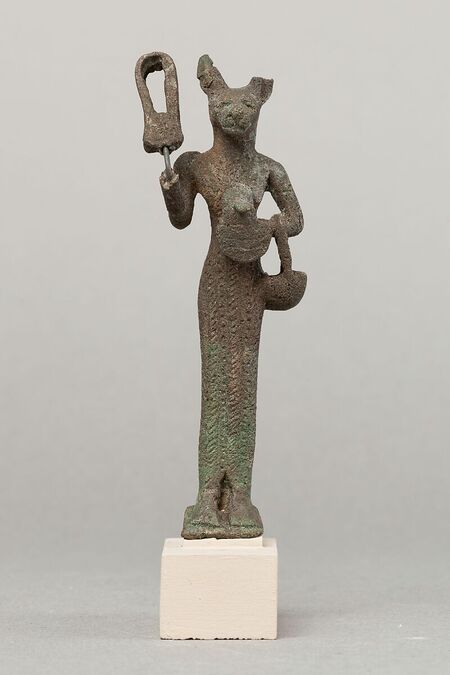
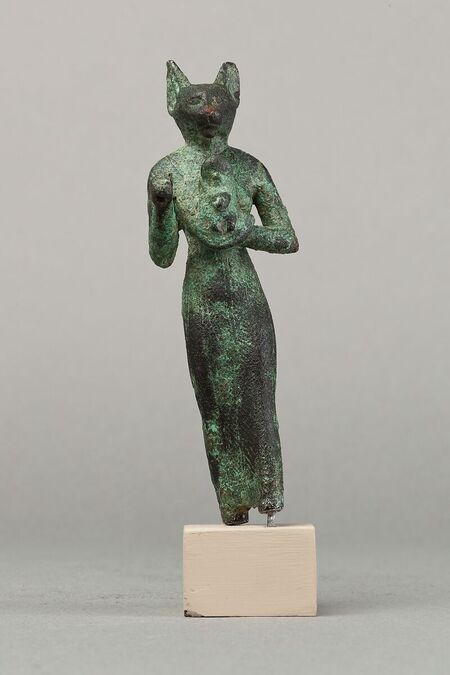
Bust statues of the goddess Bastet. Late Period — Ptolemaic Period 664–30 BCE Metropolitan Museum
Bastet’s depiction is characterized by serenity and restraint. She is often seated upright, motionless, and gazing forward. Her form is graceful, elegant, and well-proportioned. The surface of the bronze statuettes may be adorned with engraving, ornamentation, or symbols. Sometimes Bastet wears a necklace or earrings, elements that help distinguish the goddess from a mere animal representation.
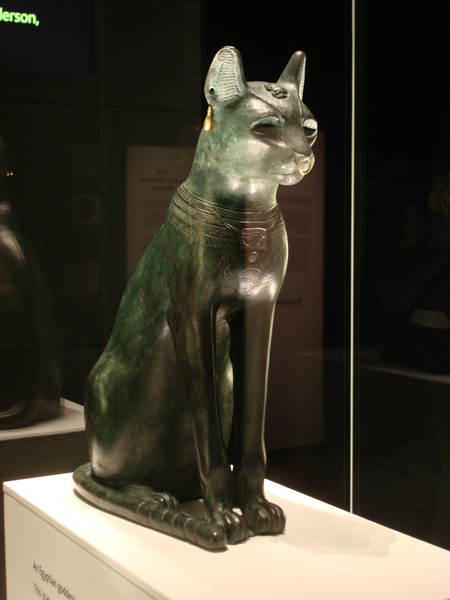
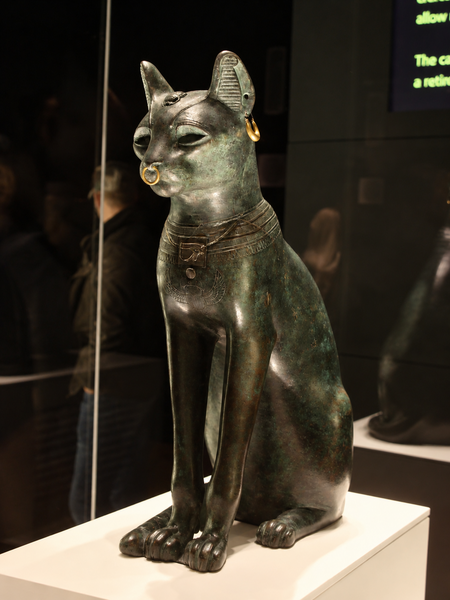
Bronze sculpture from Ancient Egypt, displayed at the British Museum, depicts the goddess Bastet. Dated to 600 BCE. Artist: Oxyman
Cat Mummification
Mummification was one of the most crucial methods of preserving the body in ancient Egyptian culture. Egyptians believed that the preservation of the body was necessary for the human being’s existence in the afterlife. Later, this practice was also applied to animals.
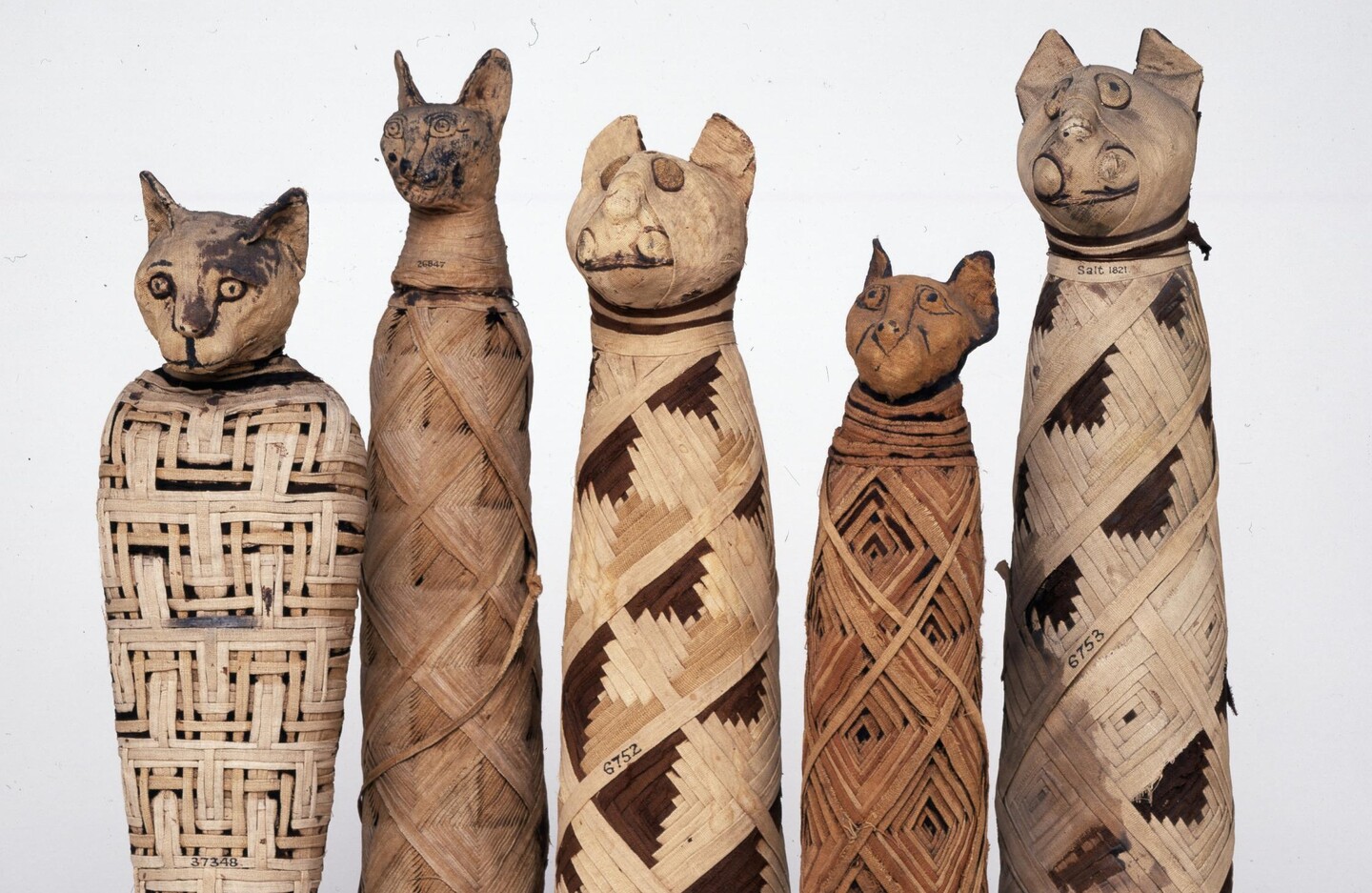
Cat Mummies. Roman Period. The British Museum
Cat mummies were often made from the remains of domestic or specially bred animals. The bodies were treated, wrapped in linen bandages, and given shape. They were layered, sometimes creating geometric patterns. The way the bandages were arranged could form rhomboid, diagonal, and crossed designs. Comparing the mummies reveals differences in their decoration.
Mummified cat. Greco-Roman period
The appearance of cat mummies varies greatly. Some resemble the elongated form of the animal, while others are folded into a compact shape.
Cat Mummification. Late Period