Navigation
- Research Concept
- Hieratic Scale: Size as a Language of Status
- Karnak: King, God, and the Vanquished
- Luxor: The Battle of Kadesh
- Abu Simbel: Extreme Monumentality
- Late Reliefs: The Resilience of Tradition
- Comparative Analysis
- Conclusion
- Sources
Concept
Egyptian temple relief conveys power not only through the pharaoh’s attributes, inscriptions, and scenes of victory, but also through the relationship between human figures. In one composition, the pharaoh might occupy a significant portion of the wall, while his adversaries are depicted as minimized and clustered into a tight group. This disparity forces us to consider scale not as a neutral method of representing the body, but as a tool for organizing the relationships between characters. The choice of theme stems from an interest in how formal artistic decisions transform into political statements and how the size of a figure makes power visible and recognizable.
This research investigates the relationship between the scale of the Pharaoh, the deity, and the enemy in temple reliefs. The core problem is that the conventional formula—“the more important the character, the larger they are”—is useful for a first introduction to Egyptian art but proves insufficient for analyzing a specific image. It is necessary to determine whether scale operates identically in military and ritual scenes, and whether the king can be directly equated with the god.
The key research question is: to what extent does the relative size of a figure express its political and religious status, and is this principle retained in later depictions of analogous scenes? The working hypothesis posits that hieratic scale particularly delineates the pharaoh from the defeated adversary, whereas the relationship between the king and the deity requires a more complex explanation. Comparable size between these characters does not necessarily imply equality of status; hierarchy can also be expressed through gesture, direction of movement, nature of action, and the placement of the figures.
Materials are selected based on two criteria: thematic comparability and suitability for visual analysis. The core collection consists of reliefs from the New Kingdom at Karnak, Luxor, and Abu Simbel. To test the historical consistency of the motif, later temple reliefs with similar scenes are included. The work differentiates between established fact, original observation, and hypothesis.
Hieratic scale. Size as a language of status.
Chariot of Network I from the Karnak Temple, 1290–1279 BCE.
Hieratic scale is a principle where the size of a figure is determined by its social, political, and religious status, rather than by perspective. • Pharaoh — the bearer of royal power and mediator between humans and gods • Deity — the source of the king’s authority • Enemy — the embodiment of chaos and a threat to cosmic order • Entourage and prisoners — contextual figures, often depicted as smaller
Karnak. King, God, and the Defeated
Relief of the Karnak Temple, 1290–1279 BCE
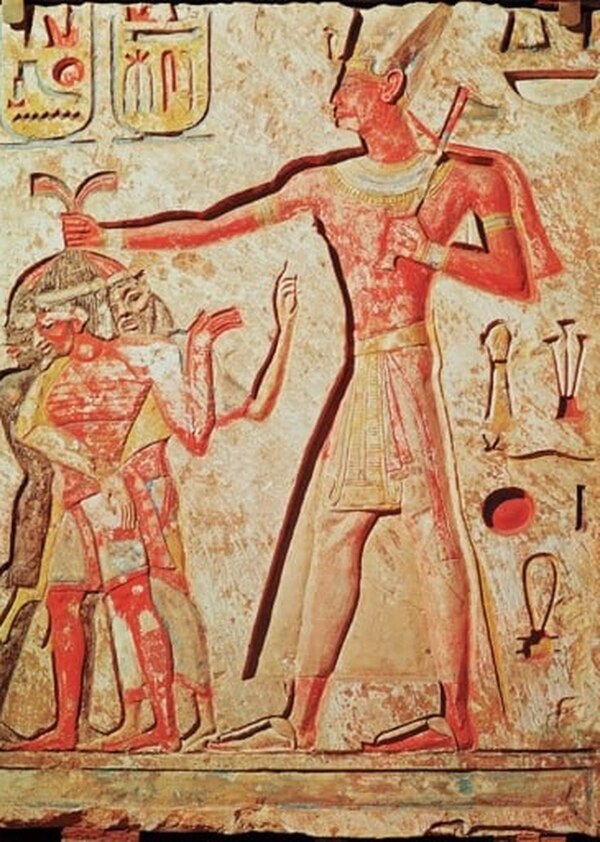
In scenes of defeat, the pharaoh holds a central position while the adversaries are depicted as a group.
The deity sanctions the king’s victory—the military narrative thus becomes a religious assertion of order.
Scale works in conjunction with posture, gesture, and the arrangement of figures.
Karnak. Composition Analysis
For analysis, two relationships are important:
• the size of the monarch relative to an individual enemy • the size of the monarch relative to the entire group of captives
A group may occupy significant space but fail to give any single adversary independent compositional weight.
The height of the crown is not mixed with the height of the body—the headwear reinforces vertical leadership, but it is not equal to the character’s stature.
In the reliefs of Luxor, Ramesses II is depicted larger than his enemies and occupies the center of the composition. He is shown as active: ruling from a chariot, shooting an arrow from a bow, and striking down opponents. The enemies, conversely, are smaller, shown as a group in chaotic motion—fleeing, falling, or defeated. Thus, scale works in conjunction with action here. The large, active figure of the pharaoh underscores his power, while the diminished, chaotic enemies signify their defeat. The Battle of Kadesh transforms into an image of the savior-king who secures Egypt’s victory alone.
Luxor. The Battle of Kadesh
Scene of the Battle of Kadesh Reliefs by Ramses II, 1274 BCE
Abu Simbel with Ramses II, 13th Century BCE
Ramesses II
Ramesses II is depicted in a chariot at the center of the scene. Enemies are shown running, wounded, or defeated.Negative space, the direction of movement, and weaponry enhance the emphasis on the pharaoh, alongside the scale.The scene transforms into a political and religious manifesto. The pharaoh’s victory is presented as the triumph of order over chaos.
Luxor. Scale and Action
Relief of the Temple of Luxor, 13th Century BCE
Luxor Temple Ramses II 13th Century BCE
Luxor Temple Hof Ramses II 13th Century BCE
Luxor Temple Hof Ramses II, 13th Century BCE
Relief from Luxor Temple, 13th century BCE
Does the scale shift when moving from enemy defeat to military narrative? Scale is supplemented by composition, gesture, the chariot, and the placement of figures.
Abu Simbel. Ultimate monumentality
Ramesses II — The Great Temple at Abu Simbel, 13th Century BCE