Description
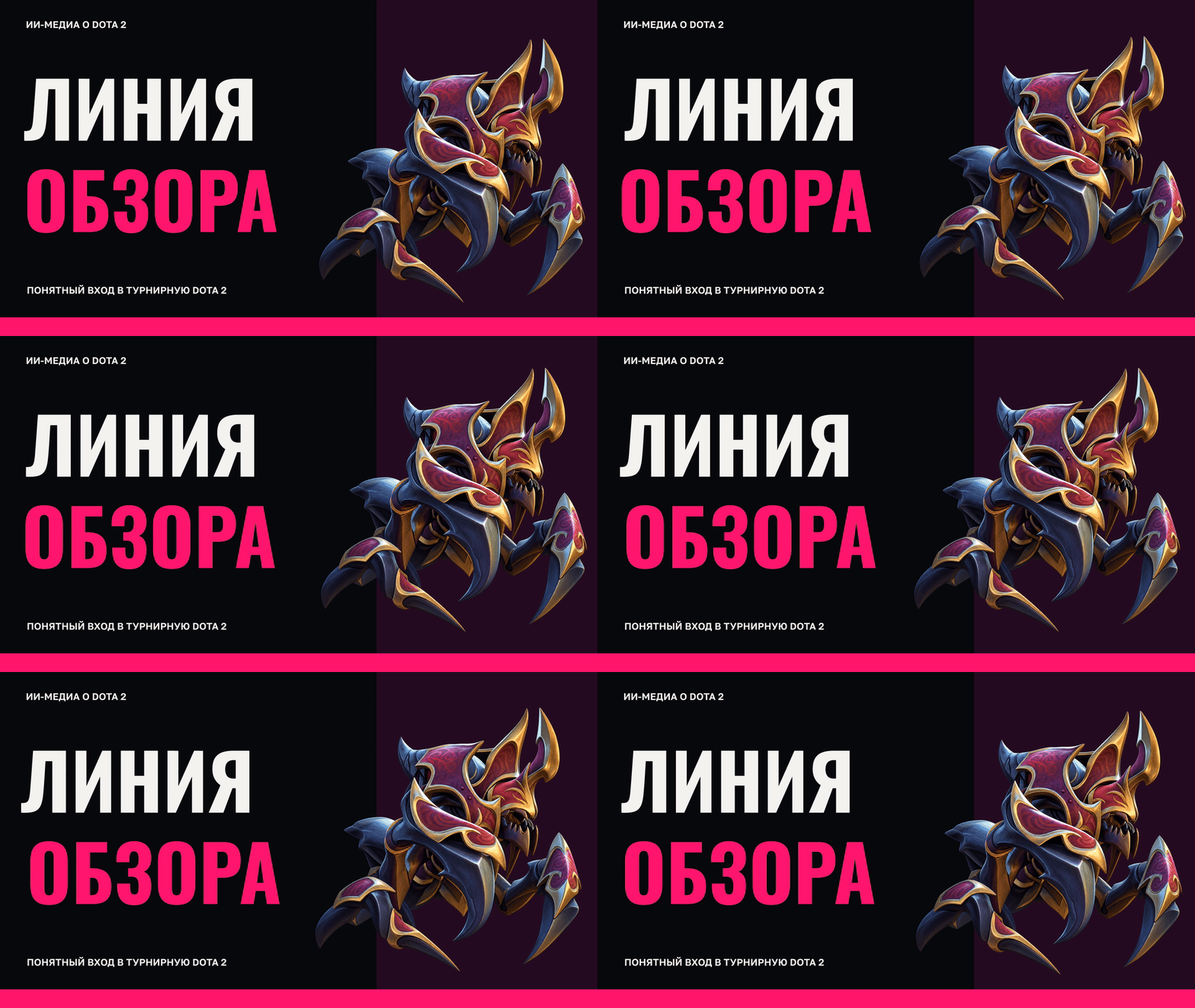
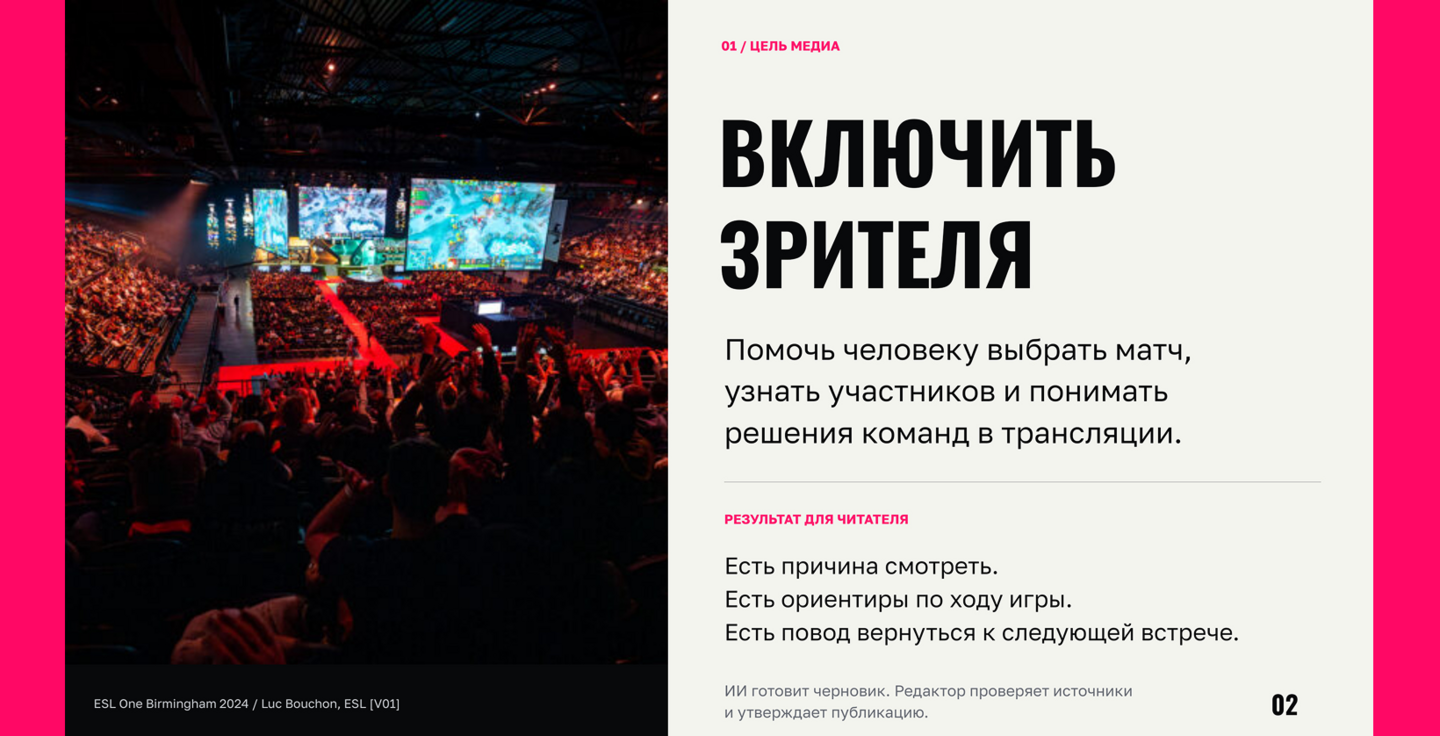
«Viewline» is a Russian-language AI media platform dedicated to the professional Dota 2 scene. Its purpose is to help newcomers track the tournament landscape—allowing users to select a match, learn about the participants, and understand the key strategic decisions made by the teams during the broadcast.
The Goal of Media
Themes
The segment is a Russian-language B2C media platform focused on esports. The niche is providing an accessible entry point into competitive Dota 2 through specific matches, participants, and gameplay context.
The title, «Overview Line, ” connects observation of the game with editorial curation. The descriptor is: „Accessible entry into competitive Dota 2.“ A short appeal to the reader reads: „Start with a match.“
Editorial Sections:
- Before the Match. Who is playing, what the matchup means for the participants, what the intrigue is, and what to watch for. Includes the time and a link to the official broadcast.
- Who is on the Server. Teams, players, and rivalries necessary to understand the selected match.
- Meta for the Viewer. How the patch manifests in hero selection and the decisions made by professional teams. Each piece includes the date and game version.
- What Decided It. A single episode—its explanation and timecode. The analysis connects what was seen with the guidance provided in the pre-match material.
- Entering the Game. The objective of the match, key on-screen elements, and terminology for a first-time viewer. This level is available separately so an experienced player can jump straight to the action.
Tone: Clear, lively, and respectful of the reader’s lack of knowledge. Gaming terms are explained upon first appearance. Facts, editorial interpretation, and assumptions are denoted differently. Any conclusion regarding the impact of an action on the game’s outcome must be substantiated with arguments.
Competitors
Direct Competitors: Cybersport.ru, Cyber, Dota2.ru — Russian-language editorial platforms that regularly capture reader attention with Dota 2 content.
Key Observation: Pre-match context already exists.
The BETBOOM TEAM — OG edition preview links the new encounter to previous results, indicating the time and tournament situation. The material includes sports betting advertising. [S24]
Viewer Goal. News, interviews, previews, and a match center. It helps viewers keep up with the agenda.
Platforms. Website, Telegram, and mobile application. The channel covers several disciplines.
Format and Adaptation. The website features in-depth material. Telegram provides short text, video, and questions with reaction options.
Visual Language. A large headline and a news visual. The website includes visible sections and commentary.
Tone and Barrier to Entry. The presentation is conversational. Nicknames and roles often require prior knowledge of the scene.
Audience Response. In the UNIVERSE announcement, the author offers a choice of reactions: 7 hearts and 16 clowns. Snapshot dated 10/02. [S26]
Conclusion for the Project. The material about BETBOOM TEAM and OG shows that the concept of pre-match context is already being implemented by a direct competitor. It links the match to a previous series, provides the time, and shows the teams' standing. A Telegram announcement for another event is supplemented with a question and suggested reactions. Our solution: reveal unfamiliar roles and tournament implications first, then return to the chosen match after the finale. Reaction icons capture the reader’s action but do not reveal the reason behind it.
What to Incorporate: Differentiation must be achieved through the depth of explanation and the linkage between episodes.
Sources: S01, S02, S03, S24, S26.
Key Observation: Clear analogies help ease entry.The guide, «How to Watch Dota 2 If You’ve Never Played, ” explains the spectacle through familiar sporting situations. This is historical material from 2018. [S05]Viewer Task. Authoritative explanations, blogs, news, and match center.Platforms. The website and VK. The relevant Telegram channel, linked from the site, is marked as CS2.Format and Adaptation. Long-form text interspersed with gameplay screenshots. The entire adaptation chain was not reviewed.Visual Language. A collage on the cover, followed by images alongside explanations.Tone and Barrier to Entry. Understandable analogies. The balance between simplicity and accuracy is crucial.Audience Response. Comments show interest in the game and a note regarding the simplification of mechanics. [S05]Takeaway for the Project. Archival guides lower the barrier for a first-time viewer. One reader comments on their interest in the game, while another points out an exception to the explained rule. This is a specific signal for our editorial standard: simplification must remain accurate. This historical discussion does not reflect the current audience. Our format ties introductory explanations to chosen, current matches.What We Are Taking Forward: To explain simply, verify exceptions, and confirm patch relevance.Sources: S04, S05, S06.
Key Observation: Calendar and broadcast entry points.The Team Liquid — Aurora kickoff post links to the match page. A separate monthly overview helps users select an event from the calendar. [S25, S27]Viewer Goal: News, tournament calendar, results, and in-game guides.Platforms: Website and Telegram @dota2_russia.Format and Adaptation: The channel features an announcement with a link. The website provides event details.Visual Language: Service-oriented delivery: headline, short paragraph, link to the content.Tone and Barrier to Entry: Terms like Bo3 and player positions usually require prior knowledge.Audience Response: The selected notification has 321 views. Reactions in the web preview are not displayed. [S27]Project Takeaway: Competitors already have convenient entry points—a monthly calendar and kickoff notifications. Therefore, a single link to the broadcast does not create differentiation. Our brief supplements the schedule with the rationale for watching and an explanation of two or three key team decisions. The view count of a single post does not measure the utility of such an explanation.What We Are Incorporating: We are adding a reason to watch and in-game orientation to the schedule.Sources: S07, S08, S09, S25, S27.
Indirect: Liquipedia, Dotabuff, FISSURE — a reference guide, statistics service, and broadcast organizer. They solve specific viewer needs in a different way.
Key Observation: Facts are interconnected.Liquipedia page descriptions link tournaments, rosters, and results. This provides a convenient structure for verifying reference data. [S10]User Task: Finding information on tournaments, teams, players, and results.Scope: The study examined a web encyclopedia.Format and Adaptation: Articles and tables featuring linked entities.Visual Language: Header hierarchy, reference blocks, and tournament brackets.Tone and Entry Barrier: A neutral, reference-based tone. The reader independently selects the relevant facts.Audience Feedback: The community contributes to the database. Feedback regarding ease of use for beginners has not been investigated.Project Implication: The reference work is valuable as a tool for independent searching and editorial verification. The ability to navigate from a tournament to a team and then to a player helps reconstruct connections. For our objective, additional filtering is required: which of the found facts explain this specific match. A complete review of the Dota section was not feasible, so the conclusion on the structure is based on the official reference material, without assigning a score to the interface.What We Are Implementing: The editorial team will select facts pertaining to a single match and retain the relevant links.Sources: S10, S11.
Key Observation: The time frame alters the meaning of a number.On the Esports page, the hero selection relates to the last 30 days, while the team block refers to the last three months. They cannot be read as a single dataset. [S12]Audience Goal: To understand matches, hero statistics, team data, and the professional meta.Platforms: The Esports web section, the blog, and the forum.Format and Adaptation: Searching for series, leagues, and teams. Match tables and cards.Visual Language: Numerical hierarchy, hero icons, and period indicators.Tone and Barrier to Entry: An analytical presentation. The meaning of the metrics must be interpreted.Audience Feedback: The forum provides a space for discussion. Comparable feedback on the section has not been collected.Conclusion for the Project: A single interface hosts several temporal windows simultaneously. This is a valuable illustration of why a number cannot be separated from its contextual label. For the «Overview Line, ” statistics serve as a guide: directing attention to a specific hero selection or team action. Linking a metric to the match outcome requires separate substantiation.Scope of Work: Every number must be provided with a time period, context, and explanation for the viewer.Sources: S12, S13.
Key Observation: The organizer sells the event. The PARI UNIVERSE announcement combines dates, participants, and stages. News media shorten this source material for their feeds. [S16, S26, S30]
Audience Task. Tournaments, broadcasts, and official event information.
Platforms. Website, Telegram, VK, and streaming platforms.
Format and Adaptation. The website features a detailed announcement. External media extract a brief news hook.
Visual Language. The hero, team emblems, and dates are assembled into a large poster.
Tone and Barrier to Entry. An emotional invitation to follow the competition.
Audience Response. Engagement is distributed across platforms. A comparable metric was not calculated.
Project Takeaway. This case allows us to trace one piece of news across three platforms: the official announcement, an emotional Telegram post from Cybersport.ru, and a short link from Dota2.ru to the material. The function of the message differs across these platforms. Our piece must also answer the question for a new viewer: which match is worth paying attention to, and what can be understood from it?
What We Are Working On: Dates and participants become the basis of the editorial brief.
Sources: S14, S15, S16, S26, S30.
Potential Participants: Team Spirit, ESL, and Valve — ecosystem participants with their own audiences and sources. As they develop ongoing explanatory formats, they may compete more strongly for new viewers. These are scenarios for our niche, not assertions about their future plans.
Key Observation: Players transform the scene into a narrative.The Telegram announcement for the Illidan interview links to the full video on YouTube and Okko. The MVP card continues the plot from the previous episode. [S28, S29]Viewer Task: Club stories, interviews, results, and top episodes.Platforms: Telegram, links to YouTube and Okko.Format and Adaptation: A short announcement leads to a long-form video. Clips and MVPs support the match narrative.Visual Language: Club iconography and player names. The personal protagonist unites the interviews, clips, and cards.Tone and Barrier to Entry: Casual, fan-driven tone from the club’s perspective.Audience Feedback: The interview announcement shows 656 likes and 77 negative reactions. The reason is unknown. [S28]Takeaway for the Project: People’s stories provide an emotional entry point. However, the club chooses the heroes and the framing of the story according to its own agenda. A potential threat to the project is the need for a constant series of explanations for new fans. This is a script, not the club’s stated plan. Reactions to a specific interview cannot be generalized to the audience’s disposition toward the educational format.What to Proceed With: Unveiling the personalities of the players and the stances of both teams.Sources: S17, S18, S28, S29.
Key Observation: The tournament format is already explained.The EPT 2026/27 page links events, qualifications, points, and FAQ. The reader can learn how teams gain access to the tournaments. [S19]Viewer Task. The EPT season, calendar, qualifications, and tournament rules.Platforms. Website, Twitch, YouTube, and social media.Format and Adaptation. The season page gathers the details. Broadcasts and announcements accompany individual events.Visual Language. The trophy and the main headline set the scale of the competition.Tone and Barrier to Entry. The organizer’s tone. The FAQ studied is predominantly in English.Audience Feedback. The utility of the FAQ for new viewers has not been measured. Public pages do not provide such an assessment.Project Conclusion. The organizer already has an authoritative explanation of its competition. For the media, the remaining task is selection and Russian-language interpretation: what winning or losing in a selected match signifies. A potential scenario is ESL regularly providing localized support for newcomers. The study does not assert that such a launch is planned.What We Will Work On: Translating the tournament format into the understandable consequences of a specific match.Sources: S19, S20.