Concept
In my visual research, I want to examine the self-portraits and drawings of American artist Lee Godie to trace how, through photography, posing, and manipulating her own image, she created various versions of herself. To what extent can a self-portrait reflect a person’s identity if that person chooses how others see them? And among these many images, is there one that can be called authentic?
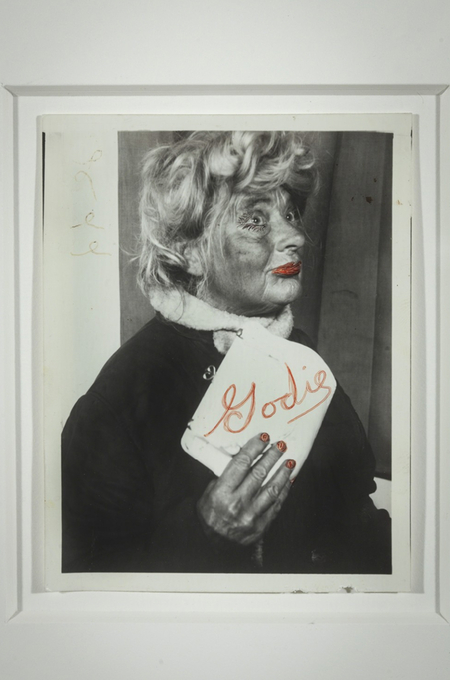
Lee Godie (1908–1994) was an American self-taught artist who, for a significant portion of her life, sold her work on the streets of Chicago near the Art Institute. In the 1970s and 1980s, she began creating self-portraits in photo booths at bus stations. It is noticeable that in some photos she appears serious, while in others she poses in hats, holds flowers or other objects, and looks beyond the frame. Sometimes she finishes inking her own lips, eyes, and other facial details. It seems to us that we are not looking at just the photographs of one person, but a multitude of different characters. Consequently, the ordinary photo booth became a space for her to constantly experiment with her own image.Typically, a photograph is perceived as evidence of how a person actually looked at a specific moment in time. However, in Godie’s case, this sense of authenticity becomes quite conditional. I find it interesting that the photograph—which seems to be the same image of a real person—does not allow for a clear separation from a fabricated persona. This raises the question: exactly where is this boundary drawn, and can it even be defined?
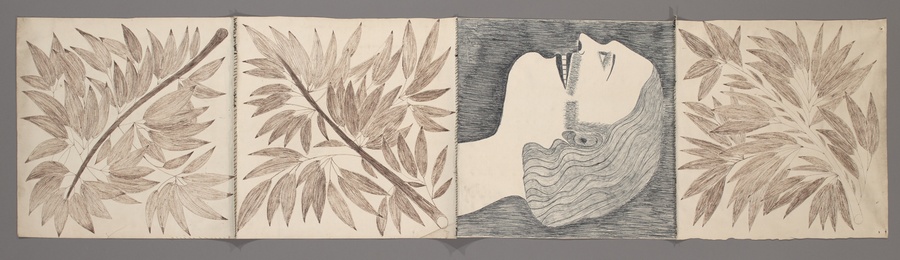
The Waiter; LeavesDate: Lee Godie
In this research, I plan to compare Godi’s series of self-portraits, examining recurring gestures, facial expressions, objects, and methods of photographic intervention. I am also interested in comparing her self-portraits with her drawn female figures to understand how the artist’s perceptions of appearance and beauty were reflected in her depictions of herself.
Another crucial detail is the recurrence of her self-portraits. Godi returned to the same format over many years, yet each time she could create an entirely new image. I find it compelling to view these photographs as one cohesive series. Perhaps it is in the repetition that what cannot be seen in a single shot becomes noticeable.
Through these comparisons, I aim to explore the self-portrait as a mechanism for reinterpreting one’s own appearance. I wonder why a multitude of images of one person does not necessarily help us know them better. Perhaps each new portrait does not bring us closer to some singular authentic self, but rather demonstrates how differently a person can represent themselves.
¹ Introduction
Lee Godie, Untitled, Photography
Lee Godie entered the Chicago art scene in the late 1960s. She sold her drawings and paintings right near the Institute of Art—to students, museum visitors, and passersby. Although she had not received formal art education, she called herself a French Impressionist. She presented herself as an artist, set her own prices for her work, and could refuse to sell to anyone she disliked. These were the first indications that she was crafting a specific persona even before she began using photography to do so.Relatively little is known about her life before 1968. Much biographical information remains unverified, and Godie was reluctant to speak about her past. Therefore, today, her work is one of the primary ways to learn about her, even if it does not fully reveal her personality.
Lee Godie Untitled (in white fur stole with heart-shaped cameo)
Photo Booth Studio
In the 1970s and 80s, she regularly photographed herself in automated photo booths at Chicago bus stations. The artist lived on the streets of Chicago for a long time, so the small, enclosed space inside a bustling bus station took on an entirely different meaning for her. She took several hundred self-portraits, utilizing the rather limited capabilities of the ordinary photo booth machine. Unlike traditional portrait studio photography, there was no freedom to choose the lighting or the camera angle in the photo booth. Therefore, we can see the self-portraits against the same background inside a small, enclosed space. It was these limitations that made her photographs especially interesting and recognizable.
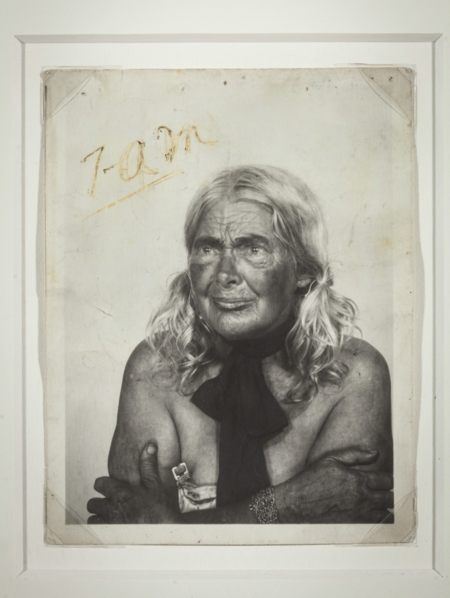
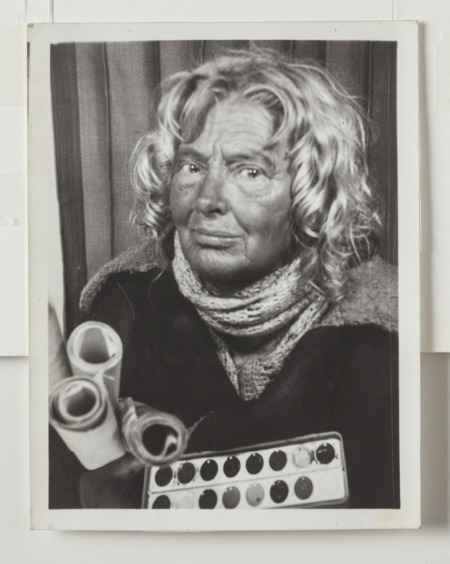
Lee Godie, Untitled (photo booth self-portrait), 1970s // Lee Godie, Untitled (photo booth self-portrait), 1970s
In a standard portrait, the surroundings and setting are highly significant, but here all attention is focused on the person. In this work, Godi chose a different path of variety by changing clothing, head position, facial expression, and also by using different objects in the frame. Through this, Godi embodied various roles. In some photographs, she presented herself as a wealthy socialite, posing in furs and jewelry; in others, she depicted herself as an artist, holding her own work before the camera, or as a successful woman with money in her hands.
Lee Godie Untitled (Photo Booth Self-Portrait gelatin silver print with ballpoint pen
The photo booth was a solitary moment of privacy…
Lee Godie, untitled, n.d. Collection of Scott H. Lang, IL.
Does the image depend on the pose?
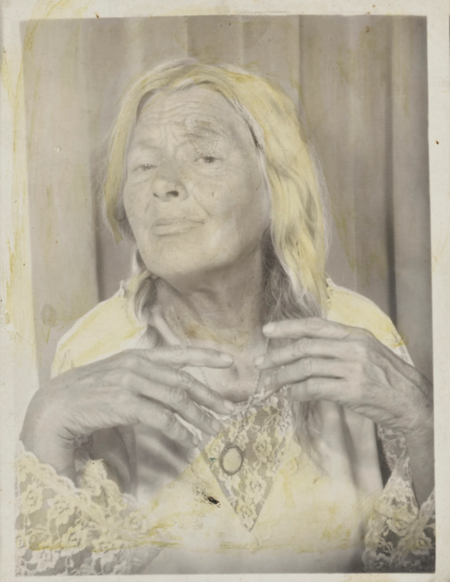
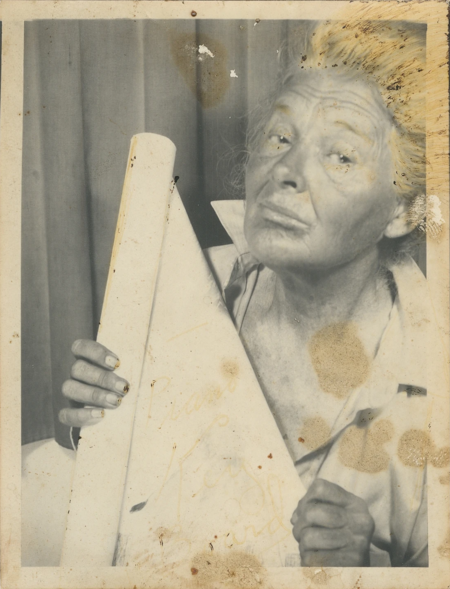
Lee Godie, Portrait circa 1980s, Paint on Gelatin Silver Print Mounted on Canvas // Lee Godie, This is Lee Godie, The French Impressionist, c. 1980s, Yellow ballpoint pen on black and white photograph
If you place several of Godi’s self-portraits side-by-side, you can notice that she rarely limited herself to a simple gaze toward the camera. It creates the impression that before every shot, the artist decided exactly how she wanted to present herself.In her self-portraits, Godi often referenced the images of famous actresses, such as Clara Bow and Joan Crawford, recreating their characteristic poses, hairstyles, and makeup. Thus, the elements in the frame did not simply complement the photograph but helped create a specific persona before the camera.
Lee Godie Self-Portrait Photograph Original black and white photo
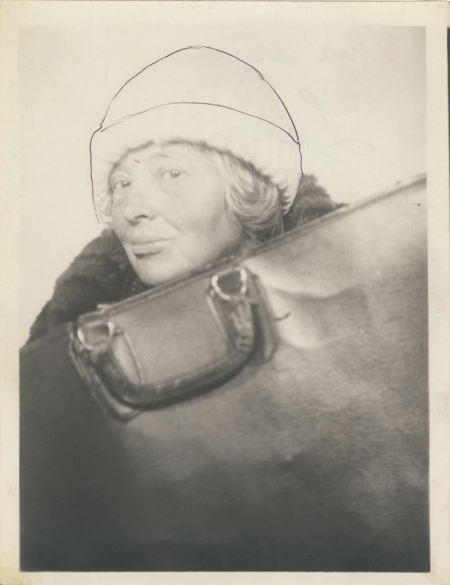
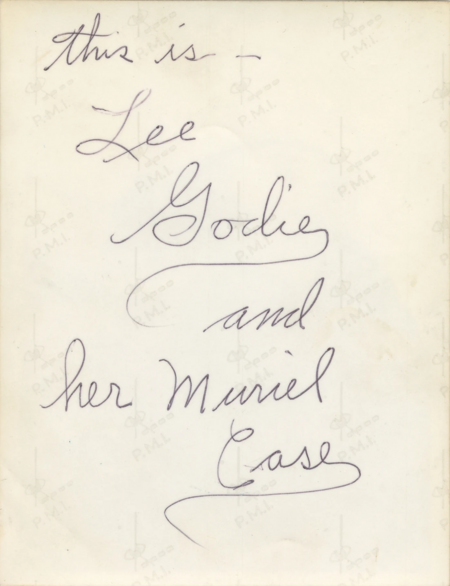
Lee Godie and her Muriel Case, circa 1980s
Lee — I Kept / Saying Left / Side and / Grooves till / I Got to the / Camera / Sincerely 1970s Lee Godie
One person can evoke such vastly different impressions without even changing their appearance. Perhaps Godi used photography not so much to present her authentic self, but rather to try on the personas she wished to associate with. Furthermore, behind the crafted roles, one can sometimes detect fatigue or other emotions that are difficult to definitively separate from the performance in front of the camera.
⁴ Viewpoint
Lee Godie Untitled (12 photobooth self-portraits, detail)
It is interesting to observe the direction of his gaze. In many photographs, Godi is looking somewhere beyond the frame. Direct eye contact with the viewer occurs rarely.
Untitled (Photo Booth Self-Portrait), Lee Godie
Lee and Cameo / on a Chair / Sincerily / 1970s, Lee Godie, Gelatin silver print with ink
Typically, when we look at a portrait, the subject’s gaze helps establish a specific connection with them. If a person looks directly at us, it creates the feeling that they have noticed our presence. In Godi’s case, the opposite occurs because she refuses to look into the camera. Because of this, some of her self-portraits appear somewhat detached. The artist is not striving for intimacy with the viewer.
Lee Godie Untitled (Self-Portrait), 1970–1980