Topics
Navigator Concept Common Features Distinctions Cultural Significance Conclusion Bibliography Image Sources
Concept
Color is the key; the eye is the hammer; the soul is a multi-stringed piano.

The theme of this visual study is the comparison between the paintings of Wassily Kandinsky and the animated works of Oskar Fischinger. Music unites their creations: although neither was a professional musician, their most significant pieces were dedicated to exploring the relationship between sound and image. Each artist developed this direction in their own way, surpassing the other in specific artistic and technical solutions.Their work demonstrates the principles of synesthesia, which they utilized in the search for correspondences between different sensory perceptions. It is worth noting that Wassily Kandinsky, according to some biographical accounts, possessed innate synesthesia [1]. The goal of this study is to broaden the understanding of the context in which both artists worked, their shared objectives in creating art, as well as the fundamental differences in their approaches and visual components.
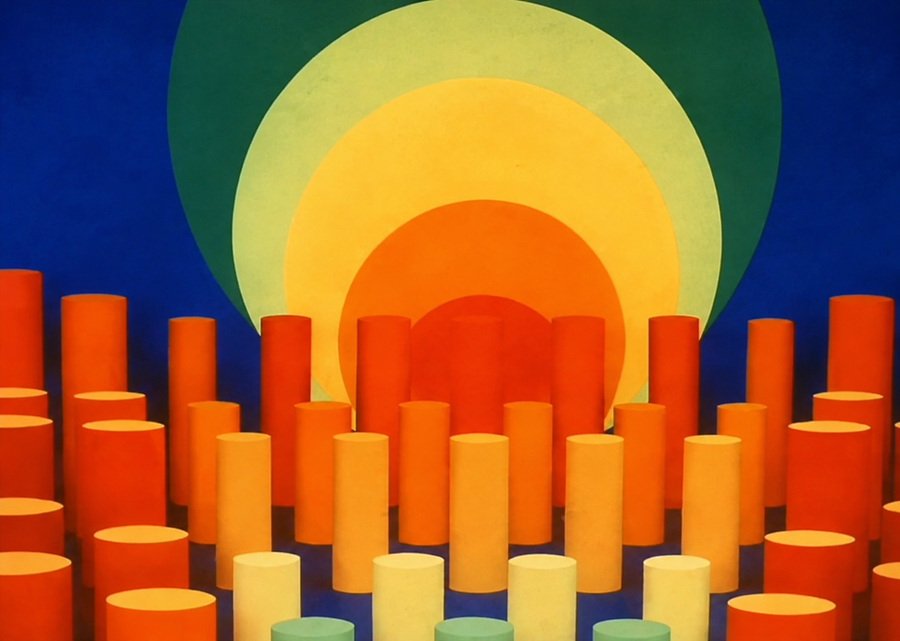
A frame from «Composition in Blue» by Oscar Fischinger, 1935.
Adhering to Kandinsky’s theory, one might say that color, much like sound, is an abstract image in human perception—it lacks a definitive shape or boundary. Fischinger applies this principle in his animation studies as he attempts to visualize musical sound. Shapes emerge from nothing, dissolve, and disappear in time with the music. Geometric forms, lines, and spots of color become independent expressive elements that interact with one another, much like musical instruments.
Despite the overarching idea, the methods of its realization differ among the creators. Kandinsky aimed to find consistent associations between color, form, and sound. In his theoretical works, he described the emotional and sonic impact of individual colors, correlating them with the timbres of musical instruments. However, his system was not a rigid classification: the same instrument could be associated with different shades depending on its register and character of sound.
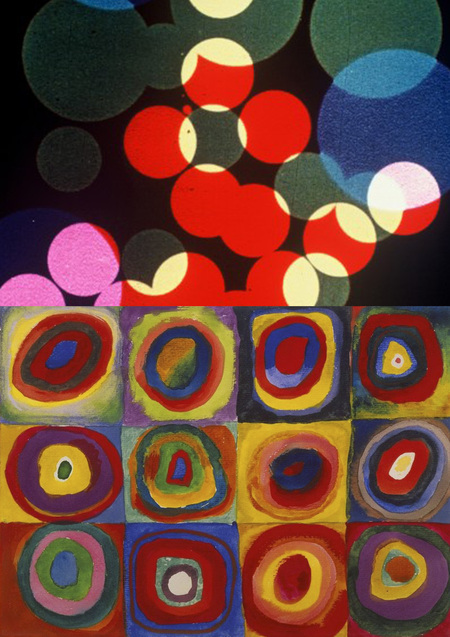
Color Sketch. Squares with Concentric Circles, W. Kandinsky, 1913.
Fishinger, in turn, translated musical structure directly into motion. His works were built on synchronizing visual elements with the rhythm, tempo, and dynamics of a musical piece. If Kandinsky conveyed musical sensations through static composition, Fishinger gained the opportunity to explore their development over time.
A particular interest lies in comparing how both artists used abstract forms to convey an invisible and immaterial phenomenon—sound. In both cases, the viewer encounters an attempt to move beyond conventional artistic perception, where imagery is usually associated with concrete objects and narratives. Color and form cease to serve an exclusively decorative function and become an independent language of communication.
General Characteristics
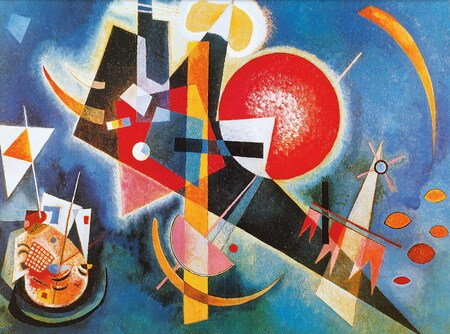

In Blue, Wassily Kandinsky, 1925, Frame from Composition in Blue, Otto Fischinger, 1935.jpg
Kandinsky’s idea that non-objective art is a path to higher spiritual truth became the foundation for Fischenger’s cinema. Kandinsky wrote about «sounding points,» while Fischenger took abstract forms and made them move on screen to music. [1] Vasily Kandinsky directly influenced Oscar Fischenger. Although they were not close friends and belonged to different generations of the avant-garde, their creative trajectories share many conceptual similarities.
Composition VII, Wassily Kandinsky, 1913
Both can be called art revolutionaries—Kandinsky chose the canvas as his experimental ground, while Fischinger focused on the backstage of animation. Fischinger’s works in general reflect the changing epochs: in the new era, the boundaries defining an artist’s practice significantly expanded.
A frame from «Pictorial Movement No. I, ” O. Fischer, 1947.
The difference in forms
The most obvious difference in the approaches of the two authors is form. Kandinsky was a painter, whereas Fischinger was mostly an engineer—his work was not limited to the visual elements of the paintings; it also included devices invented for creating stop-motion animation.
A frame from «Composition in Blue» by Otto Fischinger, 1935.
Kandinsky’s works are difficult to «decipher» because of the futuristic manner in which he depicted sounds—one canvas might show several stages of a particular instrument’s resonance. The painting, as a whole, presents all the necessary information for understanding the artwork, and Fischer’s animated «pro-clips» will not achieve the intended effect on the viewer without sound.
Composition VIII, Wassily Kandinsky, 1923
Kandinsky’s compositions are frozen in time, while Fischinger’s compositions unfold across the frames of film. His technique allows him to avoid overwhelming the viewer with a massive amount of information, making Fischinger’s works more accessible and captivating for the general audience.
Stills from Optical Poem by O. Fischinger, 1938
Conclusion
Bibliography
Image Sources