Placeholder text
Navigation
{1} Concept of Visual Research {2} Painting within the Space of Painting {3} Sculptural Image in Pictorial Space {4} Relief as Part of the Image {5} Conclusion {6} Bibliography {7} Image Sources
Visual Research Concept
Beginning in the 1530s, Dutch and Italian artists increasingly incorporated other images into their paintings—for instance, a statue in a niche or a relief on a capital. At first glance, these elements seem to be part of the setting, like a table, a window, or a book on a windowsill. However, a painting is always a smaller version of the world, and everything included in it has been deliberately chosen by the artist. If there was room for an additional image, that decision must have a specific rationale, and the goal of this study is to establish that rationale.
The subject of this analysis is representation—that is, the connection between the image and reality. An image can serve as a double of reality or its substitute, and sometimes it turns out to be an illusion. The embedded image allows us to observe these relationships in a miniature form, as the image is viewed at the moment when another image is looking at it. The interest in this technique is related to the shifting status of the image itself. During the Middle Ages, the icon was primarily present within the church and participated in religious services, but by the end of the fifteenth century, the painting was already being considered the work of a master, something that could be compared with and discussed alongside other works. The embedded image effectively captures this shift, because through it, the artist is making a statement about what an image is.
The analysis of each work is based on three levels of examination. In the text, these levels are not presented separately; instead, they integrate into a single line of reasoning, but the order remains consistent. The mimesis level answers the question of what is depicted. The term «mimesis» signifies imitation, so at this level, we discuss precisely what has been reproduced, what narrative lies at the foundation, which characters are shown, and to what context the artist is referring. The semiotic level describes how it is structured. Attention here is paid to the signs that compose the work—meaning the material, color, composition, and scale—as well as how the embedded image differs from the surrounding picture and how the viewer notices this difference. The iconological level explains what lies behind what is seen. Here, the artist’s choices are connected to the culture of the era, to conceptions of the religious image, and to the humanistic context. The argument moves from description to interpretation, though transitions between the levels can be made freely. Formal analysis can be likened to a microscope, while iconography is comparable to a telescope—and it is useful to use both.
The material was selected based on a simple principle. We needed works where an embedded image is clearly discernible and notably distinct from the main painting, whether in material or placement within the frame. The works are categorized by the type of embedded image, and within each group, they are arranged chronologically. Among them are well-known pieces, such as Holbein’s «Ambassadors, ” and works that receive less attention. There is a roughly equal representation of Netherlandish and Italian masters, which allows for a comparison of the two traditions. There are also limitations. The study is based on reproductions, so texture and original dimensions remain inaccessible, and some altarpieces have been disassembled, requiring us to judge their original appearance from descriptions.
The research draws upon several types of literature. Some works explain how the overall perception of the image has changed; others are dedicated to Netherlandish painting and its hidden symbolism; a third set analyzes specific pieces, such as the Ghent Altarpiece and the commission for Chancellor Roland. For the Italian segment, Renaissance art history is crucial, and the habits of the contemporary viewer are described in specialized studies. The remaining sources in the bibliography provide general context.
The research consists of three chapters. The first is dedicated to paintings within paintings. The second discusses sculpture, and the third covers relief. Within each chapter, the works are organized chronologically, and Dutch and Italian examples are juxtaposed where it helps highlight differences. Each chapter concludes with a brief summary.
The research question is formulated as follows: What do the images that artists place inside paintings say about their relationship with reality, and how does this differ from mere interior decoration? The following hypothesis is proposed. Embedded images illustrate how the relationship between an image and reality can be constituted. A painting within a painting speaks to the authenticity of the image and how easily it deceives. Sculpture raises the question of the boundary between the living and the carved. Relief adds a secondary text that is read more slowly than the main text. If this is true, the image serves as a means by which the painting reflects upon its own connection to the world, and this must be manifested in how the embedded image differs from its surroundings.
Painting in the Space of Painting
Chapter One is dedicated to paintings within paintings. The relationship between the image and reality is most clearly visible here, because the same image is presented twice, and the difference between them is immediately apparent. Three works are examined, in which this difference is explained differently.
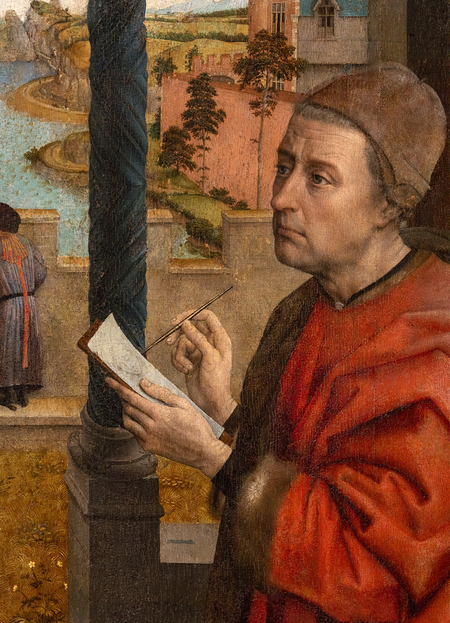
Rogier van der Weyden depicted St. Luke in the moment he is painting the Virgin Mary (circa 1435, Fig. 1). St. Luke, the patron saint of artists, is kneeling and holding a silver stylus, while Mary with the infant sits before him. Behind them unfolds a view of a river and a town, where ordinary life is underway. Mary is rendered in paint and appears alive, while Luke’s drawing is made with a silver line—meaning a different technique and on a different medium. The scene is shown at the moment of appearance, and this difference suggests that the drawing remains merely a trace of what has been seen. Luke and Mary are turned toward each other, and there is a space between them—a space into which the viewer seems to step.
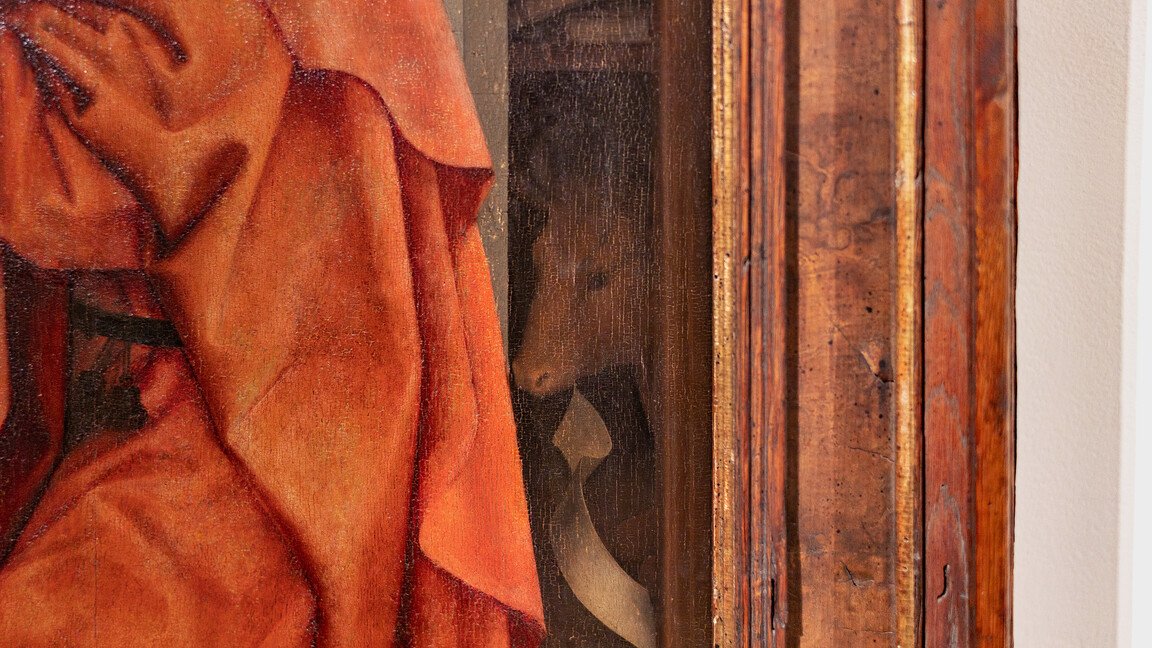
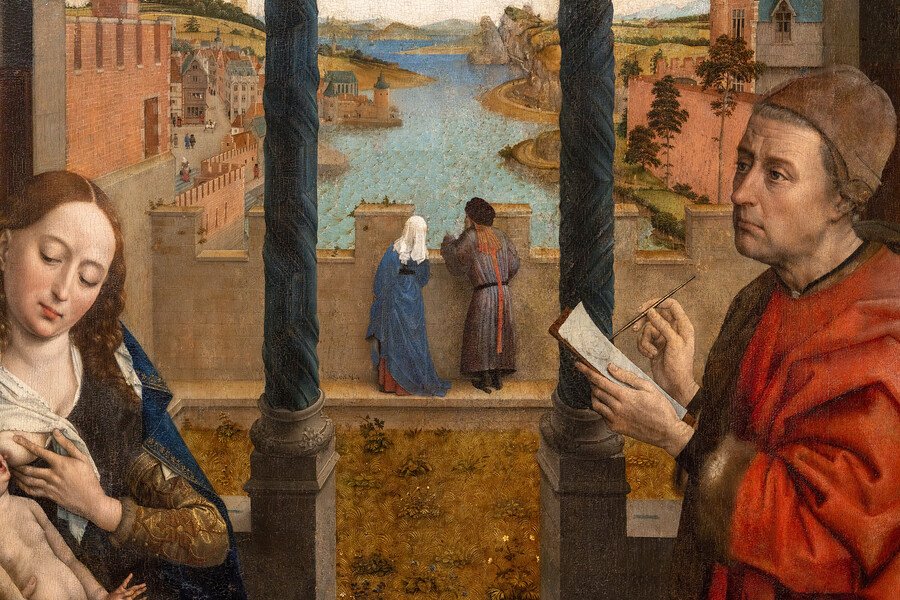
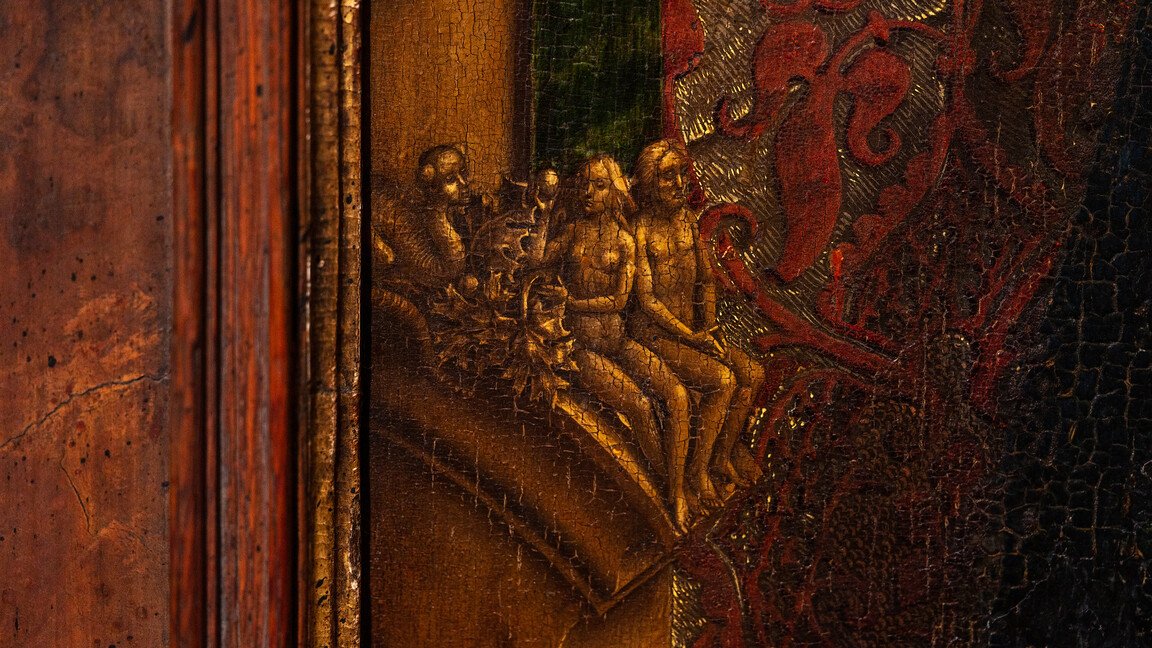
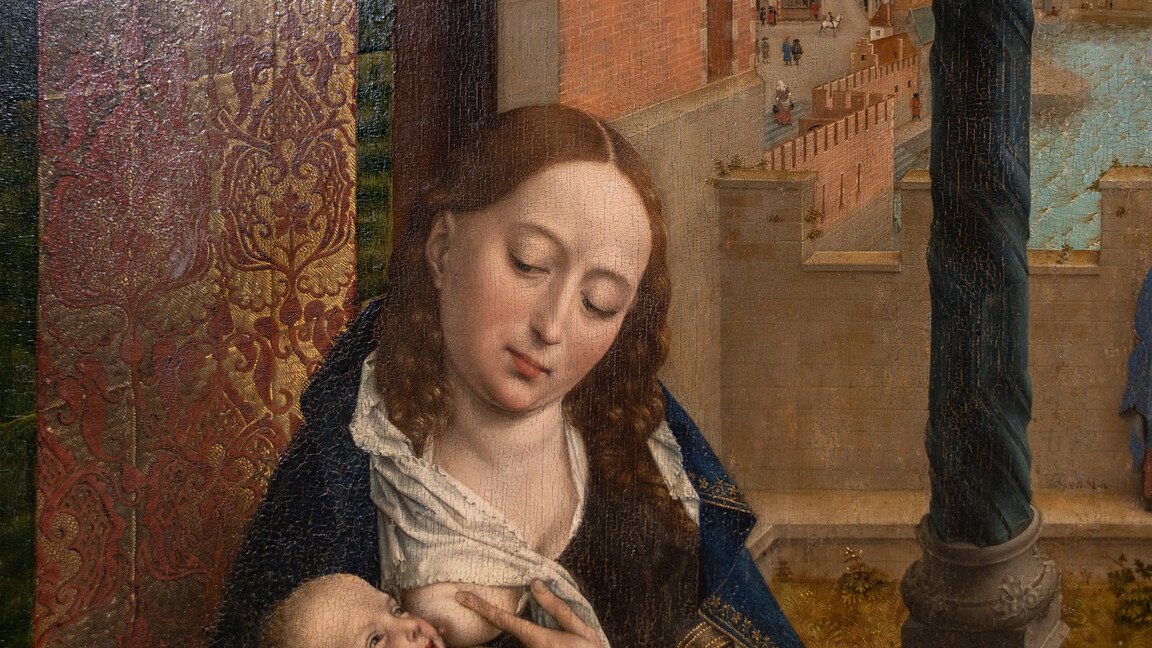
The legend of Luke suggested that the first icon of Mary was painted from life, and because of this, it is rooted in the original archetype. This was an important argument for honoring the image, as it alleviated doubt about how accurately the image conveyed what it depicted. Roger adds his own thought to the legend. If Luke draws, it means he is selecting lines and possesses mastery, and the authenticity of the image depends on the artisan’s skill. The painting speaks to craft as a mode of testimony.
In Quentin Massys' painting «The Money Changer and His Wife» (1514, Fig. 2), a cramped room is depicted. The husband weighs coins on a small scale; pearls and a ring lie on the table, while the wife nearby leafs through a book of hours. On a page, a miniature of the Madonna and Child can be discerned. The woman’s gaze seems to slide from the page toward the gold. Interestingly, the miniature differs from the rest of the painting in scale and color. It is tiny and rendered with the dense, bright colors of a manuscript, whereas the coins and pearls are conveyed with a soft, almost palpable painting style. The viewer, following the heroine, shifts their gaze from the sacred image to the gleam of metal—a transition that was clearly orchestrated by the artist.
Sculptural form in a painterly space
Relief as part of the image
Conclusion