Concept
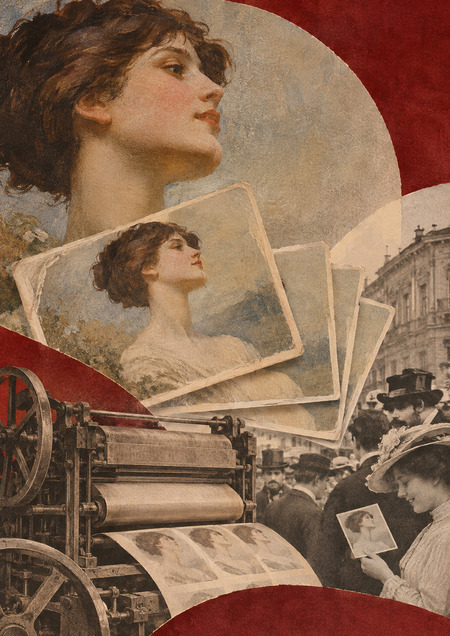
At the turn of the 19th and 20th centuries, sociocultural and technological shifts in Russia created the foundation for a new publishing model. This work focuses on Joseph Knebel—a publisher who transformed painting from an elite commodity into a serial and accessible product. The historical prerequisites that collectively enabled Knebel to build an innovative business model, a «factory of masterpieces,» which contributed to the popularization of Russian art, are analyzed.
Joseph Knebel, at the turn of the 19th and 20th centuries, managed to revolutionize the perception of fine art dissemination in Russia. Knebel, building upon emerging opportunities, transformed painting from an elite, exclusive product into a commercial product accessible to a broad range of consumers.
The choice of theme and its relevance stems from a focus on the business aspects: people usually talk about «artists, ” but rarely about the „logistics”—how, for instance, a painting ends up on a magazine cover or a postcard. The interdisciplinary nature of this work lies at the intersection of print history, art economics (editions, costs), and cultural studies (how a mass-market product influences elite perception). The sources also lend themselves to this approach: there is interesting visual material with an emphasis on painting, including thousands of its postcards that have been digitized.The business model under consideration is a prototype for modern digital platforms (ArtStation, Saatchi Art), where the artist sells not the original, but a reproduction license.
Research Objective: to trace how the publisher, utilizing reproduction technologies, printing, and mass production, made works of art accessible to a broader audience, transforming them into reproducible commercial products, thereby contributing to the popularization of Russian art among the public. The originality of this topic lies in the end-to-end analysis of the path an artwork takes from its original form to the consumer, with an emphasis on business aspects that are typically omitted in art scholarship. This study aims to examine the facets of the art economy.
Curating Visual Material: The Journey from Original to Publication—Printing and Production, Seriation, Design and Branding, Distribution Channels, and Audience. The sample also includes Knebel’s related lines (children’s literature, art books, textbooks, guidebooks)—his program as a unified system for art popularization.Textual Sources: Books and online resources on art history (cultural and business context); studies by L. Univerg, library catalogs, an English article on Knebel, and memoirs by I. Grabar and the daughter of publisher M. Knebel.A shortage of information regarding print runs, publication prices, company revenue, and other economic indicators of the firm has been identified.
The methodology is structured as a multi-layered visual-historical analysis of Knebel’s published works (albums, reproductions, postcards, covers) through three lenses: as an image, as a product of production, and as a commodity. Subsequently, these findings are contextualized within the era and synthesized into the schema «original → reproduction → series → brand → consumer, ” illustrating how Knebel made art reproducible and accessible.
The structure is shaped for the course «Business Models in Art»: the focus is on the logic of value creation and profit extraction, not aesthetics.Core principles for structuring the work: Logical Sequence: moving from the general (historical context) to the specific (analysis of particular aspects of publishing activities) and back to a synthesis.Thematic Cohesion: addressing individual facets of the topic linked by a common problem.Methodological Foundation: the structure reflects the chosen methodology—analysis through three lenses (visual, production, and market).
HYPOTHESIS / QUESTION???????
Chapter 1. The Context of the Era: Josef Knebel and the Genesis of the Mass Art Market in Russia.
By the end of the 19th century, the salon as a form of artistic life underwent transformations in Russia. Concurrently existed official salons (at the Academy of Arts, the Society for the Encouragement of Arts) and private ones—commercial gallery-salons, as well as intellectual «salons”—literary and artistic drawing rooms.
In the art salons of late 19th-century Russia, originals were typically exhibited. The salon served as a mediator between the artist and the market: paintings were sold here, and prices and reputations were established. What the salon approved became fashionable; what it rejected sought other paths.Reproductions also existed and played a role in the dissemination of art, but the primary function and value of the salons lay specifically in showcasing authentic works of painting.
Reproductions, at that time, were typically etchings or lithographs—each of which was a work of art in itself—but they were more often distributed in albums, magazines, or as individual prints.
By the late 19th century in Russia, conditions arose where the reproduction of painting became a noticeable commodity.
1.1. Russia at the Turn of the 19th and 20th Centuries: The Development of Printmaking and the Reproduction Market.
Based on available historical data and research, the prerequisites for developing a business based on the printing trade included: Technologies that made large-format reproduction possible; Socio-cultural factors (museums, literacy) that created potential demand; The competitive landscape (the mass market for reproductions) against which Knebel carved out his unique niche; Knebel’s own experience and methodology, as well as the influence of European practices.
Technological Developments. Photomechanical reproduction in Russia displaced woodcut and lithography starting in the 1880s; inexpensive zincography and phototypy were utilized; heliogravure was high-quality but costly and low-volume, and it was commissioned in Vienna, where Knebel studied and worked.
Public Museums. The Tretyakov Gallery opened in 1881 and was transferred to Moscow in 1892; the Russian Museum was founded in 1895 and opened in 1898. Knebel published albums of heliogravures based on three collections (1901–1906): the original remained in the museum, and the copy was kept at home.
Literacy. The 1897 census revealed that 21% were literate (29% of men, 13% of women); urban men aged 9–49 accounted for 66%, while those in rural areas in the 1860s–1880s were approximately 6%. The purchaser was an urban resident—a small but growing demographic.
The Mass Market of Reproductions. The audience for illustrated magazines grew from approximately 100,000 subscribers in the late 1870s to about 500,000 by the turn of the 20th century. The magazine «Niva» published oleographs (academic and salon paintings); starting in 1899, it featured collections of essays instead of paintings. Cheap, decorative, and deemed «lowbrow» by critics—such was the mass consumption of art. Knebel proposed something different.Knebel’s Experience. Starting in 1882, he operated a substantial bookstore specializing in art literature; twelve years of trade gave him an understanding of the consumer even before he began publishing.The European Model. The first attempt—an album of heliogravures featuring paintings by Russian artists from the Moscow firm A. Kano (1886–1888)—failed. The concept of the Kano album (1886) referenced foreign heliogravure albums—Russian publishers were simply adapting a ready-made format.
1.2. Joseph Knebel: Biography and the Formation of a Publisher.
Iosif Nikolaevich Knebel (1854–1926) founded the first specialized publisher for fine arts in Russia in Moscow. It published about seven hundred editions: reproduction albums, monographs on artists, children’s books, and school paintings. Thanks to him, reproductions of paintings from the Tretyakov Gallery, the Russian Museum, and the Rumyantsev Museum found their way into private homes and school classrooms. Nearly all of Knebel’s publications are an exemplary standard of publishing and design.
The obvious situation with the painting market at the end of the 19th century: a growing urban population and the emergence of a middle class that wants «art in the home» but cannot afford the original…
Knebel, as an entrepreneur, sees this gap and solves it through business.
Born in Galicia in 1854. He graduated from the University of Vienna and the Vienna Academy of Commercial Sciences. Vienna, where he studied and gained experience working with printing houses, later became a hub for complex reproduction commissions.
In 1880, he moved to Moscow and headed the Moscow branch of the Riga publishing and book trade firm Deibner. In 1882, he founded the bookstore «Grossman and Knebel» and subsequently became its sole owner.
Twelve years of successful commerce (since 1882) provided a deep understanding of the demand for art publications. The shop sold Russian and foreign literature. He began his own publishing house in 1894–1895 with literature and scientific popularization, later specializing in art.
The next step led Knebels to establish his own production base. He became a major shareholder in the A. A. Levenson printing house (supervising publishing activities from 1906–1907)—one of Moscow’s premier print shops for lithographic works.
By 1914, the firm had achieved international recognition: at the International Exhibition of Printing and Graphics in Leipzig, Knebels published 31 of the 214 Russian art publications (14.5%).
Alexandre Benois wrote about the publisher: «In any major undertaking, the primary strength lies in the personal human qualities that lend vitality, brilliance, and significance to the enterprise—and Knebel possesses these personal qualities in abundance”[12].