Функции музыкального инструмента в сценах наказания и искушения
от Босха до Тенирса
Navigation
1. Concept and Topic Selection2. Bosch: The Tool as Instrument of Punishment and Blasphemy3. Bruegel: The Tool as a Sign of Vice4. The 17th Century: The Tool as Spectacle5. Conclusion
Concept
Musical instruments in 15th–17th century painting rarely become the subject of individual analysis; more often, they are perceived as an attribute of the scene—a detail indicating a character’s profession or mood. However, in scenes of punishment and temptation, the instrument behaves differently—it does not simply adorn the action; it participates in it. The harp, lute, bagpipe, hurdy-gurdy, and drum become instruments of influence upon the sinner: they punish, seduce, point to vice, or parody sacred music. I am interested in the instrument as a visual motif: what functions does it perform in scenes of punishment and temptation, and how do those functions change over time? The context of this research is the ambivalent attitude toward music in culture. Music could be seen as either divine harmony or as worldly temptation leading to sin. It is this duality that explains why, in hell, the musical instrument transforms from a sign of praise into an instrument of punishment. Here, the instrument is not background detail, but a carrier of meaning. The material shows that the instrument functions differently depending on the era and the narrative. In Bosch’s work, it is integrated into a system of punishment: the sinner suffers from the very instrument by which they sinned. In Bruegel’s and 17th-century masters’ work, the instrument moves away from physicality and hell: it increasingly points to human foolishness or becomes part of an entertaining scene. What changes is not the instrument itself, but its role in the depiction. Material Selection Principle: Artistic works where the instrument performs a function other than musical performance—punishing, indicating vice, parodying a sacred image, or exposing folly. The material is divided into two streams. The first is the 15th–16th centuries: Bosch, where the instrument first becomes a system. The second is the 16th–17th centuries: Bruegel and 17th-century masters (Teniers, Callot), where the instrument marks foolishness and loses its terrifying function. The analysis is structured around the functions of the instrument, not the chronology of the schools.
Research Objective—to trace how the function of musical instruments in scenes of punishment and temptation shifts from torture and parodic-sacredness (Bosech) through marking (Bruegel) to spectacle (17th century), and to demonstrate how culture transitions from fear of hell to secular curiosity.
Hypothesis
The musical instrument in scenes of punishment and temptation is not a random detail, but a functional system. In the 15th–16th centuries, the dominant function was torturous and parody-sacred: the instrument punishes the sinner’s body and turns praise into sacrilege. By the 17th century, the dominant function shifted to a marking and spectacular one: the instrument increasingly exposes not hell, but human foolishness and carelessness, and in scenes of temptation, it becomes an object of scrutiny, part of an entertaining spectacle. This transformation of the dominant function reflects a shift from a theological model of punishment to secular satire and curiosity, yet the musical instrument itself continues to point toward vice throughout the entire period.Bosch: The Tool as an Instrument of Punishment and Blasphemy
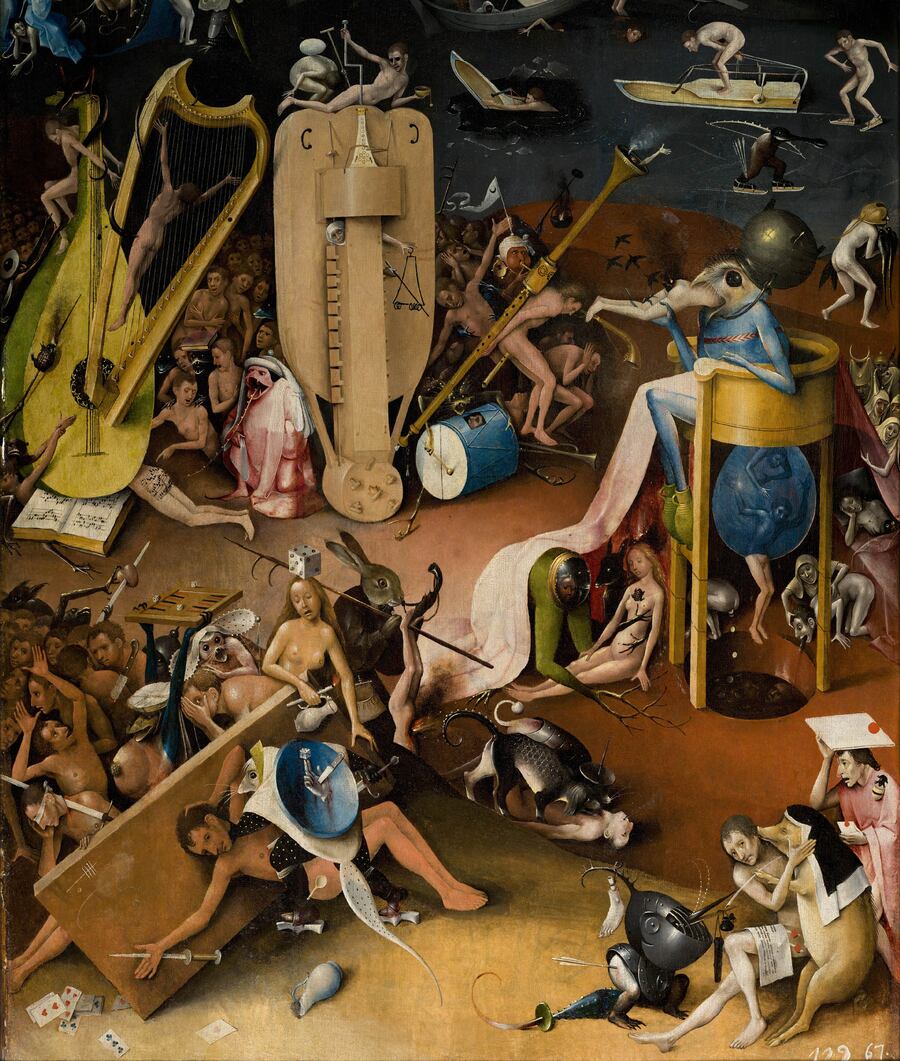
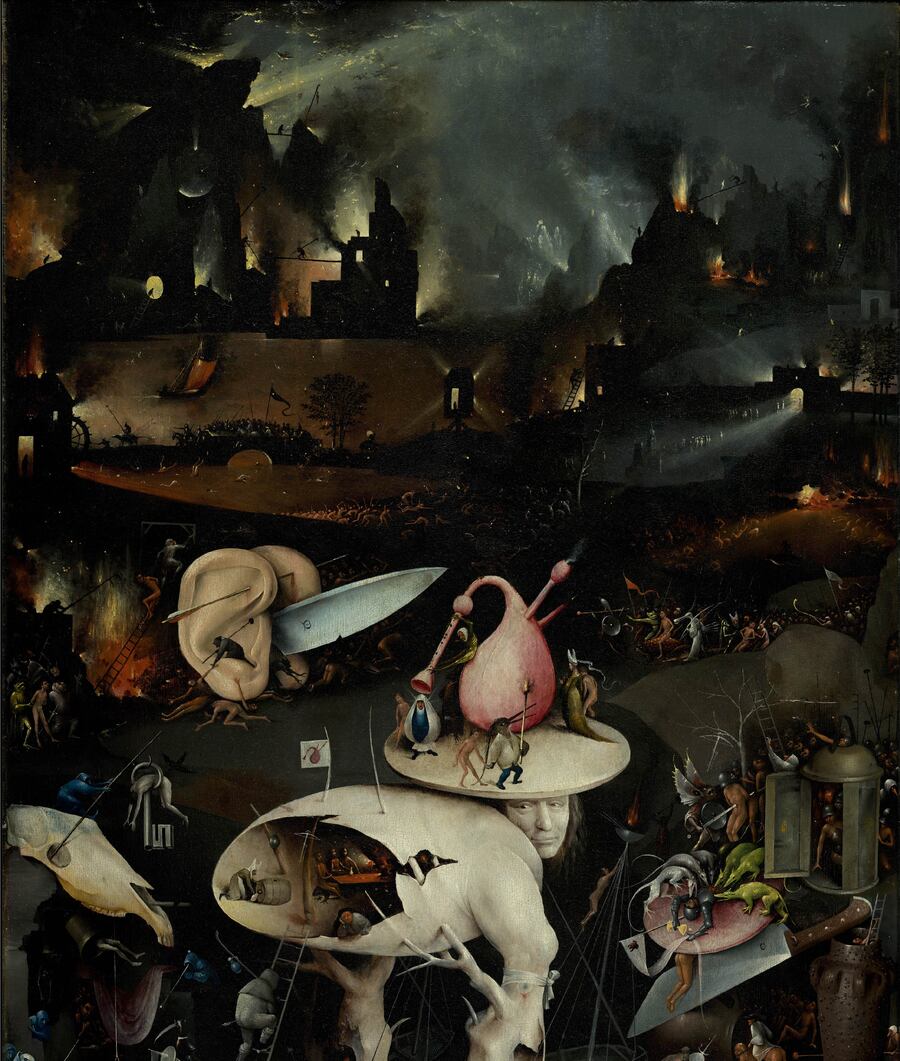
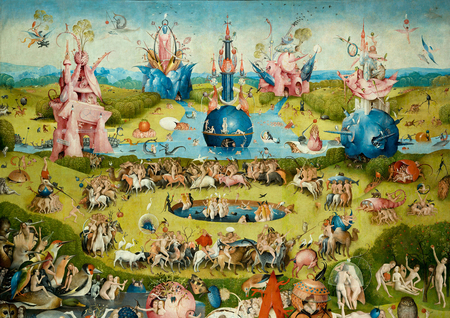
Hieronymus Bosch, «The Garden of Earthly Delights,» right panel. c. 1490–1510. Museo del Prado, Madrid
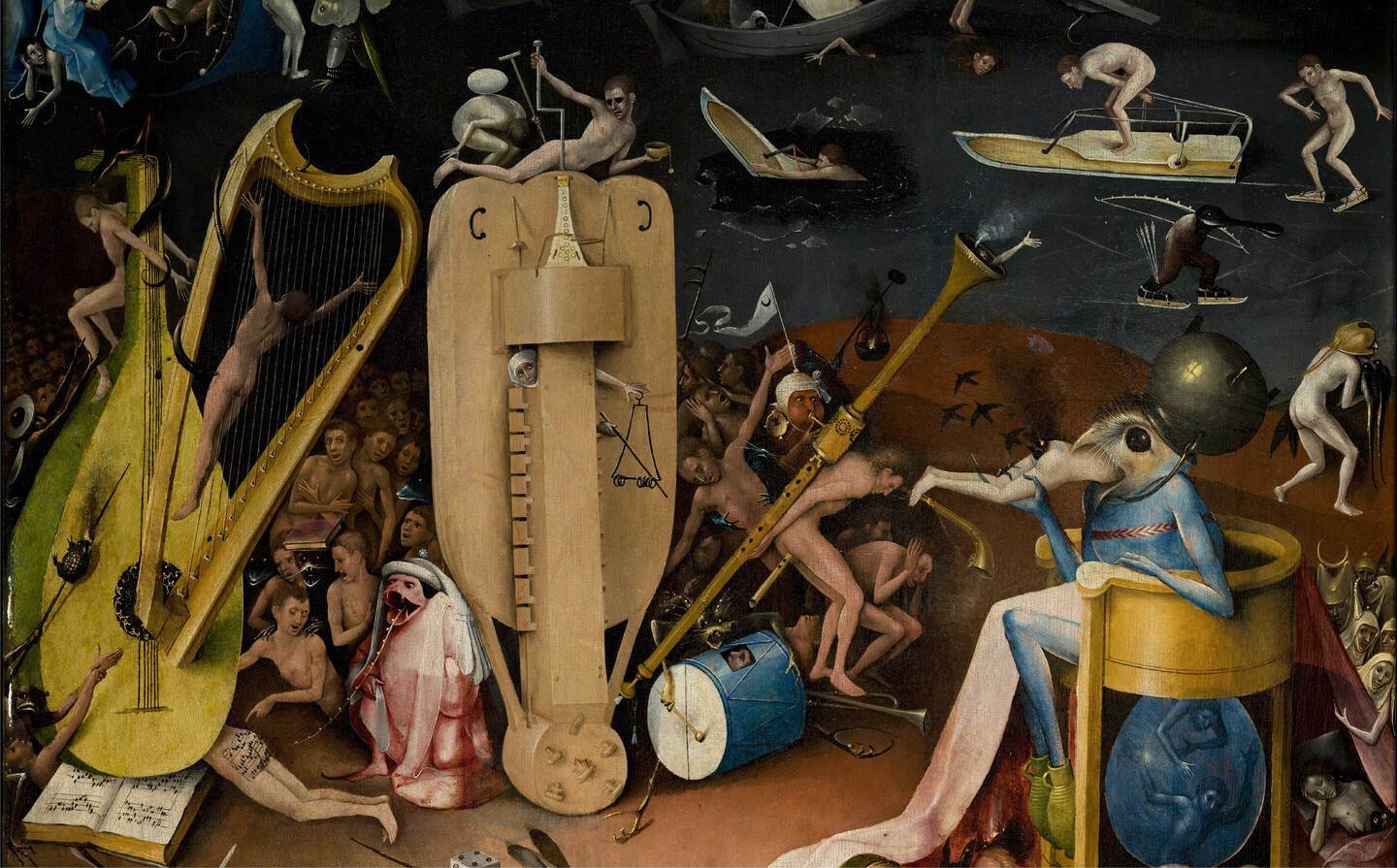
The right wing of the triptych, traditionally called the «Musical Hell, ” is built around instruments of immense size: harp, lute, wheel harp, trumpet, drum, and bagpipe. They do not sound—they execute. The interpretation of this „Musical Hell“ remains a subject of debate: some researchers see it as an indication of specific sins, a reference to the Apocalypse, or an inversion of the iconography of angels praising God. However, one thing is perfectly clear: the musical instrument in this scene functions—it does not decorate.
Fragment: Harp on which a sinner is crucified. Hieronymus Bosch, «The Garden of Earthly Delights, ” c. 1490–1510
One of the sinners is crucified on the strings of a harp. His body is arched, his arms are spread wide, and the strings pass through his flesh. A musical instrument, which in life was a source of harmony, becomes an instrument of execution. He who was meant to play becomes the subject upon which they play. This is the first technique of the torturous function—the instrument’s contact with the body.
Fragment: a lute pressing the body: notes on the sinner’s buttocks. Hieronymus Bosch, «Garden of Earthly Delights.» c. 1490–1510
Another sinner is crushed by a huge lute, and the notes of a melody are pressed onto his buttocks. In the culture of that time, music was firmly linked to lust: it was believed that «lust is the music of the flesh, ” and instruments like the lute and bagpipes were perceived as symbols of romantic yearning and debauchery. In hell, the lute „punishes“ for that very sin. The notes on the body are a parody of divine music that should sound in paradise—the sinner’s body transforms into a musical score. This is the second technique—body deformation by instrument.
Excerpt: Wheel harp. Hieronymus Bosch, «The Garden of Earthly Delights,» c. 1490–1510
Hurdy-gurdy—an instrument with an ambiguous reputation. In this context, it becomes a marker of spiritual blindness. One who did not see the truth in life is given an instrument that «plays» without the involvement of sight. This is the third technique—turning the body into an instrument.
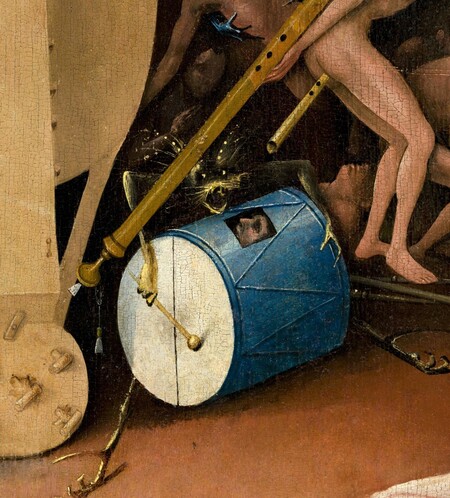
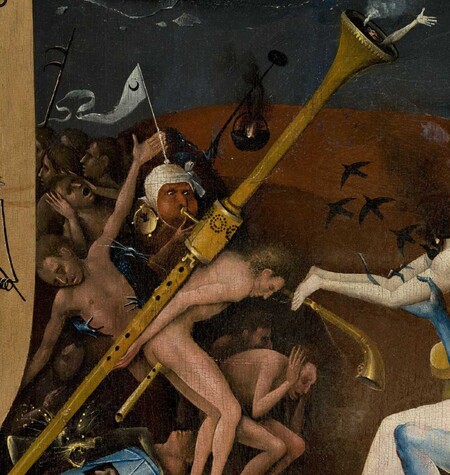
Fragment: drum, bagpipe, and trumpet. Hieronymus Bosch, «The Garden of Earthly Delights,» c. 1490–1510
The hurdy-gurdy in Dutch tradition was often associated with lust, which is why it becomes a universal symbol of evil in Bosch. The drum and trumpet in hell are a parody of the heavenly trumpets meant to call the righteous. Here, they call the sinners to execution. The instrument isn’t just near the sinner—it acts upon their body, transforming punishment into a physical experience.
Analysis of these fragments shows that Bosch’s torture function is built upon three techniques: the instrument making contact with the body, the deformation of the body, and the body transforming into an instrument. This distinguishes Bosch’s painting from earlier depictions of hell, where instruments were merely present but did not act. However, he also employs a second logic: a musical instrument may not touch the body, yet it can turn praise into sacrilege. The following works explore this idea.
Fragment: A pipe inserted into the body of a demon. Hieronymus Bosch, «The Last Judgment, ” 1504
On the right panel of «The Judgment,» there is a scene that immediately draws the eye: a pipe inserted into the body of a demon. Bosch reverses a familiar image: what represented praise in heaven means wrath in hell. Thus, a divine attribute transforms into its opposite. This is the first device of the parodic-sacral function—the inversion of a sacred attribute.
Fragments: angels and a demon with trumpets. Hieronymus Bosch, «The Last Judgment» 1504
In «The Judgment, ” angels and demons are depicted with identical brass instruments. However, while the angelic trumpets summon the righteous, the demonic ones cast sinners down. The very same musical instrument functions in two opposing ways, which makes the inversion visible: the viewer recognizes the sacred image while simultaneously seeing it flipped. Bosch also employs a second technique—the doubling of the instrument.
Fragment: Demon with a bagpipe. Hieronymus Bosch, «The Temptation of Saint Anthony,» 1505–1506
On the scene of temptation, the instrument functions differently: it does not punish the body or invert praise—it seduces. The demon plays the hurdy-gurdy to distract the saint from contemplation. Here, the musical instrument is not an instrument of torture, but an instrument of temptation. This shows that Bosch can make the same symbol function in various ways depending on the narrative.
Fragment: A monster with a flute instead of a face. Hieronymus Bosch, «The Garden of Earthly Delights» (or «The Rise of the Sun,» depending on context/variant), 1500–1502.
In «Hay Weaver, ” the musical instrument „grows“ with the monster’s body: the flute sprouts from his face—replacing his mouth and nose. Music becomes his nature, not an action. This is the ultimate point of inversion: the instrument is no longer merely a tool or a symbol; it becomes part of the body.
The Boscha musical instrument operates under two logics. The first is torturous: the instrument punishes the body, deforms it, and transforms the sinner into an instrument. The second is parodically sacral: the instrument does not touch the body, but it converts praise into sacrilege, turning the sacred image inside out. Both logics are tied to sin: the sinner suffers from the very musical instrument with which they sinned, or they witness the familiar sign of honor morphing into a symbol of punishment.
Bruegel: The tool as a sign of vice
Bruegel works with the same formula as Bosch, but he changes its function. He replicates the Boschian motif of the tool-marker and transfers it to a new context: in Bosch, the tool acted upon the body or twisted praise into sacrilege, whereas in Bruegel, it points—toward foolishness, carelessness, and social hypocrisy. The musical instrument no longer relates to the sinner’s body nor parodies angelic music; it becomes a sign of vice that the viewer must interpret. Bruegel liberates Bosch’s formula from theological precision and transforms it into social commentary.