Sometimes the echo speaks louder than the voice.
We are accustomed to seeking truth from the outside—in events, in other people, in change. But what if everything that happens to us is merely a reflection of what has been sounding inside for a long time? What if the scariest thing isn’t encountering a monster, but meeting yourself—your true self—and not recognizing it?

Project Goal
To explore the nature of self-deception through the genre of psychological horror. To investigate whether a video game can create an experience where the player gradually realizes that the source of terror lies within. Not the fear of the dark that dissipates with light, but the truth we have spent years learning not to hear. And to survive, this truth must be accepted, no matter how unbearable it may be.
The player’s objective seems simple: find the master switch and disable the receiver that has only caught static for decades. But as they delve into the archives, it becomes more complex. Initially, the player simply wants to eliminate the oppressive hum. Then, collecting fragments of recordings, they realize: this hum isn’t just noise. It is the voice of the past, a voice that needs an audience. A painful choice arises: silence the truth forever and retreat into ignorance, or stay and listen to it all the way through, risking their sanity.

Core Gameplay
«Fermi Paradox» is a horror walking simulator with exploration elements. The player moves through three levels of the complex: satellite dishes, residential buildings, and an underground bunker. Progression requires solving simple puzzles related to power delivery, restoring audio communication, and deciphering data. The main gameplay loop is: find an audio cassette, activate the playback device, listen to the recording, gain a new piece of the story, and receive a key to the next location. The game avoids jump scares; instead, it cultivates a mounting sense of unease through sound design and atmosphere.
Core Feature
The protagonist experiences discomfort from background noise, echoes, sounds, and voices, but this allows them to move forward and listen to the truth. There is a function to mute the tactile discomfort, but doing so will also mute the truth.
Step Price
The signal opens the doors. The location features doors and elevators that only function when the main receiver, capturing the «echo, ” is active. The stronger the signal, the more zones become accessible. However, as the signal intensifies, the player begins to lose touch with reality—sounds distort, hallucinations increase, and voices from recordings begin to sound in their head. The player must decide for themselves how close to the edge to venture to proceed further.
Game World
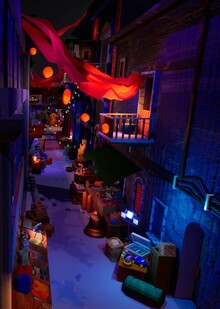
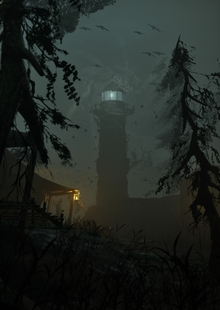
The action takes place at a radio astronomy observatory. Its unique location, far from civilization, provided perfect radio silence.
The complex includes:
Antenna field — rusted parabolic dishes buried in sand. The wind, caught in the metal frames, creates a low-frequency hum.
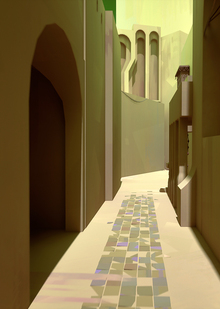
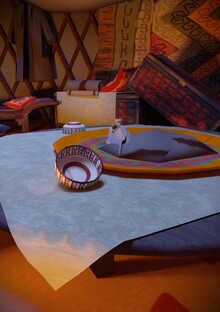
Residential and scientific complexes — small sections where life once bustled.
The bunker — a deep, shielded room housing the main receiver. A long staircase leads to it, and with every step, external noises fade, giving way to a high-pitched electrical ringing in the ears.
Plot
In the late 1990s, the «OZMA» project was shut down. Officially, it was due to a lack of results. Unofficially, it was because of a peculiar signal captured just before the closure. The signal was rhythmic and clearly artificial, but it didn’t originate from space—it had been reflected off the Earth’s ionosphere.
Radio waves, generated by a forgotten catastrophe, traveled into the sky and, after decades of journeying, returned. The realization that humanity had looked into the stars hoping for a miracle, but had only received a delayed reflection of its own pain, was unbearable. The project was closed, and the archives were classified.
Twenty years later, one of the scientists returned to the bunker to turn off the receiver. But he realized: turning it off meant once again closing his eyes to the truth. And the truth demanded to be accepted.
Structure
The game is not divided into chapters or levels. The progression is continuous, and progress is automatically saved when moving to a new zone. Key audio recordings are activated in a specific sequence, but they can be replayed. The final act takes place in a bunker, where the player must perform a final action that determines the ending.
Narrative
The story is revealed through discovered audio diaries of scientists, official communications, fragments of radio broadcasts, and personal video messages. Each recording is someone’s voice from the past—inspired, frightened, or desperate. They play back in real-time through the speakers of old tape recorders that the player activates. Gradually, the voices begin to overlap, creating a chorus in which the protagonist loses the boundary between «then» and «now.»
Interactive
The game is played from a first-person perspective. The interface is kept minimal—there are no health indicators, ammunition counts, or maps. The inventory is presented as a backpack that can be opened in real-time, but it only contains key items found throughout the environment (magnetic keycards, cassettes, tools). Interaction with objects is performed by pressing a key, accompanied by the character’s hand animating to touch the item. In certain situations (for example, when tuning the radio receiver), a simple QTE appears: the player must turn the knob until the indicators align.
A crucial feature is the audio feedback. The longer the player remains in a dangerous zone with a strong signal, the more intense the low-frequency hum builds, and the voices become distorted. This does not affect health but creates psychological pressure, compelling the player to act.
Scalability
The release version is designed for 2–2.5 hours of gameplay—enough for one playthrough with either of the two endings. Replayability is ensured by the second ending, as well as the possibility of finding hidden audio logs that shed light on secondary plot details. Furthermore, the non-linearity within the locations allows players to explore them in different orders, which provides a slightly different narrative experience. In the future, the universe could be expanded through additional content (stories from other observatory staff).