Concept
How to create a throne worthy of God himself?
This question has been reflected in Christian art throughout the centuries. The throne became part of a sacred image—it was elevated, adorned, and imbued with symbols. Through it, a person expressed reverence for those they deemed worthy of the highest honor.
My interest in this topic stems from a desire to reveal the semantic meaning in details that appear secondary at first glance. The depiction of a throne can be viewed as a simple compositional decision, but its form and ornamentation are capable of reflecting a profound respect for the sacred image. This research will demonstrate how artists conveyed ideas of divine greatness through a single object.
Key Question: How did the representation of the throne evolve in Christian art, and what role did it gradually assume within the artistic composition?
Hypothesis: The image of the throne gradually shifted from a relatively conventional signifier of a character’s high status to a complex spatial and decorative object that became an independent element of the artistic composition.
The main criterion for material selection was the ability to trace the changes in the throne’s form, structure, decorative design, and compositional role across different historical periods.
Structure: Section 1. The Symbolism of the Throne in Christian Art. The objective of this section is to explain why the throne became an important element in Christian painting and what meanings it conveyed.Section 2. Early Christian Art (4th–6th Centuries) 2.1. Throne Structure and Architectural Framing 2.2. Decorative Elements of the Throne 2.3. The Throne in Compositional SpaceSection 3. Byzantine Art (7th–11th Centuries) 2.1. Throne Structure and Architectural Framing 2.2. Decorative Elements of the Throne 2.3. The Throne in Compositional SpaceSection 4. 12th–14th Centuries: Byzantine and Western European Traditions 4.1. Throne Structure and Architectural Framing — Byzantine Tradition. — Western European Tradition. 4.2. Decorative Elements of the Throne — Byzantine Tradition. — Western European Tradition. 4.3. The Throne in Compositional Space — Byzantine Tradition. — Western European Tradition.Section 5. The Empty Throne (Hetoimasia) This section does not represent a final stage in the throne’s evolution: empty and occupied thrones were depicted in parallel. 5.1. 4th–6th Centuries: Early depictions of the empty throne. 5.2. 7th–11th Centuries: The empty throne in religious compositions. 5.3. 12th–14th Centuries: The empty throne in the iconography of the Last Judgment.
It is important to me that the viewer sees in the throne not merely a background or a decorative addition, but the trace of human reverence for the sacred. There was care taken regarding where Christ or the Theotokos would be enthroned in the image. Even in details we sometimes overlook, the artist sought to convey love and devotion: before them was not just a significant figure, but a magnificence worthy of the most beautiful.
Section 1. The Symbolism of the Throne in Christian Art
1.1. The Throne as a Symbol of Divine PowerIn Christian painting, the throne represented not so much a piece of furniture as a specific status of the depicted character. This meaning is connected to biblical concepts of God’s authority: the prophet Isaiah sees the Lord on a high throne (Isa. 6:1), and in the Gospel of Matthew, Christ is presented as sitting on the throne of glory as Judge (Matt. 25:31). Therefore, the seated figure of Christ could be perceived as an image of the heavenly sovereign.The throne helped convey what could not be shown directly—divine majesty and superiority over the earthly world. In medieval painting, objects and gestures held meaning not in themselves, but as part of a religious icon [1].
1.2. The Mother of God’s Throne: Veneration and the IncarnationIn the imagery of the Mother of God, the throne acquires added significance. Mary is depicted as the Queen of Heaven, but her majesty is primarily linked to the Infant Christ: by sitting on the throne, she herself serves as his support. Therefore, this image is associated with the concept of the Mother of God as the «Throne of Wisdom.»
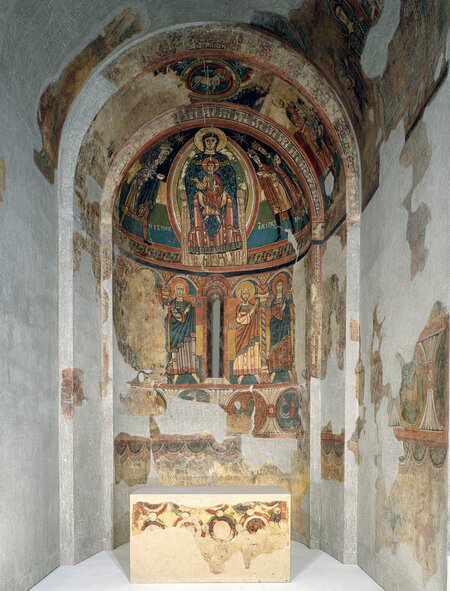
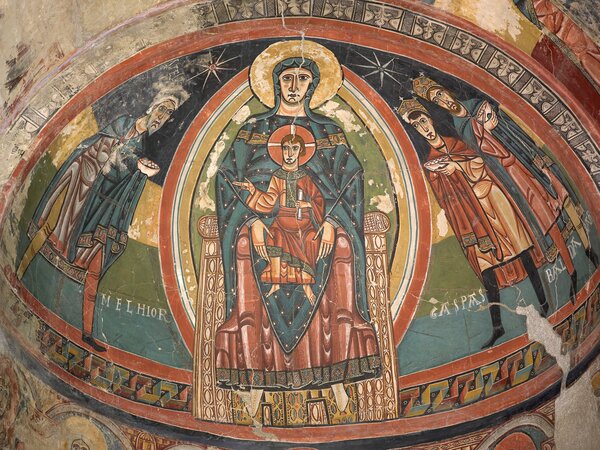
Master of Santa Maria de Taul. Fresco painting of the apse of the Santa Maria de Taul Church. Circa 1123. National Museum of Art of Catalonia, Barcelona.
In the fresco of Santa Maria de Taule church (c. 1123), Mary with the Child is the central figure, and the Magi are turned toward them with their gifts. The high throne emphasizes the solemnity of the scene: before us is not an everyday meeting of a mother with her guests, but the adoration of Christ. His presence immediately allows the viewer to understand to whom the honors are directed.
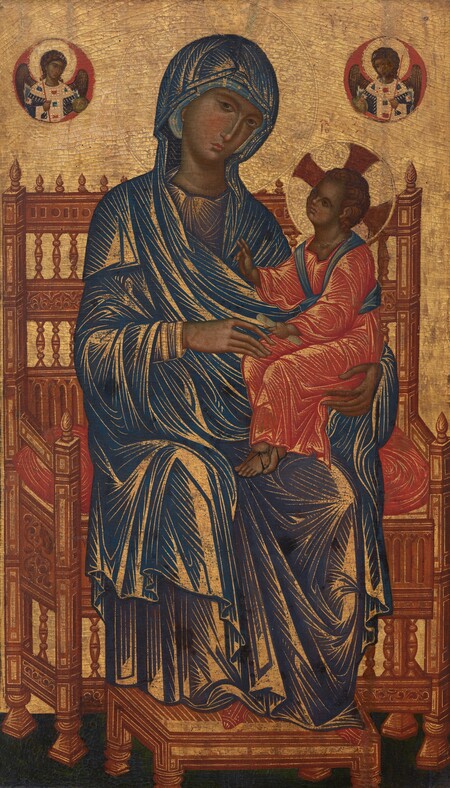
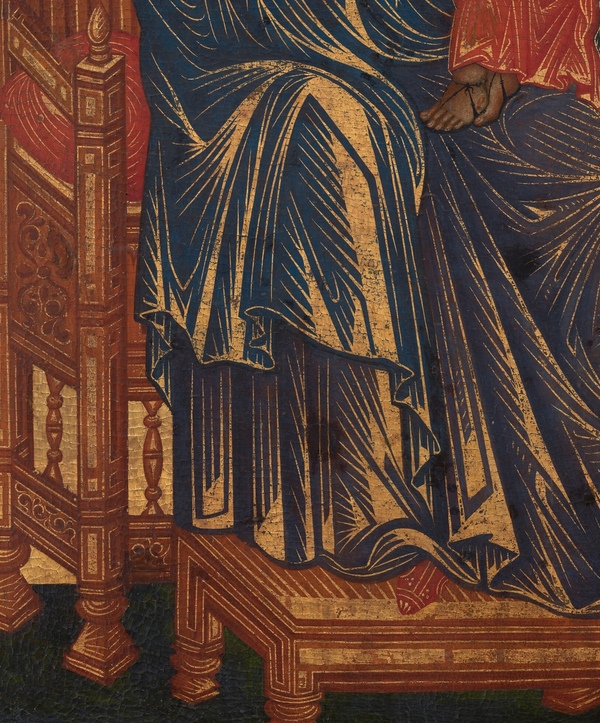
Unknown Byzantine Master. «The Mother of God with Child Enthroned» («Madonna Cana»). c. 1250–1275. Tempera on wood. National Gallery of Art, Washington.
In the Byzantine «Madonna of Cana» (circa 1250–1275), meaning is enriched by specific details. The throne features a high, ornate backrest, Mary wears red shoes, and the angels hold symbols of imperial dignity. Together, they form an image of the Theotokos as a heavenly queen, although the gold background does not depict a specific royal hall [3].
1.3. The Throne’s Details as a Language of Symbols
Margarita d’Arcenzo. «The Mother of God with Child on the Throne and Scenes from the Lives of Saints.» c. 1263–1264. Tempera on wood. National Gallery, London.
Sometimes the meaning of a throne is revealed not through its size or riches, but through a single detail. In a painting by Margherita d’Areccio (c. 1263–1264), lions are depicted near the Virgin Mary’s seat. They evoke the throne of King Solomon, described in the Third Book of Kings (1 Kings 10:18–20). This reference connects the Infant Christ with the biblical representation of wisdom and spiritual power [2].
The throne in Christian painting was not a random piece of furniture. It could signify divine power, the regal dignity of the Virgin Mary, the reverence for Christ, and a connection to Old Testament figures. Furthermore, its symbolism remained consistent whether the depiction was stylized or highly ornate: what mattered was not the external realism of the object, but the meaning the artist conveyed through it.
Section 2. Early Christian Art (4th–6th Centuries)
2.1. The Structure of the Throne and Architectural FramingIn early Christian painting, the depiction of the throne was shaped by ancient imagery of rulers and venerated figures. Artists used the recognizable seat to emphasize Christ or the Virgin Mary, but the level of refinement varied across different monuments. Kurt Weitzmann, characterizing the transition from ancient to Christian art, noted: «this transition was not abrupt» [2, p. 1] (trans. from English). Therefore, the development of the throne should be viewed not as a direct shift from simple to complex, but as an expansion of its expressive capabilities.
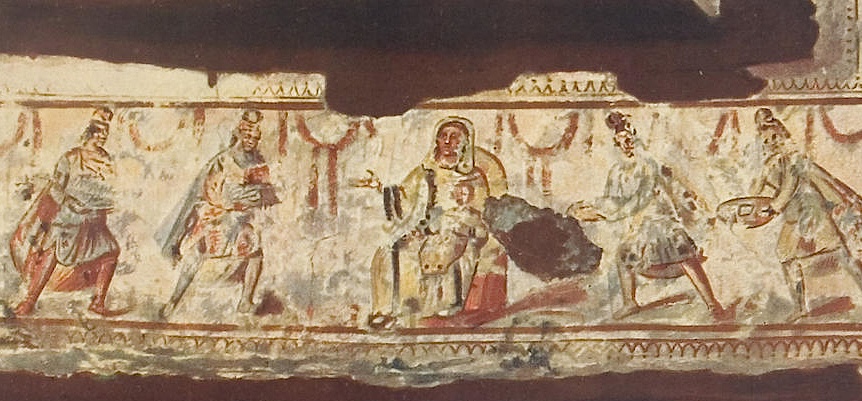
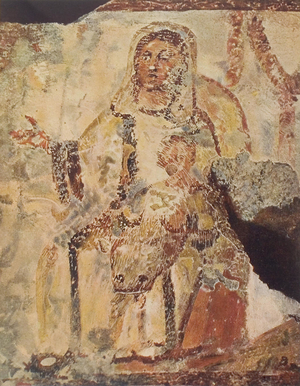
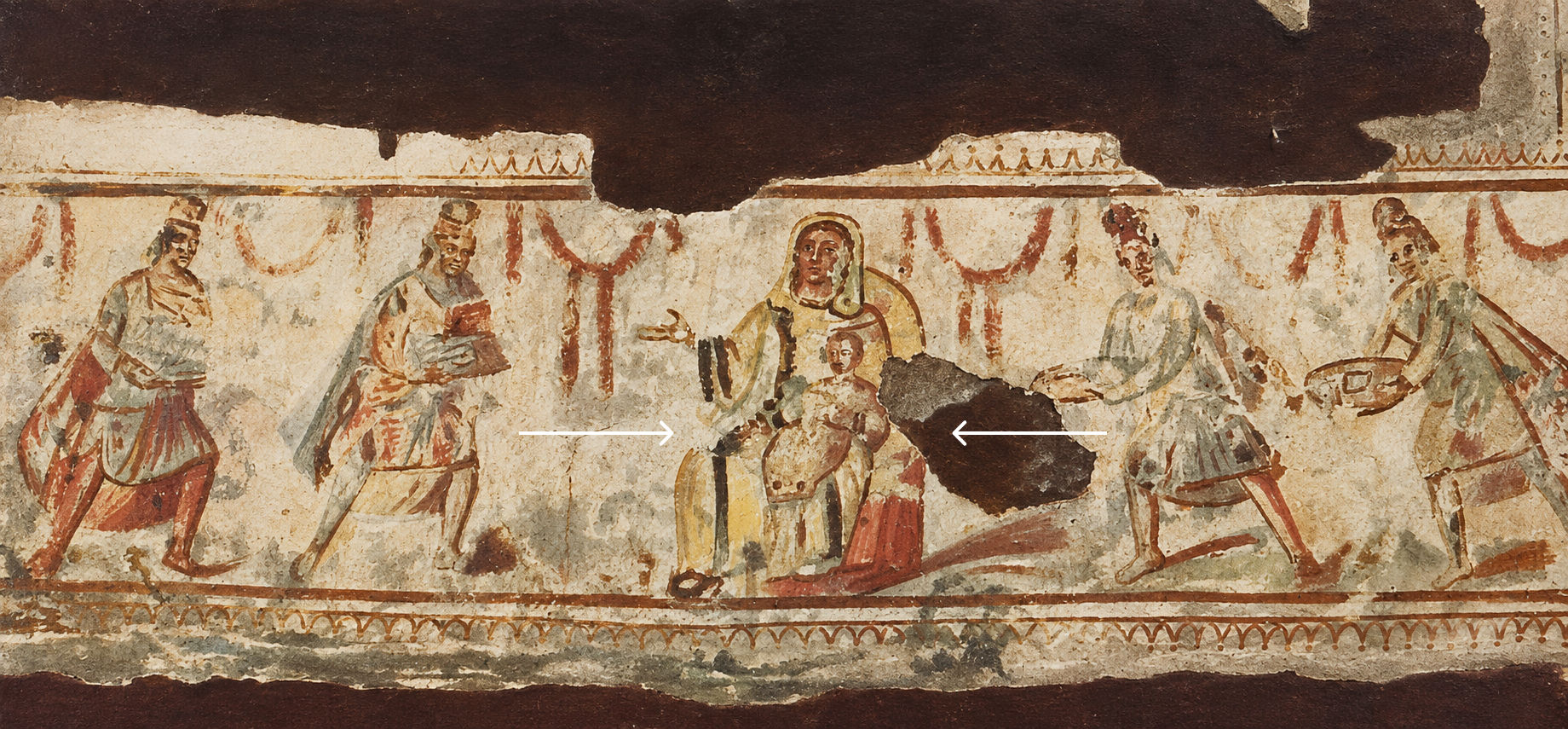
Unknown Master. «Adoration of the Magi.» First half of the 4th century. Fresco. Catacombs of Domitilla, Rome.
In the fresco «Adoration of the Magi» from the Catacombs of Domitilla (first half of the 4th century), Mary sits with the Infant, receiving gifts. The seat is depicted modestly; attention is focused on the movement of the Magi and the event of adoration [3].
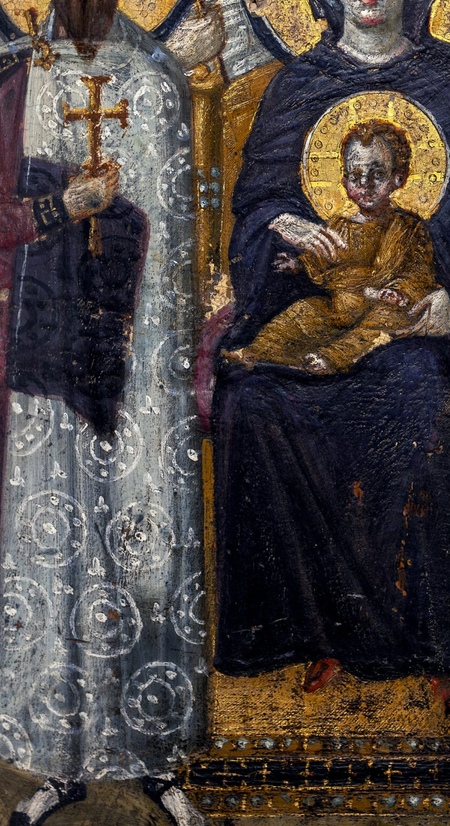
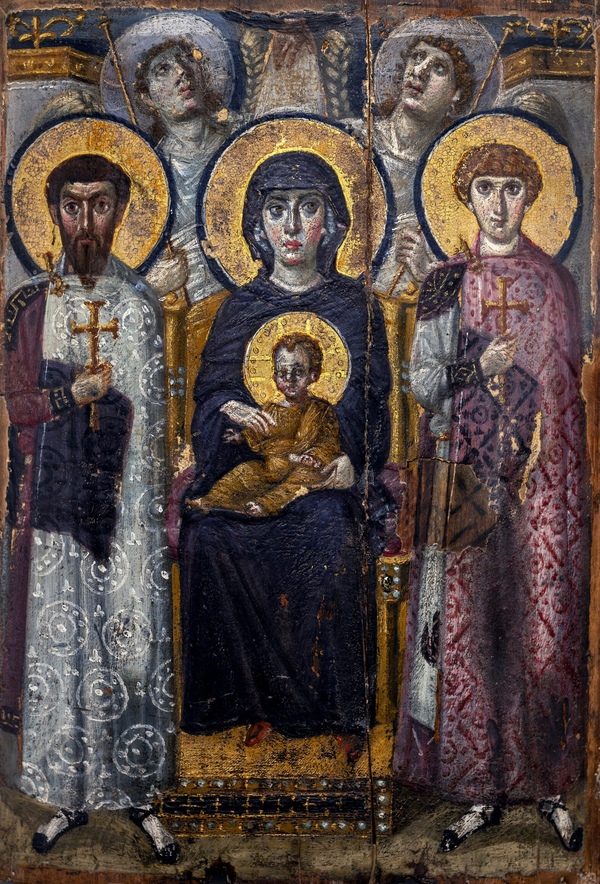
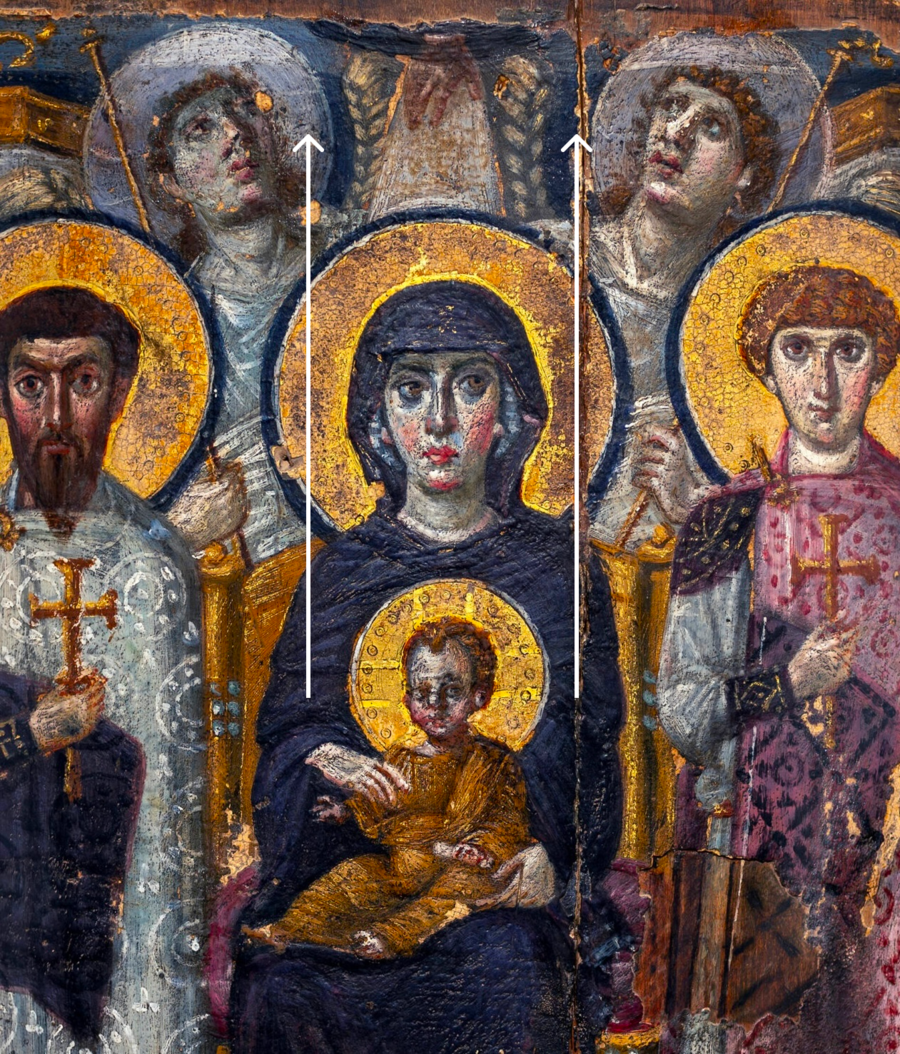
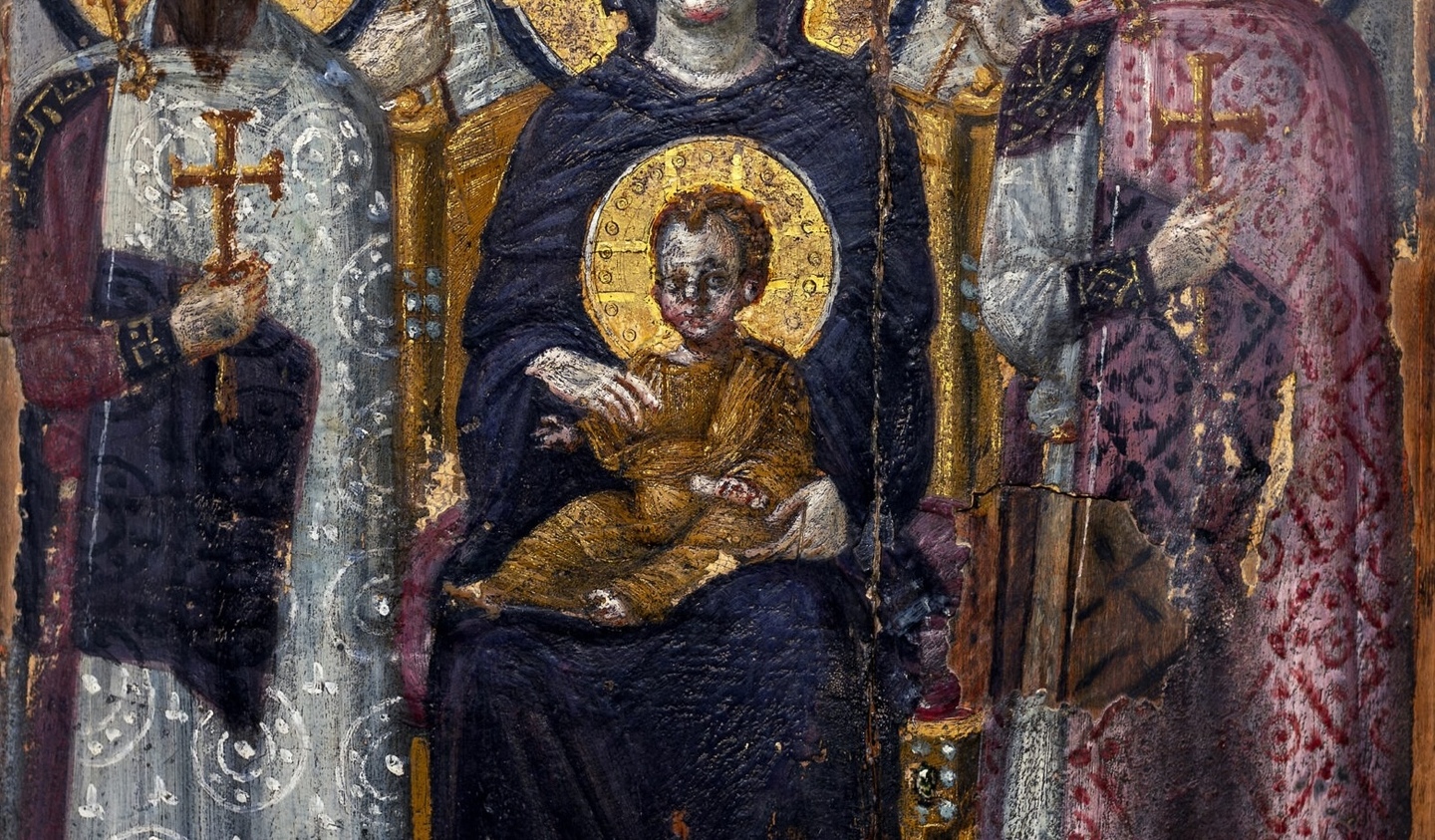
Unknown Master. «The Theotokos with Child between Saints Theodore and George and Angels.» 6th–early 7th century. Encaustic on wood. Monastery of Saint Catherine, Sinai, Egypt.
In the Sinai icon from the 6th–early 7th century, the structure of the throne can be examined in more detail: the armrests, pedestal, and the turn of the side elements create a sense of depth. The architectural element above the angels constrains the space, lending completeness to the scene [1].2.2. Decorative Design of the ThroneThe decoration reveals another function of the throne—the expression of reverence through preciousness and solemnity.
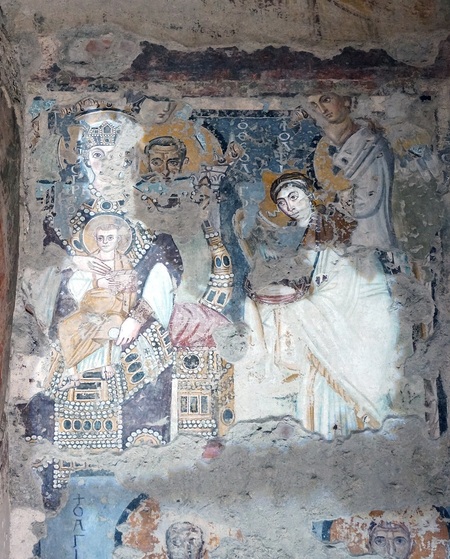
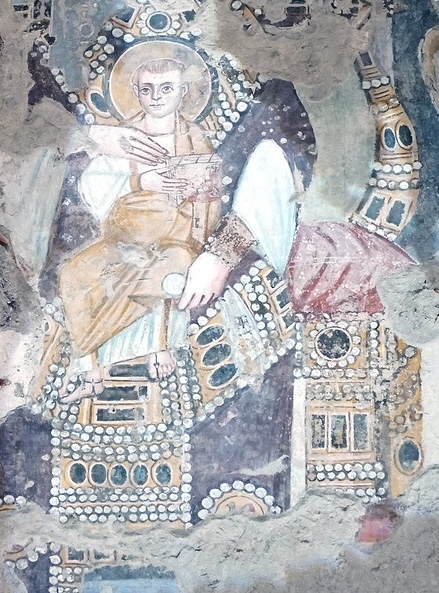
Unknown Master. «Maria Regina (Mother of God on the Throne with the Child and an Angel).» Early 6th century. Fresco. Santa Maria Antiqua Church, Rome.
In the fresco «Maria Regina» from Santa Maria Antiqua (6th century), the Mother of God is depicted in imperial robes and a crown. Her throne is adorned with what appears to be precious stones. It is perceived as an attribute of heavenly majesty rather than ordinary furniture: the earthly language of imperial ceremonial has been transposed into a sacred image [4].
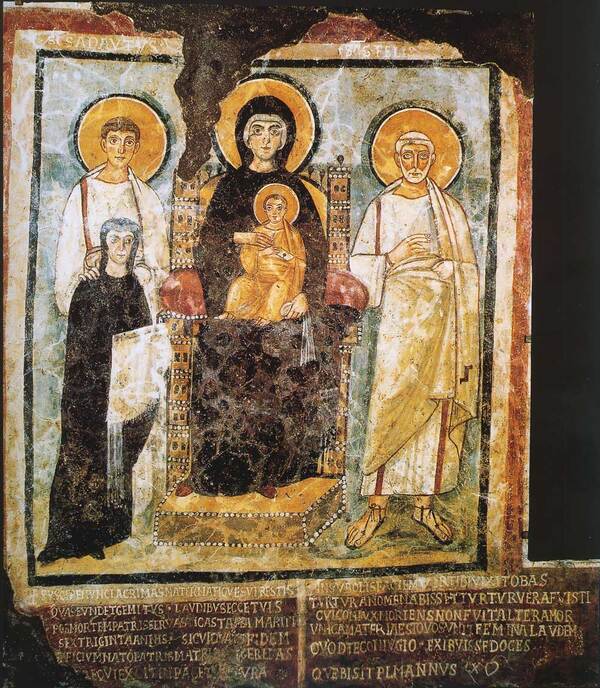
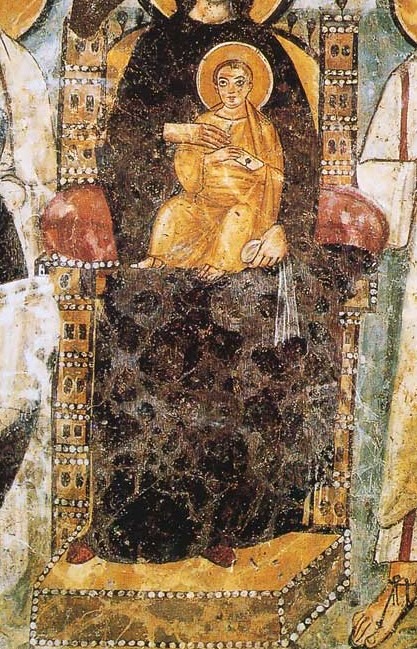
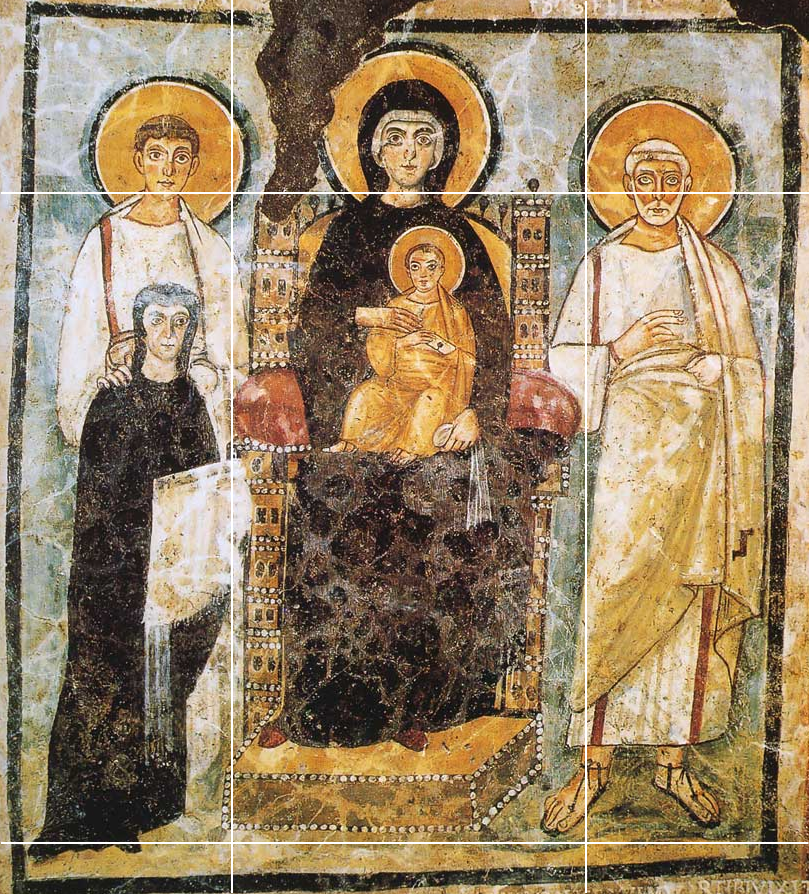
Unknown Master. «Virgin and Child Enthroned between St. Felix and Adact, with Donor Turtura.» After 528. Fresco. Catacombs of Commodilla, Rome.
The high throne in the Commodified Catacombs fresco (after 528 AD) is also richly decorated. Columns, bright cushions, and an embellished base make it noticeable even among several figures.In both cases, the significance lies not in the patterns themselves, but in the attention artists devote to highlighting the Mother of God’s place.
2.3. The Throne in Compositional SpaceThe placement of the throne dictates how the viewer reads the character hierarchy.