
Chronology
- 1890–1920
- 1930–1950
- 1960–1980
- 1990–2020
Concept
Women’s tennis originated in the late 19th century. Ladies were restricted to wearing long skirts, corsets, and hats. As a professional structure, it solidified in the 1970s. A pivotal moment was the creation of the WTA—Women’s Tennis Association—in 1973, led by Billie Jean King, which secured equal prize money and professional status for women, separating them from amateur competitions.
My visual research focuses on the evolution of the women’s tennis uniform over nearly a hundred years and how the fashion of each era influenced the athletes' appearance, sometimes at the expense of comfort. Over the last century, Victorian corset dresses have transformed into attire that balances comfort, functionality, and modern style.
1890s–1920s
The origins of women’s tennis date back to the late 19th century. Clothing at that time was extremely uncomfortable and was required to meet specific standards. The first changes only began appearing in the 1920s. Jean Patou, a French designer, was a pioneer in women’s tennis attire in the 1920s; he eliminated corsets and skirts, replacing them with short-sleeved blouses and skirts that did not restrict movement.
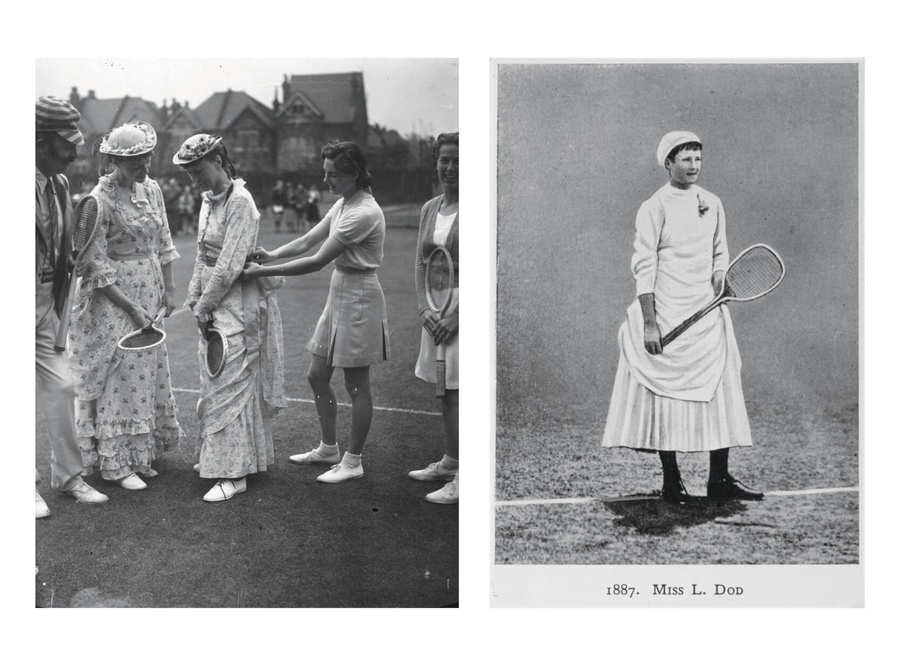
Tennis Suits from 1887 and 1890
Tennis attire up to the 1920s adhered completely to Victorian fashion: female athletes wore long dresses that reached their ankles and had long sleeves. Stockings and corsets were also mandatory elements of the uniform. Such clothing severely restricted movement and hindered women’s ability to move freely on the court. A distinctive feature of these dresses was their white color—sweat stains were less noticeable on white, which held special significance in tennis, particularly given the strict fashion standards of the time.
Suzanne Lenglen (Wimbledon 1921) Designer: Jean Patou
In 1921, at the Wimbledon tournament, French tennis player Suzanne Lenglen first stepped onto the court wearing an outfit designed by Jeanne Pato. Her ensemble consisted of a white silk pleated skirt almost knee-length, a short-sleeved blouse, a sleeveless cardigan, and a headscarf.
The novelty was that underneath the outfit, there was no corset—Lenglen became the first tennis player to forgo it on the court. The short skirt and bare arms did not restrict her movements, allowing her to run and move more freely, whereas her opponents in heavy, long dresses were far less mobile. It was this very attire that set a new standard for women’s sportswear and everyday clothing, becoming a symbol of the emancipation of the 1920s.
Suzanne Lenglen and Julie Vlasto. Designer: Jean Patou. (1926)
Helen Wills (1924)
1930s–1950s
From the 1930s through the 1950s, the women’s tennis attire underwent significant changes, evolving from formal and restrained to something more practical, elegant, and even controversial. The starting point for these transformations was the revolution of the 1920s, when Suzanne Lenglen abandoned the corset and shortened her skirt.
American Wightman Cup Team at Wimbledon (1938)
The 1930s proved to be a turning decade in terms of freedom of movement. By the late 1930s, shorts began actively replacing skirts, allowing female athletes maximum mobility. In 1932, American tennis player Alice Marble made a true breakthrough by stepping onto the court in shorts—an unprecedented act of daring for that era—and she was followed that same decade by Helen Jacobs, who also played in shorts. During this period, skirts became noticeably shorter than previous models, and the silhouette became more fitted.
Alice Marble (1932), Mrs. H. Sperling, and Miss Helen Jacobs (1935)
Louisa Brown and Pauline Betz (1944), Helen Wills-Moody and Helen Jacobs (1938), Pauline Betz (1946)
In the 1940s, the women’s tennis outfit continued to evolve toward greater freedom, even as World War II made adjustments to fashion as a whole. During this decade, looser, flowing dresses became fashionable, often worn over ruffled bloomers.
The 1950s marked an era of remarkable balance between sporty functionality and high feminine fashion. During this decade, the silhouette of the tennis dress incorporated elements of Christian Dior’s famous New Look aesthetic: a cinched wasp waist, crisp collar lines, and flared, flowing skirts. Despite being forbidden from appearing at Wimbledon, Ted Tinling continued to dress top female tennis players through his assistants, crafting magnificent fitted dresses with pleated skirts for champions like Maureen Connolly in the 1950s. Designers of this period frequently utilized light, flowing fabrics that beautifully accentuated the athletes' movements during play. Many tennis outfits from that time looked so elegant and refined that they could easily be worn not just on the court, but in daily life as well.
Connell (right) and Doris Hart (1953)
Carol Fageros Short (1958) and Maria Bueno (1959)
1960s–1980s
From the 1960s through the 1980s, the women’s tennis outfit fully transitioned from formal wear into comfortable, functional, and vibrant sportswear. These decades marked a decisive move away from lingering Victorian constraints, embracing color, innovative fabrics, and boundary-pushing designs.
1960s Lea Pericoli. Designer: Ted Tingling
The emergence of even shorter skirts was a defining trend of the 1960s. Ted Tinling continued to dress stars, and in the 1960s, his clientele included legends like Billie Jean King. Tinling experimented not only with length but also with color—he was among the first to introduce colored trim, monograms, and appliqués to strictly white tennis outfits, gradually softening the Wimbledon white dress code. In the 1960s, dresses with a more straight, relaxed cut also appeared, echoing the everyday youth fashion of the era—trapeze dresses and knitted tennis sweaters became integral parts of the tennis wardrobe.
Lia Pericoli (1964), Virginia Wade (1968)
It was during this period that vibrant figures such as Martina Navratilova and Chris Evert emerged, and tennis fashion became not merely functional but highly expressive. The key shift was the introduction of color. While Wimbledon maintained its strict adherence to white, athletes at other tournaments began appearing in bright pink, yellow, blue, and plaid dresses. Ted Tingling regained his status as a leading tennis designer and continued to create short, on-court dresses—featuring deep cutouts, open backs, and short sleeves. The major breakthrough of the 1970s was the rise of separates. Furthermore, synthetic fabrics like polyester and acrylic were incorporated, as they were better at wicking moisture and resisting wrinkles.