CONCEPT
Gradually, everything becomes a city. Urban logic permeates various spheres of life, transforming into a universal scale for measuring time, value, speed, and visibility. The city begins to be perceived as the measure of existence—and as the sole, supposedly inevitable—mode of life.
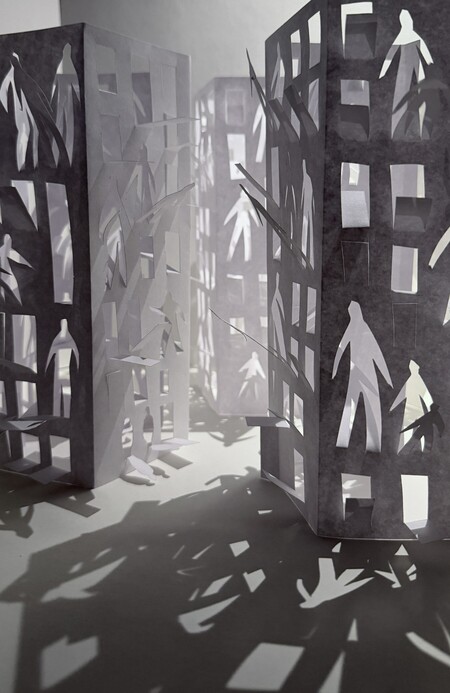
The «Homes» project is an installation composed of numerous paper objects—“houses» resembling high-rise buildings. Each one is unique, hand-folded, and features «windows» cut out of its surfaces, some of which are human silhouettes.
My project explores the alteration of human perception—of the self and others—situated within the environment of a global city. It addresses the tension between the individual and the mass, between personal history and the depersonalizing logic of the global, where individual existence is incorporated into a collective rhythm and scale, and where the single subject is a fractal of the overall infrastructure.
I am interested in the dual role of the individual within the global city: simultaneously vulnerable and protected. I experienced this for the first time when I moved from Nizhny to Moscow: in the scale of the metropolis, I become almost invisible, yet this very anonymity creates a feeling of shelter—a place where one can dissolve and escape scrutiny while preserving one’s inner space.
This is the origin of the project’s title—"Doma"—which flickers between the plural form of the word «home» and the state of «being at home.»
CONCEPT OF THE SINGLE OBJECT
Each object is cut and assembled by hand from a sheet of A4 office paper. This is a reflection on the inner home that one cannot leave, on the people we let in, and the traces they leave within us; on how we view the world and how the world views us.
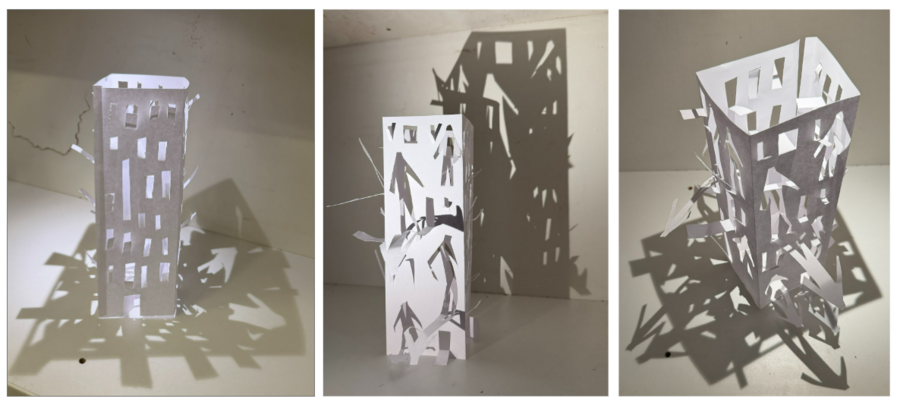
Home | 2026
Paper 7.4×7,4×21 cm Finished work, photos from various angles
EXHIBITION CONCEPT
The exhibition envisions an installation composed of small clusters of paper objects, which will be distributed across the surfaces present in the display space. This type of presentation necessitates generating a mass of objects through their spread throughout the entire space, while maintaining careful attention to each individual piece. Furthermore, if windows are present, this exhibition concept suggests that the city can «burst» into the gallery through those windows, spreading across the display space. No dedicated pedestals are required—only the room’s existing architecture may be used. Works by other exhibition participants may be placed between the object groups.
Through this exhibition, I create an environment where individual «human houses» begin to interact, generating a sense of mass—whether of buildings or people—meeting here and there, influencing one another by supporting, shadowing, or casting silhouettes. During the exhibition, the installation becomes a home for each individual «house.»
Finished Works. Example Object Group Layout.
Completed Works. Example of Object Group Layout.
Finished Projects. Example composition of a group of objects.
The paper «houses» in this project exist as separate, fragile internal worlds. When brought together, they form a system where each individual piece can be substituted, yet still contributes to the whole.
I want to present the global city as an organism composed of specific people—each with their own history and internal volume—bearing the marks of mutual influence between the city, myself, and others.
One question this project poses is: What do we leave within one another, and within the vast infrastructure that shapes us and which we replicate in our own image?
I propose viewing the global city as a site of influence where global factors—which are significantly more powerful than any single individual subject and even the aggregate of those subjects—operate. The viewer and the exhibition space environment (drafts, accidental movement nearby) will serve as metaphors and actors embodying these global forces, possessing the power to change, preserve, or dismantle the existing status quo.
During the exhibition period, some objects may be subtly altered by the environment—such as drafts or visitors—much like how the environment influences and changes each of us. It is also interesting to explore whether someone might attempt to adjust the installation by accidentally touching it, or if they will intentionally change it upon noticing. To prevent major damage, the objects are affixed nearly invisibly to the surfaces upon which they will be installed.
Exhibition layout option. 3D visualization, top-down view.
Exhibition concept. 3D visualization, side view.
ESTIMATED INSTALLATION DIMENSIONS
Plan is schematic (top view). Object placement corresponds to the 3D visualization, schematic.
On the plan: 13 objects, measuring 7×7 x 21 (cm) 10 objects, measuring 5×5 x 15 (cm)
TECHNICAL SPECIFICATIONS
Total Number of Items:
23 pcsLarge Items:
7×7 x 21 cm, 13 pcsSmall Items:
5×5 x 14.5 cm, 10 pcsStatus:
Completed itemsAssembly Time:
Up to 2 hours, including securing items to the display surface (using tape or L-shaped paper adhesive, after degreasing the mounting surface).Additional Requirements:
General lighting is required.If possible, provide accent lighting (one ceiling spot fixture for each installation group; in the proposed exhibition, this is 8 fixtures).
Regular visits to the exhibition by the author—no less than once every 3–5 days—are necessary to check its condition, document any changes, and make adjustments if needed.
Number of Pieces:
Depending on the size of the exhibition space, the number of pieces may be reduced or increased as necessary. When increasing the quantity, manual production speed ranges from 3 to 6 pieces per day.
Production can also be done using plotter cutting, which requires 2–3 weeks for mockup preparation and cutting. In this case, the number of pieces can be significantly increased—for example, up to 1,000 units. The estimated project budget in this scenario is up to 56,000 rubles and, in addition to the production cost, includes up to 4 assistants for assembly and installation of the pieces in the exhibition, with an installation duration of up to 8 hours.