Closeness and Separation
How Hands Organize Relationships Between Figures in Giotto’s Frescoes in the Scrovegni Chapel
Comparison Boundaries
The comparison is limited to a single ensemble. Therefore, recurring movements are examined within a broader pictorial language. The distinction between encounter and conflict manifests here in the construction of specific scenes, rather than being explained by a shift in era.
Why I Chose This Topic
In Giotto’s frescoes in the Scrovegni Chapel, even a slight movement of a hand changes how we understand the relationship between people. Characters might stand close to one another, but this proximity looks different: as a greeting, an act of help, a command, or an attack. I am interested in comparing such scenes and understanding what details allow us to distinguish these actions. To do this, I examine who initiates the movement, whether another person responds to it, and how much space remains between the figures.
In this study, I examine the frescoes by Giotto and his workshop in the Scrovegni Chapel in Padua, created around 1303–1305. This dating is indicated on the official website of the museums of Padua. I limit the material to a single ensemble so that I can compare gestures within a unified artistic system. Later paintings of the altar area, sculpture, and decorative objects are excluded from the scope. This makes it simpler to focus on how the scenes themselves are constructed, without having to explain every difference by a change in artist or era.
Research Question and Hypothesis
The main research question is: How can proximity, power, and conflict be differentiated in the frescoes of a single chapel based on hand gestures and the distance between figures?
I hypothesize that the meaning of a gesture depends on how the other character responds to it. When people reach toward each other, they are more often perceived as a pair or a group. If the movement originates from only one side, the distinction in their roles becomes more noticeable—one is calling, helping, commanding, or restraining another. However, this is not a universal rule. An embrace could be a hold, and people can remain connected even without physical touch. Therefore, it is important to examine these exceptions.
For comparison, I selected scenes where the hands are clearly visible and help interpret the action—ranging from the expulsion of Joachim to the encounter between Christ and Mary Magdalene. The examples are drawn from several sections of the fresco. Initially, an entire scene is presented, followed by details when necessary. I return to a specific fresco only when a fragment allows me to examine something that is lost in the overall composition.
How the Research is Structured
I organized the work based on how the figures interact with one another, rather than following the sequence of biblical events. Chapter One examines conversion, pointing, and stopping at a distance. Chapter Two compares mutual touches; Chapter Three focuses on handing off and support. Chapter Four is dedicated to grabbing, and Chapter Five to gestures near the immobile body. In the final chapter, I examine what happens to the connection between characters when their hands are not touching. This division helps reveal how similar movements carry different meanings in different scenes.
When making comparisons, I ask the same questions: Who initiates the movement? Toward whom is the palm directed? Is there a response? Does the hand touch a body or an object? I then look at the turn of the head, the torso’s inclination, and the empty space between the figures. This allows me to explain my conclusions through observable details. Since one pose cannot definitively reveal a character’s emotion or the artist’s intention, I separate observation from possible interpretation.
What Sources I Relied Upon
For this work, I selected sources to help verify information about the chapel and to examine its frescoes more closely. The dates and description of the ensemble were drawn from the official websites of the Padua museums and the Scrovegni Chapel. The publication from the Institute of Restoration helps account for the condition of the frescoes—what we see today is also dependent on the preservation of the paint layer. I cross-reference the titles of the scenes and the reproductions with the Web Gallery of Art catalog. Giovanna Valencano’s article is necessary for analyzing the scene of the chapel model presentation. Full details regarding these materials are provided in the bibliography.
The main part of the research is built upon comparing the images themselves. I examine entire scenes and individual details, checking how the hands relate to the poses and the arrangement of the figures. The chapter titles help describe these observations but do not delineate the established rules Jotto used. From a reproduction, it is impossible to accurately restore movement or find the single correct meaning of every gesture. Therefore, in the conclusions, I note both the recurring techniques and the scenes that do not fit the initial hypothesis.
Content
1. Contact and Boundary 2. Mutual Touch 3. Giving and Support 4. Touch as Grasp 5. Hands Near an Inanimate Body 6. The Rupture That Maintains Connection
What to ObserveFirst, it is important to understand who initiates the movement and toward whom it is directed. Then, you can compare the responsive gesture and the point of contact. Finally, you should look at the entire figure: where the head is turned, how the body is angled, and how much space is left around it.
1. Address and Boundary
The hand directs the address or defines the boundary. The juxtaposition of four scenes allows one to distinguish distance, dialogue, and action.
Giotto and his workshop. «The Expulsion of Joachim from the Temple.» c. 1303–1305. Fresco. Scrovegni Chapel, Padua. [I01]
Exclusion and the Edge PositionJoachim is already outside the sacred space, yet the priest’s hand continues to guide him outward. This boundary is perceived both through the contact between the figures and their placement near the architecture.
Giotto and Workshop. «The Annunciation to the Virgin Anne.» c. 1303–1305. Fresco. Scrovegni Chapel, Padua. [I02]
Giotto and the Workshop. «Annunciation: Archangel Gabriel.» c. 1303–1305. Fresco. Cappella Scrovegni, Padua. [I08]
Giotto and the Workshop. «The Annunciation: Mary.» c. 1303–1305. Fresco. Scrovegni Chapel, Padua. [I09]
Architecture divides; the joint connects.
In the scene with Anna, the address passes through an opening. In two parts of the Annunciation, Gabriel and Mary also occupy separate spaces. The turns of the figures and the raised hand of the angel allow us to read them as participants in the same address.
Giotto and the Workshop. «Christ Among Teachers.» c. 1303–1305. Fresco. Scrovegni Chapel, Padua. [I14]
Attention is distributed across the group. In the scene with the teachers, the young Christ is highlighted by his central placement. His hand dictates one direction, while the movements of the other participants create several responses. The viewer sequentially shifts focus among the participants.
Giotto and the Workshop. «The Raising of Lazarus.» c. 1303–1305. Fresco. Cappella Scrovegni, Padua. [I15]
Active Hand and Rigid Body
The Resurrection of Lazarus is structured around the contrast between Christ’s moving hand and the vertical body in the burial wrappings. Adjacent figures are occupied with the fabric or reacting to the event. Their gestures further specify the different roles within a single group.
Direction of Gesture and Figure Response
In «The Exile of Joachim, ” the priest’s hand reaches the hero’s garment, continuing a motion of withdrawal. In the scene with Anne, the gesture crosses the room’s boundary without physical contact. In „Christ Among the Teachers, ” the direction of the arms and the turns of several figures create an exchange revolving around a central point.
In „The Resurrection of Lazarus, ” the active gesture is juxtaposed against the constrained body. These instances demonstrate that the form of a raised hand alone does not determine meaning. It requires establishing the addressee and correlating the movement with the figure’s overall posture.
2. Mutual Contact
Counter-movement often forms a pair. However, reciprocity does not require identical body positions and can emerge through an intermediary.
Giotto and the Workshop. «Meeting at the Golden Gates.» c. 1303–1305. Fresco. Scrovegni Chapel, Padua. [I03]
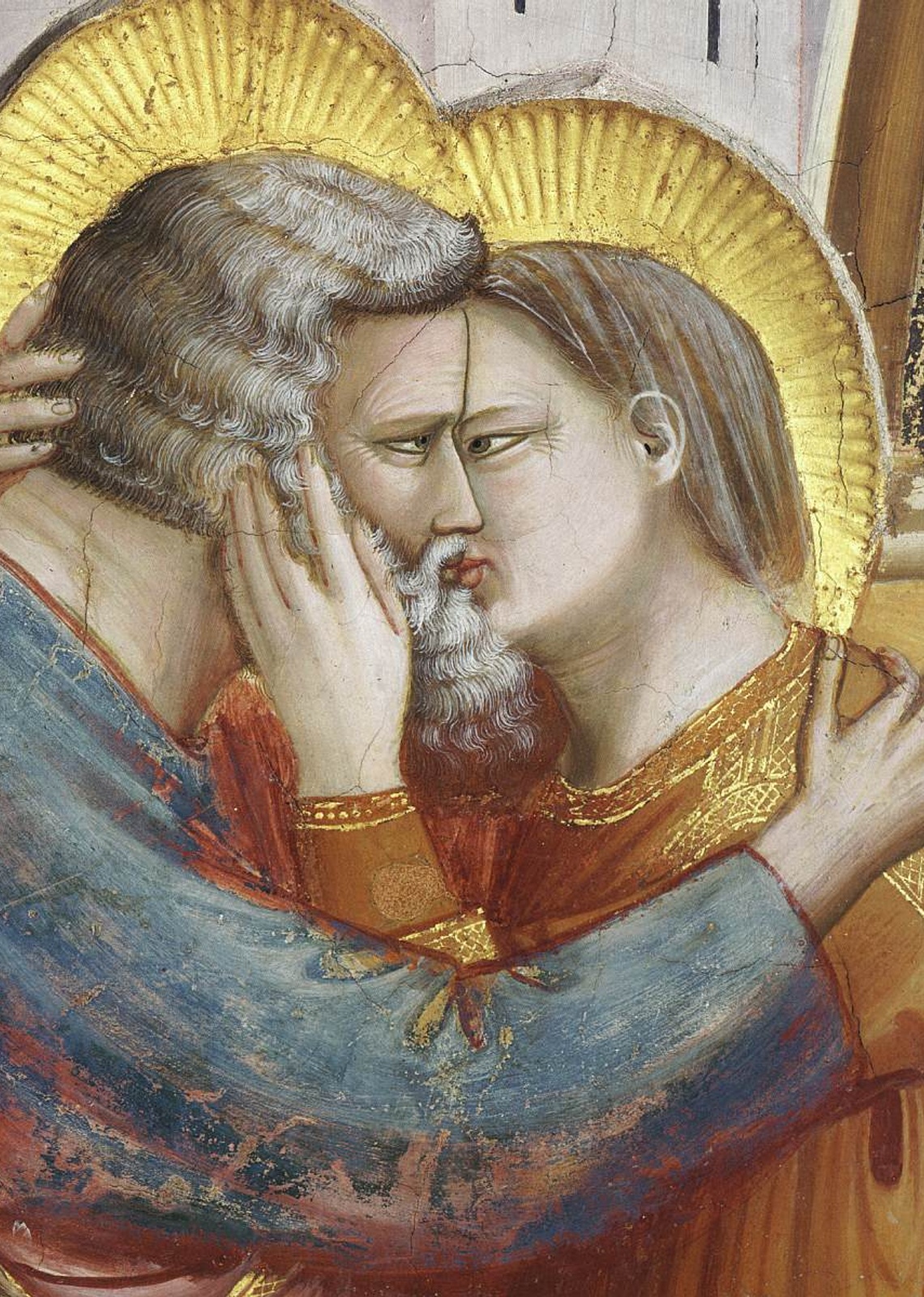
Giotto and the Workshop. «Meeting at the Golden Gates» (detail). c. 1303–1305. Fresco. Scrovegni Chapel, Padua. [I03]
Where the touch concludesIn the meeting by the gate, a hand near the head supports the closeness of the faces. The movement does not draw attention away from the couple; instead, it guides the gaze from one participant to the other. This way, the figures form a compact center within a wider scene.
Giotto and his workshop. «The Meeting of Mary and Elizabeth.» c. 1303–1305. Fresco. Scrovegni Chapel, Padua. [I10]
Reciprocity with Different Inclinations
Maria and Elizaveta do not mirror each other’s poses. Elizaveta’s lean is more pronounced, but the direction of their arms maintains a sense of mutuality. This example allows us to separate the reciprocity of movement from the external symmetry of the composition.