Cover Design Task: Identify the object of study and the research question.
Formulate your topic as a question or an area of ambiguity that you are investigating. The cover must clearly indicate that the subsequent presentation will show the course of the research, not merely an opinion. Formulations such as «we investigated…» or «we explored…» work very effectively.
Step 2. Problem
Описать, что именно неизвестно или вызывает вопрос
In the museum card, an ornament is often displayed in isolation; however, this perspective does not explain the role it plays in a person’s overall image. In ancient Egyptian painting and sculpture, adornment coexists with clothing, hairstyle, posture, and other attributes. I want to understand how this combination influences the perception of the character and what visual cues help convey their role and status.
Working Hypothesis
Украшения читаются в связи с другими деталями образа
I hypothesize that in ancient Egyptian imagery, adornments function not in isolation, but in conjunction with the clothing, hairstyle, posture, and other elements of the figure. Their combination can help the viewer distinguish the roles and status of the characters. This can be tested by comparing specific artworks and noting which attributes are visible, which are confirmed by the catalog, and where interpretation begins. Social status cannot be deduced from a single piece of jewelry alone.
Step 4. Review
Показать, как именно проверялась гипотеза
First, I select pieces with museum or scientific tags and save the exact link to the image and its description. For each image, I note: who is depicted, where the jewelry is located, its shape and color, how it relates to clothing, hairstyle, posture, and other elements. Then, I mark what is explicitly stated by the source (title, date, context, attribution) and what constitutes my interpretation.
I compare painted scenes and sculptural images based on the same criteria. I examine the social significance by considering the composition and context of the scene, not merely the presence of gold or a single piece of jewelry. The primary cases and links are saved below. I only use candidate photographs from the original Notion page after cross-referencing them with the source material.
Step 5. Result
Показать фактический результат проверки
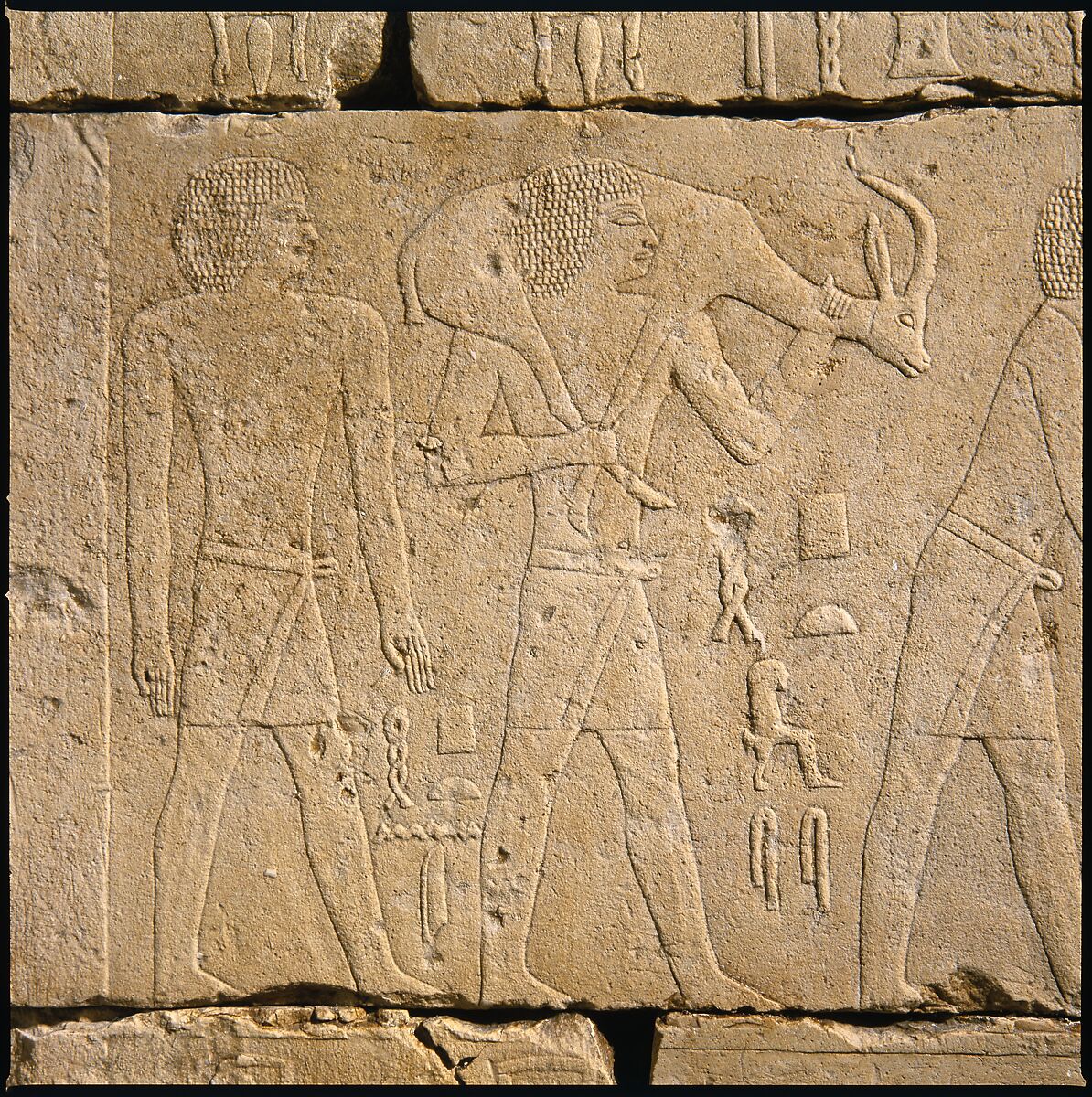
Initial comparisons confirm that jewelry must be read in conjunction with the figure and its context. On the eastern wall of the tomb of Ramesses, collars, bracelets, anklets, and elaborate wigs belong to the figures of women—embodiments of rural estates; the Metropolitan Museum of Art specifies that these are not servants. UCL notes the elaborate collars worn by the owner of the tomb of Usernester, his sons, and his wife (who also wears a bracelet), while servants are depicted without adornment. On the statue of Hatshepsut, the jewelry is shown alongside the hat headdress and the gown; the seated posture is associated with receiving divine gifts, and the inscriptions and nine loaves under her feet designate her as a ruler. From these three case studies, a working observation can be formulated: facial details and attributes, taken together, help interpret a figure’s role. These are preliminary cases, not a universal pattern; closer visual analysis of the arrangement of details and a broader selection are required.
Step 6. Final
Зафиксировать проверенный вывод и границы его применимости
From the first three examples, I observe that ornamentation in Ancient Egyptian imagery cannot be read in isolation from the clothing, hairstyle, posture, regalia, or narrative. In the scene of Ramesses, the jewelry, wigs, and the function of personification figures are crucial; in the description of Usernester, the contrast between the owner’s family and the servants is important; and with Hatshepsut, it is the combination of the headdress, collar, bracelets, seated posture, and royal inscriptions. Together, these details help to understand the artistic image and the character’s role—the social conclusion relies on context, not on a single piece of ornamentation. This is a preliminary conclusion based on the three monuments; it does not cover all epochs or social groups. Next, I need to compare the images in detail and expand the collection.
Comparison Pieces
- East Wall of the Tomb of Raemka, Metropolitan Museum of Art (Object 08.201.1f; c. 2446–2389 BCE). In a scene featuring women adorned with collars, bracelets, anklets, and elaborate wigs, they represent rural estates; the museum clarifies that these individuals are not servants. I am comparing the adornments with the clothing, hairstyles, poses, and the role of the figures within the composition. Source: https://www.metmuseum.org/art/collection/search/5773712. Relief from the Tomb of Usernetjer and his Family, UCL Digital Egypt. The description shows the owner and his sons wearing wide collars, the wife wearing a collar and bracelet, and the servants wearing no adornments. I am cross-referencing this distribution with the composition and am careful not to automatically generalize this to the entire society. Source: https://www.ucl.ac.uk/museums-static/digitalegypt/jewellery/ok.html3. Sculpture of Hatshepsut in the Khat headdress, Metropolitan Museum of Art (Object 30.3.3; c. 1473–1458 BCE). The catalog describes the dress, headdress wrap, wide collar, bracelets, and wide anklets. The seated posture is associated with receiving temple gifts; inscriptions and nine lotus flowers beneath her feet designate her as a ruler. I am examining how the adornments, regalia, pose, and inscriptions work together to form the sculptural image. Source and image: https://www.metmuseum.org/art/collection/search/547761I use supplementary museum parallels from Notion to refine the naming and form of details, but not as independent proof of social status: collar from Lisht, 22.1.248—https://www.metmuseum.org/art/collection/search/545071; collar of Waha, 40.3.2—https://www.metmuseum.org/art/collection/search/544321; elements of faience collars, 31.114.2a—https://www.metmuseum.org/art/collection/search/549198; collar 26.8.59a—https://www.metmuseum.org/art/collection/search/547636; sweret bead, 40.3.1—https://www.metmuseum.org/art/collection/search/545117; seated male figure, a candidate from the GEM collection, requires separate verification of attribution and signature—https://gem.eg/en/collection/artefacts/seated-male-figure.Metropolitan Museum of Art reference materials: on amulets https://www.metmuseum.org/essays/egyptian-amulets; on gold https://www.metmuseum.org/essays/gold-in-ancient-egypt; on faience https://www.metmuseum.org/fr/essays/egyptian-faience-technology-and-production; on turquoise https://www.metmuseum.org/essays/turquoise-in-ancient-egypt. Candidate photographs from the original Notion page are not