Visual Research Concept
Rationale for Topic SelectionRenaissance art is characterized by artists' aspiration to convey reality, a living moment, and the human condition. During this period, perspective, composition, gestures, and characters' facial expressions gained particular significance in art. This collection of artistic devices allows Renaissance artworks to be viewed not merely as depictions of specific events, but as unique stage productions.The theme of the theatricality of the artistic image is of particular interest for studying the visual language of the Renaissance. Despite the lack of a direct connection to theatrical arts, many works by Italian creators of that era possess characteristic signs of staged action: the communication among characters; gestures expressing the characters' emotions; the placement of characters in space; and composition, which helps draw the viewer’s attention to specific moments within the work.I am especially interested in studying how artists created the sensation of the viewer’s presence in the same space as the characters.I selected this topic because I want to trace how various artistic techniques formed the theatrical quality of Italian Renaissance works and how these techniques influenced the audience’s perception of the depicted events.
Material Selection for ResearchThe primary materials for this study were works of Italian Renaissance visual art from the 15th and 16th centuries. When selecting these works, my main focus was on the presence of theatricalizing devices: composition that emphasizes specific moments within the depicted narrative; the interaction and emotion of the characters; the spatial organization of the artwork; and the emotional expressiveness embedded in the piece.As visual material, I selected works by artists from different periods of the Renaissance. This allowed me to trace the unique artistic techniques used to create the effect of theatricalization in the works.Research StructureI will examine the works of various creators from the Italian Renaissance in chronological order. I chose a chronological approach so that I could track how the features of theatricalization in Italian art changed over time. I will analyze each piece individually.Selection of Textual SourcesFor the selection of materials for the visual research, I relied on online sources. I analyzed articles related to my research topic. This was done to accurately interpret the subjects depicted in the works I chose, as well as to study the artistic techniques the creators employed when theatricalizing the imagery.
The question I posed to myself at the beginning of the research was: How did Renaissance Italian artists use theatrical techniques to create an artistic image and evoke an emotional response in the viewer?
Hypothesis: The theatricality in Renaissance Italian art was shaped through the interplay of various artistic methods, such as composition, perspective, gesture, plasticity, and character miming. Their use allowed artists to create the effect of a stage performance, enhance the expressiveness of the works, and make the viewer a participant in the depicted event.
How does theatricality influence art?
Theater is an art form that originated long before our time and has influenced other manifestations of art that developed in tandem with it. Theatricality in the visual arts manifested through numerous elements: facial expression, composition, lighting, and dynamic movement.
Artists and sculptors sought to convey stories through their creations in a way that they could be understood centuries later. The theatricalization of the artistic image helped achieve this goal, ensuring the enduring relevance of the artworks.
Early Renaissance
«The Miracle of the Stator» Mazzaccho
«Miracle with a Stator» Mazzaccio 1425–1427
The story of «The Wonder with the Stator»
The fresco is based on a Gospel scene where Christ instructs the Apostle Peter to catch fish in the lake and retrieve a stater (coin) from its mouth to pay the temple tax.
It is worth noting that in this fresco, Masaccio depicts three events simultaneously. In the center, the tax collector asks Christ to pay the tax. On the left side, we can see Peter taking the coin from the mouth of a fish. On the right side of the fresco, Peter hands the coin to the collector.
Петр достает монету
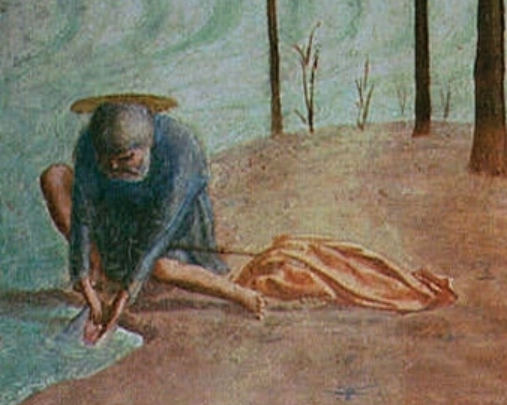
Петр уплачивает налог
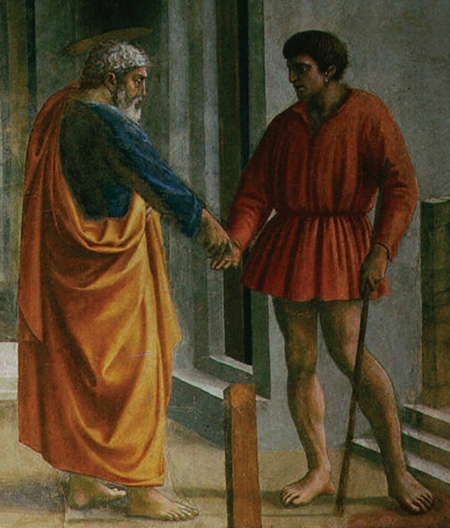
Analysis of «The Miracle of the Stator»
Placing three actions on a single fresco immediately evokes a theatrical composition. One could argue that the viewer observes the development of the action from one episode to the next. Masaccio allows the viewer to interpret the narrative independently. However, all the events depicted on the fresco look dynamic. The characters are not simply standing still; one can perceive a «living moment» rather than a deliberately staged scene. The characters interact with one another through glances, poses, facial expressions, and gestures.
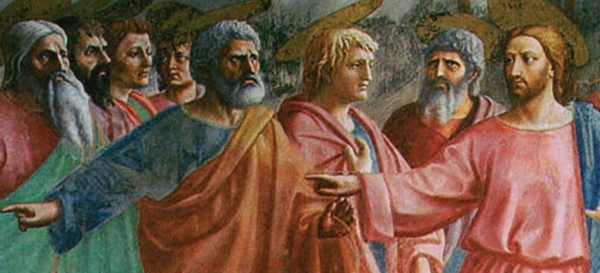
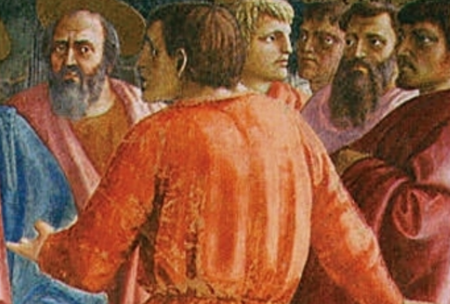
At the center of the fresco, Jesus is depicted gesturing toward a body of water. A tax collector reaches out his hand to collect the toll. In this way, the gestures function as distinct visual signifiers, connecting individual fragments of the artwork. Through these gestures, we can understand the context of the action taking place.
Image taken from the article «Masaccio, The Tribute Money and Expulsion in the Brancacci Chapel»
Mazaccio structures the architectural elements so that the lines of perspective guide the viewer’s eye toward the central figure of Christ. This gives the space depth, and the arrangement of the characters is perceived as part of a single scenic environment. If we examine the fresco from left to right, we can notice that the composition seems to «expand.» The left side features Peter in open space; in the center, we see Jesus with the apostles standing together. However, the right side of the fresco shows only the bread server and Peter, and this section appears closer to the viewer due to the architecture standing behind them.
In «The Miracle of Stator,» Mazzacchio’s theatricalization of the artistic image is manifested through the organization of a sequential narrative within the unified space of the fresco. The artist merges three episodes from a biblical story, employing composition, gestures, and the direction of the characters' gazes to create the sensation of live stage action.
«Spring» by Sandro Botticelli
«Spring» by Sandro Botticelli, 1482
Analysis of «Spring»
Unlike the other works I examined in this study, Botticelli’s «Spring» does not depict specific historical or religious events. It can be said that the painting illustrates a space filled with figures from ancient mythology. At the center of the work is the goddess Venus, surrounded by other mythological characters: Mercury, the Three Graces, Cupid, Flora, the nymph Chloris, and the god Zephyrus.
One of the main theatrical techniques in «Spring» is the arrangement of characters within the canvas space. It is noticeable that almost all nine characters stand in a single horizontal line. Because of this, there may be a feeling that each character portrays their specific role in the painting’s space.Venus is positioned in the center, slightly receding into the work’s space. To her left and right, characters are placed, forming independent groups.It can be said that not all the heroes interact with one another. Each one reveals a separate segment of the work’s overall narrative.
Flora, Chlorida, Zephyr
The interaction between mythological characters plays a significant role in the theatricalization of the figures. This is particularly expressive in the right portion of the painting, where Zephyr is depicted chasing the nymph Chloris. In the next section of the painting, the nymph is already portrayed as Flora—the goddess of spring, scattering flowers.
The viewer can trace the nymph’s transformation and the sequence of events depicted in the painting. At the moment Zephyr touches her, flowers burst from Chloris’s mouth—this symbolizes the change in the nymph’s form and the process of maturation.
Три грации
Купидон
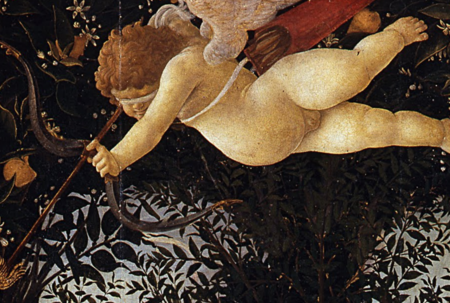
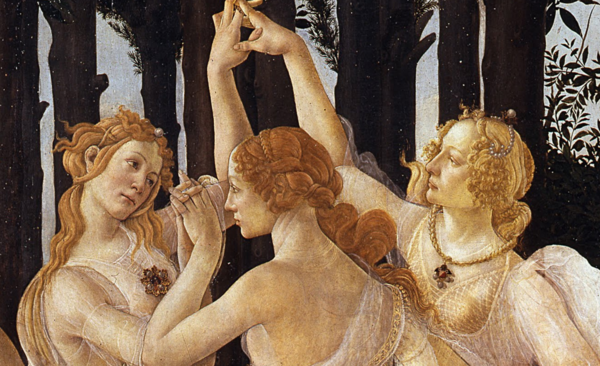
When analyzing the placement of the figures in the painting, one should also pay attention to the three graces standing next to Venus. The young women symbolize the three facets of love: chastity, beauty, and pleasure.Above Venus is Cupid (her son). He wears a blindfold, symbolizing unpredictable, blind passion. Cupid aims his bow at one of the dancing graces. This action symbolizes the intersection of spiritual purity and earthly desire; Cupid serves as the link between them.
Venus
As I wrote above, Venus is the focal point of the work. It is noticeable that the goddess does not participate in the general action. Her gaze is directed toward the viewer. The viewer «reads» the painting not through the characters addressing them, but through the composition’s openness, the expressiveness of the central figure, and the conceptual nature of the depicted space.