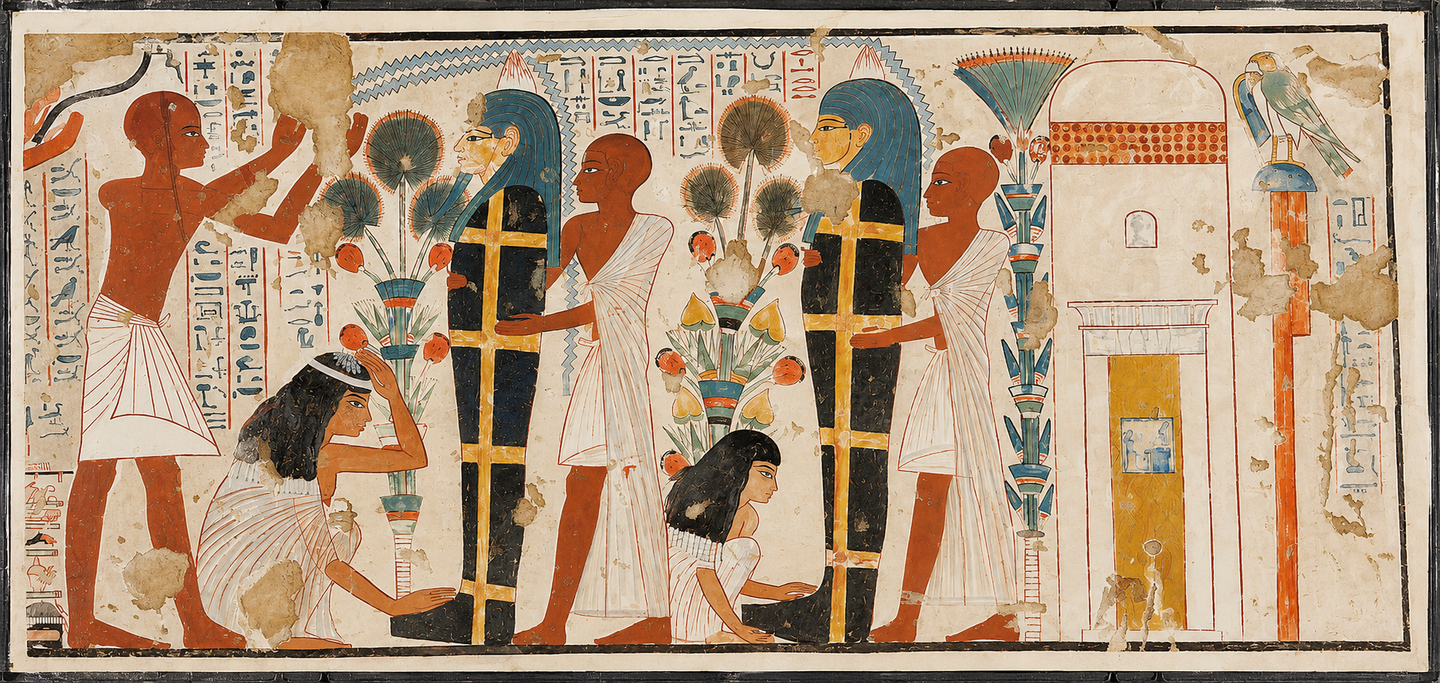
Concept
The ancient Egyptian civilization developed in the Nile River valley, evolving over millennia in close connection with natural cycles, religious beliefs, and the worship of divine forces. Central to the Egyptians' worldview was the concept of the cyclical nature of life, death, and rebirth.The cult of the afterlife held immense importance in Ancient Egyptian culture. Egyptians believed that death was not the end of human existence but a transition to another world.From these beliefs arose a complex system of funerary rituals, which included mummification, body preparation rites, and funeral processions. Mythological concepts of the deceased’s journey through the afterlife—the Duat—meetings with various deities, overcoming trials, and undergoing Osiris’s judgment were also integral to the funerary culture. The idea of the Field of Reeds—a kind of paradise where a person could continue their earthly life without worldly worries—also occupied a significant place.
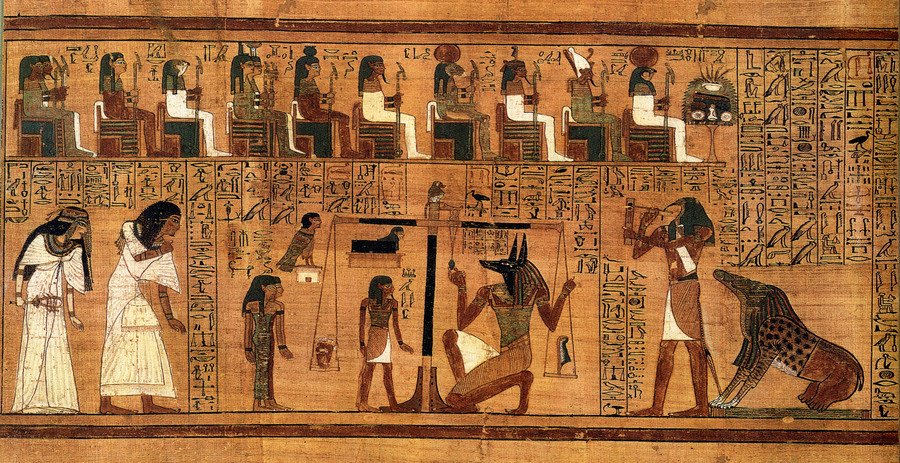
Fragment of the Papyrus of Ani. The Trial of Osiris. c. 13th century BCE.
Central Question: «What journey does a person take after death, and how is that depicted in the funerary art of Ancient Egypt?»
Themes related to the afterlife remain relevant to this day, reflected in artworks from different eras. Throughout history, humanity has sought to comprehend the nature of death and envision human existence beyond earthly life, finding expression in various mythical archetypes, symbols, and artistic narratives.
Papyrus of Tsekhons. Scene with Ialu fields, 4th–1st century BCE.
Ancient Egypt holds a special place in the history of forming such concepts, where the belief in an afterlife became an integral part of religious culture and significantly influenced the development of funerary art. Studying the system of afterlife imagery, its symbolism, and its visual characteristics allows one to understand how ancient Egyptians conceptualized posthumous human existence and embodied these ideas in art. Furthermore, it provides an opportunity to trace the origins of artistic traditions depicting the afterlife and to gain a deeper understanding of how the themes of death and eternal life were portrayed in subsequent cultures.
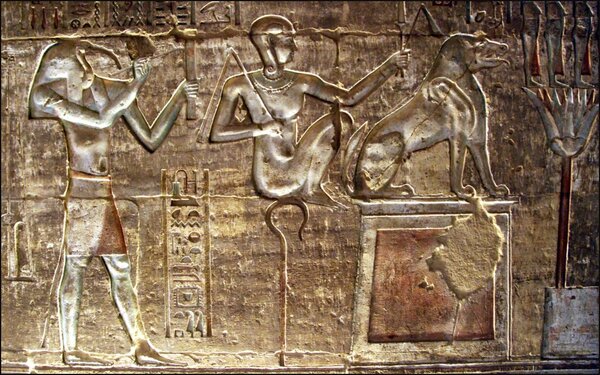
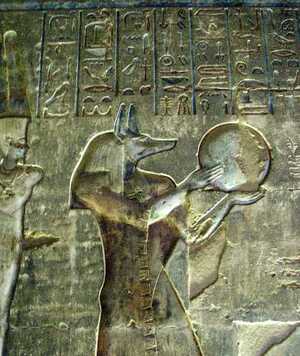
Fragment of a relief from the Temple of Hathor. Scene of the judgment of Osiris, circa 13th century BCE/Fragment of a relief from the Temple of Hathor. Scene with Anubis, circa 3rd century BCE.
The goal of the study is to analyze images depicting funerary motifs and identify their visual characteristics.
The research topic involves comparing images of funerary scenes presented in the selected materials and identifying their visual characteristics—composition, color, and figure hierarchy. The objective is to compile theoretical material on this research topic and define the symbolism embedded in the artworks.
For a deeper analysis of the visual research theme, materials such as reliefs, murals, and papyri discovered in pharaohs' tombs were chosen. This selection is based on the fact that these artworks most vividly represent the main themes related to ancient Egyptian concepts of the afterlife.
Rubrics
1. Mummification and Funerary Rites: Preparing for the Afterlife
2. Funeral Procession: Escorting the Deceased to the Land of the Dead
3. Journey Through the Duat and the Judgment of Osiris: Achieving Eternal Life
4. Fields of Iaru: The Image of Blissful Life in the Afterworld
Mummification and Burial Rites: Preparing for the Afterlife
The art of mummification held a special place in the funerary rituals of Ancient Egypt because preserving the body was considered one of the most vital conditions for the continuation of human existence after death. According to ancient Egyptian beliefs, the physical body remained an essential part of the deceased’s identity and served as the link between the various components of their being. Therefore, the mummification process aimed not only at the physical preservation of the remains but also at preparing the person for rebirth and passage into the afterlife.This process lasted 70 days and involved several stages, each carrying significant ritual meaning as well as practical implications for the handling of corpses. The main elements of the process were: cleansing the body, removing the organs, dehydration, anointing the body with various oils, and wrapping it in linen bandages.
Copy of a fragment from the Sennedjem painting. Mummification scene. Circa 16th–11th centuries BCE.
The painting depicts a scene of mummification and funerary rituals. At the center of the composition is Anubis—the god of burial rites, mummification, and the afterlife. He is leaning over the body of the deceased, performing the rites of preparation for burial. On the right, figures of priests and scribes are shown, also participating in the ritual actions and keeping records. Above them stands Osiris—the god of rebirth and king of the underworld. His figure is depicted significantly larger than the others, emphasizing the divinity’s high status and special significance.Color held particular meaning in ancient Egyptian art. The black color, used in the central part of the composition to depict Anubis and the funeral bier, is connected to the underworld. However, in ancient Egyptian culture, it held not only a relation to death but also a positive connotation: it was associated with the fertile land of the Nile Valley, renewal, and rebirth. The white color of the burial shrouds and mummification wrappings creates a visual contrast with the dark figure of the god. Furthermore, it is linked to purity and the ritual aspect of funerary rites.
The symbols presented play a vital role in the composition. Anubis embodies the protection of the body and the preparation of the deceased for the afterlife. The scales refer to the judgment of Osiris, during which the heart of the deceased was weighed against the feather of Ma’at. The Eye of Udjat symbolizes protection and healing, while the ankh represents life and rebirth.
Fragment of the Papyrus of Ani. Scene with the Ba soul. c. 13th century BCE.
The image on the papyrus is also connected to burial customs and the ancient Egyptians' beliefs about the afterlife. It depicts the Ba hovering above the deceased’s body. The composition, typical of ancient Egyptian art, is structured horizontally.The color palette is based on a combination of ochre, yellow, and golden hues. Gold was associated with divinity and immortality, while the black and white colors, much like in the previous work, emphasize the image’s connection to funerary symbolism and conceptions of the afterlife.The Ba held special symbolic significance: according to Egyptian beliefs, it could leave the burial site and return to the deceased’s body, maintaining a connection between the different components of their being. During the New Kingdom, these ideas were increasingly given visual form, and the image of the Ba began to be depicted as a bird with a human head.
Both images complement the understanding of the mummification process and reveal different facets of Egyptian afterlife beliefs: the preservation of the body and the connection of the soul to it, unified by the idea of continuing life after death.
A special and concluding role in burial rites was played by the ritual of incising the lips. This was performed so that the soul of Ba could acquire its secret, true name by remembering who it was. Furthermore, the soul, just as at birth, had to regain the ability to ingest the food and drink necessary for existence in the afterlife. This was the specific purpose of the lip-opening ritual.
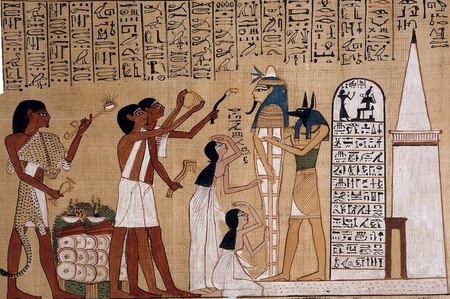
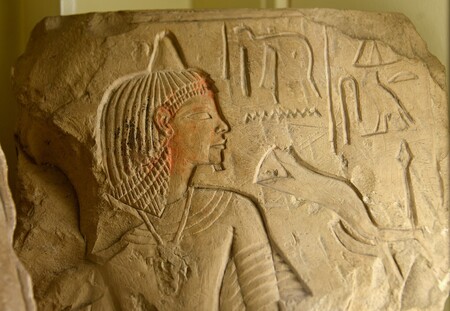
Fragment of the Hunefar Papyrus. Scene of the lip-slitting ritual, circa 13th century BCE./Fragment of a relief with a scene of lip-slitting, circa 14th century BCE.
The papyrus depicts a complete funeral ritual scene. The body of the deceased occupies the central position in the composition, surrounded by mourners, ritual participants, and the god Anubis.The mourners carry significant symbolic weight in the image. They portrayed the roles of the goddesses Isis and Nephthys, and their lament expressed not only sorrow for the deceased but also held ritual significance; it was believed that their weeping assisted the departed soul on its journey to the afterlife. According to tradition, the women who performed these roles were not to be related to the deceased by blood. Their duty was to occupy specific places at the head and feet of the deceased. The leopard-skin robe of the priest was also a part of the rite, connected to the ritual of mouth opening. This robe emphasized the sacred nature of the event and adherence to established ceremonial traditions.
The second image shows a fragment of a relief that allows for a more detailed examination of the portrait of the deceased undergoing a ritual, as well as a special tool—the «pesesh-keph.» Using this tool, the deceased’s ability to use their mouth was symbolically restored. The relief is notable because the image was rendered using a sunken relief technique. This allowed the silhouette of the figures to become more pronounced when struck by sunlight. Upon close inspection, traces of ochre paint can be seen, indicating that the relief was originally painted.
Thus, mummification was not merely a funerary practice, but a significant religious ritual embodying the ancient Egyptians' belief in the possibility of eternal life.
Funeral procession: escorting the deceased into the world of the dead
Funerary processions in Ancient Egypt were a vital part of the burial rites. During these processions, the deceased’s body was transported from the embalming site to the tomb. The Egyptians believed that death was not the end of life, but a transition to the afterlife. Consequently, they paid great attention to performing all necessary rituals, believing that these determined a person’s continued existence after death.The lavishness of the burial depended on the deceased person’s status and wealth. Various items that might be useful in the afterlife—vessels, canopic jars, jewelry, clothing, furniture, food, and other possessions—were placed with the body in the tomb.