Navigation
I. Concept II. The Image of the Male Hippo as a Visualization of Chaos III. The Image of the Female Hippo as the Protection of Motherhood and the Magic of Birth IV. The Image of the Hippopotamus in Funerary Cult V. Conclusion
I. Concept
Topic Selection
For my visual research, I chose the theme of the hippopotamus image in ancient Egyptian art, as I am interested in how the same animal could acquire entirely different meanings within the culture and artistic tradition of that ancient civilization.
The second millennium BCE, the Middle Kingdom, and the beginning of the New Kingdom represent a period when the image of the hippopotamus in Egyptian art undergoes a significant transformation, while remaining recognizable and semantically rich. The visual material from this millennium demonstrates the unique coexistence of two opposites. This chronological slice is interesting because it allows one to see how, within a single culture and almost simultaneously, the same animal is rendered both as an object subject to control and neutralization, and as an object embodying benevolent protection.
I was interested in how the artistic form, the animal’s positioning, its surroundings, and the image’s context influenced the perception of this image.
Research Question and Hypothesis
Research Question: What symbolic meanings did the image of the hippopotamus acquire in the visual art of Ancient Egypt during the Second Millennium BCE, depending on the context of the depiction? How do formal techniques—material, posture, and decorative elements—construct the dual nature of this image?
Hypothesis:
The duality of the hippopotamus image in ancient Egyptian art from the 2nd millennium BCE is not narrative, but is achieved through formal means: the material, posture, and decorative setting shift the same zoomorphic image between different meanings.
Research Object, Subject, and Methodology
Research Subject: The artistic achievements of Ancient Egyptian art from the Middle and New Kingdoms periods.
Subject of Study: The depiction of the hippopotamus—its artistic interpretation and symbolic meaning in sculpture, painting, and graphics.
Research Methods: - Visual analysis of artworks; - Analysis of poses, attributes, setting, and composition; - Historical-cultural method, allowing the correlation of artistic imagery with ancient Egyptian worldviews; - Classification of works by art type and nature of representation.
Material Selection Principle
For the study, works were selected that meet the following criteria:
1. Chronological criterion. The works date to the Middle or New Kingdoms or are faithful reproductions of images from the corresponding period.
2. Iconographic criterion. The work features a recognizable depiction of a hippopotamus or a deity in whose form the hippo is the primary zoomorphic component.
3. Artistic criterion. The material allows for an examination of the features of form, plasticity, composition, color, line, and decorative elements.
4. Symbolic criterion. The image allows for tracing the connection between the hippopotamus and ideas of rebirth, protection, fertility, danger, or resistance to chaos.
5. Provenance authenticity.
II. Visualization of Chaos
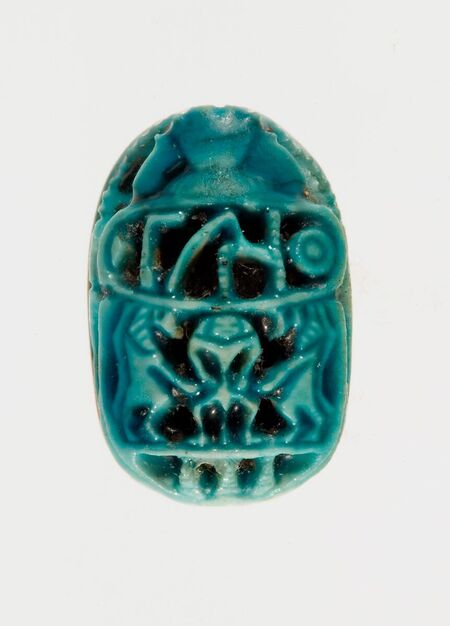
A key monument of the Middle Kingdom is the scarab of Amenemhat III featuring a hippopotamus hunting scene (The Metropolitan Museum of Art, 26.2.1, c. 1859–1749 BCE). The scarab’s reverse bears the king’s cartouche, beneath which is an image of the god Bes flanked by two hippopotamuses. The bottom side depicts a hunter in a boat with a harpoon striking a hippopotamus. Notably, despite the royal name on the scarab, the hunter himself lacks royal attributes. This suggests that by the end of the XII Dynasty, the visual formula of «hippopotamus slaying» was already circulating as an apotropaic motif accessible not only to the king but also to private individuals through amulets.
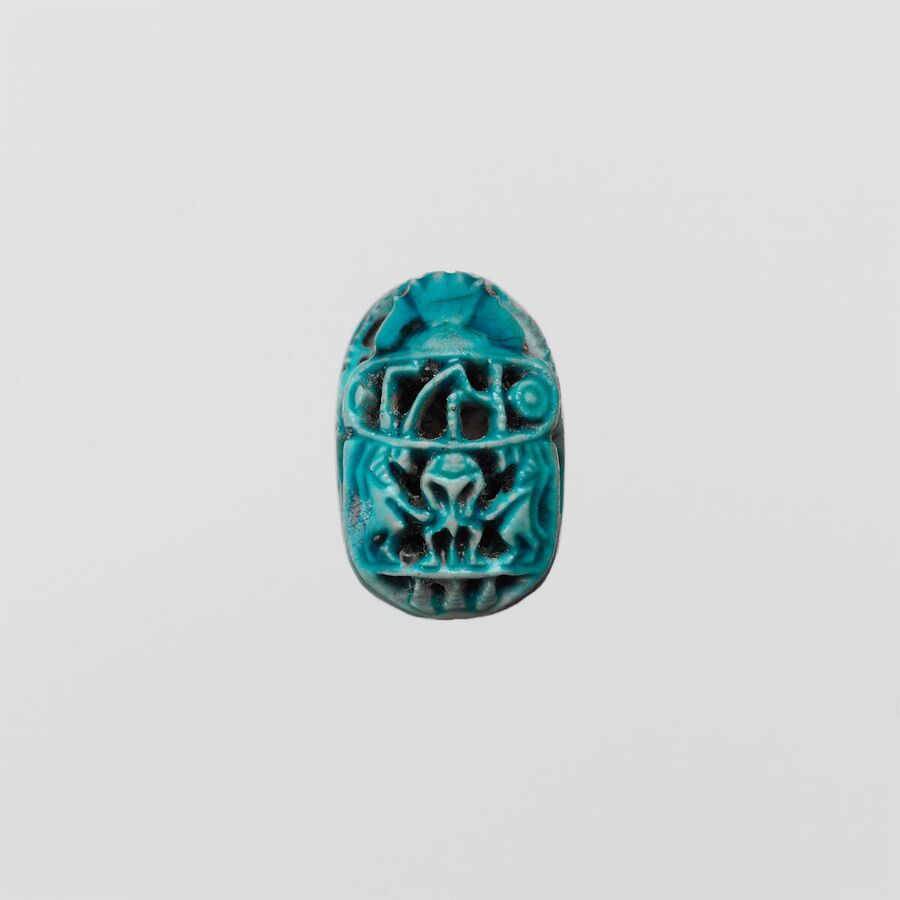
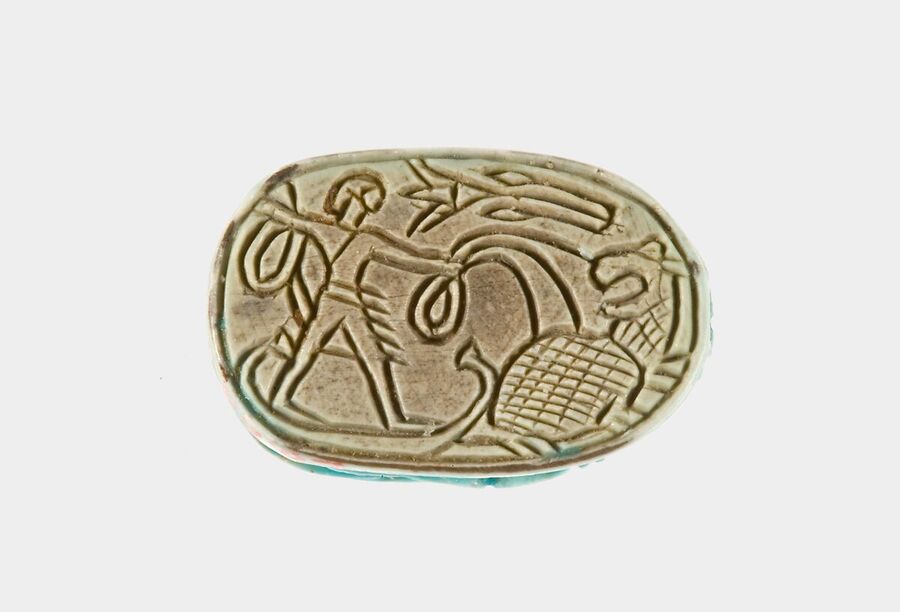
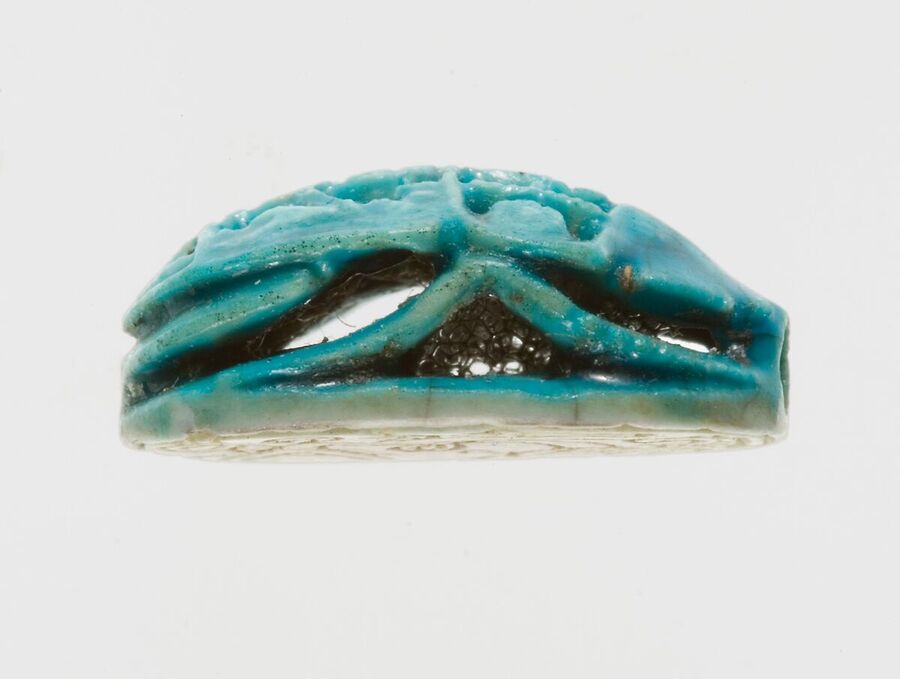
Image Analysis. The scarab’s composition is structured according to a semantic hierarchy: the royal name at the top, protective deities (Bes and the hippopotamuses) in the middle, and the hunting scene at the bottom. The harpoon in the act of being thrown is not depicted—the hunter’s arm is drawn back, the rope is taut, but the weapon itself is omitted due to space constraints. This economy of representation is characteristic of small glyptics: the viewer completes the missing element because the formula «hunter + boat + rope + hippopotamus» is already recognizable. Symbolically, the scene is read as the triumph of order over the chaotic force embodied by the hippopotamus.
III. The Defense of Motherhood and the Magic of Birth
The second motif of the hippopotamus in the 2nd millennium BCE is associated with the goddess Taweret. Her iconography combines attributes of various animals: the body of a pregnant female hippopotamus, lion paws, a crocodile tail, and human breasts. This hybridity is not perceived as a threat because it is functionally oriented toward protecting the vulnerable—pregnant women, childbirths, and infants.
The Metropolitan Museum of Art collection holds the Taurt amulet from the Late Middle Kingdom (Accession No. 13.180.7, circa 1850–1700 BCE), crafted from lapis lazuli and discovered in the Theban necropolis of Asasif. The amulet measures only 1.4 cm high. Its material and miniature scale define the way it was interacted with: the amulet was worn on the body, maintaining constant tactile contact with the owner. Lapis lazuli, imported from Afghanistan, was an expensive material, suggesting the owner held a high status. Taurt’s function as a protector is underscored by her connection to the so-called Middle Kingdom «birth tusks, ” which featured her image to safeguard both mother and child.
Image Analysis. The formal attributes of Tawret in the lapis lazuli amulet are minimized due to the hardness of the stone and its small size: the lion paws are not detailed, and the crocodile tail is indicated only by side seams. However, recognizability is ensured by the silhouette: a vertical posture, a pronounced abdomen, and a characteristic face. It is this very scarcity of detail that paradoxically enhances the apotropaic function—the amulet does not «depict» the goddess; rather, it «is» her in a maximally concentrated form, devoid of any extraneous elements.
IV. Mortuary Cult
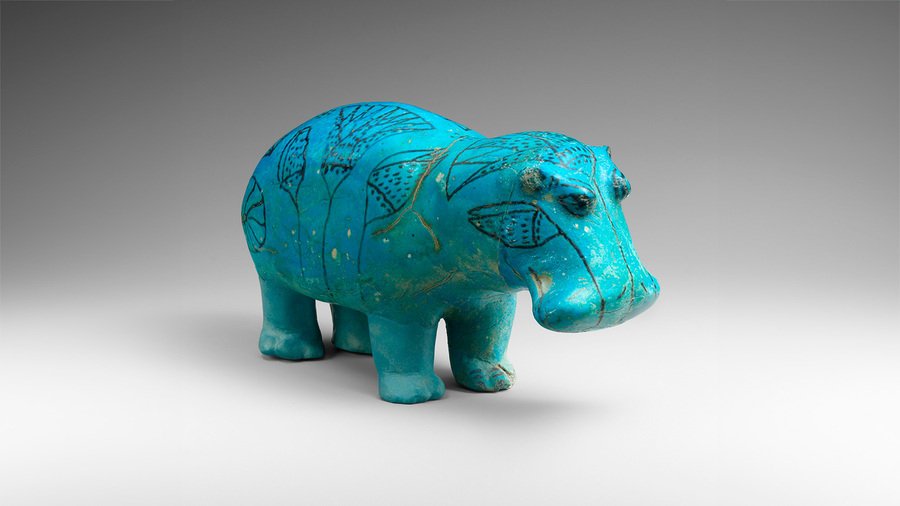
The third and most studied mode is the faience hippopotamus figures placed in tombs of the Middle Kingdom. The most famous example is a statuette nicknamed «William» in the 20th century (Metropolitan Museum of Art, 17.9.1). It was created during the reign of Senusret I—Senusret II (circa 1961–1878 BCE) and originates from the Senbi II tomb complex in Meir. The figure is made of faience—a quartz paste with blue glaze—and decorated with lotus stems and flowers. The lotus signifies the animal’s natural habitat and simultaneously symbolizes rebirth, as the flower closes at night and opens in the morning.
The decisive visual detail is intentional damage. Three of William’s four legs were broken in antiquity; modern restorations have repaired them, but the fracture marks are documented. The museum description explicitly states the reason: the Egyptians believed the image could come to life, and they immobilized the hippopotamus so it would not harm the deceased. A similar practice has been documented for other Middle Kingdom faience hippopotami.
A second example is the standing hippopotamus from the Tomb of Reniseneb (Metropolitan Museum of Art, 26.7.898, c. 1810–1700 BCE). This figurine was discovered wrapped in the shrouds of the mummy, positioned behind the deceased, along with a mirror, necklace, and a shen amulet. The placement of the hippopotamus in immediate proximity to the mummy’s body suggests its role as a personal protective talisman, rather than merely an item of funerary equipment. The size of the figurine (11.7 cm in length) and its position within the burial indicate that it was conceived as an active participant in the afterlife, not a passive illustration.
Image Analysis. The composition of William’s body painting serves the objective of creating a habitat: lotus stems cover the animal’s back and sides, creating an effect of immersion in a swampy landscape. The blue glaze intensifies the association with water and rebirth. However, this idyllic surface contradicts the act of violence inflicted upon the figure—the severing of its legs transforms the image into an object whose power remains, but whose movement is halted. The hippopotamus in the tomb is not a «favorite toy» or a «pet»; it is captive life energy redirected to serve the deceased.